



IGFBP-3 Protein, Human (HEK293, His)

Based on 1 Customer Validation
IGFBP-3 protein is a part of IGFBP that significantly prolongs IGF half-life and modulates growth effects in cell culture. It inhibits or stimulates IGF-induced cellular responses by changing the kinetics of interaction with cell surface receptors. IGFBP-3 Protein, Human (HEK293, His) is the recombinant human-derived IGFBP-3 protein, expressed by HEK293 , with N-His labeled tag.
- Species: Human
- Source: HEK293
-
Storage:Stored at -80°C for 1 year from date of receipt. It is stable at -20°C for 3 months after opening. It is recommended to freeze aliquots at -80°C for extended storage. Avoid repeated freeze-thaw cycles.


To place orders, for customer services and technical support, please contact: MedChemExpress USA
Tel: 609-228-6898 E-mail: [email protected] [email protected]


-
 Biological Activity
-
Technical Parameters
-
Product Properties
- Documentation
- Help & FAQs




Biological Activity
Description
IGFBP-3 protein is a part of IGFBP that significantly prolongs IGF half-life and modulates growth effects in cell culture. It inhibits or stimulates IGF-induced cellular responses by changing the kinetics of interaction with cell surface receptors. IGFBP-3 Protein, Human (HEK293, His) is the recombinant human-derived IGFBP-3 protein, expressed by HEK293 , with N-His labeled tag.
Background
IGFBP-3 Protein, a member of the insulin-like growth factor-binding proteins (IGFBPs), plays a crucial role in extending the half-life of insulin-like growth factors (IGFs) and modulating their growth-promoting effects on cell culture. With the capacity to either inhibit or stimulate IGF-induced cellular responses, IGFBP-3 exerts its regulatory influence by altering the interaction dynamics between IGFs and their respective cell surface receptors. Additionally, IGFBP-3 exhibits IGF-independent antiproliferative and apoptotic effects mediated by its receptor TMEM219/IGFBP-3R. Furthermore, IGFBP-3 inhibits the positive effect of humanin on insulin sensitivity and promotes testicular germ cell apoptosis. Interactions with XLKD1 and the formation of a ternary complex with IGF1 or IGF2 and a glycoprotein (ALS) further underscore the diverse roles of IGFBP-3. The intricate network of interactions, including those with humanin and TMEM219, highlights the multifaceted nature of IGFBP-3 in modulating cellular processes and signaling pathways associated with growth and apoptosis.
Verified Bioactivity
1. Measured by its binding ability in a functional ELISA. Immobilized human IGF2 at 10 μg/mL (100 μl/well) can bind biotinylated Human His-IGFBP3, The EC50 of biotinylated Human His-IGFBP3 is ≤18 ng/mL.
2. Measured by its binding ability in a functional ELISA. Immobilized human IGF1 at 10 μg/mL (100 μl/well) can bind biotinylated Human His-IGFBP3, The EC50 of biotinylated Human His-IGFBP3 is ≤24 ng/mL.
3. Measured by its ability to inhibit the biological activity of IGFI or IGFII on MCF7 human breast adenocarcinoma cells (Karey, K.P. et al. (1988) Cancer Research 48:4083.). The ED50 for this effect is typically 0.05-0.2 μg/mL in the presence of 14 ng/mL human IGFII.
MCE Validation Data
-
Purity - SDS-PAGE
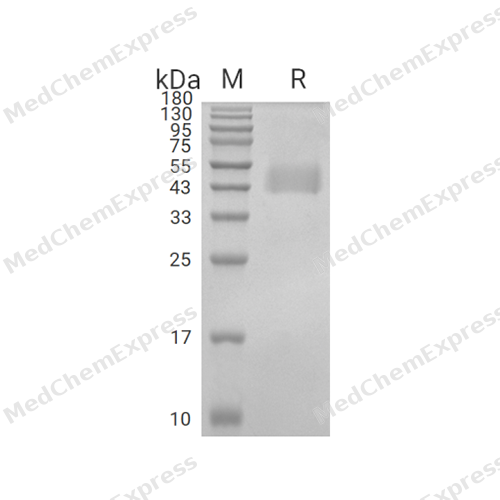
Purity - SDS-PAGE


Technical Parameters
-
Species Human
-
Source HEK293
-
Tag N-His
-
Accession
P17936-1/NP_000589.2 (G28-K291)
-
Molecular Construction
-
N-term
-
His
-
IGFBP-3 (G28-K291)
Accession # P17936-1/NP_000589.2 -
C-term
-
-
Protein Length
Full Length of Isoform-1
-
Synonyms
IGFBP3; Binding Protein 53; Insulin Like Growth Factor Binding Protein 3; Binding Protein 29; IBP3; IGFBP-3; Insulin-Like Growth Factor-Binding Protein 3; IBP-3; IGF-Binding Protein 3; CDNA FLJ43234 Fis, Clone HCHON2002964, Highly Similar To Insulin-Like Growth Factor-Binding Protein 3; BP-53; Insulin-Like Growth Factor Binding Protein 3, Isoform CRA_b; Acid Stable Subunit Of The 140 K IGF Complex; Insulin-Like Growth Factor Binding Protein 3; Growth Hormone-Dependent Binding Protein
-
AA Sequence
GASSAGLGPVVRCEPCDARALAQCAPPPAVCAELVREPGCGCCLTCALSEGQPCGIYTERCGSGLRCQPSPDEARPLQALLDGRGLCVNASAVSRLRAYLLPAPPAPGNASESEEDRSAGSVESPSVSSTHRVSDPKFHPLHSKIIIIKKGHAKDSQRYKVDYESQSTDTQNFSSESKRETEYGPCRREMEDTLNHLKFLNVLSPRGVHIPNCDKKGFYKKKQCRPSKGRKRGFCWCVDKYGQPLPGYTTKGKEDVHCYSMQSK
-
Predicted Molecular Mass
31 kDa
-
Molecular Weight
Approximately 40-52 kDa, based on SDS-PAGE under reducing conditions, due to the glycosylation.
-
Glycosylation
Yes
-
Purity
≥ 95%, as determined by reducing SDS-PAGE.


Product Properties
Solution
Supplied as a 0.22 μm filtered solution of PBS, pH 7.4.
<1 EU/μg, determined by LAL method.
Stored at -80°C for 1 year from date of receipt. It is stable at -20°C for 3 months after opening. It is recommended to freeze aliquots at -80°C for extended storage. Avoid repeated freeze-thaw cycles.
Shipping with dry ice.


Documentation
-
Data Sheet (237 KB)
-
SDS (252 KB)
- English - EN (252 KB)
- Français - FR (252 KB)
- Deutsch - DE (252 KB)
- Norwegian - NO (252 KB)
- Español - ES (252 KB)
- Swedish - SV (252 KB)
- Italian - IT (252 KB)
- Korean - KR (252 KB)
- Portuguese - PT (252 KB)
-
Handling Instructions (2659 KB)

Calculators
Concentration (start) × Volume (start) = Concentration (final) × Volume (final)


 Powered by Bioz

