



IL-20R beta Protein, Rat (HEK293, His)

Based on 1 Customer Validation
IL-20R beta Protein (IL20RB) is the beta subunit of IL-20 receptor, forms functional heterodimers with different subunit protein and involves in STAT3 activation pathway. The IL-20RA/IL-20RB dimer is a receptor for IL-19, IL-20 and IL-24. The IL-22RA1/IL-20RB dimer is a receptor for IL-20 and IL-24. IL-20R beta Protein is consists of 308 amino acids (M1-T308) with a transmembrane domain (226-249 a.a.). IL-20R beta Protein, Rat (HEK293, Fc) is produced in HEK293 cells with a C-Terminal hFc-tag.
- Species: Rat
- Source: HEK293
-
Storage:Stored at -20°C for 2 years from date of receipt. After reconstitution, it is stable at 4°C for 1 week or -20°C for longer (with carrier protein). It is recommended to freeze aliquots at -20°C or -80°C for extended storage.


To place orders, for customer services and technical support, please contact: MedChemExpress USA
Tel: 609-228-6898 E-mail: [email protected] [email protected]


-
 Biological Activity
-
Technical Parameters
-
Product Properties
- Documentation
- References
- Help & FAQs




Biological Activity
Description
IL-20R beta Protein (IL20RB) is the beta subunit of IL-20 receptor, forms functional heterodimers with different subunit protein and involves in STAT3 activation pathway[1]. The IL-20RA/IL-20RB dimer is a receptor for IL-19, IL-20 and IL-24. The IL-22RA1/IL-20RB dimer is a receptor for IL-20 and IL-24[2]. IL-20R beta Protein is consists of 308 amino acids (M1-T308) with a transmembrane domain (226-249 a.a.). IL-20R beta Protein, Rat (HEK293, Fc) is produced in HEK293 cells with a C-Terminal hFc-tag.
Background
IL-20R beta (IL-12RB), also known as a beta subunit of IL-20 receptor (IL-20RB), belongs to the type II cytokine receptor family. IL-20R beta is widely expressed with highest levels in skin and testis and highly expressed in psoriatic skin[1].
IL-20R beta forms functional heterodimers with different subunit protein. IL-20R beta serves as the receptor for IL-19, IL-20 and IL-24 by dimerizing with IL20RA, however serves as the receptor for IL-20 and IL-24 by dimerizing with IL-22RA1[2].
IL-20RB/IL-20RA and IL-20RB/IL-22RA1, act function by binding IL-20, and then stimulates a signal transduction pathway through STAT3 in a keratinocyte cell line[1].
However, the expression of both IL-20RB/IL-20RA is found to be upregulated in psoriatic skin lesions on keratinocytes[3].
IL-20RB/IL-20RA and IL-20RB/IL-22RA1 bind to IL-24, induce rapid activation of Stat-1 and Stat-3 transcription factors, which appear to play a role in cell survival and proliferation[4].
In Vivo
IL-2R beta/IL2RA is a receptor complex for IL-19. IL-2R beta is significantly up-regulated after IL-19 treatment (2 mg/kg; i.v. via tail wein; once daily for one week) in epidural fibrosis (EF) rats model[5].
rIL-19 treatment improved hematoma clearance and attenuated neurological deficits induced by GMH, which was mediated through the upregulation of the IL-2R1/ERK/Nrf2 pathways[6].
Verified Bioactivity
Measured by its binding ability in a functional ELISA. Immobilized Human IL-19, at 0.1 μg/mL (100 μL/well) can bind IL-20R beta. The ED50 for this effect is 28.75 ng/mL.
MCE Validation Data
-
Purity - SDS-PAGE
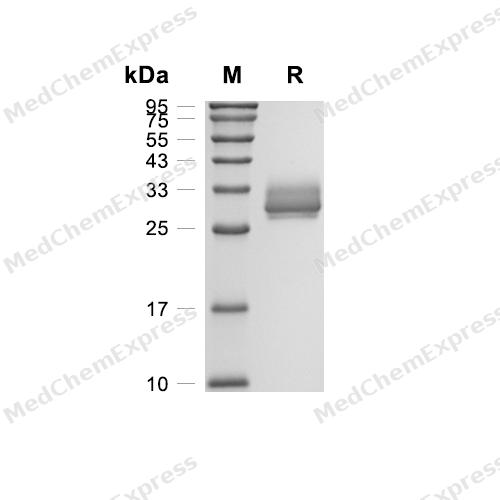
Purity - SDS-PAGE
-
Bioactivity - ELISA
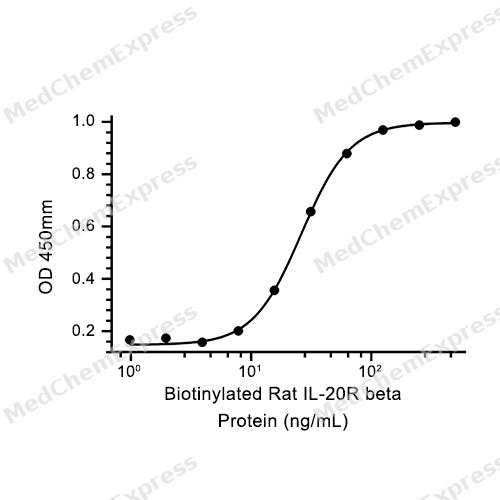
Bioactivity - ELISA


Technical Parameters
-
Species Rat
-
Source HEK293
-
Tag C-6*His
-
Accession
B8K1X9 (A27-P227)
-
Molecular Construction
-
N-term
-
IL-20Rβ (A27-P227)
Accession # B8K1X9 -
His
-
C-term
-
-
Protein Length
Partial
-
Synonyms
IL20RB; Interleukin-20 Receptor Subunit Beta; Prev. FNDC6; IL-20R-Beta; IL-20R2; MGC34923; DIRS1; IL-20RB; Fibronectin Type III Domain Containing 6; Interleukin 20 Receptor Beta; Interleukin 20 Receptor Beta Subunit; Interleukin-20 Receptor II; Interleuki
-
AA Sequence
ATILPAPQNFSVRSTNMKHLLMWNPVTQPGETVFYFVQYQGEYESLYMSHIWIPSSQCSPTKGLECDVTDDVTATVPYNFRVMAMLGSQSSAWSNLEHPFNRNATVLTPPRMEVTEHGLHLVVELEDLGPQFEFLVVYWRMEPGAVERVKVVRSGDIPVHLETMDPGVMYCVKAQALVKTIGRHSAFSQPTCVEMQGESLP
-
Molecular Weight
Approximately 32-36 kDa, based on SDS-PAGE under reducing conditions, due to the glycosylation.
-
Glycosylation
Yes
-
Purity
≥ 95%, as determined by reducing SDS-PAGE.


Product Properties
Lyophilized powder.
Lyophilized from a 0.22 μm filtered solution of PBS, pH 7.4.
<1 EU/μg, determined by LAL method.
It is not recommended to reconstitute to a concentration less than 100 μg/mL in ddH2O. For long term storage it is recommended to add a carrier protein (0.1% BSA, 5% HSA, 10% FBS or 5% Trehalose).
Stored at -20°C for 2 years from date of receipt. After reconstitution, it is stable at 4°C for 1 week or -20°C for longer (with carrier protein). It is recommended to freeze aliquots at -20°C or -80°C for extended storage.
Room temperature in continental US; may vary elsewhere.


Documentation
-
Data Sheet (264 KB)
-
SDS (251 KB)
- English - EN (251 KB)
- Français - FR (251 KB)
- Deutsch - DE (251 KB)
- Norwegian - NO (251 KB)
- Español - ES (251 KB)
- Swedish - SV (251 KB)
- Italian - IT (251 KB)
- Korean - KR (251 KB)
- Portuguese - PT (251 KB)
-
Handling Instructions (2659 KB)


References
[1]. Blumberg H, et al. Interleukin 20: discovery, receptor identification, and role in epidermal function. Cell. 2001 Jan 12;10 4(1):9-19. [Content Brief]
[2]. Wegenka UM. IL-20: biological functions mediated through two types of receptor complexes. Cytokine Growth Factor Rev. 2010 Oct;21(5):353-63. [Content Brief]
[3]. Sheikh F, et al. Cutting edge: IL-26 signals through a novel receptor complex composed of IL-20 receptor 1 and IL-10 receptor 2. J Immunol. 2004 Feb 15;172(4):2006-10. [Content Brief]
[4]. Wang M, et al. Interleukin-24 and its receptors. Immunology. 2005 Feb;114(2):166-70. [Content Brief]
[5]. Wang QJ, et al. Exogenous IL-19 mediates downregulation of TGF-β through Erk and p38 pathway to inhibit epidural fibrosis. Eur Rev Med Pharmacol Sci. 2019 Sep;23(17):7184-7190. [Content Brief]

Calculators
Concentration (start) × Volume (start) = Concentration (final) × Volume (final)


 Powered by Bioz

