



IL-2R gamma/CD132 Protein, Mouse (HEK293, His)

Based on 1 Customer Validation
IL-2R gamma (CD132), a type I cytokine receptor expressed on leucocyte subsets, is a receptor for IL-2. IL-2R gamma forms heterodimer with IL-2R beta, and increases the affinity of IL-2R beta for IL-2. IL-2R gamma takes part in inflammatory response and mediates activation of the cells . IL-2R gamma plays an important role in the development, activation, proliferation, differentiation and regulation of lymphocytes and other cell types. IL-2R gamma/CD132 Protein, Mouse (HEK293, His) is a recombinant mice extracellular region of IL-2R gamma with a C-Terminal 6*His tag, which is produced in HEK293 cells.
- Species: Mouse
- Source: HEK293
-
Storage:Stored at -20°C for 2 years from date of receipt. After reconstitution, it is stable at 4°C for 1 week or -20°C for longer (with carrier protein). It is recommended to freeze aliquots at -20°C or -80°C for extended storage.


To place orders, for customer services and technical support, please contact: MedChemExpress USA
Tel: 609-228-6898 E-mail: [email protected] [email protected]


-
 Biological Activity
-
Technical Parameters
-
Product Properties
- Documentation
- References
- Help & FAQs




Biological Activity
Description
IL-2R gamma (CD132), a type I cytokine receptor expressed on leucocyte subsets, is a receptor for IL-2. IL-2R gamma forms heterodimer with IL-2R beta, and increases the affinity of IL-2R beta for IL-2. IL-2R gamma takes part in inflammatory response and mediates activation of the cells [1][2]. IL-2R gamma plays an important role in the development, activation, proliferation, differentiation and regulation of lymphocytes and other cell types[3]. IL-2R gamma/CD132 Protein, Mouse (HEK293, His) is a recombinant mice extracellular region of IL-2R gamma with a C-Terminal 6*His tag, which is produced in HEK293 cells.
Background
IL-2R gamma (CD132), a receptor for IL-2, is a member of the type I cytokine receptor family and type 5 subfamily. IL-2R gamma is expressed in spleen and thymus[1].
The sequence of amino acids in IL-2R beta differs in different species. Mice IL-2R gamma shares 80.70% aa sequence identity with rats. Mice IL-2R gamma shares <75% aa sequence identity with human.
IL-2R gamma has low-affinity for IL-2, but has intermediate affinity for IL-2 when forming heterodimer with IL-2R beta. IL-2R beta/gama heterodimer complex transduces a signal when IL-2 concentrations are relatively high[2]. IL-2R gamma can be utilized by the IL-2, IL-4, IL-7, IL-9, and IL-15 receptor, and takes part in the development, activation, proliferation, differentiation and regulation of lymphocytes and other cell types[3]. IL-2R gamma maintains mainstream B- and T-cell generation and function, and is also important for NK-cell development[4]. Mutations of L-2R gamma causes severe impairment in innate and adaptive immunity in mice[5].
IL-2R gamma is involved in inflammatory response, and mediates activation of the cells[1].
In Vitro
IL-2R gamma binds to IL-2 in recombinant IL-2R gamma plasmid (pGEX-4T-1-IL-2Rγ)-transfected 293T cells[6].
MCE Validation Data
-
Purity - SDS-PAGE
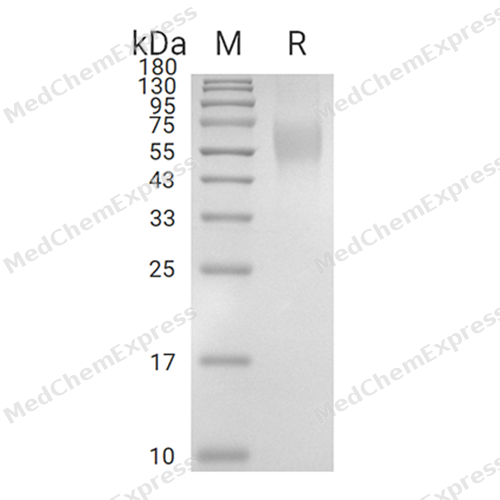
Purity - SDS-PAGE


Technical Parameters
-
Species Mouse
-
Source HEK293
-
Tag C-6*His
-
Accession
Q3UPA9 (S25-A263)
-
Protein Length
Partial
-
Synonyms
IL2RG; IL-2 Receptor Subunit Gamma; Prev. SCIDX1; CD132 Antigen; Prev. CIDX; IL-2RG; Prev. IMD4; Common Cytokine Receptor Gamma Chain; Cytokine Receptor Common Subunit Gamma; Combined Immunodeficiency, X-Linked; GammaC; Severe Combined Immunodeficiency; C
-
AA Sequence
SKVLMSSANEDIKADLILTSTAPEHLSAPTLPLPEVQCFVFNIEYMNCTWNSSSEPQATNLTLHYRYKVSDNNTFQECSHYLFSKEITSGCQIQKEDIQLYQTFVVQLQDPQKPQRRAVQKLNLQNLVIPRAPENLTLSNLSESQLELRWKSRHIKERCLQYLVQYRSNRDRSWTELIVNHEPRFSLPSVDELKRYTFRVRSRYNPICGSSQQWSKWSQPVHWGSHTVEENPSLFALEA
-
Predicted Molecular Mass
29 kDa
-
Molecular Weight
Approximately 45-75 kDa, based on SDS-PAGE under reducing conditions.
-
Purity
≥ 95%, as determined by reducing SDS-PAGE.


Product Properties
Lyophilized powder.
Lyophilized from a 0.22 μm filtered solution of 20 mM Tris-HCl, 150 mM NaCl, pH 8.5.
Note: For SPR assay, please replace the buffer. Primary amine components (e.g., Tris, imidazole) can affect protein-coupled chips.
<1 EU/μg, determined by LAL method.
It is not recommended to reconstitute to a concentration less than 100 μg/mL in ddH2O. For long term storage it is recommended to add a carrier protein (0.1% BSA, 5% HSA, 10% FBS or 5% Trehalose).
Stored at -20°C for 2 years from date of receipt. After reconstitution, it is stable at 4°C for 1 week or -20°C for longer (with carrier protein). It is recommended to freeze aliquots at -20°C or -80°C for extended storage.
Room temperature in continental US;may vary elsewhere.


Documentation
-
Data Sheet (265 KB)
-
SDS (252 KB)
- English - EN (252 KB)
- Français - FR (252 KB)
- Deutsch - DE (252 KB)
- Norwegian - NO (252 KB)
- Español - ES (252 KB)
- Swedish - SV (252 KB)
- Italian - IT (252 KB)
- Korean - KR (252 KB)
- Portuguese - PT (252 KB)
-
Handling Instructions (2659 KB)


References
[1]. X Cao, et al. Characterization of cDNAs encoding the murine interleukin 2 receptor (IL-2R) gamma chain: chromosomal mapping and tissue specificity of IL-2R gamma chain expression. Proc Natl Acad Sci U S A. 1993 Sep 15;90(18):8464-8. [Content Brief]
[2]. S Hodge, et al. Surface and intracellular interleukin-2 receptor expression on various resting and activated populations involved in cell-mediated immunity in human peripheral blood. Scand J Immunol. 2000 Jan;51(1):67-72. [Content Brief]
[3]. W P Weidanz, et al. Signalling through the IL-2 receptor γ(c) peptide (CD132) is essential for the expression of immunity to Plasmodium chabaudi adami blood-stage malaria. [Content Brief]
[4]. J P DiSanto, et al. Lymphoid development in mice with a targeted deletion of the interleukin 2 receptor gamma chain. Proc Natl Acad Sci U S A. 1995 Jan 17;92(2):377-81. [Content Brief]
[5]. Leonard D Shultz, et al. Humanized NOD/LtSz-scid IL2 receptor common gamma chain knockout mice in diabetes research. Ann N Y Acad Sci. 2007 Apr;1103:77-89. [Content Brief]
[6]. Mengmeng Zhao, et al. Expression of Interleukin-2 receptor subunit gamma (IL-2Rγ) and its binding with IL-2 induced activation of CD4 T lymphocytes in flounder (Paralichthys olivaceus). Fish Shellfish Immunol. 2022 Mar;122:426-436. [Content Brief]

Calculators
Concentration (start) × Volume (start) = Concentration (final) × Volume (final)


 Powered by Bioz

