



IL-4R alpha/CD124 Protein, Mouse (HEK293, His)

Based on 1 Customer Validation
IL-4R alpha is a subunit alpha shared by IL-4 and IL-13 receptors, found in leukocytes originally. IL-4R alpha couples to the JAK1/2/3-STAT6 pathway and involves in promoting Th2 differentiation. IL-4R alpha/CD124, Mouse exerts IL-4 binding function and results the phosphorylation of C-terminal tyrosine residues. IL-4R alpha/CD124, Mouse has an immunoreceptor tyrosine inhibitor motif (ITIM), which can bind to the SH2 domain of some phosphatases by phosphorylating ITIM. IL-4R alpha/CD124, Mouse has a transmembrane domain. IL-4R alpha/CD124 Protein, Mouse is produced in HEK293 cells, including a Fibronectin typr III domainand a C-terminal His-tag.
- Species: Mouse
- Source: HEK293
-
Storage:Stored at -20°C for 2 years from date of receipt. After reconstitution, it is stable at 4°C for 1 week or -20°C for longer (with carrier protein). It is recommended to freeze aliquots at -20°C or -80°C for extended storage.


To place orders, for customer services and technical support, please contact: MedChemExpress USA
Tel: 609-228-6898 E-mail: [email protected] [email protected]


-
 Biological Activity
-
Technical Parameters
-
Product Properties
- Documentation
- References
- Help & FAQs




Biological Activity
Description
IL-4R alpha is a subunit alpha shared by IL-4 and IL-13 receptors, found in leukocytes originally. IL-4R alpha couples to the JAK1/2/3-STAT6 pathway and involves in promoting Th2 differentiation. IL-4R alpha/CD124, Mouse exerts IL-4 binding function and results the phosphorylation of C-terminal tyrosine residues. IL-4R alpha/CD124, Mouse has an immunoreceptor tyrosine inhibitor motif (ITIM), which can bind to the SH2 domain of some phosphatases by phosphorylating ITIM. IL-4R alpha/CD124, Mouse has a transmembrane domain. IL-4R alpha/CD124 Protein, Mouse is produced in HEK293 cells, including a Fibronectin typr III domainand a C-terminal His-tag.
Background
Interleukin-4R alpha (IL-4Rα), also known as CD124 and B cell stimulatory factor (BSF) receptor, is one of the anti-inflammatory cytokines, and highly expressed in activated T-cells[1].
IL-4R alpha participates in forming two interleukin receptors in different cell types. For the type I receptor, depends on IL-4R alpha binding IL-4 to recruit IL-2R gamma chain in immune cells. IL-2R gamma is the common subunit for a variety of interleukin receptors, involved in the stimulation of neutrophil phagocytosis by IL-15. For the type II receptor, depends on IL-4R alpha binding IL-4 to recruit IL-13R alpha 1 chain. IL-13R alpha 1 is an alternat accessory protein to the common cytokine receptor gamma chain in non-immune cells[2][3].
The sequence of amino acids in IL-4R alpha proteins in mouse shows low homology with human (52.82%) and rat (53.35%).
需要补上
IL-4 R alpha generates a soluble form by alternate splicing or proteolysis, maintaining ligand binding properties and inhibiting IL-4 bioactivity. IL-4 R alpha soluble isoform 1 can be produced by proteolytic cleavage at the cell surface (shedding) by a metalloproteinase[4].
IL-4 R alpha plays an important role in Th2-biased immune responses, alternative macrophage activation, mucosal immunity, allergic inflammation, tumor progression, and atherogenesis[5].
In Vitro
IL-4 R alpha plays a key role in the control of RSV-induced lung injury by alternatively activated macrophages, and induces AA-Mφ differentiation[6].
IL-4 R alpha deficiency, in IL-4R alpha-/- RSV infected mice model, leads to strong inflammation in the lungs compared with control[6].
In Vivo
IL-4 R alpha is regulated by IFN-beta in response to RSV (severe respiratory syncytial virus), exhibits sustained proinflammatory cytokine production[6].
Verified Bioactivity
Measured by its ability to inhibit the IL-4-dependent proliferation of HT-2 mouse T cells. The ED50 for this effect is 0.17 μg/ml in the presence 3 ng/mL of Recombinant Mouse IL‑4, corresponding to a specific activity is 5.88×10^3 units/mg.
MCE Validation Data
-
Purity - SDS-PAGE
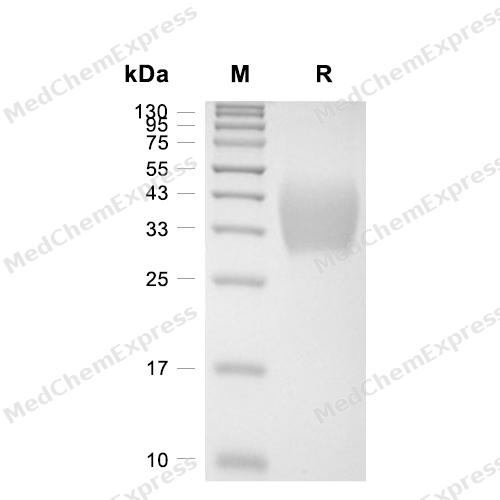
Purity - SDS-PAGE
-
Bioactivity - Cell-Based Assay
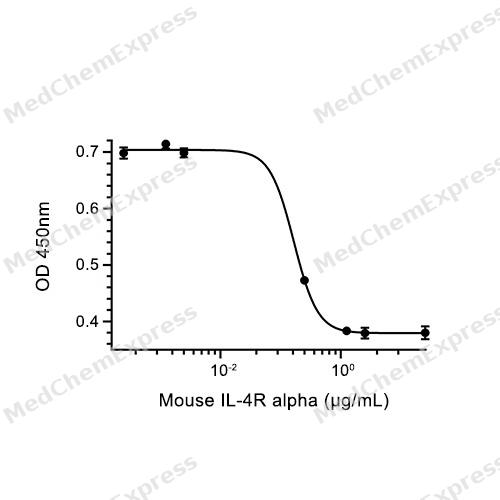
Bioactivity - Cell-Based Assay


Technical Parameters
-
Species Mouse
-
Source HEK293
-
Tag C-6*His
-
Accession
P16382-1 (I26-R233)
-
Molecular Construction
-
N-term
-
IL-4R alpha/CD124 (I26-R233)
Accession # P16382-1 -
6*His
-
C-term
-
-
Protein Length
Extracellular Domain
-
Synonyms
IL4R; IL4RA; Interleukin 4 Receptor; Interleukin-4 Receptor Alpha Chain; Interleukin-4 Receptor Subunit Alpha; IL-4R Subunit Alpha; CD124; IL4R Nirs Variant 1; IL-4 Receptor Subunit Alpha; CD124 Antigen; Interleukin 13 Receptor; IL-4R-Alpha; IL-4RA
-
AA Sequence
IKVLGEPTCFSDYIRTSTCEWFLDSAVDCSSQLCLHYRLMFFEFSENLTCIPRNSASTVCVCHMEMNRPVQSDRYQMELWAEHRQLWQGSFSPSGNVKPLAPDNLTLHTNVSDEWLLTWNNLYPSNNLLYKDLISMVNISREDNPAEFIVYNVTYKEPRLSFPINILMSGVYYTARVRVRSQILTGTWSEWSPSITWYNHFQLPLIQR
-
Molecular Weight
Approximately 32-45 kDa, based on SDS-PAGE under reducing conditions, due to the glycosylation.
-
Glycosylation
Yes
-
Purity
≥ 95%, as determined by reducing SDS-PAGE.


Product Properties
Lyophilized powder.
Lyophilized from a 0.22 μm filtered solution of PBS, pH 7.4.
<1 EU/μg, determined by LAL method.
It is not recommended to reconstitute to a concentration less than 100 μg/mL in ddH2O. For long term storage it is recommended to add a carrier protein (0.1% BSA, 5% HSA, 10% FBS or 5% Trehalose).
Stored at -20°C for 2 years from date of receipt. After reconstitution, it is stable at 4°C for 1 week or -20°C for longer (with carrier protein). It is recommended to freeze aliquots at -20°C or -80°C for extended storage.
Room temperature in continental US; may vary elsewhere.


Documentation
-
Data Sheet (265 KB)
-
SDS (252 KB)
- English - EN (252 KB)
- Français - FR (252 KB)
- Deutsch - DE (252 KB)
- Norwegian - NO (252 KB)
- Español - ES (252 KB)
- Swedish - SV (252 KB)
- Italian - IT (252 KB)
- Korean - KR (252 KB)
- Portuguese - PT (252 KB)
-
Handling Instructions (2659 KB)


References
[1]. Keegan AD,et al. An IL-4 receptor region containing an insulin receptor motif is important for IL-4-mediated IRS-1 phosphorylation and cell growth. Cell. 1994 Mar 11;76(5):811-20. [Content Brief]
[2]. Zurawski SM, et al. The primary binding subunit of the human interleukin-4 receptor is also a component of the interleukin-13 receptor. J Biol Chem. 1995 Jun 9;270(23):13869-78. [Content Brief]
[3]. Rolling C, et al. IL4 and IL13 receptors share the gamma c chain and activate STAT6, STAT3 and STAT5 proteins in normal human B cells. FEBS Lett. 1996 Sep 9;393(1):53-6. [Content Brief]
[4]. Jung T, et al. Soluble human interleukin-4 receptor is produced by activated T cells under the control of metalloproteinases. Int Arch Allergy Immunol. 1999 May;119(1):23-30. [Content Brief]
[5]. HageT,etal.Crystalstructureoftheinterleukin-4/receptoralphachaincomplexrevealsamosaicbindinginterface.Cell.1999Apr16;97(2):271-81. [Content Brief]
[6]. Shirey KA, Pletneva LM, Puche AC, Keegan AD, Prince GA, Blanco JC, Vogel SN. Control of RSV-induced lung injury by alternatively activated macrophages is IL-4R alpha-, TLR4-, and IFN-beta-dependent. Mucosal Immunol. 2010 May;3(3):291-300. [Content Brief]
[7]. Myburgh E, et al. Murine IL-4 is able to signal via chimeric human IL-4Ralpha/mouse gamma-chain receptor. Mol Immunol. 2008 Mar;45(5):1327-36. [Content Brief]

Calculators
Concentration (start) × Volume (start) = Concentration (final) × Volume (final)


 Powered by Bioz

