



Ki67/MKI67 Protein, Human (GST)

Based on 1 Customer Validation
Ki67/MKI67 is localized on mitotic chromosomes and maintains its dispersion during nuclear envelope disassembly. It covers a large portion of the chromosome surface and prevents chromatin from collapsing into clumps. Ki67/MKI67 Protein, Human (GST) is the recombinant human-derived Ki67/MKI67 protein, expressed by E. coli , with N-GST labeled tag.
- Species: Human
- Source: E. coli
-
Storage:Stored at -20°C for 2 years from date of receipt. After reconstitution, it is stable at 4°C for 1 week or -20°C for longer (with carrier protein). It is recommended to freeze aliquots at -20°C or -80°C for extended storage.


To place orders, for customer services and technical support, please contact: MedChemExpress USA
Tel: 609-228-6898 E-mail: [email protected] [email protected]


-
 Biological Activity
-
Technical Parameters
-
Product Properties
- Documentation
- Help & FAQs




Biological Activity
Description
Ki67/MKI67 is localized on mitotic chromosomes and maintains its dispersion during nuclear envelope disassembly. It covers a large portion of the chromosome surface and prevents chromatin from collapsing into clumps. Ki67/MKI67 Protein, Human (GST) is the recombinant human-derived Ki67/MKI67 protein, expressed by E. coli , with N-GST labeled tag.
Background
The Ki67/MKI67 protein is essential for maintaining the dispersion of individual mitotic chromosomes in the cytoplasm following nuclear envelope disassembly. Positioned on the surface of the mitotic chromosome, specifically within the perichromosomal layer, Ki67/MKI67 covers a significant fraction of the chromosome surface, preventing the collapse of chromosomes into a singular chromatin mass. Functioning as a surfactant with a high net electrical charge, it establishes a steric and electrostatic charge barrier, facilitating independent chromosome motility. Ki67/MKI67 exhibits DNA-binding capabilities, displaying a preference for supercoiled DNA and AT-rich DNA. While it does not contribute to the internal structure of mitotic chromosomes, its role in chromatin organization remains uncertain, raising the possibility that this may be an indirect consequence of its primary function in maintaining dispersed mitotic chromosomes. The protein interacts with various partners, including KIF15, NIFK, PPP1CC, and forms part of a complex involving ZNF335, HCFC1, CCAR2, EMSY, RBBP5, ASH2L, and WDR5, suggesting its involvement in intricate cellular processes and molecular networks.
MCE Validation Data
-
Purity - SDS-PAGE
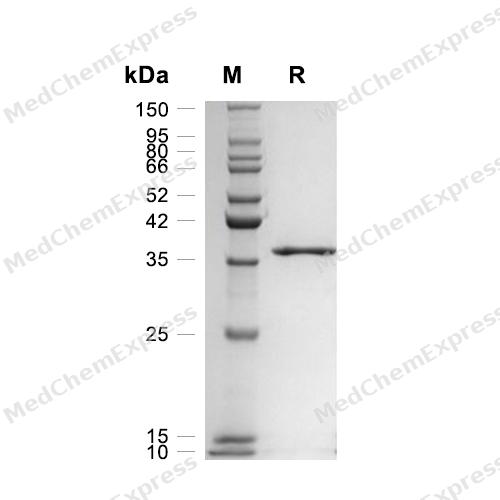
Purity - SDS-PAGE


Technical Parameters
-
Species Human
-
Source E. coli
-
Tag N-GST
-
Accession
P46013-1 (M1-P120)
-
Protein Length
Partial
-
Synonyms
MKI67; Antigen Ki67; Marker Of Proliferation Ki-67; Ki-67; Antigen Identified By Monoclonal Antibody Ki-67; Proliferation-Related Ki-67 Antigen; PPP1R105; Antigen KI-67; MIB-1; KI67 Antigen; Protein Phosphatase 1, Regulatory Subunit 105; MIB-; Molecular I
-
AA Sequence
MWPTRRLVTIKRSGVDGPHFPLSLSTCLFGRGIECDIRIQLPVVSKQHCKIEIHEQEAILHNFSSTNPTQVNGSVIDEPVRLKHGDVITIIDRSFRYENESLQNGRKSTEFPRKIREQEP
-
Molecular Weight
Approximately 37-41 kDa, based on SDS-PAGE under reducing conditions.
-
Purity
≥ 95%, as determined by reducing SDS-PAGE.


Product Properties
Lyophilized powder.
Lyophilized from a 0.2 μm filtered solution of 20 mM PB, 150 mM NaCl, pH 7.4.
<1 EU/μg, determined by LAL method.
It is not recommended to reconstitute to a concentration less than 100 μg/mL in ddH2O. For long term storage it is recommended to add a carrier protein (0.1% BSA, 5% HSA, 10% FBS or 5% Trehalose).
Stored at -20°C for 2 years from date of receipt. After reconstitution, it is stable at 4°C for 1 week or -20°C for longer (with carrier protein). It is recommended to freeze aliquots at -20°C or -80°C for extended storage.
Room temperature in continental US; may vary elsewhere.


Documentation
-
Data Sheet (236 KB)
-
SDS (251 KB)
- English - EN (251 KB)
- Français - FR (251 KB)
- Deutsch - DE (251 KB)
- Norwegian - NO (251 KB)
- Español - ES (251 KB)
- Swedish - SV (251 KB)
- Italian - IT (251 KB)
- Korean - KR (251 KB)
- Portuguese - PT (251 KB)
-
Handling Instructions (2659 KB)

Calculators
Concentration (start) × Volume (start) = Concentration (final) × Volume (final)


 Powered by Bioz

