



Leptin Receptor/LEPR Protein, Human (HEK293, His)

Based on 1 Customer Validation
Leptin Receptor/LEPR Protein, as the receptor of LEP/leptin, plays a key role in mediating central and peripheral effects through multiple signaling pathways such as JAK2/STAT3 and MAPK cascade/FOS. In the hypothalamus, it regulates appetite, influencing orexigenic factors and inhibiting orexigenic neuropeptides. Leptin Receptor/LEPR Protein, Human (HEK293, His) is the recombinant human-derived Leptin Receptor/LEPR Protein, expressed by HEK293 , with C-10*His labeled tag.
- Species: Human
- Source: HEK293
-
Storage:Stored at -20°C for 2 years from date of receipt. After reconstitution, it is stable at 4°C for 1 week or -20°C for longer (with carrier protein). It is recommended to freeze aliquots at -20°C or -80°C for extended storage.


To place orders, for customer services and technical support, please contact: MedChemExpress USA
Tel: 609-228-6898 E-mail: [email protected] [email protected]


-
 Biological Activity
-
Technical Parameters
-
Product Properties
- Documentation
- Help & FAQs




Biological Activity
Description
Leptin Receptor/LEPR Protein, as the receptor of LEP/leptin, plays a key role in mediating central and peripheral effects through multiple signaling pathways such as JAK2/STAT3 and MAPK cascade/FOS. In the hypothalamus, it regulates appetite, influencing orexigenic factors and inhibiting orexigenic neuropeptides. Leptin Receptor/LEPR Protein, Human (HEK293, His) is the recombinant human-derived Leptin Receptor/LEPR Protein, expressed by HEK293 , with C-10*His labeled tag.
Background
Leptin Receptor/LEPR Protein functions as a receptor for the hormone LEP/leptin, playing a pivotal role in mediating its central and peripheral effects through the activation of diverse signaling pathways, including JAK2/STAT3 and the MAPK cascade/FOS. In the hypothalamus, LEP acts as an appetite-regulating factor, inducing a decrease in food intake and an increase in energy consumption by influencing anorexinogenic factors and suppressing orexigenic neuropeptides. Furthermore, it regulates bone mass and secretion of hypothalamo-pituitary-adrenal hormones. In the periphery, Leptin R/LEPR impacts basal metabolism, reproductive function, pancreatic beta-cell function, insulin secretion, angiogenesis, and innate and adaptive immunity. The control of energy homeostasis and melanocortin production, as well as the regulation of fertility, growth, and glucose homeostasis, involves distinct signaling pathways. Additionally, Leptin R/LEPR participates in the counter-regulatory response to hypoglycemia by inhibiting neurons of the parabrachial nucleus and has specific effects on T lymphocyte responses, modulating the proliferation of naive and memory T cells and influencing cytokine production. Moreover, it may serve as a transporter for LEP across the blood-brain barrier and is involved in LEP endocytosis, albeit without inducing phosphorylation of and activating STAT3.
Verified Bioactivity
Measured by its binding ability in a functional ELISA. Immobilized human Leptin at 5 μg/mL (100 μL/well) can bind human Leptin receptor. The ED50 for this effect is < 0.5 μg/mL.
MCE Validation Data
-
Purity - SDS-PAGE
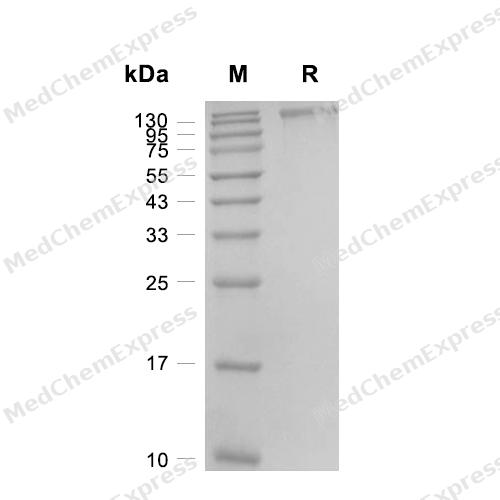
Purity - SDS-PAGE
-
Bioactivity - ELISA
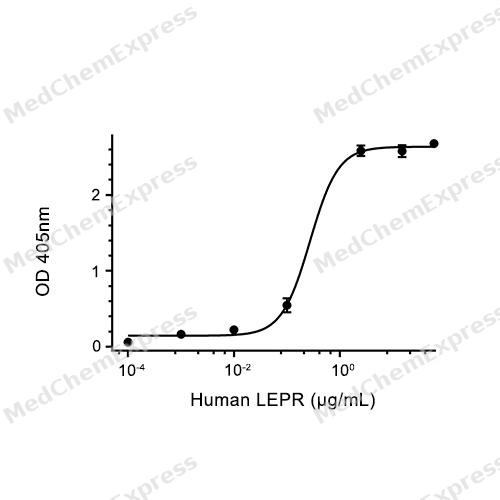
Bioactivity - ELISA


Technical Parameters
-
Species Human
-
Source HEK293
-
Tag C-10*His
-
Accession
P48357-1 (F22-D839)
-
Molecular Construction
-
N-term
-
LEPR (F22-D839)
Accession # P48357-1 -
10*His
-
C-term
-
-
Protein Length
Extracellular Domain
-
Synonyms
LEPR; HuB219; Leptin Receptor; LEPR Protein ( OBR,CD295protein ); OBR; CD295 Antigen; CD295; LEPR Protein; LEP-R; LEPRD; OB-R; DB; OB Receptor
-
AA Sequence
FNLSYPITPWRFKLSCMPPNSTYDYFLLPAGLSKNTSNSNGHYETAVEPKFNSSGTHFSNLSKTTFHCCFRSEQDRNCSLCADNIEGKTFVSTVNSLVFQQIDANWNIQCWLKGDLKLFICYVESLFKNLFRNYNYKVHLLYVLPEVLEDSPLVPQKGSFQMVHCNCSVHECCECLVPVPTAKLNDTLLMCLKITSGGVIFQSPLMSVQPINMVKPDPPLGLHMEITDDGNLKISWSSPPLVPFPLQYQVKYSENSTTVIREADKIVSATSLLVDSILPGSSYEVQVRGKRLDGPGIWSDWSTPRVFTTQDVIYFPPKILTSVGSNVSFHCIYKKENKIVPSKEIVWWMNLAEKIPQSQYDVVSDHVSKVTFFNLNETKPRGKFTYDAVYCCNEHECHHRYAELYVIDVNINISCETDGYLTKMTCRWSTSTIQSLAESTLQLRYHRSSLYCSDIPSIHPISEPKDCYLQSDGFYECIFQPIFLLSGYTMWIRINHSLGSLDSPPTCVLPDSVVKPLPPSSVKAEITINIGLLKISWEKPVFPENNLQFQIRYGLSGKEVQWKMYEVYDAKSKSVSLPVPDLCAVYAVQVRCKRLDGLGYWSNWSNPAYTVVMDIKVPMRGPEFWRIINGDTMKKEKNVTLLWKPLMKNDSLCSVQRYVINHHTSCNGTWSEDVGNHTKFTFLWTEQAHTVTVLAINSIGASVANFNLTFSWPMSKVNIVQSLSAYPLNSSCVIVSWILSPSDYKLMYFIIEWKNLNEDGEIKWLRISSSVKKYYIHDHFIPIEKYQFSLYPIFMEGVGKPKIINSFTQDDIEKHQSD
-
Molecular Weight
Approximately 100-180 kDa, based on SDS-PAGE under reducing conditions, due to the glycosylation.
-
Glycosylation
Yes
-
Purity
≥ 95%, as determined by reducing SDS-PAGE.


Product Properties
Lyophilized powder
1.Lyophilized from a 0.22 μm filtered solution of PBS, pH 7.4.
2.Lyophilized from a 0.22 μm filtered solution of PBS, pH 8.0, 8% trehalose.
Please refer to the lot-specific COA for specific buffer information.
<1 EU/μg, determined by LAL method.
It is not recommended to reconstitute to a concentration less than 100 μg/mL in ddH2O. For long term storage it is recommended to add a carrier protein (0.1% BSA, 5% HSA, 10% FBS or 5% Trehalose).
Stored at -20°C for 2 years from date of receipt. After reconstitution, it is stable at 4°C for 1 week or -20°C for longer (with carrier protein). It is recommended to freeze aliquots at -20°C or -80°C for extended storage.
Room temperature in continental US; may vary elsewhere.


Documentation
-
Data Sheet (241 KB)
-
SDS (251 KB)
- English - EN (251 KB)
- Français - FR (251 KB)
- Deutsch - DE (251 KB)
- Norwegian - NO (251 KB)
- Español - ES (251 KB)
- Swedish - SV (251 KB)
- Italian - IT (251 KB)
- Korean - KR (251 KB)
- Portuguese - PT (251 KB)
-
Handling Instructions (2659 KB)

Calculators
Concentration (start) × Volume (start) = Concentration (final) × Volume (final)


 Powered by Bioz

