



NAMPT Protein, Mouse
Based on 4 publication(s) in Google Scholar
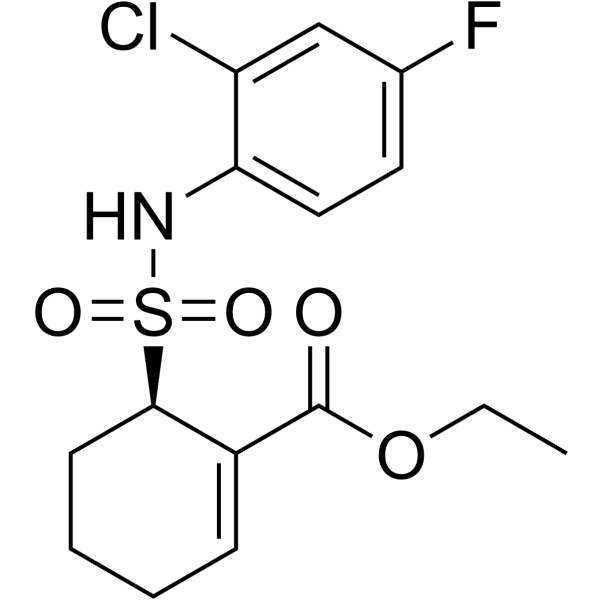
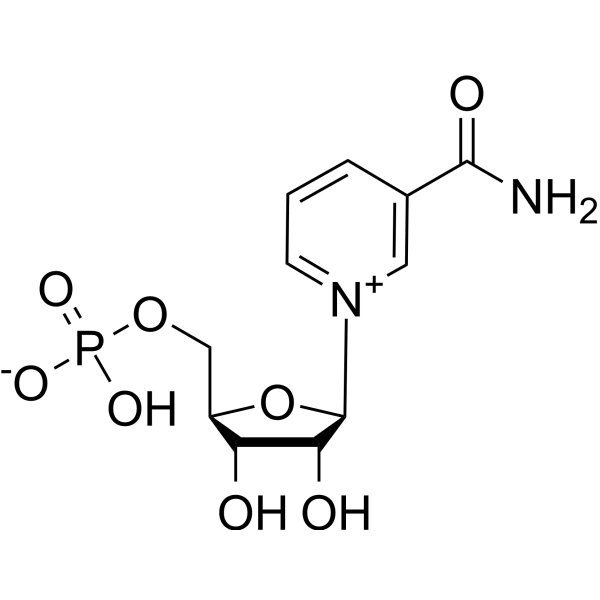
NAMPT protein has dual functions of cytokine and adipokine. Due to limited ATP activation, its secreted form lacks enzymatic activity. It catalyzes the condensation of nicotinamide and 5-phosphoribosyl-1-pyrophosphate to produce nicotinamide mononucleotide, which is critical for NAD biosynthesis. NAMPT Protein, Mouse is the recombinant mouse-derived NAMPT protein, expressed by E. coli , with tag free.
- Species: Mouse
- Source: E. coli
-
Storage:Stored at -20°C for 2 years from date of receipt. After reconstitution, it is stable at 4°C for 1 week or -20°C for longer (with carrier protein). It is recommended to freeze aliquots at -20°C or -80°C for extended storage.


To place orders, for customer services and technical support, please contact: MedChemExpress USA
Tel: 609-228-6898 E-mail: [email protected] [email protected]


-
 Biological Activity
-
Technical Parameters
-
Product Properties
- Documentation
- Help & FAQs




Biological Activity
Description
NAMPT protein has dual functions of cytokine and adipokine. Due to limited ATP activation, its secreted form lacks enzymatic activity. It catalyzes the condensation of nicotinamide and 5-phosphoribosyl-1-pyrophosphate to produce nicotinamide mononucleotide, which is critical for NAD biosynthesis. NAMPT Protein, Mouse is the recombinant mouse-derived NAMPT protein, expressed by E. coli , with tag free.
Background
The NAMPT protein exhibits dual functionality, acting both as a cytokine with immunomodulating properties and as an adipokine with anti-diabetic properties. Interestingly, its secreted form lacks enzymatic activity, attributed in part to the limited activation by ATP in the extracellular space and plasma due to its low levels. Functionally, NAMPT catalyzes the condensation of nicotinamide with 5-phosphoribosyl-1-pyrophosphate, yielding nicotinamide mononucleotide—an intermediate crucial in the biosynthesis of NAD. As the rate-limiting component in the mammalian NAD biosynthesis pathway, NAMPT plays a pivotal role in modulating circadian clock function. Its NAMPT-dependent oscillatory production of NAD governs the oscillation of clock target gene expression by releasing the core clock component, the CLOCK-BMAL1 heterodimer, from NAD-dependent SIRT1-mediated suppression.
Verified Bioactivity
Measured by its ability to induce VEGF secretion by PC-3 human prostate cancer cells. The ED50 for this effect is 1-5 μg/mL.
MCE Validation Data
-
Purity - SDS-PAGE
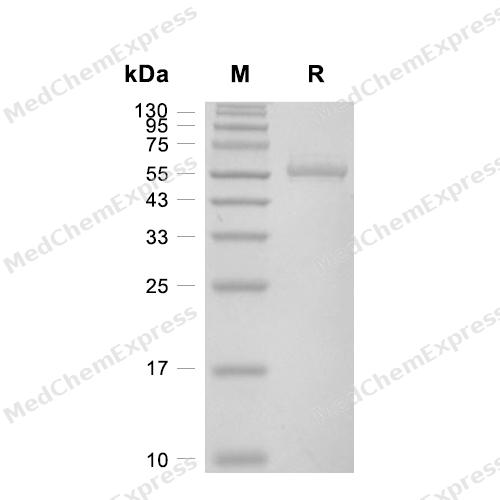
Purity - SDS-PAGE
-
Bioactivity - Cell-Based Assay
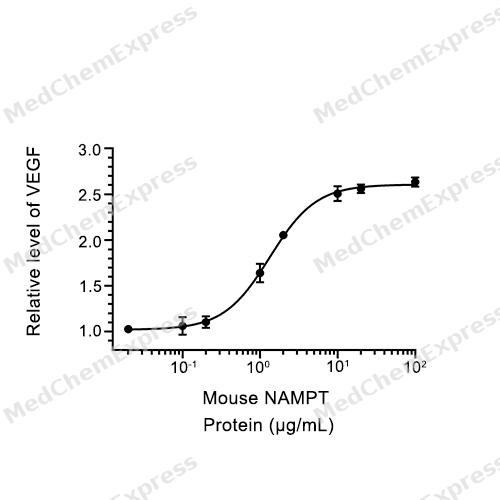
Bioactivity - Cell-Based Assay


Publications (4)
-
Journal Impact Factor
-
Most Recent
-
-
J Invest Dermatol
Dendritic cells remodel eccrine sweat gland niche metabolism through oxidative phosphorylation during aging. [Abstract]2026 Mar 24:S0022-202X(26)00998-X. PMID: 41887396 -
Eur J Pharmacol
NAMPT mediates PDGF-induced pulmonary arterial smooth muscle cell proliferation by TLR4/NF-κB/PLK4 signaling pathway. [Abstract]2023 Dec 15:961:176151. PMID: 37914064 -


Technical Parameters
-
Species Mouse
-
Source E. coli
-
Tag Tag Free
-
Accession
Q99KQ4 (M1-H491)
-
Gene ID59027
-
Molecular Construction
-
N-term
-
NAMPT (M1-H491)
Accession # Q99KQ4 -
C-term
-
-
Protein Length
Full Length
-
Synonyms
NAMPT; Pre-B-Cell Colony-Enhancing Factor 1; Prev. PBEF1; Pre-B-Cell Colony Enhancing Factor 1; Visfatin; 1110035O14Rik; PBEF; Nampt; NAmPRTase; VF; Nicotinamide Phosphoribosyltransferase; Pre-B Cell-Enhancing Factor
-
AA Sequence
MNAAAEAEFNILLATDSYKVTHYKQYPPNTSKVYSYFECREKKTENSKVRKVKYEETVFYGLQYILNKYLKGKVVTKEKIQEAKEVYREHFQDDVFNERGWNYILEKYDGHLPIEVKAVPEGSVIPRGNVLFTVENTDPECYWLTNWIETILVQSWYPITVATNSREQKKILAKYLLETSGNLDGLEYKLHDFGYRGVSSQETAGIGASAHLVNFKGTDTVAGIALIKKYYGTKDPVPGYSVPAAEHSTITAWGKDHEKDAFEHIVTQFSSVPVSVVSDSYDIYNACEKIWGEDLRHLIVSRSTEAPLIIRPDSGNPLDTVLKVLDILGKKFPVTENSKGYKLLPPYLRVIQGDGVDINTLQEIVEGMKQKKWSIENVSFGSGGALLQKLTRDLLNCSFKCSYVVTNGLGVNVFKDPVADPNKRSKKGRLSLHRTPAGNFVTLEEGKGDLEEYGHDLLHTVFKNGKVTKSYSFDEVRKNAQLNIEQDVAPH
-
Molecular Weight
Approximately 56 kDa, based on SDS-PAGE under reducing conditions.
-
Purity
≥ 90%, as determined by reducing SDS-PAGE.


Product Properties
Lyophilized powder
Lyophilized from a 0.22 μm filtered solution of 10 mM Tris-HCl, 1 mM EDTA, 6% trehalose, pH 8.0.
Note: For SPR assay, please replace the buffer. Primary amine components (e.g., Tris, imidazole) can affect protein-coupled chips.
<1 EU/μg, determined by LAL method.
It is not recommended to reconstitute to a concentration less than 100 μg/mL in ddH2O.
Stored at -20°C for 2 years from date of receipt. After reconstitution, it is stable at 4°C for 1 week or -20°C for longer (with carrier protein). It is recommended to freeze aliquots at -20°C or -80°C for extended storage.
Room temperature in continental US; may vary elsewhere.


Documentation
-
Data Sheet (238 KB)
-
SDS (252 KB)
- English - EN (252 KB)
- Français - FR (252 KB)
- Deutsch - DE (252 KB)
- Norwegian - NO (252 KB)
- Español - ES (252 KB)
- Swedish - SV (252 KB)
- Italian - IT (252 KB)
- Korean - KR (252 KB)
- Portuguese - PT (252 KB)
-
Handling Instructions (2659 KB)

Calculators
Concentration (start) × Volume (start) = Concentration (final) × Volume (final)


 Powered by Bioz

