



Nucleophosmin/Npm1 Protein, Human (150a.a, His)

Based on 1 Customer Validation
The nucleophosmin/Npm1 protein plays critical roles in ribosome biogenesis, centrosome duplication, protein chaperones, histone assembly, and cell proliferation. Npm1 is a key player in the cellular orchestra that promotes ribosome nuclear export, associates with nucleolar ribonucleoprotein structures, and interacts with single-stranded nucleic acids. Nucleophosmin/Npm1 Protein, Human (150a.a, His) is the recombinant human-derived Nucleophosmin/Npm1 protein, expressed by E. coli , with N-His labeled tag.
- Species: Human
- Source: E. coli
-
Storage:Stored at -20°C for 2 years from date of receipt. After reconstitution, it is stable at 4°C for 1 week or -20°C for longer (with carrier protein). It is recommended to freeze aliquots at -20°C or -80°C for extended storage.


To place orders, for customer services and technical support, please contact: MedChemExpress USA
Tel: 609-228-6898 E-mail: [email protected] [email protected]


-
 Biological Activity
-
Technical Parameters
-
Product Properties
- Documentation
- Help & FAQs




Biological Activity
Description
The nucleophosmin/Npm1 protein plays critical roles in ribosome biogenesis, centrosome duplication, protein chaperones, histone assembly, and cell proliferation. Npm1 is a key player in the cellular orchestra that promotes ribosome nuclear export, associates with nucleolar ribonucleoprotein structures, and interacts with single-stranded nucleic acids. Nucleophosmin/Npm1 Protein, Human (150a.a, His) is the recombinant human-derived Nucleophosmin/Npm1 protein, expressed by E. coli , with N-His labeled tag.
Background
Nucleophosmin/Npm1 protein stands at the crossroads of diverse cellular processes, orchestrating pivotal roles in ribosome biogenesis, centrosome duplication, protein chaperoning, histone assembly, and the intricate regulation of cell proliferation. This multifaceted protein emerges as a key player in the cellular orchestra, binding to ribosomes to facilitate their nuclear export, associating with nucleolar ribonucleoprotein structures, and interacting with single-stranded nucleic acids. Functioning as a chaperonin, Npm1 collaborates with core histones H3, H2B, and H4, and stimulates the endonuclease activity of APEX1 on double-stranded DNA while inhibiting its activity on single-stranded RNA. Beyond its involvement in nucleolar processes, Npm1 regulates centrosome and centriole duplication, counteracts apoptosis, and modulates the transcriptional activity of MYC target genes in conjunction with MYC. The intricate web of interactions involves partners such as NSUN2, SENP3, RPS10, NEK2, ROCK2, BRCA2, RPGR, CENPW, EIF2AK2/PKR, CEBPA, DDX31, NOP53, LRRC34, RRP1B, NPM3, ALKBH2, and TTF1, underscoring the complexity and versatility of Npm1 in cellular functions.
MCE Validation Data
-
Purity - SDS-PAGE
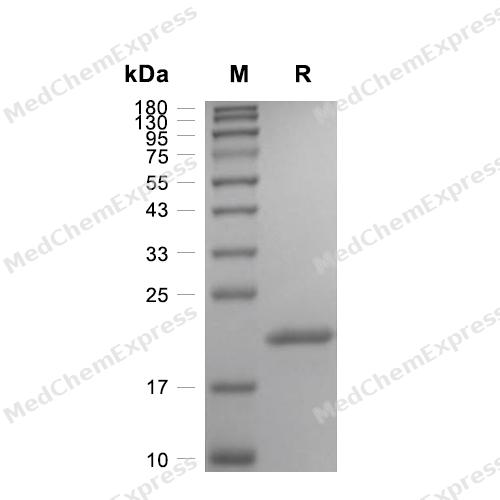
Purity - SDS-PAGE


Technical Parameters
-
Species Human
-
Source E. coli
-
Tag N-His
-
Accession
P06748-1 (M9-L158)
-
Molecular Construction
-
N-term
-
His
-
Npm1 (M9-L158)
Accession # P06748-1 -
C-term
-
-
Protein Length
Partial
-
Synonyms
NPM1; Numatrin; Nucleophosmin 1; B23; Nucleophosmin; Nucleophosmin (Nucleolar Phosphoprotein B23, Numatrin); NPM; Nucleophosmin/Nucleoplasmin Family, Member 1; Nucleolar Phosphoprotein B23; Testicular Tissue Protein Li 128; Nucleolar Protein NO38; Mutant
-
AA Sequence
MSPLRPQNYLFGCELKADKDYHFKVDNDENEHQLSLRTVSLGAGAKDELHIVEAEAMNYEGSPIKVTLATLKMSVQPTVSLGGFEITPPVVLRLKCGSGPVHISGQHLVAVEEDAESEDEEEEDVKLLSISGKRSAPGGGSKVPQKKVKL
-
Molecular Weight
Approximately 20 kDa, based on SDS-PAGE under reducing conditions.
-
Purity
≥ 90%, as determined by reducing SDS-PAGE.


Product Properties
Lyophilized powder.
Lyophilized from a 0.22 μm filtered solution of 0.1% TFA, 20% Acetonitrile, pH 2.5.
<1 EU/μg, determined by LAL method.
It is not recommended to reconstitute to a concentration less than 100 μg/mL in ddH2O. For long term storage it is recommended to add a carrier protein (0.1% BSA, 5% HSA, 10% FBS or 5% Trehalose).
Stored at -20°C for 2 years from date of receipt. After reconstitution, it is stable at 4°C for 1 week or -20°C for longer (with carrier protein). It is recommended to freeze aliquots at -20°C or -80°C for extended storage.
Room temperature in continental US; may vary elsewhere.


Documentation
-
Data Sheet (236 KB)
-
SDS (251 KB)
- English - EN (251 KB)
- Français - FR (251 KB)
- Deutsch - DE (251 KB)
- Norwegian - NO (251 KB)
- Español - ES (251 KB)
- Swedish - SV (251 KB)
- Italian - IT (251 KB)
- Korean - KR (251 KB)
- Portuguese - PT (251 KB)
-
Handling Instructions (2659 KB)

Calculators
Concentration (start) × Volume (start) = Concentration (final) × Volume (final)


 Powered by Bioz

