



PCSK9 Protein, Mouse (HEK293, His)
Based on 1 publication(s) in Google Scholar
The PCSK9 protein regulates cholesterol levels by degrading LDLR, VLDLR, LRP1/APOER, and LRP8/APOER2 receptors. It promotes LDLR degradation, inhibits recycling, induces ubiquitination, and affects APOB degradation. Additionally, PCSK9 influences BACE1 intermediates, ENaC surface expression, and neuronal apoptosis by modulating LRP8/APOER2 levels and anti-apoptotic signaling pathways. PCSK9 Protein, Mouse (HEK293, His) is the recombinant mouse-derived PCSK9 protein, expressed by HEK293, with C-6*His labeled tag.
- Species: Mouse
- Source: HEK293
-
Storage:Stored at -20°C for 2 years from date of receipt. After reconstitution, it is stable at 4°C for 1 week or -20°C for longer (with carrier protein). It is recommended to freeze aliquots at -20°C or -80°C for extended storage.


To place orders, for customer services and technical support, please contact: MedChemExpress USA
Tel: 609-228-6898 E-mail: [email protected] [email protected]


-
 Biological Activity
-
Technical Parameters
-
Product Properties
- Documentation
- Help & FAQs




Biological Activity
Description
The PCSK9 protein regulates cholesterol levels by degrading LDLR, VLDLR, LRP1/APOER, and LRP8/APOER2 receptors. It promotes LDLR degradation, inhibits recycling, induces ubiquitination, and affects APOB degradation. Additionally, PCSK9 influences BACE1 intermediates, ENaC surface expression, and neuronal apoptosis by modulating LRP8/APOER2 levels and anti-apoptotic signaling pathways. PCSK9 Protein, Mouse (HEK293, His) is the recombinant mouse-derived PCSK9 protein, expressed by HEK293, with C-6*His labeled tag.
Background
The PCSK9 protein plays a pivotal role in the intricate regulation of plasma cholesterol homeostasis. It engages with members of the low-density lipid receptor family, including low-density lipoprotein receptor (LDLR), very low-density lipoprotein receptor (VLDLR), apolipoprotein E receptor (LRP1/APOER), and apolipoprotein receptor 2 (LRP8/APOER2), facilitating their degradation within intracellular acidic compartments. Operating through a non-proteolytic mechanism, PCSK9 enhances the degradation of hepatic LDLR via a clathrin LDLRAP1/ARH-mediated pathway and may impede LDLR recycling from endosomes to the cell surface, directing it to lysosomes for degradation. Moreover, PCSK9 induces ubiquitination of LDLR, leading to subsequent degradation, and inhibits the intracellular degradation of APOB through the autophagosome/lysosome pathway, independent of LDLR. Additionally, PCSK9 is implicated in the disposal of non-acetylated intermediates of BACE1 in the early secretory pathway, hinders epithelial Na(+) channel (ENaC)-mediated Na(+) absorption by increasing its proteasomal degradation, and modulates neuronal apoptosis by regulating LRP8/APOER2 levels and related anti-apoptotic signaling pathways.
Verified Bioactivity
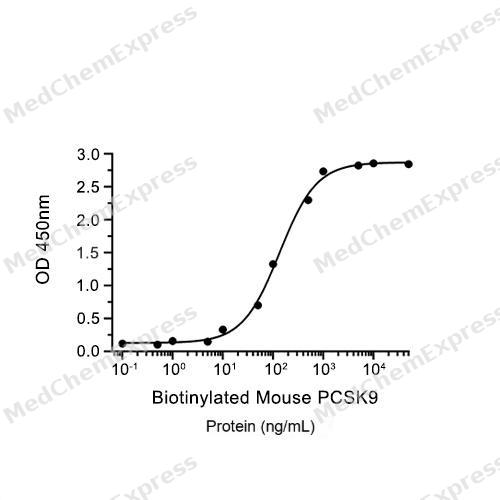
Measured by its binding ability in a functional ELISA. When Recombinant Mouse LDLR Protein is immobilized at 2 µg/mL (100 µL/well) can bind Biotinylated Mouse PCSK9 Protein. The ED50 for this effect is 135.1 ng/mL.
MCE Validation Data
-
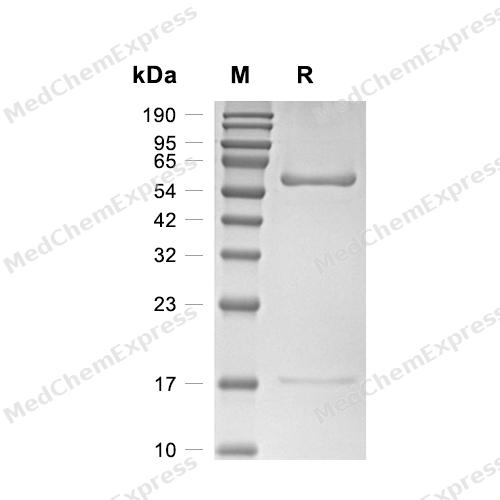
Purity - SDS-PAGE
Purity - SDS-PAGE
-
Bioactivity - ELISA
Bioactivity - ELISA


Publications (1)
-
Journal Impact Factor
-
Most Recent
-
Sci Rep
HIIT and MICT mitigate endothelial dysfunction in early atherosclerotic mice via PCSK9 inhibition. [Abstract]2025 Aug 19;15(1):30411. PMID: 40830352


Technical Parameters
-
Species Mouse
-
Source HEK293
-
Tag C-6*His
-
Accession
Q80W65 (Q35-Q155&S156-Q694)
-
Gene ID100102
-
Molecular Construction
-
N-term
-
PCSK9 (Q35-Q155&S156-Q694)
Accession # Q80W65 -
6*His
-
C-term
-
-
Protein Length
Full Length of Mature Protein (with Propeptide)
-
Synonyms
PCSK9; PC9; Prev. HCHOLA3; Hypercholesterolemia, Autosomal Dominant 3; NARC-1; Neural Apoptosis Regulated Convertase 1; Subtilisin/Kexin-Like Protease PC9; Neural Apoptosis-Regulated Convertase 1; FH3; LDLCQ1; Proprotein Convertase 9; FHCL3; NARC1; Propro
-
AA Sequence
QDEDGDYEELMLALPSQEDGLADEAAHVATATFRRCSKEAWRLPGTYIVVLMEETQRLQIEQTAHRLQTRAARRGYVIKVLHIFYDLFPGFLVKMSSDLLGLALKLPHVEYIEEDSFVFAQSIPWNLERIIPAWHQTEEDRSPDGSSQVEVYLLDTSIQGAHREIEGRVTITDFNSVPEEDGTRFHRQASKCDSHGTHLAGVVSGRDAGVAKGTSLHSLRVLNCQGKGTVSGTLIGLEFIRKSQLIQPSGPLVVLLPLAGGYSRILNAACRHLARTGVVLVAAAGNFRDDACLYSPASAPEVITVGATNAQDQPVTLGTLGTNFGRCVDLFAPGKDIIGASSDCSTCFMSQSGTSQAAAHVAGIVARMLSREPTLTLAELRQRLIHFSTKDVINMAWFPEDQQVLTPNLVATLPPSTHETGGQLLCRTVWSAHSGPTRTATATARCAPEEELLSCSSFSRSGRRRGDWIEAIGGQQVCKALNAFGGEGVYAVARCCLVPRANCSIHNTPAARAGLETHVHCHQKDHVLTGCSFHWEVEDLSVRRQPALRSRRQPGQCVGHQAASVYASCCHAPGLECKIKEHGISGPSEQVTVACEAGWTLTGCNVLPGASLTLGAYSVDNLCVARVHDTARADRTSGEATVAAAICCRSRPSAKASWVQ
-
Molecular Weight
Approximately 19 kDa (prodomain) & 65 kDa (mature form of PCSK9), based on SDS-PAGE under reducing conditions, due to the glycosylation.
-
Glycosylation
Yes
-
Purity
≥ 95%, as determined by reducing SDS-PAGE.


Product Properties
Lyophilized powder
Lyophilized from a 0.22 μm filtered solution of 20 mM Tris-HCl, 150 mM NaCl, pH 7.8.
Note: For SPR assay, please replace the buffer. Primary amine components (e.g., Tris, imidazole) can affect protein-coupled chips.
<1 EU/μg, determined by LAL method.
It is not recommended to reconstitute to a concentration less than 100 μg/mL in ddH2O. For long term storage it is recommended to add a carrier protein (0.1% BSA, 5% HSA, 10% FBS or 5% Trehalose).
Stored at -20°C for 2 years from date of receipt. After reconstitution, it is stable at 4°C for 1 week or -20°C for longer (with carrier protein). It is recommended to freeze aliquots at -20°C or -80°C for extended storage.
Room temperature in continental US; may vary elsewhere.


Documentation
-
Data Sheet (264 KB)
-
SDS (252 KB)
- English - EN (252 KB)
- Français - FR (252 KB)
- Deutsch - DE (252 KB)
- Norwegian - NO (252 KB)
- Español - ES (252 KB)
- Swedish - SV (252 KB)
- Italian - IT (252 KB)
- Korean - KR (252 KB)
- Portuguese - PT (252 KB)
-
Handling Instructions (2659 KB)

Calculators
Concentration (start) × Volume (start) = Concentration (final) × Volume (final)


 Powered by Bioz

