



Plasminogen Protein, Human
Based on 1 Customer Validation
Plasminogen protein is the key precursor of plasmin and plays a central role in a variety of physiological and pathological processes. Plasmin is derived from plasminogen and dissolves fibrin during blood coagulation, affecting embryonic development, tissue remodeling, tumor invasion and inflammation. Plasminogen Protein, Human is the recombinant human-derived Plasminogen protein, expressed by E. coli , with tag free.
- Species: Human
- Source: E. coli
-
Storage:Stored at -20°C for 2 years from date of receipt. After reconstitution, it is stable at 4°C for 1 week or -20°C for longer (with carrier protein). It is recommended to freeze aliquots at -20°C or -80°C for extended storage.


To place orders, for customer services and technical support, please contact: MedChemExpress USA
Tel: 609-228-6898 E-mail: [email protected] [email protected]


-
 Biological Activity
-
Technical Parameters
-
Product Properties
- Documentation
- Help & FAQs




Biological Activity
Description
Plasminogen protein is the key precursor of plasmin and plays a central role in a variety of physiological and pathological processes. Plasmin is derived from plasminogen and dissolves fibrin during blood coagulation, affecting embryonic development, tissue remodeling, tumor invasion and inflammation. Plasminogen Protein, Human is the recombinant human-derived Plasminogen protein, expressed by E. coli , with tag free.
Background
Plasminogen Protein plays a crucial role in diverse physiological and pathological processes, functioning as the precursor to plasmin—a potent proteolytic factor with multifaceted activities. Plasmin's primary function involves the dissolution of fibrin in blood clots, contributing to processes such as embryonic development, tissue remodeling, tumor invasion, and inflammation. It weakens the walls of the Graafian follicle during ovulation and activates various enzymes, including urokinase-type plasminogen activator, collagenases, and complement zymogens such as C1 and C5. Plasmin's proteolytic action extends to cleaving fibronectin, laminin, fibrin, thrombospondin, and von Willebrand factor, resulting in cell detachment and apoptosis. Its involvement in tissue remodeling and tumor invasion may be modulated by CSPG4. Plasminogen also binds to cells, and the derived angiostatin serves as an angiogenesis inhibitor, blocking neovascularization and impeding the growth of experimental primary and metastatic tumors in vivo. The diverse roles of Plasminogen underscore its significance in orchestrating complex cellular and physiological processes.
Verified Bioactivity
Measured by its binding ability in a functional ELISA. Immobilized Human Plasminogen at 2 μg/mL can bind Anti-Plasminogen antibody. The ED50 for this effect is 10-50 ng/mL.
MCE Validation Data
-
Purity - SDS-PAGE

Purity - SDS-PAGE
-
Bioactivity - ELISA
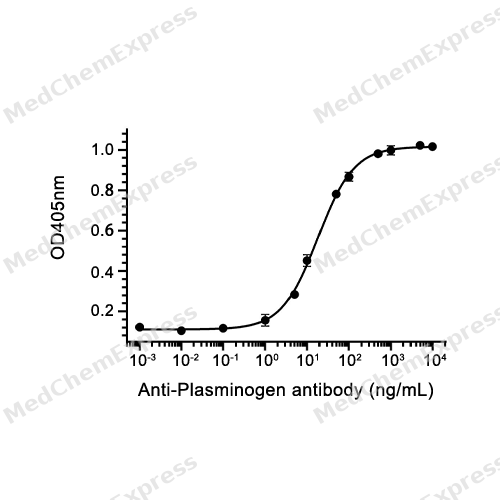
Bioactivity - ELISA


Technical Parameters
-
Species Human
-
Source E. coli
-
Tag Tag Free
-
Accession
P00747 (V98-P356)
-
Molecular Construction
-
N-term
-
Plasminogen (V98-P356)
Accession # P00747 -
C-term
-
-
Protein Length
Partial
-
Synonyms
PLG; PLG Protein; Plasminogen; Plasmin; HCG2029799, Isoform CRA_d; HAE4; HCG2029799, Isoform CRA_b
-
AA Sequence
VYLSECKTGNGKNYRGTMSKTKNGITCQKWSSTSPHRPRFSPATHPSEGLEENYCRNPDNDPQGPWCYTTDPEKRYDYCDILECEEECMHCSGENYDGKISKTMSGLECQAWDSQSPHAHGYIPSKFPNKNLKKNYCRNPDRELRPWCFTTDPNKRWELCDIPRCTTPPPSSGPTYQCLKGTGENYRGNVAVTVSGHTCQHWSAQTPHTHNRTPENFPCKNLDENYCRNPDGKRAPWCHTTNSQVRWEYCKIPSCDSSP
-
Predicted Molecular Mass
29.7 kDa
-
Molecular Weight
Approximately 35 kDa, based on SDS-PAGE under reducing conditions.
-
Purity
≥ 95%, as determined by reducing SDS-PAGE.


Product Properties
Lyophilized powder
Lyophilized from a 0.22 μm filtered solution of 20 mM NaAc, 4 % Mannitol, pH 5.5.
<1 EU/μg, determined by LAL method.
It is not recommended to reconstitute to a concentration less than 100 μg/mL in ddH2O.
Stored at -20°C for 2 years from date of receipt. After reconstitution, it is stable at 4°C for 1 week or -20°C for longer (with carrier protein). It is recommended to freeze aliquots at -20°C or -80°C for extended storage.
Room temperature in continental US; may vary elsewhere.


Documentation
-
Data Sheet (236 KB)
-
SDS (252 KB)
- English - EN (252 KB)
- Français - FR (252 KB)
- Deutsch - DE (252 KB)
- Norwegian - NO (252 KB)
- Español - ES (252 KB)
- Swedish - SV (252 KB)
- Italian - IT (252 KB)
- Korean - KR (252 KB)
- Portuguese - PT (252 KB)
-
Handling Instructions (2659 KB)

Calculators
Concentration (start) × Volume (start) = Concentration (final) × Volume (final)


 Powered by Bioz

