



PRDX6 Protein, Human (His)
Based on 1 publication(s) in Google Scholar
The PRDX6 protein is a thiol-specific peroxidase that plays a crucial role in cellular defense against oxidative stress. It catalyzes the reduction of hydrogen peroxide and various organic hydroperoxides to water and alcohols. PRDX6 Protein, Human (His) is the recombinant human-derived PRDX6 protein, expressed by E. coli , with N-6*His labeled tag.
- Species: Human
- Source: E. coli
-
Storage:Stored at -80°C for 1 year from date of receipt. It is stable at -20°C for 3 months after opening. It is recommended to freeze aliquots at -80°C for extended storage. Avoid repeated freeze-thaw cycles.


To place orders, for customer services and technical support, please contact: MedChemExpress USA
Tel: 609-228-6898 E-mail: [email protected] [email protected]


-
 Biological Activity
-
Technical Parameters
-
Product Properties
- Documentation
- Help & FAQs




Biological Activity
Description
The PRDX6 protein is a thiol-specific peroxidase that plays a crucial role in cellular defense against oxidative stress. It catalyzes the reduction of hydrogen peroxide and various organic hydroperoxides to water and alcohols. PRDX6 Protein, Human (His) is the recombinant human-derived PRDX6 protein, expressed by E. coli , with N-6*His labeled tag.
Background
PRDX6, a thiol-specific peroxidase, demonstrates a crucial role in cellular defense against oxidative stress by catalyzing the reduction of hydrogen peroxide and various organic hydroperoxides to water and alcohols, respectively. This multifunctional enzyme exhibits the ability to reduce H(2)O(2) as well as short-chain organic, fatty acid, and phospholipid hydroperoxides. Additionally, PRDX6 possesses phospholipase activity, allowing it to either reduce the oxidized sn-2 fatty acyl group of phospholipids through peroxidase activity or hydrolyze the sn-2 ester bond of phospholipids through phospholipase activity. These functions are dependent on its binding to phospholipids at acidic pH and to oxidized phospholipids at cytosolic pH. Beyond its peroxidase activity, PRDX6 serves a critical role in phospholipid homeostasis and acts as an acyl-CoA-dependent lysophospholipid acyltransferase, facilitating the conversion of lysophosphatidylcholine (LPC) into phosphatidylcholine (PC). The enzyme exhibits a clear preference for LPC as the lysophospholipid and palmitoyl CoA as the fatty acyl substrate.
Verified Bioactivity
The enzyme activity of this recombinant protein is testing in progress, we cannot offer a guarantee yet.
MCE Validation Data
-
Purity - SDS-PAGE
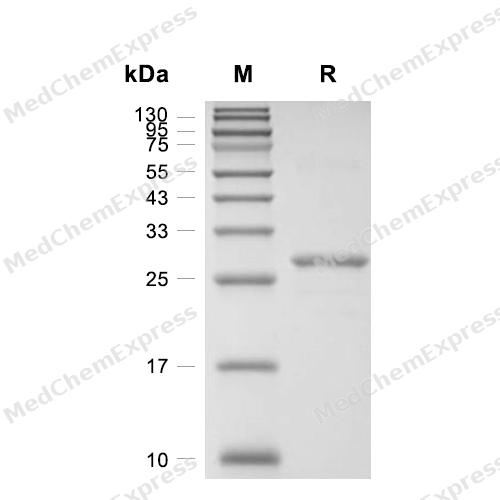
Purity - SDS-PAGE


Publications (1)
-
Journal Impact Factor
-
Most Recent


Technical Parameters
-
Species Human
-
Source E. coli
-
Tag N-6*His
-
Accession
P30041 (M1-P224)
-
Molecular Construction
-
N-term
-
6*His
-
PRDX6 (M1-P224)
Accession # P30041 -
C-term
-
-
Protein Length
Full Length
-
Synonyms
PRDX6; PRX; Peroxiredoxin 6; P29; AiPLA2; Red Blood Cells Page Spot 12; NSGPx; Lyso-PC Acyltransferase 5; AOP2; LPC Acyltransferase 5; Acidic Calcium-Independent Phospholipase A2; Antioxidant Protein 2; Lysophosphatidylcholine Acyltransferase 5; Liver 2D
-
AA Sequence
MPGGLLLGDVAPNFEANTTVGRIRFHDFLGDSWGILFSHPRDFTPVCTTELGRAAKLAPEFAKRNVKLIALSIDSVEDHLAWSKDINAYNCEEPTEKLPFPIIDDRNRELAILLGMLDPAEKDEKGMPVTARVVFVFGPDKKLKLSILYPATTGRNFDEILRVVISLQLTAEKRVATPVDWKDGDSVMVLPTIPEEEAKKLFPKGVFTKELPSGKKYLRYTPQP
-
Predicted Molecular Mass
27.2 kDa
-
Molecular Weight
Approximately 30-33 kDa, based on SDS-PAGE under reducing conditions.
-
Purity
≥ 95%, as determined by reducing SDS-PAGE.


Product Properties
Solution
Supplied as a 0.22 μm filtered solution of PBS, pH 7.4.
<1 EU/μg, determined by LAL method.
Stored at -80°C for 1 year from date of receipt. It is stable at -20°C for 3 months after opening. It is recommended to freeze aliquots at -80°C for extended storage. Avoid repeated freeze-thaw cycles.
Shipping with dry ice.


Documentation
-
Data Sheet (236 KB)
-
SDS (254 KB)
- English - EN (254 KB)
- Français - FR (254 KB)
- Deutsch - DE (254 KB)
- Norwegian - NO (254 KB)
- Español - ES (254 KB)
- Swedish - SV (254 KB)
- Italian - IT (254 KB)
- Korean - KR (254 KB)
- Portuguese - PT (254 KB)
-
Handling Instructions (2659 KB)

Calculators
Concentration (start) × Volume (start) = Concentration (final) × Volume (final)


 Powered by Bioz

