



RGMB Protein, Human (HEK293, His)

Based on 1 Customer Validation
The RGMB protein is a member of the repulsion guidance molecule (RGM) family and plays a critical role in the developing nervous system by enhancing bone morphogenetic protein (BMP) signaling. As a BMP coreceptor, RGMB promotes neuronal adhesion and may inhibit neurite outgrowth. RGMB Protein, Human (HEK293, His) is the recombinant human-derived RGMB protein, expressed by HEK293 , with C-His labeled tag.
- Species: Human
- Source: HEK293
-
Storage:Stored at -20°C for 2 years from date of receipt. After reconstitution, it is stable at 4°C for 1 week or -20°C for longer (with carrier protein). It is recommended to freeze aliquots at -20°C or -80°C for extended storage.


To place orders, for customer services and technical support, please contact: MedChemExpress USA
Tel: 609-228-6898 E-mail: [email protected] [email protected]


-
 Biological Activity
-
Technical Parameters
-
Product Properties
- Documentation
- Help & FAQs




Biological Activity
Description
The RGMB protein is a member of the repulsion guidance molecule (RGM) family and plays a critical role in the developing nervous system by enhancing bone morphogenetic protein (BMP) signaling. As a BMP coreceptor, RGMB promotes neuronal adhesion and may inhibit neurite outgrowth. RGMB Protein, Human (HEK293, His) is the recombinant human-derived RGMB protein, expressed by HEK293 , with C-His labeled tag.
Background
RGMB Protein, a member of the repulsive guidance molecule (RGM) family, plays a crucial role in shaping the developing nervous system by contributing to its patterning. Functioning as a bone morphogenetic protein (BMP) coreceptor, RGMB enhances BMP signaling, highlighting its involvement in pivotal cellular processes. Additionally, RGMB promotes neuronal adhesion and may exert an inhibitory effect on neurite outgrowth. Existing as a homooligomer, RGMB interacts with DRGX and forms functional complexes with BMP2, BMP4, ACVR1, BMPR1A, BMPR1B, and ACVR2B, orchestrating a network of interactions critical for cellular signaling. Notably, its complex with the receptor NEO1/neogenin adopts a heterotetrameric structure with a 2:2 stoichiometry, where RGM molecules act as staples, bringing two NEO1 receptors together without direct self-interaction. This unique arrangement facilitates downstream signaling activation via the RhoA pathway, emphasizing RGMB's multifaceted role in orchestrating intricate molecular events during neural development.
Verified Bioactivity
Measured by its binding ability in a functional ELISA. Immobilized Human BMP-4 at 1 μg/mL (100 μL/well) can bind Biotinylated Human RGM-B. The ED50 for this effect is 797.3 ng/mL.
MCE Validation Data
-
Bioactivity - ELISA
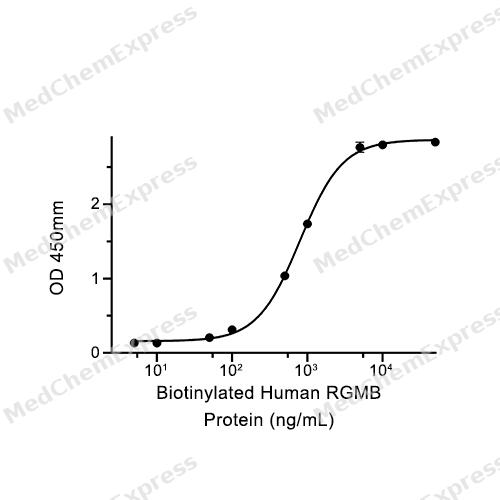
Bioactivity - ELISA


Technical Parameters
-
Species Human
-
Source HEK293
-
Tag C-6*His
-
Accession
Q6NW40/J3KNF6 (G46-N413)
-
Molecular Construction
-
N-term
-
RGMB (G46-N413)
Accession # Q6NW40/J3KNF6 -
His
-
C-term
-
-
Protein Length
Full Length of Mature Protein
-
Synonyms
RGMB; Repulsive Guidance Molecule Family Member B; Repulsive Guidance Molecule BMP Co-Receptor B; Repulsive Guidance Molecule B; DRAGON; RGM Domain Family, Member B; DRG11-Responsive Axonal Guidance And Outgrowth Of Neurite; FLJ90406
-
AA Sequence
GDCQQPAQCRIQKCTTDFVSLTSHLNSAVDGFDSEFCKALRAYAGCTQRTSKACRGNLVYHSAVLGISDLMSQRNCSKDGPTSSTNPEVTHDPCNYHSHAGAREHRRGDQNPPSYLFCGLFGDPHLRTFKDNFQTCKVEGAWPLIDNNYLSVQVTNVPVVPGSSATATNKITIIFKAHHECTDQKVYQAVTDDLPAAFVDGTTSGGDSDAKSLRIVERESGHYVEMHARYIGTTVFVRQVGRYLTLAIRMPEDLAMSYEESQDLQLCVNGCPLSERIDDGQGQVSAILGHSLPRTSLVQAWPGYTLETANTQCHEKMPVKDIYFQSCVFDLLTTGDANFTAAAHSALEDVEALHPRKERWHIFPSSGN
-
Molecular Weight
Approximately 42 kDa, based on SDS-PAGE under reducing conditions.
-
Glycosylation
Yes
-
Purity
≥ 90%, as determined by reducing SDS-PAGE.


Product Properties
Lyophilized powder
Lyophilized from a 0.2 μm filtered solution of 20 mM PB, 150 mM NaCl, pH 7.4.
<1 EU/μg, determined by LAL method.
It is not recommended to reconstitute to a concentration less than 100 μg/mL in ddH2O. For long term storage it is recommended to add a carrier protein (0.1% BSA, 5% HSA, 10% FBS or 5% Trehalose).
Stored at -20°C for 2 years from date of receipt. After reconstitution, it is stable at 4°C for 1 week or -20°C for longer (with carrier protein). It is recommended to freeze aliquots at -20°C or -80°C for extended storage.
Room temperature in continental US; may vary elsewhere.


Documentation
-
Data Sheet (238 KB)
-
SDS (251 KB)
- English - EN (251 KB)
- Français - FR (251 KB)
- Deutsch - DE (251 KB)
- Norwegian - NO (251 KB)
- Español - ES (251 KB)
- Swedish - SV (251 KB)
- Italian - IT (251 KB)
- Korean - KR (251 KB)
- Portuguese - PT (251 KB)
-
Handling Instructions (2659 KB)

Calculators
Concentration (start) × Volume (start) = Concentration (final) × Volume (final)


 Powered by Bioz

