



S100A1 Protein, Human
Based on 1 Customer Validation
S100A1 is a small calcium-binding protein that plays critical roles in multiple processes, including Ca(2+) homeostasis and cardiomyocyte regulation. Elevated intracellular Ca(2+) triggers conformational changes in S100A1, thereby interacting with key proteins in cardiomyocytes such as RYR1, RYR2, ATP2A2 and F1-ATPase. S100A1 Protein, Human is the recombinant human-derived S100A1 protein, expressed by E. coli , with tag free.
- Species: Human
- Source: E. coli
-
Storage:Stored at -80°C for 1 year from date of receipt. It is stable at -20°C for 3 months after opening. It is recommended to freeze aliquots at -80°C for extended storage. Avoid repeated freeze-thaw cycles.


To place orders, for customer services and technical support, please contact: MedChemExpress USA
Tel: 609-228-6898 E-mail: [email protected] [email protected]


-
 Biological Activity
-
Technical Parameters
-
Product Properties
- Documentation
- Help & FAQs




Biological Activity
Description
S100A1 is a small calcium-binding protein that plays critical roles in multiple processes, including Ca(2+) homeostasis and cardiomyocyte regulation. Elevated intracellular Ca(2+) triggers conformational changes in S100A1, thereby interacting with key proteins in cardiomyocytes such as RYR1, RYR2, ATP2A2 and F1-ATPase. S100A1 Protein, Human is the recombinant human-derived S100A1 protein, expressed by E. coli , with tag free.
Background
S100A1 is a small calcium-binding protein that plays crucial roles in various biological processes, including Ca(2+) homeostasis, chondrocyte biology, and cardiomyocyte regulation. Upon an increase in intracellular Ca(2+) levels, S100A1 binds calcium, triggering conformational changes that facilitate interactions with specific target proteins, subsequently modulating their activity. Particularly, in cardiomyocytes, S100A1 orchestrates a network governing sarcoplasmic reticulum Ca(2+) cycling and mitochondrial function by interacting with key proteins such as ryanodine receptors RYR1 and RYR2, sarcoplasmic reticulum Ca(2+)-ATPase/ATP2A2, and mitochondrial F1-ATPase. This multifaceted protein also contributes to diastolic Ca(2+) dissociation and myofilament mechanics, enhancing relaxation during diastole. S100A1 exists as a dimer of either two alpha chains, two beta chains, or one of each, and it forms heterodimers with S100P. Additionally, it engages in various interactions with proteins like AGER, CAPZA1, FKBP4, RYR1, RYR2, CACYBP, PPP5C, ATP2A2, PLN, ATP5F1A, and ATP5F1B, participating in diverse cellular processes in a calcium-dependent manner.
Verified Bioactivity
Measured by its binding ability in a functional ELISA. Immobilized recombinant human Fc-S100B at 10 μg/mL (100 μl/well) can bind biotinylated human S100A1 with a linear range of 200-250 ng/mL.
MCE Validation Data
-
Purity - SDS-PAGE
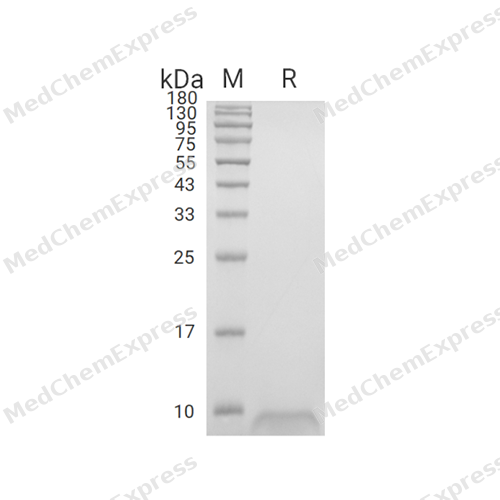
Purity - SDS-PAGE


Technical Parameters
-
Species Human
-
Source E. coli
-
Tag Tag Free
-
Accession
P23297 (M1-S94)
-
Molecular Construction
-
N-term
-
S100A1 (M1-S94)
Accession # P23297 -
C-term
-
-
Protein Length
Full Length
-
Synonyms
S100A1; Protein S100-A1; Prev. S100A; S100 Calcium-Binding Protein; S100-Alpha; Protein S100; S100 Calcium-Binding Protein A1; S100 Alpha; S-100 Protein Subunit Alpha; S100; S-100 Protein Alpha Chain; S100 Calcium Binding Protein A1; S100 Protein, Alpha P
-
AA Sequence
MGSELETAMETLINVFHAHSGKEGDKYKLSKKELKELLQTELSGFLDAQKDVDAVDKVMKELDENGDGEVDFQEYVVLVAALTVACNNFFWENS
-
Predicted Molecular Mass
10.5 kDa
-
Molecular Weight
Approximately 9-10 kDa, based on SDS-PAGE under reducing conditions.
-
Purity
≥ 95%, as determined by reducing SDS-PAGE.


Product Properties
Solution
Supplied as a 0.22 μm filtered solution of PBS, pH 7.4.
<1 EU/μg, determined by LAL method.
Stored at -80°C for 1 year from date of receipt. It is stable at -20°C for 3 months after opening. It is recommended to freeze aliquots at -80°C for extended storage. Avoid repeated freeze-thaw cycles.
Shipping with dry ice.


Documentation
-
Data Sheet (235 KB)
-
SDS (252 KB)
- English - EN (252 KB)
- Français - FR (252 KB)
- Deutsch - DE (252 KB)
- Norwegian - NO (252 KB)
- Español - ES (252 KB)
- Swedish - SV (252 KB)
- Italian - IT (252 KB)
- Korean - KR (252 KB)
- Portuguese - PT (252 KB)
-
Handling Instructions (2659 KB)

Calculators
Concentration (start) × Volume (start) = Concentration (final) × Volume (final)


 Powered by Bioz

