



Serpin D1 Protein, Human (HEK293, His)

Based on 1 Customer Validation
Serpin D1 protein is a thrombin inhibitor activated by glycosaminoglycans such as heparin or dermatan sulfate. It replaces antithrombin III and becomes the main thrombin inhibitor in the presence of dermatan sulfate. In addition to thrombin inhibition, serpin D1 also has glycosaminoglycan-independent chymotrypsin inhibitory activity. Serpin D1 Protein, Human (HEK293, His) is the recombinant human-derived Serpin D1 protein, expressed by HEK293 , with C-His labeled tag.
- Species: Human
- Source: HEK293
-
Storage:Stored at -20°C for 2 years from date of receipt. After reconstitution, it is stable at 4°C for 1 week or -20°C for longer (with carrier protein). It is recommended to freeze aliquots at -20°C or -80°C for extended storage.


To place orders, for customer services and technical support, please contact: MedChemExpress USA
Tel: 609-228-6898 E-mail: [email protected] [email protected]


-
 Biological Activity
-
Technical Parameters
-
Product Properties
- Documentation
- Help & FAQs




Biological Activity
Description
Serpin D1 protein is a thrombin inhibitor activated by glycosaminoglycans such as heparin or dermatan sulfate. It replaces antithrombin III and becomes the main thrombin inhibitor in the presence of dermatan sulfate. In addition to thrombin inhibition, serpin D1 also has glycosaminoglycan-independent chymotrypsin inhibitory activity. Serpin D1 Protein, Human (HEK293, His) is the recombinant human-derived Serpin D1 protein, expressed by HEK293 , with C-His labeled tag.
Background
Serpin D1 Protein functions as a thrombin inhibitor, with its activity activated by glycosaminoglycans such as heparin or dermatan sulfate. In the presence of dermatan sulfate, HC-II becomes the predominant thrombin inhibitor, displacing antithrombin III (AT-III). Beyond its role in thrombin inhibition, Serpin D1 also exhibits chymotrypsin-inhibiting activity, independent of glycosaminoglycans. Notably, peptides at the N-terminal of HC-II demonstrate chemotactic activity for both monocytes and neutrophils. This multifaceted functionality highlights the diverse roles of Serpin D1 in regulating protease activities and participating in immune responses, underscoring its significance in maintaining hemostasis and modulating inflammatory processes.
Verified Bioactivity
1.Measured by its ability to inhibit Thrombin (HY-114164) cleavage of 200μM Boc-VPR-AMC (HY-137784) that incubate at room temperature in kinetic mode for 5 minutes. The IC50 value is <0.5 nM.
2.Measured by its ability to inhibit Thrombin cleavage of a peptide substrate, 100 μM Boc-VPR-AMC that
incubate at room temperature in kinetic mode for 5 minutes. The IC50 value is 0.455 nM.
MCE Validation Data
-
Purity - SDS-PAGE
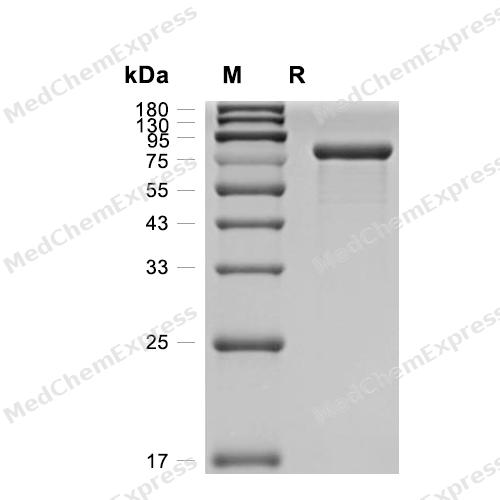
Purity - SDS-PAGE


Technical Parameters
-
Species Human
-
Source HEK293
-
Tag C-His
-
Accession
P05546 (G20-S499)
-
Molecular Construction
-
N-term
-
Serpin D1 (G20-S499)
Accession # P05546 -
His
-
C-term
-
-
Protein Length
Full Length of Mature Protein
-
Synonyms
SERPIND1; Serine (Or Cysteine) Proteinase Inhibitor, Clade D (Heparin Cofactor), Member 1; Prev. HCF2; Heparin Cofactor II; HLS2; Serpin D1; Serpin Peptidase Inhibitor, Clade D (Heparin Cofactor), Member 1; Leuserpin 2; Heparin Cofactor 2; THPH10; D22S673
-
AA Sequence
GSKGPLDQLEKGGETAQSADPQWEQLNNKNLSMPLLPADFHKENTVTNDWIPEGEEDDDYLDLEKIFSEDDDYIDIVDSLSVSPTDSDVSAGNILQLFHGKSRIQRLNILNAKFAFNLYRVLKDQVNTFDNIFIAPVGISTAMGMISLGLKGETHEQVHSILHFKDFVNASSKYEITTIHNLFRKLTHRLFRRNFGYTLRSVNDLYIQKQFPILLDFKTKVREYYFAEAQIADFSDPAFISKTNNHIMKLTKGLIKDALENIDPATQMMILNCIYFKGSWVNKFPVEMTHNHNFRLNEREVVKVSMMQTKGNFLAANDQELDCDILQLEYVGGISMLIVVPHKMSGMKTLEAQLTPRVVERWQKSMTNRTREVLLPKFKLEKNYNLVESLKLMGIRMLFDKNGNMAGISDQRIAIDLFKHQGTITVNEEGTQATTVTTVGFMPLSTQVRFTVDRPFLFLIYEHRTSCLLFMGRVANPSRS
-
Molecular Weight
Approximately 65-70 kDa, based on SDS-PAGE under reducing conditions, due to the glycosylation.
-
Purity
≥ 95%, as determined by reducing SDS-PAGE.


Product Properties
Lyophilized powder
1.Lyophilized from a 0.22 μm filtered solution of PBS, pH 7.4.
2.Lyophilized from a 0.22 μm filtered solution of PBS, pH 7.4, 8% trehalose.
Please refer to the lot-specific COA for specific buffer information.
<1 EU/μg, determined by LAL method.
It is not recommended to reconstitute to a concentration less than 100 μg/mL in ddH2O. For long term storage it is recommended to add a carrier protein (0.1% BSA, 5% HSA, 10% FBS or 5% Trehalose).
Stored at -20°C for 2 years from date of receipt. After reconstitution, it is stable at 4°C for 1 week or -20°C for longer (with carrier protein). It is recommended to freeze aliquots at -20°C or -80°C for extended storage.
Room temperature in continental US; may vary elsewhere.


Documentation
-
Data Sheet (238 KB)
-
SDS (251 KB)
- English - EN (251 KB)
- Français - FR (251 KB)
- Deutsch - DE (251 KB)
- Norwegian - NO (251 KB)
- Español - ES (251 KB)
- Swedish - SV (251 KB)
- Italian - IT (251 KB)
- Korean - KR (251 KB)
- Portuguese - PT (251 KB)
-
Handling Instructions (2659 KB)

Calculators
Concentration (start) × Volume (start) = Concentration (final) × Volume (final)


 Powered by Bioz

