



Siglec-1/CD169 Protein, Human (HEK293, His)

Based on 1 Customer Validation
Siglec-1/CD169 is a macrophage-specific adhesion molecule that mediates sialic acid-dependent binding to immune cells, limiting bacterial dissemination and enhancing phagocytosis. In addition to bacterial interactions, it facilitates the uptake of enveloped viruses and promotes macrophage-to-T cell dissemination. Siglec-1/CD169 Protein, Human (HEK293, His) is the recombinant human-derived Siglec-1/CD169 protein, expressed by HEK293 , with C-His labeled tag.
- Species: Human
- Source: HEK293
-
Storage:Stored at -20°C for 2 years from date of receipt. After reconstitution, it is stable at 4°C for 1 week or -20°C for longer (with carrier protein). It is recommended to freeze aliquots at -20°C or -80°C for extended storage.


To place orders, for customer services and technical support, please contact: MedChemExpress USA
Tel: 609-228-6898 E-mail: [email protected] [email protected]


-
 Biological Activity
-
Technical Parameters
-
Product Properties
- Documentation
- Help & FAQs




Biological Activity
Description
Siglec-1/CD169 is a macrophage-specific adhesion molecule that mediates sialic acid-dependent binding to immune cells, limiting bacterial dissemination and enhancing phagocytosis. In addition to bacterial interactions, it facilitates the uptake of enveloped viruses and promotes macrophage-to-T cell dissemination. Siglec-1/CD169 Protein, Human (HEK293, His) is the recombinant human-derived Siglec-1/CD169 protein, expressed by HEK293 , with C-His labeled tag.
Background
Siglec-1/CD169 emerges as a macrophage-restricted adhesion molecule with a pivotal role in mediating sialic acid-dependent binding to various immune cells, including granulocytes, monocytes, natural killer cells, B-cells, and CD8 T-cells. Its significance lies in limiting bacterial dissemination by engaging sialylated bacteria, thereby promoting effective phagocytosis and antigen presentation crucial for the adaptive immune response. Beyond bacterial interactions, Siglec-1 is implicated in the uptake of enveloped viruses through sialic acid recognition, leading to the formation of intracellular compartments filled with virions (VCCs). This facilitates macrophage-to-T-cell transmission of viruses, including HIV-1 or SARS-CoV-2. Acting as an endocytic receptor, Siglec-1 employs clathrin-dependent endocytosis, exhibiting a preference for alpha-2,3-linked sialic acid. Notably, it binds to SPN/CD43 on T-cells and may play a role in hemopoiesis. Additionally, Siglec-1 contributes to the inhibition of antiviral innate immunity by promoting TBK1 degradation via TYROBP and TRIM27-mediated ubiquitination. In the context of microbial infection, it facilitates viral cytoplasmic entry into activated dendritic cells by recognizing sialylated gangliosides present on the viral membrane.
Verified Bioactivity
Measured by the ability of the immobilized protein to support the adhesion of THP-1.The ED50 for this effect is 2.863 µg/mL, corresponding to a specific activity is 349.284 units/mg.
MCE Validation Data
-
Purity - SDS-PAGE
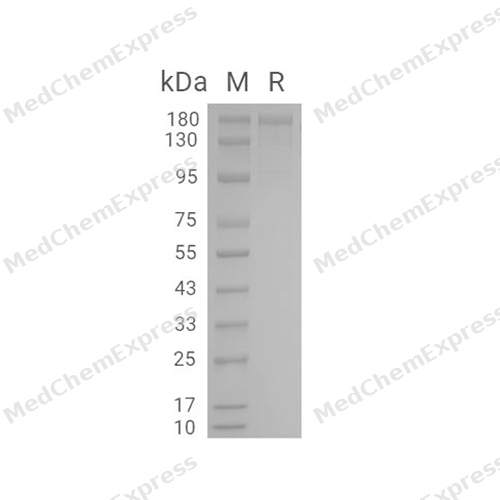
Purity - SDS-PAGE


Technical Parameters
-
Species Human
-
Source HEK293
-
Tag C-10*His
-
Accession
Q9BZZ2-1 (S20-Q1641)
-
Molecular Construction
-
N-term
-
CD169 (S20-Q1641)
Accession # Q9BZZ2-1 -
10*His
-
C-term
-
-
Protein Length
Extracellular Domain
-
Synonyms
SIGLEC1; DJ1009E24.1; Prev. SN; FLJ00055; Sialoadhesin; FLJ00073; SIGLEC-1; FLJ32150; CD169; Sialic Acid-Binding Immunoglobulin-Like Lectin 1; Sialic Acid Binding Ig-Like Lectin 1, Sialoadhesin; CD169 Antigen; Sialic Acid-Binding Ig-Like Lectin 1; Siglec-
-
AA Sequence
SWGVSSPQDVQGVKGSCLLIPCIFSFPADVEVPDGITAIWYYDYSGQRQVVSHSADPKLVEARFRGRTEFMGNPEHRVCNLLLKDLQPEDSGSYNFRFEISEVNRWSDVKGTLVTVTEEPRVPTIASPVELLEGTEVDFNCSTPYVCLQEQVRLQWQGQDPARSVTFNSQKFEPTGVGHLETLHMAMSWQDHGRILRCQLSVANHRAQSEIHLQVKYAPKGVKILLSPSGRNILPGELVTLTCQVNSSYPAVSSIKWLKDGVRLQTKTGVLHLPQAAWSDAGVYTCQAENGVGSLVSPPISLHIFMAEVQVSPAGPILENQTVTLVCNTPNEAPSDLRYSWYKNHVLLEDAHSHTLRLHLATRADTGFYFCEVQNVHGSERSGPVSVVVNHPPLTPVLTAFLETQAGLVGILHCSVVSEPLATLVLSHGGHILASTSGDSDHSPRFSGTSGPNSLRLEIRDLEETDSGEYKCSATNSLGNATSTLDFHANAARLLISPAAEVVEGQAVTLSCRSGLSPTPDARFSWYLNGALLHEGPGSSLLLPAASSTDAGSYHCRARDGHSASGPSSPAVLTVLYPPRQPTFTTRLDLDAAGAGAGRRGLLLCRVDSDPPARLQLLHKDRVVATSLPSGGGCSTCGGCSPRMKVTKAPNLLRVEIHNPLLEEEGLYLCEASNALGNASTSATFNGQATVLAIAPSHTLQEGTEANLTCNVSREAAGSPANFSWFRNGVLWAQGPLETVTLLPVARTDAALYACRILTEAGAQLSTPVLLSVLYPPDRPKLSALLDMGQGHMALFICTVDSRPLALLALFHGEHLLATSLGPQVPSHGRFQAKAEANSLKLEVRELGLGDSGSYRCEATNVLGSSNTSLFFQVRGAWVQVSPSPELQEGQAVVLSCQVHTGVPEGTSYRWYRDGQPLQESTSATLRFAAITLTQAGAYHCQAQAPGSATTSLAAPISLHVSYAPRHVTLTTLMDTGPGRLGLLLCRVDSDPPAQLRLLHGDRLVASTLQGVGGPEGSSPRLHVAVAPNTLRLEIHGAMLEDEGVYICEASNTLGQASASADFDAQAVNVQVWPGATVREGQLVNLTCLVWTTHPAQLTYTWYQDGQQRLDAHSIPLPNVTVRDATSYRCGVGPPGRAPRLSRPITLDVLYAPRNLRLTYLLESHGGQLALVLCTVDSRPPAQLALSHAGRLLASSTAASVPNTLRLELRGPQPRDEGFYSCSARSPLGQANTSLELRLEGVRVILAPEAAVPEGAPITVTCADPAAHAPTLYTWYHNGRWLQEGPAASLSFLVATRAHAGAYSCQAQDAQGTRSSRPAALQVLYAPQDAVLSSFRDSRARSMAVIQCTVDSEPPAELALSHDGKVLATSSGVHSLASGTGHVQVARNALRLQVQDVPAGDDTYVCTAQNLLGSISTIGRLQVEGARVVAEPGLDVPEGAALNLSCRLLGGPGPVGNSTFAWFWNDRRLHAEPVPTLAFTHVARAQAGMYHCLAELPTGAAASAPVMLRVLYPPKTPTMMVFVEPEGGLRGILDCRVDSEPLASLTLHLGSRLVASSQPQGAPAEPHIHVLASPNALRVDIEALRPSDQGEYICSASNVLGSASTSTYFGVRALHRLHQFQQ
-
Predicted Molecular Mass
174.6 kDa
-
Molecular Weight
Approximately 130-180 kDa, based on SDS-PAGE under reducing conditions, due to the glycosylation.
-
Glycosylation
Yes
-
Purity
≥ 95%, as determined by reducing SDS-PAGE.


Product Properties
Lyophilized powder
Lyophilized a 0.22 μm filtered solution of 20 mM MES,150 mM NaCl, pH 5.5, 10% trehalose.
<1 EU/μg, determined by LAL method.
It is not recommended to reconstitute to a concentration less than 100 μg/mL in ddH2O.
Stored at -20°C for 2 years from date of receipt. After reconstitution, it is stable at 4°C for 1 week or -20°C for longer (with carrier protein). It is recommended to freeze aliquots at -20°C or -80°C for extended storage.
Room temperature in continental US; may vary elsewhere.


Documentation
-
Data Sheet (246 KB)
-
SDS (251 KB)
- English - EN (251 KB)
- Français - FR (251 KB)
- Deutsch - DE (251 KB)
- Norwegian - NO (251 KB)
- Español - ES (251 KB)
- Swedish - SV (251 KB)
- Italian - IT (251 KB)
- Korean - KR (251 KB)
- Portuguese - PT (251 KB)
-
Handling Instructions (2659 KB)

Calculators
Concentration (start) × Volume (start) = Concentration (final) × Volume (final)


 Powered by Bioz

