



TFEB protein, Human (N-His)
Based on 1 publication(s) in Google Scholar
TFEB protein is a transcription factor that subtly regulates lysosomal function, autophagy, lipid catabolism, energy metabolism, and immune responses. It recognizes E-box and CLEAR-box sequences and controls gene expression based on nutrient availability. TFEB protein, Human (N-His) is the recombinant human-derived TFEB protein, expressed by E. coli , with N-10*His labeled tag.
- Species: Human
- Source: E. coli
-
Storage:Stored at -20°C for 2 years from date of receipt. After reconstitution, it is stable at 4°C for 1 week or -20°C for longer (with carrier protein). It is recommended to freeze aliquots at -20°C or -80°C for extended storage.


To place orders, for customer services and technical support, please contact: MedChemExpress USA
Tel: 609-228-6898 E-mail: [email protected] [email protected]


-
 Biological Activity
-
Technical Parameters
-
Product Properties
- Documentation
- Help & FAQs




Biological Activity
Description
TFEB protein is a transcription factor that subtly regulates lysosomal function, autophagy, lipid catabolism, energy metabolism, and immune responses. It recognizes E-box and CLEAR-box sequences and controls gene expression based on nutrient availability. TFEB protein, Human (N-His) is the recombinant human-derived TFEB protein, expressed by E. coli , with N-10*His labeled tag.
Background
TFEB protein operates as a key transcription factor orchestrating diverse cellular processes, including lysosomal biogenesis, autophagy, lysosomal exocytosis, lipid catabolism, energy metabolism, and immune response. Recognizing E-box sequences, TFEB's efficient DNA-binding necessitates dimerization with itself or other MiT/TFE family members like TFE3 or MITF. It responds to amino acid availability through MTOR-mediated phosphorylation, promoting cytosolic retention and inactivation. Conversely, MTOR inhibition during starvation or lysosomal stress induces TFEB dephosphorylation, leading to nuclear localization and transcriptional activation. TFEB specifically binds CLEAR-box sequences, activating the expression of lysosomal genes and regulating lysosomal positioning. Additionally, it positively regulates autophagy, contributes to T-cell-dependent antibody responses, and plays a role in vascularization of the placenta. In response to bacterial infection, TFEB mediates itaconate-induced alkylation, activating lysosomal biogenesis and aiding in bacterial clearance. Notably, the eltrombopag drug inhibits TFEB by binding to the bHLH domain and disrupting DNA-binding.
MCE Validation Data
-
Purity - SDS-PAGE
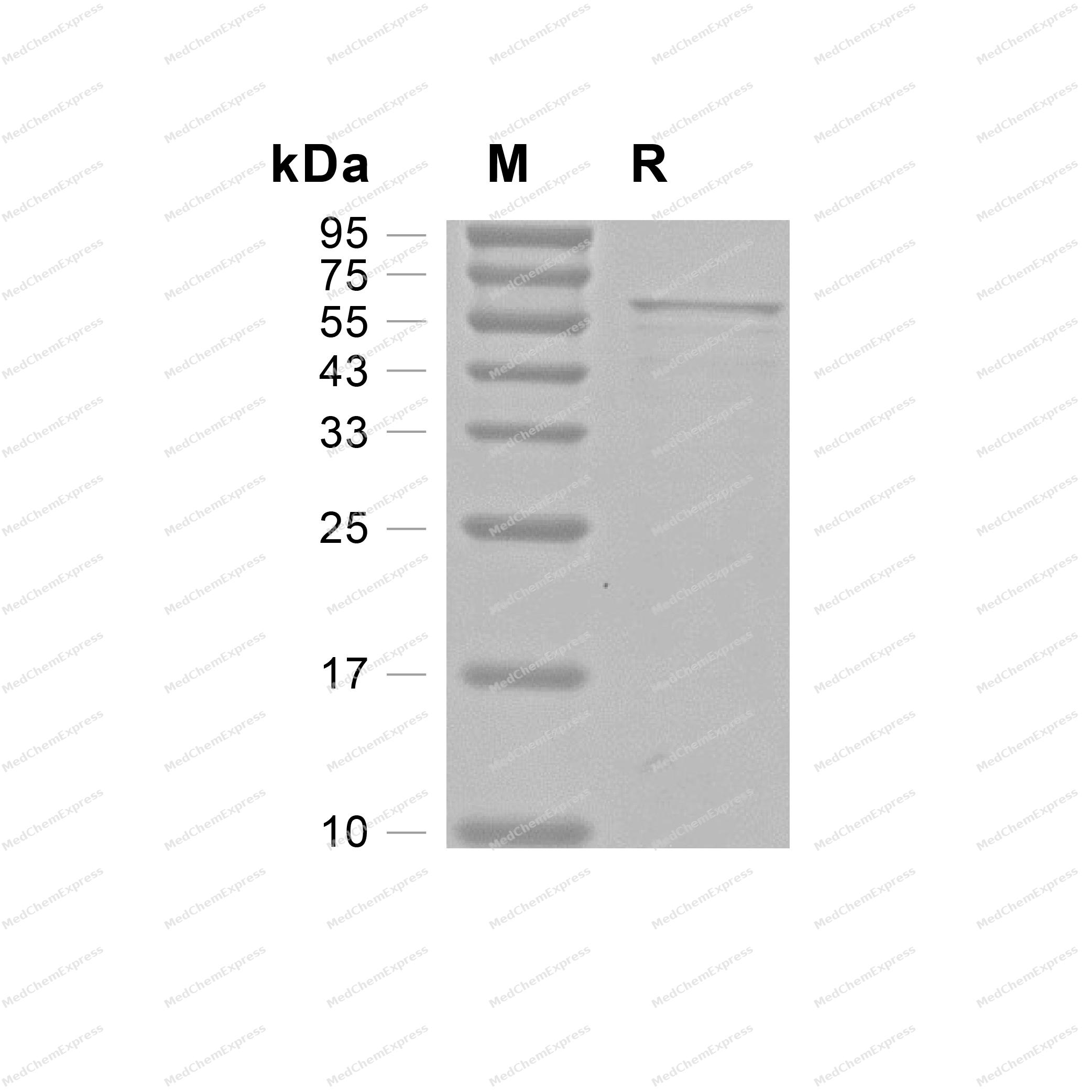
Purity - SDS-PAGE


Publications (1)
-
Journal Impact Factor
-
Most Recent
-
J Agric Food Chem
Gigantol Ameliorates Metabolic Dysfunction-Associated Steatohepatitis by Promoting TFEB-Mediated Lipophagy and Fatty Acid Oxidation. [Abstract]2026 Feb 11;74(5):4389-4406. PMID: 41612154


Technical Parameters
-
Species Human
-
Source E. coli
-
Tag N-10*His
-
Accession
P19484-1(M1-L476)
-
Gene ID7942
-
Molecular Construction
-
N-term
-
10*His
-
TFEB (M1-L476)
Accession # P19484-1 -
C-term
-
-
Protein Length
Full Length of Isoform-1
-
Synonyms
TFEB; Class E Basic Helix-Loop-Helix Protein 35; Transcription Factor EB; T-Cell Transcription Factor EB; BHLHe35; ALPHATFEB; TCFEB; BHLHE35
-
AA Sequence
MASRIGLRMQLMREQAQQEEQRERMQQQAVMHYMQQQQQQQQQQLGGPPTPAINTPVHFQSPPPVPGEVLKVQSYLENPTSYHLQQSQHQKVREYLSETYGNKFAAHISPAQGSPKPPPAASPGVRAGHVLSSSAGNSAPNSPMAMLHIGSNPERELDDVIDNIMRLDDVLGYINPEMQMPNTLPLSSSHLNVYSSDPQVTASLVGVTSSSCPADLTQKRELTDAESRALAKERQKKDNHNLIERRRRFNINDRIKELGMLIPKANDLDVRWNKGTILKASVDYIRRMQKDLQKSRELENHSRRLEMTNKQLWLRIQELEMQARVHGLPTTSPSGMNMAELAQQVVKQELPSEEGPGEALMLGAEVPDPEPLPALPPQAPLPLPTQPPSPFHHLDFSHSLSFGGREDEGPPGYPEPLAPGHGSPFPSLSKKDLDLMLLDDSLLPLASDPLLSTMSPEASKASSRRSSFSMEEGDVL
-
Predicted Molecular Mass
52.9 kDa
-
Molecular Weight
Approximately 57 kDa, based on SDS-PAGE under reducing conditions.
-
Purity
≥ 90%, as determined by reducing SDS-PAGE.


Product Properties
Lyophilized powder
1.Lyophilized from a 0.22 μm filtered solution of 20 mM PB, 150 mM NaCl, pH 8.0.
2.Lyophilized from a 0.22 μm filtered solution of PBS, 8% trehalose, pH 7.4.
Please refer to the lot-specific COA for specific buffer information.
<1 EU/μg, determined by LAL method.
It is not recommended to reconstitute to a concentration less than 100 μg/mL in ddH2O. For long term storage it is recommended to add a carrier protein (0.1% BSA, 5% HSA, 10% FBS or 5% Trehalose).
Stored at -20°C for 2 years from date of receipt. After reconstitution, it is stable at 4°C for 1 week or -20°C for longer (with carrier protein). It is recommended to freeze aliquots at -20°C or -80°C for extended storage.
Room temperature in continental US; may vary elsewhere.


Documentation
-
Data Sheet (238 KB)
-
SDS (251 KB)
- English - EN (251 KB)
- Français - FR (251 KB)
- Deutsch - DE (251 KB)
- Norwegian - NO (251 KB)
- Español - ES (251 KB)
- Swedish - SV (251 KB)
- Italian - IT (251 KB)
- Korean - KR (251 KB)
- Portuguese - PT (251 KB)
-
Handling Instructions (2659 KB)

Calculators
Concentration (start) × Volume (start) = Concentration (final) × Volume (final)


 Powered by Bioz

