



TIGIT Protein, Human (HEK293, His)
Based on 1 Customer Validation
The TIGIT protein plays a key role in immune regulation and binds with high affinity to the poliovirus receptor (PVR). This interaction induces an immunosuppressive environment by increasing IL10 secretion and decreasing IL12B secretion. TIGIT Protein, Human (HEK293, His) is the recombinant human-derived TIGIT protein, expressed by HEK293 , with C-6*His labeled tag.
- Species: Human
- Source: HEK293
-
Storage:Stored at -20°C for 2 years from date of receipt. After reconstitution, it is stable at 4°C for 1 week or -20°C for longer (with carrier protein). It is recommended to freeze aliquots at -20°C or -80°C for extended storage.


To place orders, for customer services and technical support, please contact: MedChemExpress USA
Tel: 609-228-6898 E-mail: [email protected] [email protected]


-
 Biological Activity
-
Technical Parameters
-
Product Properties
- Documentation
- Help & FAQs




Biological Activity
Description
The TIGIT protein plays a key role in immune regulation and binds with high affinity to the poliovirus receptor (PVR). This interaction induces an immunosuppressive environment by increasing IL10 secretion and decreasing IL12B secretion. TIGIT Protein, Human (HEK293, His) is the recombinant human-derived TIGIT protein, expressed by HEK293 , with C-6*His labeled tag.
Background
The TIGIT protein plays a pivotal role in immune regulation, exhibiting high-affinity binding to the poliovirus receptor (PVR). This interaction leads to increased secretion of IL10 and decreased secretion of IL12B, contributing to an immunosuppressive environment. TIGIT further exerts its immunomodulatory effect by suppressing T-cell activation and promoting the generation of mature immunoregulatory dendritic cells. Structurally, TIGIT forms a homodimer in cis, binding with high affinity to PVR, thereby creating a heterotetrameric assembly comprising two TIGIT and two PVR molecules. Additionally, TIGIT demonstrates lower-affinity binding to NECTIN2 and NECTIN3, underscoring its capacity for diverse molecular interactions. The multifaceted functions and binding affinities of TIGIT highlight its crucial role in immune regulation and its potential as a therapeutic target in modulating immune responses.
Verified Bioactivity
Loaded Belrestotug (HY-P990032) on AHC2 biosensor, can bind TIGIT Protein, Human (120a.a, HEK293, His) with an affinity constant of 6.401E-10 M as determined in BLI assay.
MCE Validation Data
-
Bioactivity - BLI
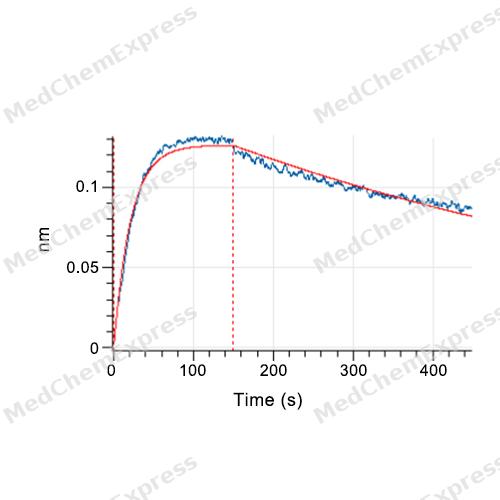
Bioactivity - BLI


Technical Parameters
-
Species Human
-
Source HEK293
-
Tag C-6*His
-
Accession
Q495A1-1 (M22-P141)
-
Molecular Construction
-
N-term
-
TIGIT (M22-P141)
Accession # Q495A1-1 -
6*His
-
C-term
-
-
Protein Length
Extracellular Domain
-
Synonyms
TIGIT; DKFZp667A205; Prev. VSIG9; FLJ39873; Prev. VSTM3; V-Set And Immunoglobulin Domain Containing 9; V-Set And Transmembrane Domain-Containing Protein 3; Washington University Cell Adhesion Molecule; T-Cell Immunoreceptor With Ig And ITIM Domains; V-Set
-
AA Sequence
MMTGTIETTGNISAEKGGSIILQCHLSSTTAQVTQVNWEQQDQLLAICNADLGWHISPSFKDRVAPGPGLGLTLQSLTVNDTGEYFCIYHTYPDGTYTGRIFLEVLESSVAEHGARFQIP
-
Predicted Molecular Mass
14.1 kDa
-
Molecular Weight
Approximately 13-19 kDa, based on SDS-PAGE under reducing conditions.
-
Glycosylation
Yes
-
Structure/Form
Monomer
-
Purity
≥ 95%, as determined by reducing SDS-PAGE.


Product Properties
Lyophilized powder.
Lyophilized from a 0.22 μm filtered solution of PBS, pH 7.4.
<1 EU/μg, determined by LAL method.
It is not recommended to reconstitute to a concentration less than 100 μg/mL in ddH2O. For long term storage it is recommended to add a carrier protein (0.1% BSA, 5% HSA, 10% FBS or 5% Trehalose).
Stored at -20°C for 2 years from date of receipt. After reconstitution, it is stable at 4°C for 1 week or -20°C for longer (with carrier protein). It is recommended to freeze aliquots at -20°C or -80°C for extended storage.
Room temperature in continental US;may vary elsewhere.


Documentation
-
Data Sheet (236 KB)
-
SDS (251 KB)
- English - EN (251 KB)
- Français - FR (251 KB)
- Deutsch - DE (251 KB)
- Norwegian - NO (251 KB)
- Español - ES (251 KB)
- Swedish - SV (251 KB)
- Italian - IT (251 KB)
- Korean - KR (251 KB)
- Portuguese - PT (251 KB)
-
Handling Instructions (2659 KB)

Calculators
Concentration (start) × Volume (start) = Concentration (final) × Volume (final)


 Powered by Bioz

