



TNF-alpha/TNFSF2 Protein, Human (177a.a, His)

Based on 1 Customer Validation
TNF-α/TNFSF2 protein is a macrophage-secreted cytokine that binds to TNFRSF1A/TNFR1 and TNFRSF1B/TNFBR, inducing tumor cell death and acting as a pyrogen. It is associated with cachexia and stimulates cell proliferation and differentiation. TNF-alpha/TNFSF2 Protein, Human (177a.a, His) is the recombinant human-derived TNF-alpha/TNFSF2 protein, expressed by E. coli , with N-6*His labeled tag.
- Species: Human
- Source: E. coli
-
Storage:Stored at -20°C for 2 years from date of receipt. After reconstitution, it is stable at 4°C for 1 week or -20°C for longer (with carrier protein). It is recommended to freeze aliquots at -20°C or -80°C for extended storage.


To place orders, for customer services and technical support, please contact: MedChemExpress USA
Tel: 609-228-6898 E-mail: [email protected] [email protected]


-
 Biological Activity
-
Technical Parameters
-
Product Properties
- Documentation
- Help & FAQs




Biological Activity
Description
TNF-α/TNFSF2 protein is a macrophage-secreted cytokine that binds to TNFRSF1A/TNFR1 and TNFRSF1B/TNFBR, inducing tumor cell death and acting as a pyrogen. It is associated with cachexia and stimulates cell proliferation and differentiation. TNF-alpha/TNFSF2 Protein, Human (177a.a, His) is the recombinant human-derived TNF-alpha/TNFSF2 protein, expressed by E. coli , with N-6*His labeled tag.
Background
The TNF-alpha/TNFSF2 Protein, a cytokine, binds to TNFRSF1A/TNFR1 and TNFRSF1B/TNFBR, primarily secreted by macrophages with the capability to induce cell death in specific tumor cell lines. Acting as a potent pyrogen, it causes fever through direct action or by stimulating interleukin-1 secretion and is implicated in the induction of cachexia. Furthermore, under specific conditions, TNF-alpha can stimulate cell proliferation and induce cell differentiation. Notably, in individuals with rheumatoid arthritis, it impairs regulatory T-cells (Treg) function via FOXP3 dephosphorylation, up-regulating the expression of protein phosphatase 1 (PP1) that dephosphorylates the key 'Ser-418' residue of FOXP3, rendering Treg cells functionally defective. Additionally, TNF-alpha is a key mediator of cell death in the anticancer action of BCG-stimulated neutrophils in combination with DIABLO/SMAC mimetic in the RT4v6 bladder cancer cell line. It induces insulin resistance in adipocytes by inhibiting insulin-induced IRS1 tyrosine phosphorylation and glucose uptake, leading to GKAP42 protein degradation and TNF-induced insulin resistance. Furthermore, it plays a role in angiogenesis by synergistically inducing VEGF production with IL1B and IL6, and it promotes osteoclastogenesis, contributing to bone resorption. Lastly, the TNF intracellular domain (ICD) form induces IL12 production in dendritic cells, highlighting its diverse impact across various physiological processes.
Verified Bioactivity
1. Measured in a cytotoxicity assay using L-929 mouse fibroblast cells in the presence of the metabolic inhibitor actinomycin D.
The ED50 for this effect is 30-150 pg/mL.
2. Loaded Adalimumab (HY-P9908) on AHC2 biosensor, can bind TNF-alpha/TNFSF2 Protein, Human (177a.a, His) with an affinity constant of 2.247E-10 M as determined in BLI assay.
MCE Validation Data
-
Bioactivity - BLI
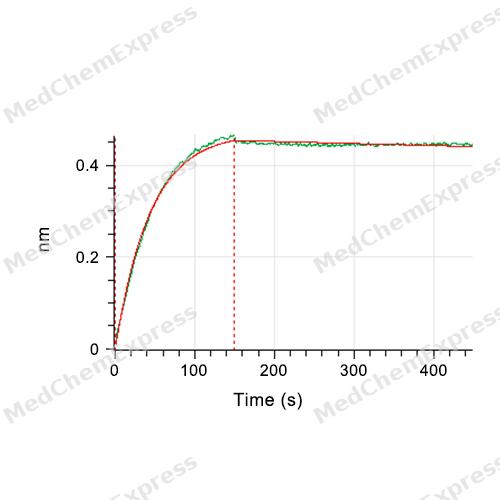
Bioactivity - BLI


Technical Parameters
-
Species Human
-
Source E. coli
-
Tag N-6*His
-
Accession
P01375 (G57-L233)
-
Molecular Construction
-
N-term
-
6*His
-
TGF-α (G57-L233)
Accession # P01375 -
C-term
-
-
Protein Length
Extracellular Domain
-
Synonyms
TNF; Tumor Necrosis Factor (TNF Superfamily, Member 2); Prev. TNFA; Tumor Necrosis Factor-Alpha; TNF-Alpha; Tumor Necrotic Factor Alpha; TNFSF2; TNF Superfamily, Member 2; Tumor Necrosis Factor Ligand Superfamily Member 2; TNF, Macrophage-Derived; TNF-A;
-
AA Sequence
GPQREEFPRDLSLISPLAQAVRSSSRTPSDKPVAHVVANPQAEGQLQWLNRRANALLANGVELRDNQLVVPSEGLYLIYSQVLFKGQGCPSTHVLLTHTISRIAVSYQTKVNLLSAIKSPCQRETPEGAEAKPWYEPIYLGGVFQLEKGDRLSAEINRPDYLDFAESGQVYFGIIAL
-
Predicted Molecular Mass
21.8 kDa
-
Molecular Weight
Approximately 18 kDa, based on SDS-PAGE under reducing conditions.
-
Purity
≥ 95%, as determined by reducing SDS-PAGE.


Product Properties
Lyophilized powder.
Lyophilized from a 0.22 μm filtered solution of 20 mM PBS, 100 mM NaCl, pH 8.0.
Less than 0.1 ng/µg (1 EU/µg) as determined by LAL test.
It is not recommended to reconstitute to a concentration less than 100 μg/mL in ddH2O. For long term storage it is recommended to add a carrier protein (0.1% BSA, 5% HSA, 10% FBS or 5% Trehalose).
Stored at -20°C for 2 years from date of receipt. After reconstitution, it is stable at 4°C for 1 week or -20°C for longer (with carrier protein). It is recommended to freeze aliquots at -20°C or -80°C for extended storage.
Room temperature in continental US;may vary elsewhere.


Documentation
-
Data Sheet (237 KB)
-
SDS (251 KB)
- English - EN (251 KB)
- Français - FR (251 KB)
- Deutsch - DE (251 KB)
- Norwegian - NO (251 KB)
- Español - ES (251 KB)
- Swedish - SV (251 KB)
- Italian - IT (251 KB)
- Korean - KR (251 KB)
- Portuguese - PT (251 KB)
-
Handling Instructions (2659 KB)

Calculators
Concentration (start) × Volume (start) = Concentration (final) × Volume (final)


 Powered by Bioz

