



TNF-alpha/TNFSF2 Protein, Human (HEK293, His-Avi)
Based on 1 Customer Validation
Tumour Necrosis Factor alpha (TNF alpha) is a potent pro-inflammatory cytokine. TNF alpha binds to its receptors, mainly TNFR1 and TNFR2, and then transmits molecular signals for biological functions such as inflammation and cell death. TNF alpha stimulates NF-κB pathway via TNFR2 promotes cancer growth, invasion, and metastasis. Anti-TNF-α MAb significantly suppresses the tumor development in colitis-associated cancer (CAC) mouse. TNF alpha as a proneurogenic factor activates the SAPK/JNK Pathway and can facilitate neuronal replacement and brain repair in response to brain injury. TNF-alpha/TNFSF2 Protein, Human (HEK293, His-Avi) is a recombinant protein with a C-Terminal Avi and a His label, It consists of 157 amino acids (V77-L233) and is produced in HEK293 cells.
- Species: Human
- Source: HEK293
-
Storage:Stored at -20°C for 2 years from date of receipt. After reconstitution, it is stable at 4°C for 1 week or -20°C for longer (with carrier protein). It is recommended to freeze aliquots at -20°C or -80°C for extended storage.


To place orders, for customer services and technical support, please contact: MedChemExpress USA
Tel: 609-228-6898 E-mail: [email protected] [email protected]


-
 Biological Activity
-
Technical Parameters
-
Product Properties
- Documentation
- References
- Help & FAQs




Biological Activity
Description
Tumour Necrosis Factor alpha (TNF alpha) is a potent pro-inflammatory cytokine[1]. TNF alpha binds to its receptors, mainly TNFR1 and TNFR2, and then transmits molecular signals for biological functions such as inflammation and cell death[2]. TNF alpha stimulates NF-κB pathway via TNFR2 promotes cancer growth, invasion, and metastasis. Anti-TNF-α MAb significantly suppresses the tumor development in colitis-associated cancer (CAC) mouse[3]. TNF alpha as a proneurogenic factor activates the SAPK/JNK Pathway and can facilitate neuronal replacement and brain repair in response to brain injury[4]. TNF-alpha/TNFSF2 Protein, Human (HEK293, His-Avi) is a recombinant protein with a C-Terminal Avi and a His label, It consists of 157 amino acids (V77-L233) and is produced in HEK293 cells.
Background
TNF alpha is produced by various types of cells including macrophages, monocytes, neutrophils, T cells, and NK-cells[2].
The amino acid sequence of human TNF alpha protein has low homology between mouse, rat, bovine, cynomolgus TNF alpha protein. While, human TNF alpha shares 94.85% aa sequence identity with cynomolgus TNF alpha protein, mouse TNF alpha shares 94.47% aa sequence identity with rat TNF alpha protein.
TNF alpha exists in two forms; a type II transmembrane protein (tmTNF-α) and a mature soluble protein (sTNF-α). TNF-α binds to its receptors, mainly TNFR1 and TNFR2, and then transmits molecular signals for biological functions such as inflammation and cell death. Both sTNF-α and tmTNF-α activate TNFR1, and process a death domain (DD) that interacts with the TNFR1-associated death domain (TRADD) adaptor protein. The TNFR2 signaling pathway is mainly activated by tmTNF-α. TNFR1 signaling tends to be pro-inflammatory and apoptotic. TNFR2 results in NF-κB and MAPKs and AKT activation, TNFR2 activation is associated with homeostatic bioactivities such as tissue regeneration, cell proliferation, and cell survival, as well as host defense and inflammation[1].
TNF-alpha is critical for normal immune response, abnormal secretion TNF alpha activates synovial fibroblasts, keratinocytes, osteoclasts, induces rheumatoid arthritis, inflammatory bowel disease, psoriatic arthritis (PsA), and noninfectious uveitis (NIU)[3]. TNF alpha positively regulates endogenous TNF-α expression levels independently of Pgp efflux activity, induces IHF cells proliferation[4]. TNF alpha in tissues may promote cancer growth, invasion, and metastasis. Besides, TNF alpha stimulates NF-κB pathway via TNFR2 and anti-TNF-α MAb significantly suppresses the tumor development in colitis-associated cancer (CAC) mouse[5]. TNF alpha as a proneurogenic factor activates the SAPK/JNK pathway and can facilitate neuronal replacement and brain repair in response to brain injury[6].
In Vitro
TNF alpha (human) (0, 10, 15, 20, 30, 50 ng/mL; 24, 48 h) reduces KB-C1 cells viability at 30 ng/mL after 48 h, reduces pro-caspase-3, cleaved caspase-3 expression in KB-C1 and KB-3-1 cells[4].
TNF alpha (human) (10, 15 ng/mL; 24 h) significantly increases the mRNA levels of Pgp (ABCB1) in KB-3-1 cells, and promotes expressive reduction on total Pgp protein levels and a slightly decreases in cell surface-Pgp in KB-C1 cells, and stimulates IHF cells proliferation, probably via ERK activation[4].
In Vivo
TNF alpha (human) (100 µg; osmium pump in back; daily for 7 days) significantly increases in the number of inflammatory cells and the degree of synovial inflammation is significantly exacerbated in twenty-four SCID-HuRAg mice[7].
Verified Bioactivity
Immobilized Human TNF alpha, His Tag at 5 μg/mL (100 μl/Well) on the plate. Dose response curve for Human TNFR2, hFc Tag with the EC50 of ≤88 ng/mL determined by ELISA.
MCE Validation Data
-
Purity - SDS-PAGE
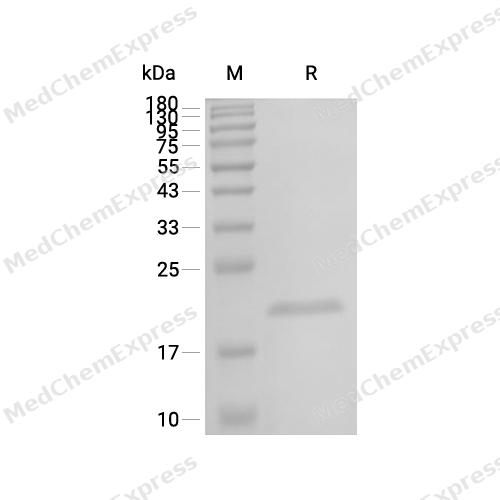
Purity - SDS-PAGE
-
Bioactivity - ELISA
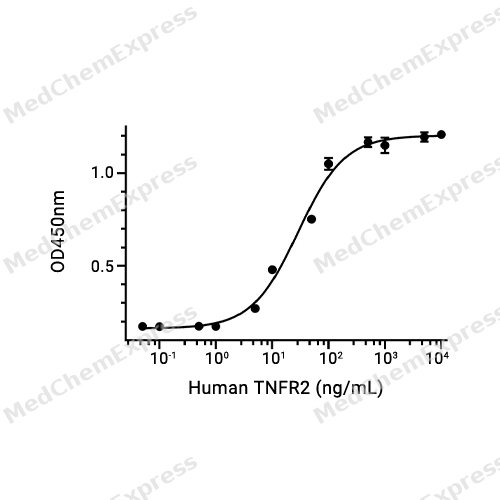
Bioactivity - ELISA


Technical Parameters
-
Species Human
-
Source HEK293
-
Tag C-Avi;C-8*His
-
Accession
P01375 (V77-L233)
-
Molecular Construction
-
N-term
-
TGF-α (V77-L233)
Accession # P01375 -
8*His-Avi
-
C-term
-
-
Protein Length
Full Length of TNF, soluble form
-
Synonyms
TNF; Tumor Necrosis Factor (TNF Superfamily, Member 2); Prev. TNFA; Tumor Necrosis Factor-Alpha; TNF-Alpha; Tumor Necrotic Factor Alpha; TNFSF2; TNF Superfamily, Member 2; Tumor Necrosis Factor Ligand Superfamily Member 2; TNF, Macrophage-Derived; TNF-A;
-
AA Sequence
VRSSSRTPSDKPVAHVVANPQAEGQLQWLNRRANALLANGVELRDNQLVVPSEGLYLIYSQVLFKGQGCPSTHVLLTHTISRIAVSYQTKVNLLSAIKSPCQRETPEGAEAKPWYEPIYLGGVFQLEKGDRLSAEINRPDYLDFAESGQVYFGIIAL
-
Predicted Molecular Mass
20.3 kDa
-
Molecular Weight
Approximately 20-25 kDa, based on SDS-PAGE under reducing conditions, due to the glycosylation.
-
Glycosylation
Yes
-
Purity
≥ 95%, as determined by Bis-Tris PAGE.


Product Properties
Lyophilized powder
Lyophilized from a 0.22 μm filtered solution of PBS, pH 7.4.
<1 EU/μg, determined by LAL method.
It is not recommended to reconstitute to a concentration less than 100 μg/mL in ddH2O. For long term storage it is recommended to add a carrier protein (0.1% BSA, 5% HSA, 10% FBS or 5% Trehalose).
Stored at -20°C for 2 years from date of receipt. After reconstitution, it is stable at 4°C for 1 week or -20°C for longer (with carrier protein). It is recommended to freeze aliquots at -20°C or -80°C for extended storage.
Room temperature in continental US; may vary elsewhere.


Documentation
-
Data Sheet (265 KB)
-
SDS (252 KB)
- English - EN (252 KB)
- Français - FR (252 KB)
- Deutsch - DE (252 KB)
- Norwegian - NO (252 KB)
- Español - ES (252 KB)
- Swedish - SV (252 KB)
- Italian - IT (252 KB)
- Korean - KR (252 KB)
- Portuguese - PT (252 KB)
-
Handling Instructions (2659 KB)


References
[1]. Horiuchi T, et al. Transmembrane TNF-alpha: structure, function and interaction with anti-TNF agents. Rheumatology (Oxford). 2010 Jul;49(7):1215-28. [Content Brief]
[2]. El-Tahan RR, et al. TNF-α gene polymorphisms and expression. Springerplus. 2016 Sep 7;5(1):1508. [Content Brief]
[3]. Jang DI, et al. The Role of Tumor Necrosis Factor Alpha (TNF-α) in Autoimmune Disease and Current TNF-α Inhibitors in Therapeutics. Int J Mol Sci. 2021 Mar 8;22(5):2719. [Content Brief]
[4]. Berguetti T, et al. TNF-α Modulates P-Glycoprotein Expression and Contributes to Cellular Proliferation via Extracellular Vesicles. Cells. 2019 May 24;8(5):500. [Content Brief]
[5]. Onizawa M, et al. Signaling pathway via TNF-alpha/NF-kappaB in intestinal epithelial cells may be directly involved in colitis-associated carcinogenesis. Am J Physiol Gastrointest Liver Physiol. 2009 Apr;296(4):G850-9. [Content Brief]
[6]. Bernardino L, et al. Tumor necrosis factor-alpha modulates survival, proliferation, and neuronal differentiation in neonatal subventricular zone cell cultures. Stem Cells. 2008 Sep;26(9):2361-71. [Content Brief]
[7]. Matsuno H, et al. The role of TNF-alpha in the pathogenesis of inflammation and joint destruction in rheumatoid arthritis (RA): a study using a human RA/SCID mouse chimera. Rheumatology (Oxford). 2002 Mar;41(3):329-37. [Content Brief]

Calculators
Concentration (start) × Volume (start) = Concentration (final) × Volume (final)


 Powered by Bioz

