



UBE2G1 Protein, Human

Based on 1 Customer Validation
The UBE2G1 protein is an important participant in the ubiquitin-proteasome system, acting as an E2 ubiquitin-conjugating enzyme to promote the attachment of ubiquitin to different protein substrates. In vitro, UBE2G1 exhibits catalytic ability in “Lys-48” and “Lys-63” linked polyubiquitination reactions. UBE2G1 Protein, Human is the recombinant human-derived UBE2G1 protein, expressed by E. coli , with tag free.
- Species: Human
- Source: E. coli
-
Storage:Stored at -20°C for 2 years from date of receipt. After reconstitution, it is stable at 4°C for 1 week or -20°C for longer (with carrier protein). It is recommended to freeze aliquots at -20°C or -80°C for extended storage.


To place orders, for customer services and technical support, please contact: MedChemExpress USA
Tel: 609-228-6898 E-mail: [email protected] [email protected]


-
 Biological Activity
-
Technical Parameters
-
Product Properties
- Documentation
- Help & FAQs




Biological Activity
Description
The UBE2G1 protein is an important participant in the ubiquitin-proteasome system, acting as an E2 ubiquitin-conjugating enzyme to promote the attachment of ubiquitin to different protein substrates. In vitro, UBE2G1 exhibits catalytic ability in “Lys-48” and “Lys-63” linked polyubiquitination reactions. UBE2G1 Protein, Human is the recombinant human-derived UBE2G1 protein, expressed by E. coli , with tag free.
Background
UBE2G1, an essential player in the ubiquitin-proteasome system, serves as an E2 ubiquitin-conjugating enzyme, facilitating the covalent attachment of ubiquitin to diverse protein substrates. In vitro, UBE2G1 showcases its catalytic competence by catalyzing both 'Lys-48'- and 'Lys-63'-linked polyubiquitination reactions. This multifaceted enzyme is implicated in potential roles, including the degradation of muscle-specific proteins, highlighting its involvement in cellular processes related to protein turnover. Additionally, UBE2G1 demonstrates its functional relevance by mediating the polyubiquitination of CYP3A4, a cytochrome P450 enzyme involved in the metabolism of various substrates, underscoring its significance in regulating specific cellular pathways.
Verified Bioactivity
Under ATP and E1 conditions, E2 covalently binds with ubiquitin molecules to form thioester complexes E2~Ub.
MCE Validation Data
-
Purity - SDS-PAGE
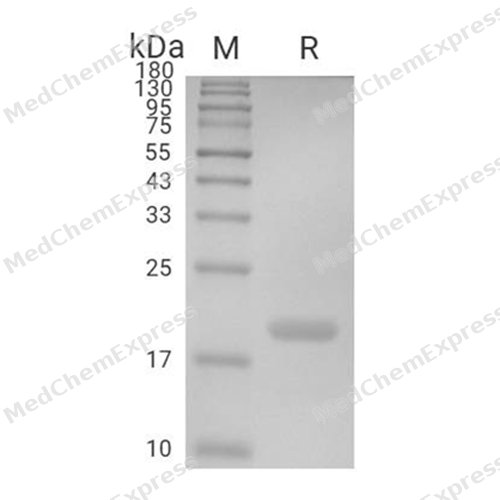
Purity - SDS-PAGE
-
Characterization - Western Blot
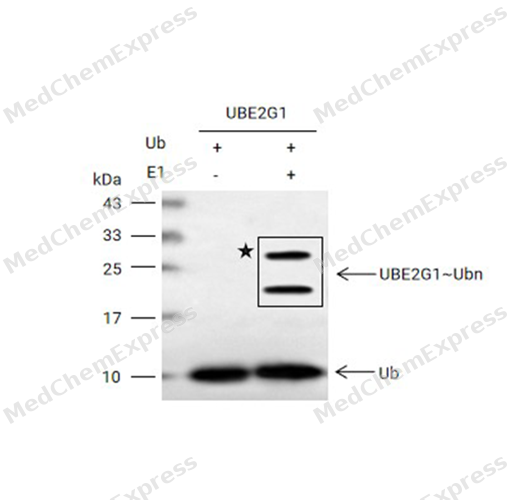
Characterization - Western Blot


Technical Parameters
-
Species Human
-
Source E. coli
-
Tag Tag Free
-
Accession
P62253 (M1-E170)
-
Molecular Construction
-
N-term
-
UBE2G1 (M1-E170)
Accession # P62253 -
C-term
-
-
Protein Length
Full Length
-
Synonyms
UBE2G1; Ubiquitin Conjugating Enzyme E2 G1; UBE2G; UBC7; Ubiquitin-Conjugating Enzyme E2G 1 (Homologous To C. Elegans UBC7); Ubiquitin-Conjugating Enzyme E2G 1 (UBC7 Homolog, C. Elegans); Ubiquitin-Conjugating Enzyme E2G 1 (UBC7 Homolog,Yeast); Ubiquitin-
-
AA Sequence
MTELQSALLLRRQLAELNKNPVEGFSAGLIDDNDLYRWEVLIIGPPDTLYEGGVFKAHLTFPKDYPLRPPKMKFITEIWHPNVDKNGDVCISILHEPGEDKYGYEKPEERWLPIHTVETIMISVISMLADPNGDSPANVDAAKEWREDRNGEFKRKVARCVRKSQETAFE
-
Predicted Molecular Mass
19.5 kDa
-
Molecular Weight
Approximately 20 kDa, based on SDS-PAGE under reducing conditions.
-
Purity
≥ 95%, as determined by reducing SDS-PAGE.


Product Properties
Lyophilized powder
1.Lyophilized from a 0.22 μm filtered solution of PBS, pH 7.4, 10% glycerol.
2.Lyophilized from a 0.22 μm filtered solution of PBS, pH 7.4, 8% glycerol.
Please refer to the lot-specific COA for specific buffer information.
<1 EU/μg, determined by LAL method.
It is not recommended to reconstitute to a concentration less than 100 μg/mL in ddH2O. For long term storage it is recommended to add a carrier protein (0.1% BSA, 5% HSA, 10% FBS or 5% Trehalose).
Stored at -20°C for 2 years from date of receipt. After reconstitution, it is stable at 4°C for 1 week or -20°C for longer (with carrier protein). It is recommended to freeze aliquots at -20°C or -80°C for extended storage.
Room temperature in continental US; may vary elsewhere.


Documentation
-
Data Sheet (236 KB)
-
SDS (254 KB)
- English - EN (254 KB)
- Français - FR (254 KB)
- Deutsch - DE (254 KB)
- Norwegian - NO (254 KB)
- Español - ES (254 KB)
- Swedish - SV (254 KB)
- Italian - IT (254 KB)
- Korean - KR (254 KB)
- Portuguese - PT (254 KB)
-
Handling Instructions (2659 KB)

Calculators
Concentration (start) × Volume (start) = Concentration (final) × Volume (final)


 Powered by Bioz

