



VEGF-D Protein, Mouse (HEK293, His)

Based on 1 Customer Validation
VEGF-D Protein, a versatile growth factor, orchestrates angiogenesis, lymphangiogenesis, and endothelial cell growth. It stimulates proliferation, migration, and influences vessel permeability. VEGF-D binds VEGFR-3, triggering crucial signaling for vascular development. Structurally, VEGF-D is a non-covalent homodimer, emphasizing its intricate role in vascular processes. VEGF-D Protein, Mouse (HEK293, His) is the recombinant mouse-derived VEGF-D protein, expressed by HEK293 , with C-6*His labeled tag.
- Species: Mouse
- Source: HEK293
-
Storage:Stored at -20°C for 2 years from date of receipt. After reconstitution, it is stable at 4°C for 1 week or -20°C for longer (with carrier protein). It is recommended to freeze aliquots at -20°C or -80°C for extended storage.


To place orders, for customer services and technical support, please contact: MedChemExpress USA
Tel: 609-228-6898 E-mail: [email protected] [email protected]


-
 Biological Activity
-
Technical Parameters
-
Product Properties
- Documentation
- Help & FAQs




Biological Activity
Description
VEGF-D Protein, a versatile growth factor, orchestrates angiogenesis, lymphangiogenesis, and endothelial cell growth. It stimulates proliferation, migration, and influences vessel permeability. VEGF-D binds VEGFR-3, triggering crucial signaling for vascular development. Structurally, VEGF-D is a non-covalent homodimer, emphasizing its intricate role in vascular processes. VEGF-D Protein, Mouse (HEK293, His) is the recombinant mouse-derived VEGF-D protein, expressed by HEK293 , with C-6*His labeled tag.
Background
VEGF-DD, a versatile growth factor, plays a pivotal role in angiogenesis, lymphangiogenesis, and endothelial cell growth by orchestrating processes such as proliferation, migration, and influencing blood vessel permeability. Its involvement spans critical phases, contributing to the formation of both venous and lymphatic vascular systems during embryogenesis, and maintaining the integrity of differentiated lymphatic endothelium in adults. Functionally, VEGF-DD binds to and activates the VEGFR-3 (Flt4) receptor, initiating essential signaling cascades for vascular development and homeostasis. Structurally, VEGF-DD exists as a homodimer, characterized by a non-covalent and antiparallel configuration, underscoring its intricate role in coordinating complex vascular phenomena.
Verified Bioactivity
Measured by its ability to inhibit the proliferation of HUVEC cells. The EC50 for this effect is 0.31 μg/mL, corresponding to a specific activity is 3.313×10⁴U/mg.
MCE Validation Data
-
Bioactivity - Cell-Based Assay
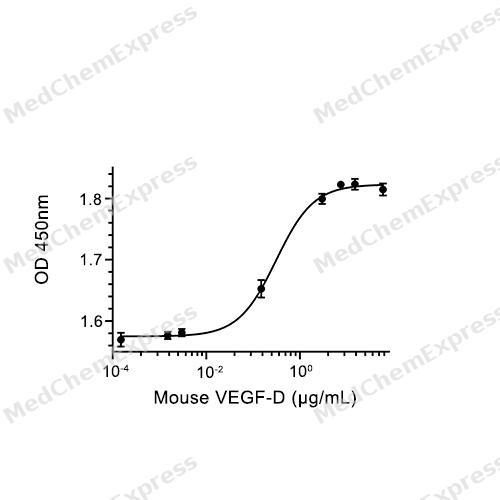
Bioactivity - Cell-Based Assay


Technical Parameters
-
Species Mouse
-
Source HEK293
-
Tag C-6*His
-
Accession
P97946 (F98-S206)
-
Molecular Construction
-
N-term
-
VEGF-DD (F98-S206)
Accession # P97946 -
6*His
-
C-term
-
-
Protein Length
Partial
-
Synonyms
VEGFD; Vascular Endothelial Growth Factor D; FIGF; VEGF-D; C-Fos Induced Growth Factor (Vascular Endothelial Growth Factor D); C-Fos-Induced Growth Factor
-
AA Sequence
FYDTETLKVIDEEWQRTQCSPRETCVEVASELGKTTNTFFKPPCVNVFRCGGCCNEEGVMCMNTSTSYISKQLFEISVPLTSVPELVPVKIANHTGCKCLPTGPRHPYS
-
Predicted Molecular Mass
13.1 kDa
-
Molecular Weight
Approximately 17-21 kDa, based on SDS-PAGE under reducing conditions.
-
Glycosylation
Yes
-
Purity
≥ 95%, as determined by reducing SDS-PAGE.


Product Properties
Lyophilized powder.
Lyophilized from a 0.22 μm filtered solution of 20 mM PB, 150 mM NaCl, pH 7.4.
<1 EU/μg, determined by LAL method.
It is not recommended to reconstitute to a concentration less than 100 μg/mL in ddH2O. For long term storage it is recommended to add a carrier protein (0.1% BSA, 5% HSA, 10% FBS or 5% Trehalose).
Stored at -20°C for 2 years from date of receipt. After reconstitution, it is stable at 4°C for 1 week or -20°C for longer (with carrier protein). It is recommended to freeze aliquots at -20°C or -80°C for extended storage.
Room temperature in continental US; may vary elsewhere.


Documentation
-
Data Sheet (236 KB)
-
SDS (252 KB)
- English - EN (252 KB)
- Français - FR (252 KB)
- Deutsch - DE (252 KB)
- Norwegian - NO (252 KB)
- Español - ES (252 KB)
- Swedish - SV (252 KB)
- Italian - IT (252 KB)
- Korean - KR (252 KB)
- Portuguese - PT (252 KB)
-
Handling Instructions (2659 KB)

Calculators
Concentration (start) × Volume (start) = Concentration (final) × Volume (final)


 Powered by Bioz

