



Wilms tumor protein/WT1 Protein, Human (His-SUMO)

Based on 1 Customer Validation
Wilms tumor protein (WT1) is a key transcription factor that critically regulates cell development and survival by binding to 5'-GCG(T/G)GGGCG-3'. It oversees target genes such as erythropoietin (EPO) and is critical for the development of the genitourinary system. Wilms tumor protein/WT1 Protein, Human (His-SUMO) is the recombinant human-derived Wilms tumor protein/WT1 protein, expressed by E. coli , with N-SUMO, N-6*His labeled tag.
- Species: Human
- Source: E. coli
-
Storage:Stored at -20°C for 2 years from date of receipt. After reconstitution, it is stable at 4°C for 1 week or -20°C for longer (with carrier protein). It is recommended to freeze aliquots at -20°C or -80°C for extended storage.


To place orders, for customer services and technical support, please contact: MedChemExpress USA
Tel: 609-228-6898 E-mail: [email protected] [email protected]


-
 Biological Activity
-
Technical Parameters
-
Product Properties
- Documentation
- Help & FAQs




Biological Activity
Description
Wilms tumor protein (WT1) is a key transcription factor that critically regulates cell development and survival by binding to 5'-GCG(T/G)GGGCG-3'. It oversees target genes such as erythropoietin (EPO) and is critical for the development of the genitourinary system. Wilms tumor protein/WT1 Protein, Human (His-SUMO) is the recombinant human-derived Wilms tumor protein/WT1 protein, expressed by E. coli , with N-SUMO, N-6*His labeled tag.
Background
Wilms tumor protein (WT1), a pivotal transcription factor, plays a crucial role in cellular development and survival by recognizing and binding to the DNA sequence 5'-GCG(T/G)GGGCG-3'. It regulates the expression of various target genes, including erythropoietin (EPO), and is indispensable for the development of the urogenital system. WT1 exhibits a dual role in tumorigenesis, acting as both a tumor suppressor and an oncogene. Its function may be isoform-specific, with isoforms lacking the KTS motif acting as transcription factors, while those containing the KTS motif potentially binding mRNA and participating in mRNA metabolism or splicing. Notably, isoform 1 has a lower affinity for DNA and can bind RNA. WT1 forms homodimers and interacts with WTIP, actively translating polysomes, nuclear ribonucleoprotein (mRNP) particles, HNRNPU, U2AF2, CITED2, ZNF224, WTAP, SRY, AMER1, RBM4, among others, highlighting its diverse interactions and regulatory roles in cellular processes.
MCE Validation Data
-
Purity - SDS-PAGE
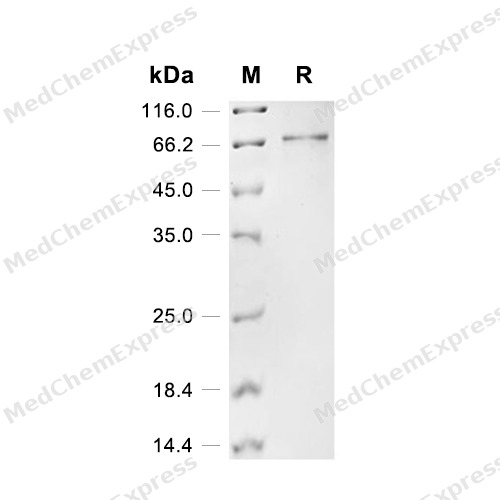
Purity - SDS-PAGE


Technical Parameters
-
Species Human
-
Source E. coli
-
Tag N-SUMO;N-6*His
-
Accession
P19544 (M1-L449)
-
Molecular Construction
-
N-term
-
6*His-SUMO
-
WT1 (M1-L449)
Accession # P19544 -
C-term
-
-
Protein Length
Full Length
-
Synonyms
WT1; WT1 Transcription Factor; GUD; Wilms Tumor 1; WIT-2; NPHS4; WAGR; AWT1; WT-1; Wilms Tumor Protein; WT33; Truncated Wilm'S Tumor Supressor Protein; Wilms Tumor Protein Isoform Ex4a(+); Wilms Tumor 1, Isoform CRA_f; Wilms Tumor Protein Homolog; Wilms'
-
AA Sequence
MGSDVRDLNALLPAVPSLGGGGGCALPVSGAAQWAPVLDFAPPGASAYGSLGGPAPPPAPPPPPPPPPHSFIKQEPSWGGAEPHEEQCLSAFTVHFSGQFTGTAGACRYGPFGPPPPSQASSGQARMFPNAPYLPSCLESQPAIRNQGYSTVTFDGTPSYGHTPSHHAAQFPNHSFKHEDPMGQQGSLGEQQYSVPPPVYGCHTPTDSCTGSQALLLRTPYSSDNLYQMTSQLECMTWNQMNLGATLKGVAAGSSSSVKWTEGQSNHSTGYESDNHTTPILCGAQYRIHTHGVFRGIQDVRRVPGVAPTLVRSASETSEKRPFMCAYPGCNKRYFKLSHLQMHSRKHTGEKPYQCDFKDCERRFSRSDQLKRHQRRHTGVKPFQCKTCQRKFSRSDHLKTHTRTHTGKTSEKPFSCRWPSCQKKFARSDELVRHHNMHQRNMTKLQLAL
-
Predicted Molecular Mass
65.2 kDa
-
Molecular Weight
Approximately 66 kDa, based on SDS-PAGE under reducing conditions.
-
Purity
≥ 90%, as determined by reducing SDS-PAGE.


Product Properties
Lyophilized powder.
Lyophilized from a 0.22 μm filtered solution of PBS, 6% trehalose, pH 7.4.
<1 EU/μg, determined by LAL method.
It is not recommended to reconstitute to a concentration less than 100 μg/mL in ddH2O.
Stored at -20°C for 2 years from date of receipt. After reconstitution, it is stable at 4°C for 1 week or -20°C for longer (with carrier protein). It is recommended to freeze aliquots at -20°C or -80°C for extended storage.
Room temperature in continental US; may vary elsewhere.


Documentation
-
Data Sheet (238 KB)
-
SDS (251 KB)
- English - EN (251 KB)
- Français - FR (251 KB)
- Deutsch - DE (251 KB)
- Norwegian - NO (251 KB)
- Español - ES (251 KB)
- Swedish - SV (251 KB)
- Italian - IT (251 KB)
- Korean - KR (251 KB)
- Portuguese - PT (251 KB)
-
Handling Instructions (2659 KB)

Calculators
Concentration (start) × Volume (start) = Concentration (final) × Volume (final)


 Powered by Bioz

