
362 Results for "

function-1

" in MedChemExpress (MCE) Product Catalog:
Products (362)

362 Results for "function-1" in MCE Product Catalog:

Cat. No.: HY-P99666

Target:  

IFNAR

Research Areas:  

Infection Cancer

Interferon alfa-2b is a type I interferon that activates novel genes and exerts potent antiviral and antiproliferative activity on target cells. Signaling by Interferon alfa-2b requires receptor-dependent activation of Stat1 and Stat2 to form a heterodimeric STAT that binds to the DNA-binding protein IRF-9 (p48) and forms ISGF-3 (IFN-stimulated gene factor 3). The driver genes are then further activated by ISGF-3 to achieve antiviral function .
loading...
    loading...
Cat. No.: HY-124350
CAS No.: 134-05-4
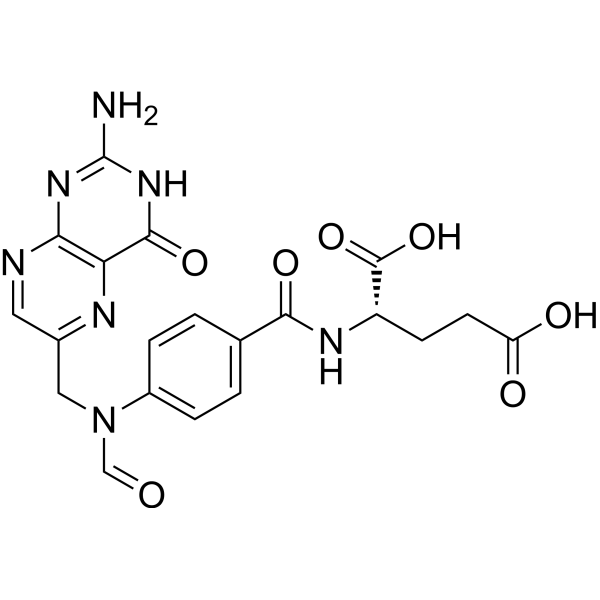
10-Formylfolic acid is a potent inhibitor of dihydrofolate reductase, with an IC50 of 80 nM against the rat enzyme. 10-Formylfolic acid also acts as an orally active folate source and a growth factor for specific bacteria. 10-Formylfolic acid supports growth and increases plasma folate levels; its absorption and metabolism patterns are similar to those of folic acid, but its liver retention is slightly higher. It exhibits high folate activity in microbial assays, serves as a growth factor for Enterococcus faecalis and Lactobacillus casei, aids folate nutrient supply, and may exert cell regulatory functions .
loading...
    loading...
Cat. No.: HY-12501
CAS No.: 1160521-50-5
Purity:  ≥98.0%
Research Areas:  

Neurological Disease

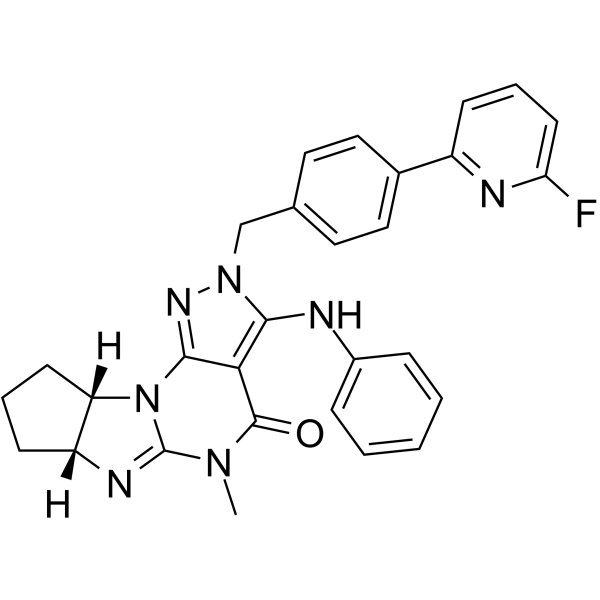
ITI-214 free base is a potent, CNS-active, orally bioavailable PDE1 inhibitor (Ki of 58 pM) with excellent selectivity against other PDE family members and against a panel of enzymes, receptors, transporters and ion channels. ITI-214 free base inhibits recombinant full-length human PDE1A, PDE1B and PDE1C with Kis of 33 pM, 380 pM and 35 pM, respectively. ITI-214 free base shows efficacy in various animal models of motor and cognitive functions .
loading...
    loading...
Cat. No.: HY-139792
CAS No.: 1177460-72-8
Synonyms: SHR117887
Target:  

Endogenous Metabolite

Research Areas:  

Metabolic Disease

Besigliptin tosylate (SHR117887) is a DPP-4 inhibitor with activity to improve metabolic control and β-cell function. Besigliptin tosylate can effectively reduce serum DPP-4 activity and improve oral glucose tolerance. Besigliptin tosylate significantly reduces fasting blood glucose levels and improves lipid profiles in a diabetic mouse model. The effect of besigliptin tosylate is comparable to that of the known compound vildagliptin (HY-14291) at the same concentration. Besigliptin tosylate increases insulin staining of pancreatic islet cells in chronic administration, indicating improved β-cell function .
loading...
    loading...
Cat. No.: HY-15116
CAS No.: 117427-00-6
Research Areas:  

Neurological Disease

ONO 1603, a novel prolyl endopeptidase inhibitor investigated as a potential antidementia drug, demonstrated neuroprotective and neurotrophic effects in cerebellar granule cells similar to tetrahydroaminoacridine (THA). At a concentration of 0.03 microM, ONO 1603 promoted neuronal survival, enhanced neurite outgrowth, increased m3-muscarinic acetylcholine receptor (mAChR) mRNA levels, and stimulated mAChR-mediated signaling pathways. These findings suggest that ONO 1603 shares pharmacological similarities with THA, indicating its potential as a therapeutic agent for Alzheimer's disease by enhancing cholinergic neurotransmission and neuronal function .
loading...
    loading...
Cat. No.: HY-153665
CAS No.: 2761446-55-1
Purity:  99.45%
Research Areas:  

Cancer

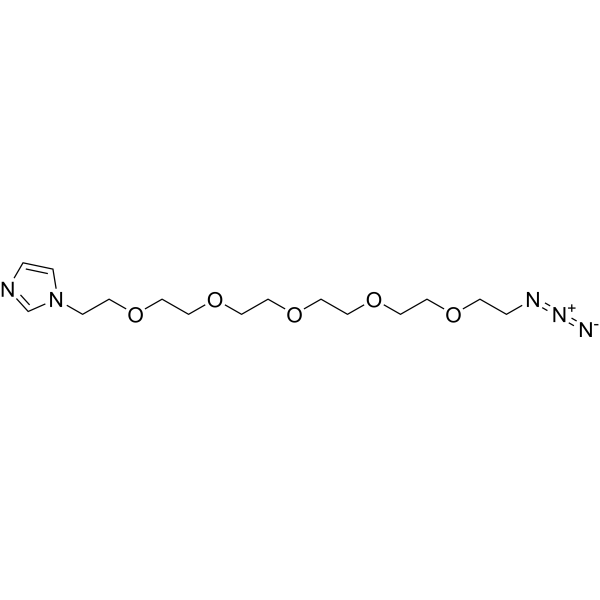
Deg-1 is a bifunctional probe with a cleavage group and a covalent binding group. Deg-1 binds covalently to target nucleic acids and acts as a click degrader to cleave nucleic acid molecules, exhibiting the potential to selectively cleave target nucleic acids intracellularly. Deg-1 contains an azide group that can undergo copper-catalyzed azide-alkyne cycloaddition (CuAAc) with alkynyl groups, as well as strain-promoted alkyne-azide cycloaddition (SPAAC) with DBCO or BCN. Deg-1 can be used in studies related to acute myeloid leukemia and RNA function .
loading...
    loading...
Cat. No.: HY-167227S
CAS No.: 1449371-87-2
Target:  

Monoamine Transporter

Research Areas:  

Neurological Disease

TAS-303 is an orally effective selective norepinephrine transporter (NET) inhibitor. TAS-303 inhibits human NET ligand binding with a Ki of 50.9 nM, and suppresses NET-mediated norepinephrine uptake with an IC50 of 38.9 nM. TAS-303 enhances norepinephrine-induced contraction in isolated rat urethral tissues, elevates plasma norepinephrine levels in rats, and increases urethral baseline pressure and leak point pressure. TAS-303 is applicable for research related to stress urinary incontinence, norepinephrine reuptake, and lower urinary tract function .

loading...
    loading...
Cat. No.: HY-34154R
CAS No.: 619-60-3
Target:  

Reference Standards

Research Areas:  

Others

4-(Dimethylamino)phenol (Standard) is the analytical standard of 4-(Dimethylamino)phenol. This product is intended for research and analytical applications. 4-(Dimethylamino)phenol is a potent cyanide antidote. 4-(Dimethylamino)phenol increases the extracellular lactate dehydrogenase (LDH) without markedly affecting gluconeogenesis. 4-(Dimethylamino)phenol cannot decreases the ATP content until the membrane becomes permeable to LDH. 4-(Dimethylamino)phenol’s toxicity is related to its reaction with glutathione and formation of covalent complexes, leading to impaired cellular function .
loading...
    loading...
Cat. No.: HY-E70703
Target:  

EGFR

Research Areas:  

Cancer

EGFR is a driver of tumorigenesis. EGFR is mainly found in an auto-inhibited, dimerization-incompetent, state at the plasma membrane (PM). Ligand binding promotes receptor dimerization, which determines a series of structural rearrangements that are conveyed to the cytoplasmic domain allowing the formation of asymmetric dimers between the two juxtaposed catalytic domains. EGFR has multiple mutants. EGFR d752-759 Recombinant Human Active Protein Kinase is a recombinant EGFR d752-759 protein that can be used to study EGFR d752-759-related functions .
loading...
    loading...
Cat. No.: HY-E70714
Research Areas:  

Cancer

EML4-ALK is a fusion-type protein tyrosine kinase produced through gene rearrangement. EML4-ALK can be used for the study of non-small cell lung carcinoma (NSCLC) and neuroblastoma (NB). EML4-ALK has multiple mutants. EML4 ALK F1174L Recombinant Human Active Protein Kinase is a recombinant EML4 ALK F1174L protein that can be used to study EML4 ALK F1174L-related functions .
loading...
    loading...
Cat. No.: HY-E70718
Target:  

FGFR

Research Areas:  

Cancer

FGFR3 activating mutations are drivers of malignancy in several human tissues, including bladder, lung, cervix, and blood. FGFR3 G697C is a mutant of FGFR3 that may be present in oral squamous cell carcinoma. FGFR3 G697C increases FGFR3 auto-phosphorylation. FGFR3 G697C Recombinant Human Active Protein Kinase is a recombinant FGFR3 G697C protein that can be used to study FGFR3 G697C-related functions .
loading...
    loading...
Cat. No.: HY-E70724
Target:  

FLT3

Research Areas:  

Cancer

FLT3 (FMS-like tyrosine kinase 3, CD135) is a type 3 receptor tyrosine kinase that plays important roles in cell survival, proliferation, and differentiation during normal hematopoiesis. FLT3 is one of the most frequently mutated genes in acute myeloid leukemia (AML). FLT3 ITD is a internal tandem duplication (ITD) mutation of FLT3 that may be present in AML cells. FLT3 ITD Recombinant Human Active Protein Kinase is a recombinant FLT3 ITD protein that can be used to study FLT3 ITD-related functions .
loading...
    loading...
Cat. No.: HY-E70734
Target:  

c-Kit

Research Areas:  

Cancer

KIT (CD117) is an important cell surface marker used to identify certain types of hematopoietic(blood) progenitors in the bone marrow. KIT is a cytokine receptor expressed on the surface of hematopoietic stem cells as well as other cell types. Altered forms of this receptor may be associated with some types of cancer. KIT A829P is a mutant of KIT. KIT A829P Recombinant Human Active Protein Kinase is a recombinant KIT A829P protein that can be used to study KIT A829P-related functions .
loading...
    loading...
Cat. No.: HY-E70735
Target:  

c-Kit

Research Areas:  

Cancer

KIT (CD117) is an important cell surface marker used to identify certain types of hematopoietic(blood) progenitors in the bone marrow. KIT is a cytokine receptor expressed on the surface of hematopoietic stem cells as well as other cell types. Altered forms of this receptor may be associated with some types of cancer. KIT D816H is a mutant of KIT. KIT D816H Recombinant Human Active Protein Kinase is a recombinant KIT D816H protein that can be used to study KIT D816H-related functions .
loading...
    loading...
Cat. No.: HY-E70736
Target:  

c-Kit

Research Areas:  

Cancer

KIT (CD117) is an important cell surface marker used to identify certain types of hematopoietic(blood) progenitors in the bone marrow. KIT is a cytokine receptor expressed on the surface of hematopoietic stem cells as well as other cell types. Altered forms of this receptor may be associated with some types of cancer. KIT D816V is a mutant of KIT. KIT D816V Recombinant Human Active Protein Kinase is a recombinant KIT D816V protein that can be used to study KIT D816V-related functions .
loading...
    loading...
Cat. No.: HY-E70737
Target:  

c-Kit

Research Areas:  

Cancer

KIT (CD117) is an important cell surface marker used to identify certain types of hematopoietic(blood) progenitors in the bone marrow. KIT is a cytokine receptor expressed on the surface of hematopoietic stem cells as well as other cell types. Altered forms of this receptor may be associated with some types of cancer. KIT T670I is a mutant of KIT. KIT T670I Recombinant Human Active Protein Kinase is a recombinant KIT T670I protein that can be used to study KIT T670I-related functions .
loading...
    loading...
Cat. No.: HY-E70738
Target:  

c-Kit

Research Areas:  

Cancer

KIT (CD117) is an important cell surface marker used to identify certain types of hematopoietic(blood) progenitors in the bone marrow. KIT is a cytokine receptor expressed on the surface of hematopoietic stem cells as well as other cell types. Altered forms of this receptor may be associated with some types of cancer. KIT V559D is a mutant of KIT. KIT V559D Recombinant Human Active Protein Kinase is a recombinant KIT V559D protein that can be used to study KIT V559D-related functions .
loading...
    loading...
Cat. No.: HY-E70741
Target:  

c-Kit

Research Areas:  

Cancer

KIT (CD117) is an important cell surface marker used to identify certain types of hematopoietic(blood) progenitors in the bone marrow. KIT is a cytokine receptor expressed on the surface of hematopoietic stem cells as well as other cell types. Altered forms of this receptor may be associated with some types of cancer. KIT V560G is a mutant of KIT. KIT V560G Recombinant Human Active Protein Kinase is a recombinant KIT V560G protein that can be used to study KIT V560G-related functions .
loading...
    loading...
Cat. No.: HY-E70843
Target:  

MEK

Research Areas:  

Cancer

MAP2K1 encodes mitogen-activated protein kinase 1 (MEK1), which is a key component in the RAS-mitogen-activated protein kinase kinase (RAS/MAPK) signal transduction pathway. MAP2K1 P124L mutation is a mild mutation. MAP2K1 P124L Recombinant Human Active Protein Kinase is a recombinant MAP2K1 P124L protein that can be used to study MAP2K1 P124L-related functions .
loading...
    loading...
Cat. No.: HY-E70872
Target:  

JAK

Research Areas:  

Cancer

TYK2 is a member of the JAK family of non-receptor tyrosine kinases that act together with signal transducer and activator of transcription (STAT) factors in mediating intracellular signal transduction. JAKs are characterized by dual kinase domain: a tyrosine kinase domain (JH1) that is preceded by a pseudokinase domain (JH2). TYK2(JH1) Recombinant Human Active Protein Kinase is a recombinant TYK2(JH1) protein that can be used to study TYK2(JH1)-related functions .
loading...
    loading...

