311 Results for "

Insecticidal activity

" in MedChemExpress (MCE) Product Catalog:
Products (311)

311 Results for "Insecticidal activity" in MCE Product Catalog:

Cat. No.: HY-W075176R
CAS No.: 118712-89-3
Research Areas:  

Others

Transfluthrin (Standard) is the analytical standard of Transfluthrin (HY-W075176). This product is intended for research and analytical applications. Transfluthrin is an insecticide with extremely low acute toxicity to vertebrates. Transfluthrin acts as a mosquito repellent, exerts mosquito control effects via electric heating fumigators, and is widely used in studies related to malaria, bancroftian filariasis and mosquito-borne infectious diseases. Transfluthrin may also induce adverse reactions such as pulmonary sensory irritation, sensitization, genotoxicity and respiratory depression, and can increase the concentrations and activities of CYP2E1 and CYP3A2 in rat brains. Transfluthrin can be removed from wastewater through biodegradation and activated sludge adsorption, and can be degraded by microorganisms such as Azovibrio and Tauera .
loading...
    loading...
Cat. No.: HY-W106720
CAS No.: 33189-72-9
Target:  

Insecticide

Research Areas:  

Infection

(E)-11-Tetradecenyl acetate is a monounsaturated 14-carbon acetate insecticide and a component of the sex pheromone of the currant shoot borer. (E)-11-Tetradecenyl acetate triggers strong antennal responses in males and is used in combination with (Z)-11-tetradecenyl acetate to produce an attracting effect. (E)-11-Tetradecenyl acetate has important application value in the sustainable control of pests, and can be used to monitor population dynamics and implement mating disruption. (E)-11-Tetradecenyl acetate is highly species-specific, triggering only extremely weak responses and showing no attracting activity towards Melanotus communis beetles. (E)-11-Tetradecenyl acetate can be used in studies related to the currant shoot borer and targeted pest control .
loading...
    loading...
Cat. No.: HY-W750153
CAS No.: 2140327-65-5
Propoxur-d7 is the deuterium labeled Propoxur. Propoxur is a reversible, competitive, orally active AChE inhibitor that can cross the blood-brain barrier. Propoxur inhibits AChE activity to induce neurotoxicity, while promoting MMP-2 expression and enhancing tumor cell migration and invasion by inducing intracellular ROS generation and activating the ERK/Nrf2 signaling pathway. On the one hand, Propoxur inhibits AChE, leading to acetylcholine accumulation and causing neurological dysfunction; on the other hand, it promotes Nrf2 nuclear translocation through ROS-dependent ERK1/2 phosphorylation, and upregulates MMP-2 and other invasion-related proteins. Propoxur is also a carbamate insecticide used to combat turf, forestry, and household pests .
loading...
    loading...
Cat. No.: HY-B0874R
CAS No.: 67375-30-8
Synonyms: FMC 45497 (Standard); Fendona (Standard); WL 85871 (Standard)
Alpha-Cypermethrin (Standard) (FMC 45497 (Standard); Fendona (Standard); WL 85871 (Standard)) is the analytical standard of Alpha-Cypermethrin (HY-B0874). This product is intended for research and analytical applications. Alpha-Cypermethrin (FMC 45497; Fendona; WL 85871) is a type II pyrethroid insecticide. Alpha-Cypermethrin acts by delaying the inactivation of voltage-gated sodium channels, prolonging sodium tail currents, and triggering repetitive neural discharges. Alpha-Cypermethrin exhibits knockdown and lethal activity against target insects such as Musca domestica and Anopheles culicifacies. Alpha-Cypermethrin induces neurotoxicity in mammals, alters placental and fetal neurodevelopment, and causes acute mortality in fish. Alpha-Cypermethrin can be used in studies related to neurotoxicity, vector-borne diseases, and malaria .
loading...
    loading...
Cat. No.: HY-B0916R
CAS No.: 114-26-1
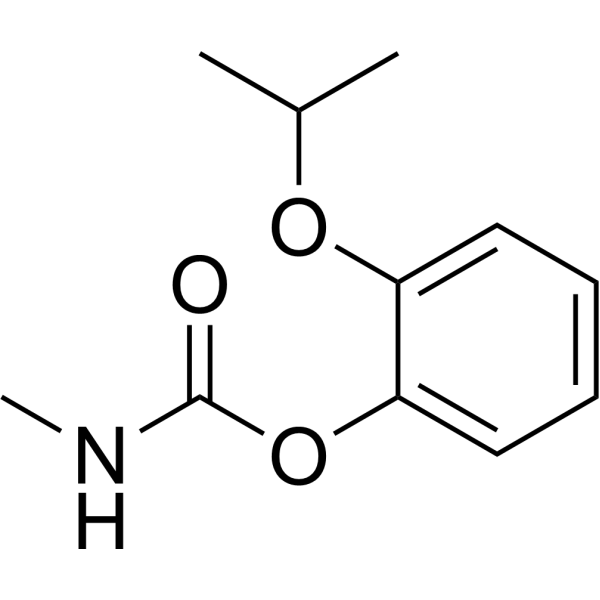
Propoxue (Standard) is the analytical standard of Propoxue (HY-B0916). This product is intended for research and analytical applications. Propoxur is a reversible, competitive, orally active AChE inhibitor that can cross the blood-brain barrier. Propoxur inhibits AChE activity to induce neurotoxicity, while promoting MMP-2 expression and enhancing tumor cell migration and invasion by inducing intracellular ROS generation and activating the ERK/Nrf2 signaling pathway. On the one hand, Propoxur inhibits AChE, leading to acetylcholine accumulation and causing neurological dysfunction; on the other hand, it promotes Nrf2 nuclear translocation through ROS-dependent ERK1/2 phosphorylation, and upregulates MMP-2 and other invasion-related proteins. Propoxur is also a carbamate insecticide used to combat turf, forestry, and household pests .
loading...
    loading...
Cat. No.: HY-B0916S
CAS No.: 1219798-56-7
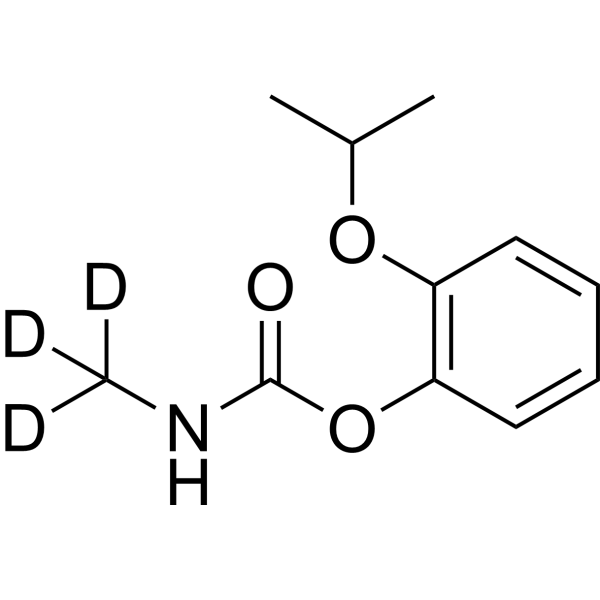
Propoxur-d3 is the deuterated form of Propoxur (HY-B0916). Propoxur is a reversible, competitive, orally active AChE inhibitor that can cross the blood-brain barrier. Propoxur inhibits AChE activity to induce neurotoxicity, while promoting MMP-2 expression and enhancing tumor cell migration and invasion by inducing intracellular ROS generation and activating the ERK/Nrf2 signaling pathway. On the one hand, Propoxur inhibits AChE, leading to acetylcholine accumulation and causing neurological dysfunction; on the other hand, it promotes Nrf2 nuclear translocation through ROS-dependent ERK1/2 phosphorylation, and upregulates MMP-2 and other invasion-related proteins. Propoxur is also a carbamate insecticide used to combat turf, forestry, and household pests .
loading...
    loading...
Cat. No.: HY-Y0496S
CAS No.: 3855-82-1
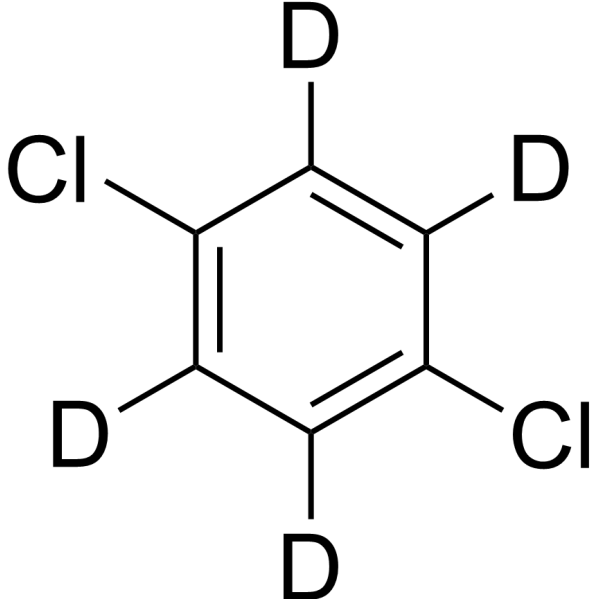
1,4-Dichlorobenzene-d4 is the deuterium labeled 1,4-Dichlorobenzene. 1,4-Dichlorobenzene is a non-genotoxic, orally active mitogenic/tumor-promoting carcinogen that is also widely used as a dye, resin intermediate, and deodorant, moth repellent/insecticide. 1,4-Dichlorobenzene induces liver tumors in mice and promotes the growth of spontaneous precancerous lesions, but shows no liver tumor-inducing activity in F344 rats. 1,4-Dichlorobenzene increases the levels of white blood cell count, serum alanine aminotransferase and blood urea nitrogen in occupationally exposed populations. 1,4-Dichlorobenzene is metabolized to 2,5-dichlorophenol and excreted in urine, and this metabolite can serve as a biomarker for 1,4-Dichlorobenzene exposure. Due to its specific hepatotoxic characteristics, 1,4-Dichlorobenzene is applicable to liver cancer-related research .
loading...
    loading...
Cat. No.: HY-138074
CAS No.: 93074-04-5
Synonyms: 5-Ketomilbemycin A4 oxime; 5-Oxomilbemycin A4 5-oxime
Target:  

Parasite

Research Areas:  

Infection

Milbemycin A4 oxime (5-Ketomilbemycin A4 oxime; 5-Oxomilbemycin A4 5-oxime) is a derivative of Milbemycin A4 (HY-126906) and a component of Milbemycin oxime (HY-B0778), both of which have insecticidal and nematicidal activities. Milbemycin A4 oxime (0.05 mg/kg) reduces the number of microfilariae in naturally infected dogs with D. immitis and inhibits the growth of clinical isolates of Candida glabrata (MIC80=16-32 μg/mL). Milbemycin A4 oxime (2.5 μg/mL) blocks the efflux of Fluconazole (HY-B0101) from clinical isolates of Candida glabrata. Milbemycin A4 oxime enhances doxorubicin-induced cell growth inhibition and increases the intracellular accumulation of doxorubicin and P-glycoprotein substrate Rhodamine 123 (HY-D0816) in doxorubicin-resistant but not sensitive MCF-7 breast cancer cells in a concentration-dependent manner.
loading...
    loading...
Cat. No.: HY-Y0496R
CAS No.: 106-46-7
Research Areas:  

Others

1,4-Dichlorobenzene (Standard) is the analytical standard of 1,4-Dichlorobenzene. This product is intended for research and analytical applications. 1,4-Dichlorobenzene is a non-genotoxic, orally active mitogenic/tumor-promoting carcinogen that is also widely used as a dye, resin intermediate, and deodorant, moth repellent/insecticide. 1,4-Dichlorobenzene induces liver tumors in mice and promotes the growth of spontaneous precancerous lesions, but shows no liver tumor-inducing activity in F344 rats. 1,4-Dichlorobenzene increases the levels of white blood cell count, serum alanine aminotransferase and blood urea nitrogen in occupationally exposed populations. 1,4-Dichlorobenzene is metabolized to 2,5-dichlorophenol and excreted in urine, and this metabolite can serve as a biomarker for 1,4-Dichlorobenzene exposure. Due to its specific hepatotoxic characteristics, 1,4-Dichlorobenzene is applicable to liver cancer-related research .
loading...
    loading...
Cat. No.: HY-Y0148
CAS No.: 1679-53-4
Synonyms: NSC 15139; 10-HDAA
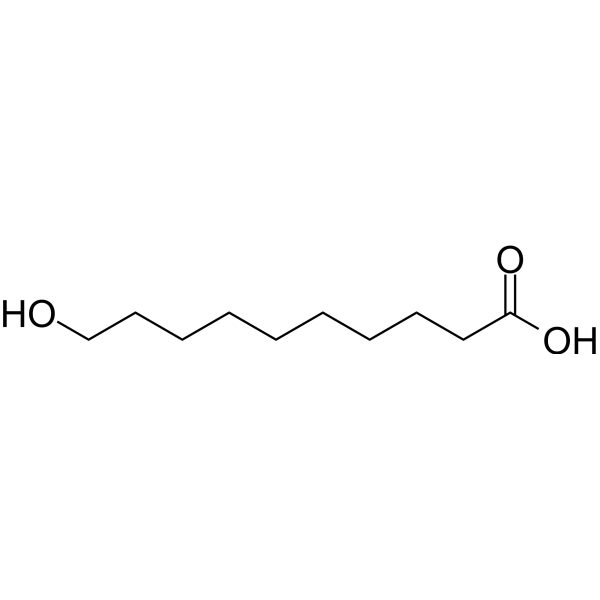
10-Hydroxydecanoic acid (10-HDAA) is a saturated fatty acid derived from 10-hydroxy-trans-2-decenoic acid, which can be isolated from royal jelly. 10-Hydroxydecanoic acid exhibits various biological activities, including anti-inflammatory, insecticidal, anti-malarial, and anti-Leishmania properties, as well as enhancing antigen-specific immune responses. The anti-inflammatory effects of 10-Hydroxydecanoic acid are primarily mediated by inhibiting the activation of NF-κB and the translation of interferon regulatory factor 1 (IRF-1), which reduces the production of interleukin 6 (IL-6) and nitric oxide (NO) in inflammatory cells. Additionally, 10-Hydroxydecanoic acid alleviates neuroinflammatory responses through the p53-autophagy pathway and the p53-NLRP3 pathway. Finally, 10-Hydroxydecanoic acid enhances antigen-specific immune responses by promoting the effective uptake of antigens by microfold cells .
loading...
    loading...
Cat. No.: HY-Y0148R
CAS No.: 1679-53-4
Synonyms: NSC 15139 (Standard); 10-HDAA (Standard)
10-Hydroxydecanoic acid (Standard) is the analytical standard of 10-Hydroxydecanoic acid. This product is intended for research and analytical applications. 10-Hydroxydecanoic acid (10-HDAA) is a saturated fatty acid derived from 10-hydroxy-trans-2-decenoic acid, which can be isolated from royal jelly. 10-Hydroxydecanoic acid exhibits various biological activities, including anti-inflammatory, insecticidal, anti-malarial, and anti-Leishmania properties, as well as enhancing antigen-specific immune responses. The anti-inflammatory effects of 10-Hydroxydecanoic acid are primarily mediated by inhibiting the activation of NF-κB and the translation of interferon regulatory factor 1 (IRF-1), which reduces the production of interleukin 6 (IL-6) and nitric oxide (NO) in inflammatory cells. Additionally, 10-Hydroxydecanoic acid alleviates neuroinflammatory responses through the p53-autophagy pathway and the p53-NLRP3 pathway. Finally, 10-Hydroxydecanoic acid enhances antigen-specific immune responses by promoting the effective uptake of antigens by microfold cells[1][2][3][4][5].
loading...
    loading...

