37 Results for "

splicing modulators

" in MedChemExpress (MCE) Product Catalog:
Products (37)

37 Results for "splicing modulators" in MCE Product Catalog:

Cat. No.: HY-174215
CAS No.: 3063511-09-8
Target:  

Tau Protein

Research Areas:  

Neurological Disease

TAU-IN-3 (Compound 2) is an orally active TAU inhibitor. TAU-IN-3 inhibits the expression of MAPT exon 10 DDPAC mutant gene in HeLa cells (IC50: 0.6 µM). TAU-IN-3 reduces the 4R/3R MAPT mRNA ratio in HeLa cells transfected with WT or DDPAC minigenes. TAU-IN-3 inhibits the insertion of endogenous MAPT exon 10 and the production of 4R tau protein in cells. TAU-IN-3 modulates tau splicing in htau mice and improves the associated behavioral phenotypes. TAU-IN-3 can be used to study neurodegenerative diseases .
loading...
    loading...
Ultevursen sodium
0 Images
RNA, (P-thio)[2′-O-(2-methoxyethyl)](A-G-m5C-m5U-m5U-m5C-G-G-A-G-A-A-A-m5U-m5U-m5U-A-A-A-m5U-m5C), sodium salt
Cat. No.: HY-147412A
Synonyms: QR-421a sodium
Ultevursen sodium (QR-421a) is a splice-modulating antisense oligonucleotide targeting exon 13 of the USH2A gene, which restores the functional expression of Usherin protein by inducing exon skipping. Ultevursen sodium binds to USH2A pre-mRNA and modulates the splicing process to specifically skip exon 13 carrying the pathogenic mutation c.2299delG, generating an in-frame transcript and a truncated yet functionally normal protein. Ultevursen sodium exhibits concentration-dependent exon skipping activity in human cells and retinal organoid models, and restores Usherin expression and retinal function in zebrafish and gene-edited mouse models. Ultevursen sodium can be used for related research on type 2 Usher syndrome and non-syndromic retinitis pigmentosa .
loading...
    loading...
Cat. No.: HY-144399A
CAS No.: 2762547-06-6
Research Areas:  

Neurological Disease

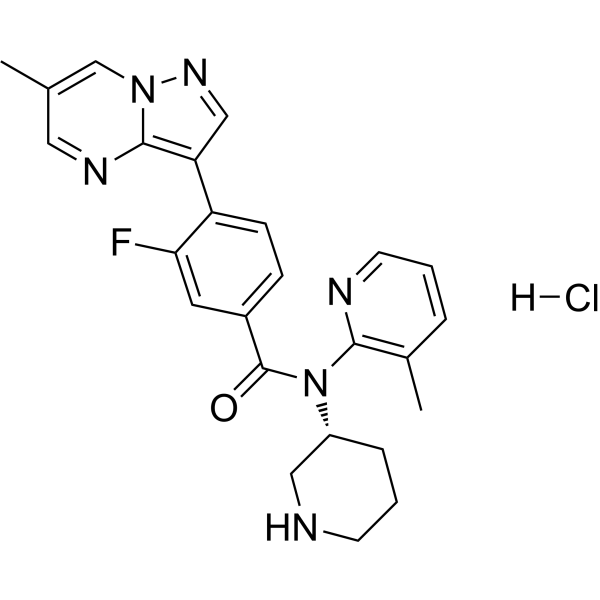
CD33 splicing modulator 1 (Compound 1) hydrochloride is a CD33 splicing modulator. CD33/Siglec 3 is a myeloid cell surface receptor known to regulate microglial activity. CD33 splicing modulator 1 hydrochloride increases exon 2 skipping in the cellular mRNA pool and can be used to study neurodegenerative diseases including Alzheimer's disease .
loading...
    loading...
Cat. No.: HY-114461
CAS No.: 147025-57-8
Research Areas:  

Cancer

FD-895 is a spliceosome modulator derived from a polyketide natural product, targeting the SF3b subunit of the spliceosome. FD-895 possesses core biological activities for regulating RNA splicing (intron retention, alternative splicing) and inducing apoptosis of cancer cells. FD-895 can be used for the research of cancer, such as chronic lymphocytic leukemia (CLL) .
loading...
    loading...
Cat. No.: HY-180907
Target:  

PROTACs Deubiquitinase

Research Areas:  

Cancer

PROTAC USP39 Degrader-1 is a USP39 PROTAC degrader with Kd values of 136 nM and 232 nM, and a DC50 value of 1.06 nM (24 h). PROTAC USP39 Degrader-1 binds to the VHL E3 ubiquitin ligase, forms a ternary complex with USP39, mediates USP39 ubiquitination and proteasomal degradation dependent on VHL recruitment, modulates splicing activity and induces 5' splice site-specific splicing patterns. PROTAC USP39 Degrader-1 can be used in the research of cervical cancer .
loading...
    loading...
Cat. No.: HY-125201
CAS No.: 2252153-37-8
Target:  

CDK

Research Areas:  

Inflammation/Immunology

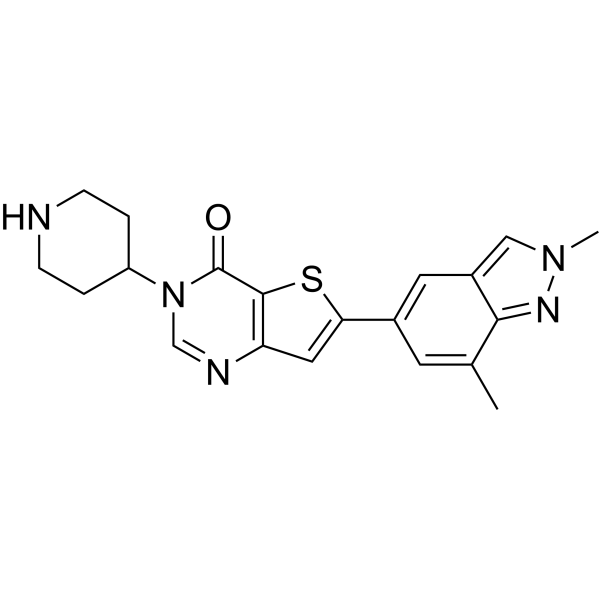
Indazole 1 is a potent CDC2-like kinase 2 (CLK2) inhibitor (IC50=12.3 nM). Indazole 1 inhibits the phosphorylation of SR proteins (e.g., SRSF1, SRSF3) and modulates alternative splicing of Wnt signaling-related genes. Indazole 1 is promising for research of osteoarthritis .
loading...
    loading...
Cat. No.: HY-N2360R
CAS No.: 19202-36-9
Hinokiflavone is a novel modulator of pre-mRNA splicing activity extracted from plants with anti-inflammatory, anti-tumor and antiviral activities. Hinokiflavone is also a potent inhibitor for matrix metalloproteinases (MMPs). Hinokiflavone attenuates the virulence of Methicillin (HY-121544)-resistant staphylococcus aureus by inhibiting caseinolytic protease P (ClpP) with an IC50 value of 34.36 mg/mL. Hinokiflavone induces apoptosis via the reactive oxygen species-mitochondria-mediated apoptotic pathway and inhibits tumor cell migration and invasion. Hinokiflavone is a SUMO protease inhibitor against sentrin-specific protease 1 (SENP1) activity .
loading...
    loading...
Cat. No.: HY-150247
CAS No.: 2726461-41-0
Target:  

DNA/RNA Synthesis

Research Areas:  

Others

RNA splicing modulator 2 (compound 256) is a RNA splicing modulator .
loading...
    loading...
Cat. No.: HY-148828
CAS No.: 1235945-37-5
Target:  

iGluR

Research Areas:  

Neurological Disease

LSP-GR3 is a novel chemically-modified RNA oligonucleotides, called splice modulating oligomers (SMOs), which potently and specifically modulate GluR alternative splicing to GluR3-flip expression throughout the CNS.
loading...
    loading...
Cat. No.: HY-148828A
Target:  

iGluR

Research Areas:  

Neurological Disease

LSP-GR3 sodium is a novel chemically-modified RNA oligonucleotides, called splice modulating oligomers (SMOs), which potently and specifically modulate GluR alternative splicing to GluR3-flip expression throughout the CNS.
loading...
    loading...
Cat. No.: HY-179117
CAS No.: 1340819-53-5
Target:  

DNA/RNA Synthesis

Research Areas:  

Infection

RNA splicing modulator 5 (compound 22) is a small molecule probe that can specifically target the K-turn region of U4/U6 snRNA. RNA splicing modulator 5 can stabilize RNA structure in vitro and inhibit its binding to Snu13 protein (IC50 = 3.2 μM) .
loading...
    loading...
Cat. No.: HY-W278073
CAS No.: 430443-35-9
Research Areas:  

Infection Cancer

RNA splicing modulator 6 (Compound c7) is a RNA splicing modulator. RNA splicing modulator 6 induces changes in pre-mRNA splicing. RNA splicing modulator 6 causes accumulation of unspliced RNA in the Hs-Hsh155 strain. RNA splicing modulator 6 reduces proliferation of chronic myeloid leukemia cells harboring the cancer-associated SRSF2 P95H mutation .
loading...
    loading...
Cat. No.: HY-147412D
Target:  

Fluorescent Dye

Research Areas:  

Neurological Disease

FAM labled Ultevursen sodiumis a FAM labled Ultevursen sodium (HY-147412A). Ultevursen sodium (QR-421a) is a splice-modulating antisense oligonucleotide targeting exon 13 of the USH2A gene, which restores the functional expression of Usherin protein by inducing exon skipping. Ultevursen sodium binds to USH2A pre-mRNA and modulates the splicing process to specifically skip exon 13 carrying the pathogenic mutation c.2299delG, generating an in-frame transcript and a truncated yet functionally normal protein. Ultevursen sodium exhibits concentration-dependent exon skipping activity in human cells and retinal organoid models, and restores Usherin expression and retinal function in zebrafish and gene-edited mouse models. Ultevursen sodium can be used for related research on type 2 Usher syndrome and non-syndromic retinitis pigmentosa .
loading...
    loading...
Cat. No.: HY-147412E
Target:  

Fluorescent Dye

Research Areas:  

Neurological Disease

Cy3 labled Ultevursen sodium is a Cy3 labled Ultevursen sodium (HY-147412A). Ultevursen sodium (QR-421a) is a splice-modulating antisense oligonucleotide targeting exon 13 of the USH2A gene, which restores the functional expression of Usherin protein by inducing exon skipping. Ultevursen sodium binds to USH2A pre-mRNA and modulates the splicing process to specifically skip exon 13 carrying the pathogenic mutation c.2299delG, generating an in-frame transcript and a truncated yet functionally normal protein. Ultevursen sodium exhibits concentration-dependent exon skipping activity in human cells and retinal organoid models, and restores Usherin expression and retinal function in zebrafish and gene-edited mouse models. Ultevursen sodium can be used for related research on type 2 Usher syndrome and non-syndromic retinitis pigmentosa .
loading...
    loading...
Cat. No.: HY-139499
CAS No.: 1510837-67-8
Target:  

DNA/RNA Synthesis

Research Areas:  

Cancer

Sudemycin D6 is a pre-mRNA splicing modulator with potent antitumour activity. Sudemycin D6 changes splice site usage of the DUSP11 and SRRM1 pre-mRNA. Sudemycin D6 reduces survival and alters cell cycle in haematopoietic cells expressing mutant U2AF1. Sudemycin D6 attenuates mutant U2AF1-induced haematopoietic progenitor cell expansion in U2AF1(S34F) transgenic mice. Sudemycin D6 can be used for cancer research .
loading...
    loading...
Cat. No.: HY-114461A
CAS No.: 1228183-92-3
Target:  

Drug Derivative

Research Areas:  

Cancer

(16R,17S)-FD-895, a similar compound to FD-895 (HY-114461), is a potent in vivo splice regulatory agent. (16R,17S)-FD-895 retains the similar anti-proliferative activity as FD-895. (16R,17S)-FD-895 can be used for research on colon cancer .
loading...
    loading...
Cat. No.: HY-L248
858 compounds

The RNA-targeted bioactive compound library is a high-quality collection of small molecules specifically designed and curated to target RNA structures and functions. It is widely applied in cutting-edge drug discovery and life science research. Unlike traditional strategies that focus on protein targets, RNA-targeted compounds can directly modulate various functional RNA molecules by influencing their splicing, translation, stability, or structural conformation, thereby enabling precise intervention in key biological processes. In the field of drug development, these compounds provide a novel approach to addressing previously “undruggable” targets and have demonstrated significant potential in areas such as oncology, antiviral therapies, and neurodegenerative diseases. For example, by targeting disease-associated RNA structural domains or regulating the aberrant expression of non-coding RNAs, these compounds can effectively inhibit disease progression or restore normal cellular function. In mechanistic studies, RNA-targeted compounds serve as valuable chemical biology tools to elucidate the roles of RNA in gene expression regulation, cellular signaling pathways, and disease development.

The MCE RNA-targeted bioactive compound library contains 858 compounds, sourced from databases such as TargetRX Atlas and R-BIND. The library features excellent structural diversity and biological activity, making it suitable for high-throughput screening (HTS), target validation, phenotypic screening, and lead compound discovery. It represents a valuable resource for RNA-related research and innovative drug development.

