52 Results for "

joining

" in MedChemExpress (MCE) Product Catalog:
Products (52)

52 Results for "joining" in MCE Product Catalog:

Cat. No.: HY-P5228A
Research Areas:  

Others

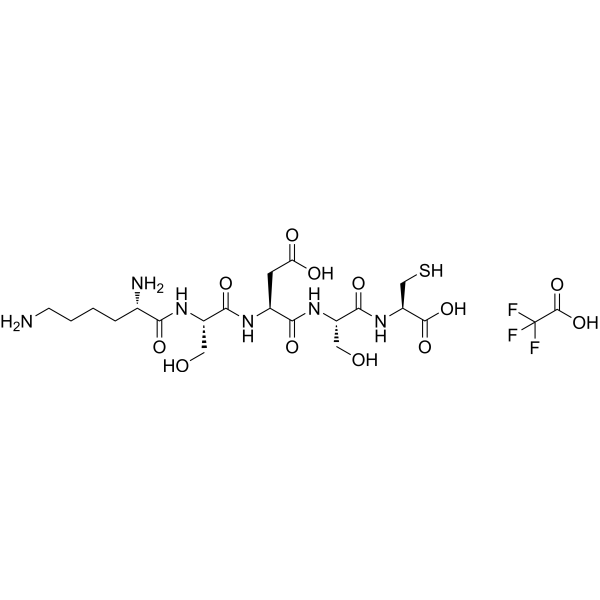
KSDSC TFA is a penta-peptide, correlated positively with hairpin DNA with tetramer loops. Therefore, KSDSC TFA joins hands with hairpin DNA (hpDNA) with improved selectivity as sensing materials in the detection system, used for surface plasmon resonance imaging (SPRi) .
loading...
    loading...
Cat. No.: HY-P82555
Synonyms: Cernunno; Nhej1; Non homologous end joining factor 1; Protein cernunnos; XLF; XRCC4 like factor

Host:  

Rabbit

Application:  

WB, IHC-P, ICC/IF, FC

Reactivity:  

Human, Mouse, Rat

loading...
    loading...
Cat. No.: HY-W800844
CAS No.: 2793446-59-8
Research Areas:  

Others

NH-bis(PEG8-OH) is a homobifunctional reagent containing two alcohols joined together by a secondary amine. The alcohols can be used in a variety of ways such as in forming esters with carboxylic acids, while the secondary amine can be used as a nucleophile in linking with ketones, aldehydes, and carboxylic acids. The PEG spacers make this molecule water-soluble, potentially altering its DMPK properties.
loading...
    loading...
Cat. No.: HY-P74842
Purity:  ≥ 95%, as determined by reducing SDS-PAGE.
Synonyms: JCHAIN; JCH; Prev. IGJ; IgJ Chain; IGCJ; J Chain; Immunoglobulin J Chain; joining Chain Of Multimeric IgA And IgM; Immunoglobulin J Polypeptide, Linker Protein For Immunoglobulin Alpha And Mu Polypeptides
Species:  
Human
Source:  
E. coli
loading...
    loading...
Cat. No.: HY-107845R
CAS No.: 14892-97-8
Research Areas:  

Cancer

SCR7 pyrazine (Standard) is the analytical standard of SCR7 pyrazine (HY-107845). This product is intended for research and analytical applications. SCR7 pyrazine is a DNA ligase IV inhibitor that blocks nonhomologous end-joining (NHEJ) in a ligase IV-dependent manner. SCR7 pyrazine increases the efficiency of Cas9-mediated homology-directed repair (HDR). SCR7 pyrazine induces cell apoptosis and has anticancer activity .
loading...
    loading...
Cat. No.: HY-P71744
Purity:  ≥ 90%, as determined by reducing SDS-PAGE.
Synonyms: JCHAIN; JCH; Prev. IGJ; IgJ Chain; IGCJ; J Chain; Immunoglobulin J Chain; joining Chain Of Multimeric IgA And IgM; Immunoglobulin J Polypeptide, Linker Protein For Immunoglobulin Alpha And Mu Polypeptides
Species:  
Mouse
Source:  
P. pastoris
loading...
    loading...
Cat. No.: HY-150279R
CAS No.: 2565638-16-4
PolQi2 (Standard) is the analytical standard of PolQi2 (HY-150279). This product is intended for research and analytical applications. PolQi2 is a PolΘ inhibitor that targets and inhibits alt-EJ (alternative end-joining) repair by inhibiting the helicase domain at the N-terminus of PolΘ. PolQi2 enhances the precision and integration efficiency of gene editing at different loci and in various cell lines. Furthermore, the combined use of PolQi2 with DNA-PK inhibitors reduces the off-target effects of Cas9. PolQi2 can be used in gene editing research .
loading...
    loading...
Cat. No.: HY-L151
544 compounds

PROTACs (Proteolysis-targeting chimeras) is a class of molecules that utilize ubiquitin-proteasome system (UPS) to ubiquitinate and degrade target proteins. The PROTACs molecule consists of two ligands joined by a linker. The one-to-one interaction between PROTACs and target proteins determines the high efficiency of PROTACs, making it a potential molecule for targeted protein degradation (TPD) therapy.

MCE supplies a unique collection of 544 PROTACs that effectively degrade target proteins with more powerful screening capability. MCE PROTAC Library is a useful tool for signal pathway research, protein degradation therapy research, drug discovery and drug repurposing, etc.

Cat. No.: HY-N21945
CAS No.: 19086-75-0
Castalin is a polyphenolic anticancer compound isolated and identified from the bark or nut shells of Castanea sativa Mill. Castalin induces DNA damage by increasing ROS to activate CHK1, while recruiting 53BP1/RIF1 and activating DNA-PKcs to initiate the NHEJ pathway for DNA repair. Castalin can be used in research related to cervical cancer and breast cancer .
loading...
    loading...
Cat. No.: HY-W547534
CAS No.: 2307-55-3
Synonyms: 2,4-Dichlorophenoxyacetic acid ammonium
Research Areas:  

Cancer

2,4-D (2, 4-dichlorophenoxyacetic acid) ammonium is a selective herbicide that can be used for the control of broad-leaved weeds. 2,4-D ammonium can induce apoptosis. 2,4-D ammonium inhibits DNA and protein synthesis, thereby preventing normal plant growth and development .
loading...
    loading...
Cat. No.: HY-L244
761 compounds

In this era of rapid advancement in gene-editing technology, the CRISPR-Cas system, with its powerful programmability, is leading a transformation in life sciences research. It enables efficient and precise targeted modification of an organism's genome, providing a robust tool for studying gene function, treating genetic diseases, and improving crop varieties. However, bottlenecks such as insufficient editing efficiency, low homologous directed repair efficiency, and potential off-target risks remain major challenges in achieving precise genetic modifications and developing gene therapies.

To overcome these limitations, the MCE High-Efficiency Gene Editing Compound Library systematically includes 761 small molecules that are known or have the potential to enhance gene-editing efficiency. These compounds work by targeting and modulating the DNA damage repair network, mechanistically inhibiting non-homologous end joining, promoting homologous directed repair, or regulating chromatin states and cellular responses, thereby significantly optimizing editing outcomes. This library is suitable for developing "CRISPR-small molecule" combination therapy strategies, improving gene-editing efficiency, and providing a powerful tool for in-depth research into the mechanisms of DNA damage repair in gene editing.

Cat. No.: HY-183630
CAS No.: 3045469-78-8
Target:  

DNA/RNA Synthesis

Research Areas:  

Cancer

AZD4956 is a potent and selective DNA polymerase theta (POLQ) inhibitor. AZD4956 exhibits an IC50 value of less than 3 μmol/L against POLQ and 3.4 μmol/L against MMEJ. AZD4956 suppresses the MMEJ pathway and enhances the activity of DNA-damaging agents in HRR-deficient cellular contexts. AZD4956 shows antitumor activity in BRCA1/2-mutated triple-negative breast cancer and prostate cancer models. AZD4956 can be used for the study of homologous recombination-deficient tumors .
loading...
    loading...

