100 Results for "

Clickable Probes

" in MedChemExpress (MCE) Product Catalog:
Products (100)

100 Results for "Clickable Probes" in MCE Product Catalog:

Cat. No.: HY-137124
CAS No.: 2219331-30-1
Research Areas:  

Cancer

BB-F-Yne is a protein arginine deiminase (PAD) inhibitor with Ki values of PAD1-4.are 2050, 1700, 1100, 3100 M -1min -1 respectively. BB-F-Yne can be used as a click probe to label PAD .
loading...
    loading...
Cat. No.: HY-137125
CAS No.: 2219324-71-5
Research Areas:  

Cancer

BB-Cl-Yne is a protein arginine deiminase (PAD) inhibitor with Ki values of PAD1-4.are 6400, 3600, 10800, 4900 M -1min -1 respectively. BB-Cl-Yne can be used as a click probe to label PAD .
loading...
    loading...
Cat. No.: HY-D2288
CAS No.: 1798306-00-9
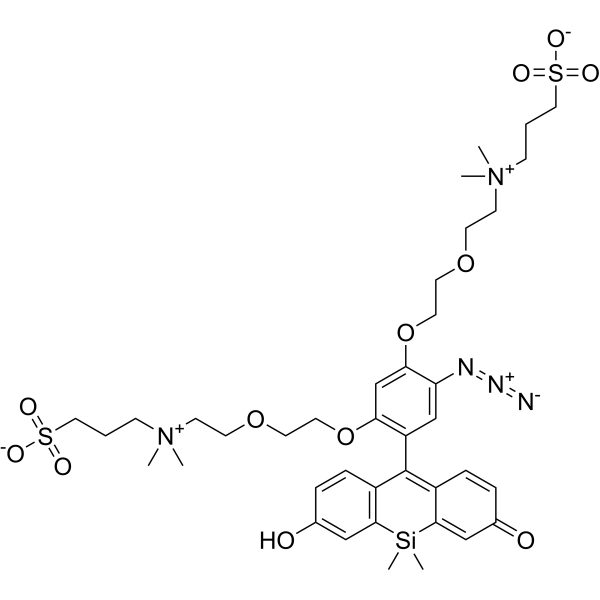
CalFluor 580 azide is a fluorogenic azide probe that is activated by Cu-catalyzed or metal-free click reaction. CalFluor 580 azide is not fluorescent until it is reacted with alkynes .
loading...
    loading...
Cat. No.: HY-W800696
CAS No.: 2644752-86-1
BP Fluor 430 Azide is a water-soluble, green-fluorescent, azide-activated probe that reacts with terminal alkynes via a copper-catalyzed click reaction (CuAAC). It also reacts with strained cyclooctyne via a copper-free click chemistry reaction to form a stable triazole and does not require a Cu-catalyst or elevated temperatures. BP Fluor 430 is a bright, photostable, green-fluorescent probe with excitation near its absorption maximum at 432 nm and emission maximum at 539 nm. This probe is water soluble and pH-insensitive from pH 4 to pH 10. A next generation probe, BP Fluor 430 Picolyl Azide, is also available for detection of low abundance alkyne-tagged biomolecules.
loading...
    loading...
Cat. No.: HY-W800698
CAS No.: 2006309-79-9
BP Fluor 430 Alkyne is a green-fluorescent alkyne-activated probe routinely used for imaging of moderate to high abundance azide-containing biomolecules. BP Fluor 430 Alkyne reacts with azides via a copper-catalyzed click reaction (CuAAC) to form a stable triazole linker. BP Fluor 430 is a bright, photostable, green-fluorescent probe optimally excited near 430 nm. This probe is water-soluble and its fluorescence is pH independent over a wide pH range.
loading...
    loading...
Cat. No.: HY-W800692
CAS No.: 2644752-84-9
BP Fluor 350 Azide is a blue-fluorescent, azide-activated probe that reacts with terminal alkynes via a copper-catalyzed click reaction (CuAAC). It also reacts with strained cyclooctyne via a copper-free click chemistry reaction to form a stable triazole and does not require Cu-catalyst or elevated temperatures. BP Fluor 350 is a water-soluble, moderately photostable, blue-fluorescent probe optimally excited by the 350 nm laser line. It is routinely used for generation of stable signal in imaging and flow cytometry. The brightness and photostability of blue dyes are best suited to direct imaging of high-abundance targets.
loading...
    loading...
Cat. No.: HY-W724743
CAS No.: 727718-93-6
Research Areas:  

Cardiovascular Disease

Losartan azide is a click chemistry reagent containing an azide group and is a synthetic intermediate for the preparation of angiotensin AT1R-targeted renal PET imaging probe [18 F]fluoropyridine-losartan .
loading...
    loading...
Cat. No.: HY-135636
CAS No.: 2748500-17-4
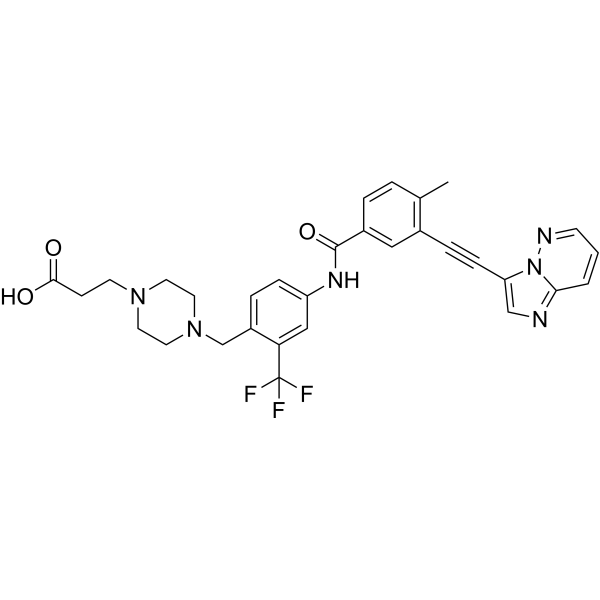
Ponatinib Acid, an analogue of Ponatinib, is usually used as a labeled chemical or fluorescent probe. Ponatinib Acid is a click chemistry reagent, it contains an Alkyne group and can undergo copper-catalyzed azide-alkyne cycloaddition (CuAAc) with molecules containing Azide groups.
loading...
    loading...
Cat. No.: HY-132913
CAS No.: 2771119-22-1
Research Areas:  

Cancer

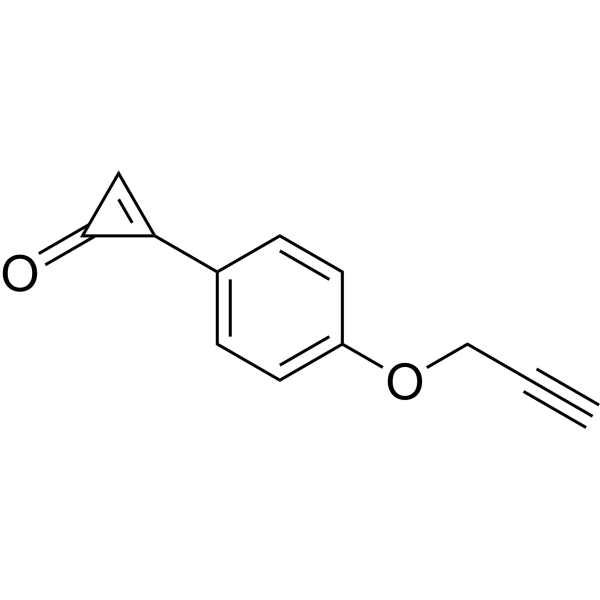
Cyclopropenone probe 1 can specifically and efficiently modify a triple-negative breast cancer driver, glutathione S-transferase pi-1 (GSTP1), by covalently binding at the catalytic active site. Cyclopropenone probe 1 is a click chemistry reagent, it contains an Alkyne group and can undergo copper-catalyzed azide-alkyne cycloaddition (CuAAc) with molecules containing Azide groups.
loading...
    loading...
Cat. No.: HY-W800704
CAS No.: 1962073-89-7
BP Fluor 594 alkyne is a bright, red-fluorescent alkyne-activated probe routinely used for imaging of azide-containing biomolecules. BP Fluor 594 alkyne reacts with azides via a copper-catalyzed click reaction (CuAAC) to form a stable triazole linker.
loading...
    loading...
Cat. No.: HY-155772
CAS No.: 2941609-83-0
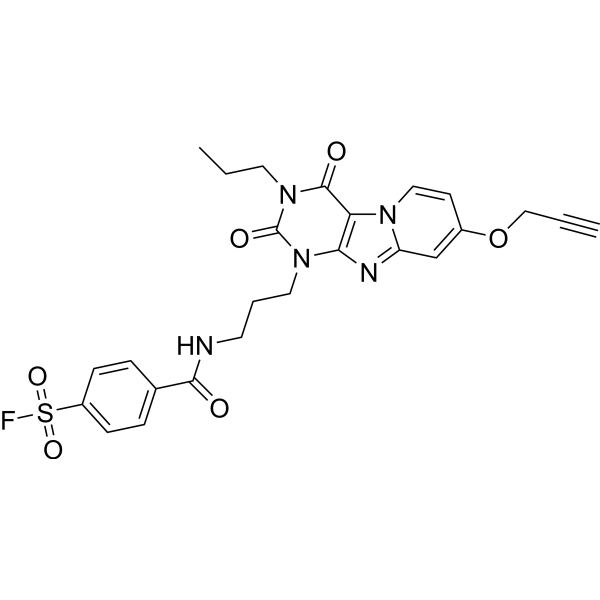
LUF7690 (Compound 9) is a clickable and covalent affinity-based probe (AfBP) that targets the human A3AR (hA3AR). LUF7690 can be used in the detection and characterization of the hA3AR in different types of granulocytes, among other cell types .
loading...
    loading...
Cat. No.: HY-151691
CAS No.: 1676067-48-3
Target:  

ADC Linkers

Research Areas:  

Others

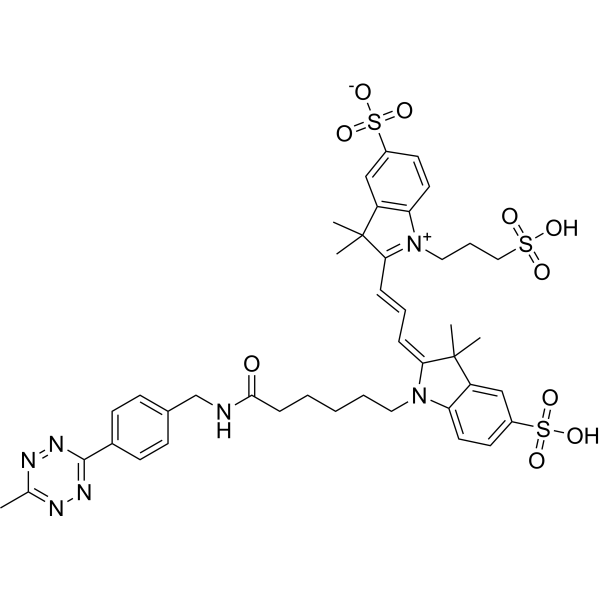
Trisulfo-Cy3 Methyltetrazine is a click chemistry reagent containing an methyltetrazine group. Methyltetrazine-activated Cy3 probe reacts with TCO-containing compounds via an Inverse-Electron-Demand Diels-Alder reaction to form a stable covalent bond and does not require Cu-catalyst or elevated temperatures .
loading...
    loading...
Cat. No.: HY-D2579
Sulfo DBCO-UBQ-2 is a click chemistry reagent combining a dark quencher, UBQ-2, with a polyaromatic-azo backbone, offering no native emission. UBQ-2 effectively quenches fluorescence in the 560-670 nm range, ideal for qPCR probes and FRET applications with orange to far-red dyes .
loading...
    loading...
Cat. No.: HY-D2802
Target:  

Fluorescent Dye

Research Areas:  

Cancer

FITC-PEG400-N3 is a fluorescent agent conjugated with FITC and an azide group, which can be used to synthesize fluorescent probes via click chemistry reactions. FITC-PEG400-N3 and its related probe molecules can be applied to targeted imaging, tissue distribution and drug delivery studies of prostate cancer (including castration-resistant prostate cancer), such as serving as a subcellular localization tool for GnRH-II binding proteins. Among them, the excitation wavelength of FITC-N3 is approximately 494 nm, and its emission wavelength is approximately 520 nm .
loading...
    loading...
Cat. No.: HY-147115
CAS No.: 79541-46-1
Target:  

Fluorescent Dye

Research Areas:  

Others

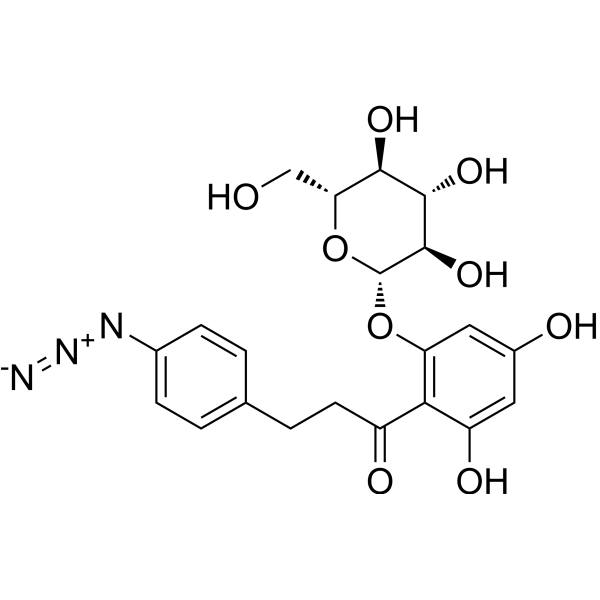
4-Azidophlorizin is a high affinity probe and photoaffinity label for the glucose transporter in brush border membranes . 4-Azidophlorizin is a click chemistry reagent, it contains an Azide group and can undergo copper-catalyzed azide-alkyne cycloaddition reaction (CuAAc) with molecules containing Alkyne groups. It can also undergo strain-promoted alkyne-azide cycloaddition (SPAAC) reactions with molecules containing DBCO or BCN groups.
loading...
    loading...
Cat. No.: HY-148835A
Purity:  99.77%
Target:  

Fluorescent Dye

Research Areas:  

Others

AzGGK TFA is an unnatural amino acid. AzGGK TFA is site-specifically incorporated into proteins via genetic-code expansion. AzGGK TFA can be used as a site-specific probe for ubiquitylation and SUMOylation. AzGGK TFA is a click chemistry reagent, it contains an Azide group and can undergo copper-catalyzed azide-alkyne cycloaddition reaction (CuAAc) with molecules containing Alkyne groups. It can also undergo strain-promoted alkyne-azide cycloaddition (SPAAC) reactions with molecules containing DBCO or BCN groups .
loading...
    loading...
Cat. No.: HY-147150
CAS No.: 150424-94-5
Target:  

Fluorescent Dye

Research Areas:  

Others

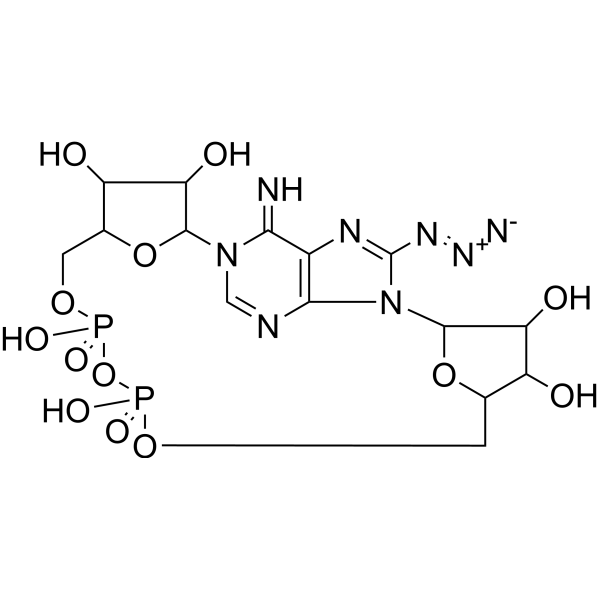
8-Azido-cADPR, with its photoactive azido group, is a potent photoaffinity probe. 8-Azido-cADPR can be used for the identification and characterization of cADPR-binding proteins . 8-Azido-cADPR is a click chemistry reagent, it contains an Azide group and can undergo copper-catalyzed azide-alkyne cycloaddition reaction (CuAAc) with molecules containing Alkyne groups. It can also undergo strain-promoted alkyne-azide cycloaddition (SPAAC) reactions with molecules containing DBCO or BCN groups.
loading...
    loading...
Cat. No.: HY-153665
CAS No.: 2761446-55-1
Purity:  99.45%
Research Areas:  

Cancer

Deg-1 is a bifunctional probe with a cleavage group and a covalent binding group. Deg-1 binds covalently to target nucleic acids and acts as a click degrader to cleave nucleic acid molecules, exhibiting the potential to selectively cleave target nucleic acids intracellularly. Deg-1 contains an azide group that can undergo copper-catalyzed azide-alkyne cycloaddition (CuAAc) with alkynyl groups, as well as strain-promoted alkyne-azide cycloaddition (SPAAC) with DBCO or BCN. Deg-1 can be used in studies related to acute myeloid leukemia and RNA function .
loading...
    loading...
Cat. No.: HY-173390
CAS No.: 2059099-03-3
Research Areas:  

Others

BCN-E-BCN is a strained cycloalkyne-based probe designed for detecting protein sulfenylation, the primary intermediate in protein oxidation. This structurally constrained cycloalkyne compound specifically recognizes sulfenic acid groups formed during thiol oxidation, while remaining completely unreactive toward other oxidative states (such as free thiols, sulfinic, or sulfonic acid groups). Researchers can leverage its efficient conjugation with azide-bearing tags through copper-free click chemistry to amplify detection signals. Compared to conventional detection methods, BCN-E-BCN demonstrates superior reaction kinetics and enhanced sensitivity. With these advantages, BCN-E-BCN shows great promise as an effective tool for protein oxidation research .
loading...
    loading...
Cat. No.: HY-W127719
CAS No.: 96087-38-6
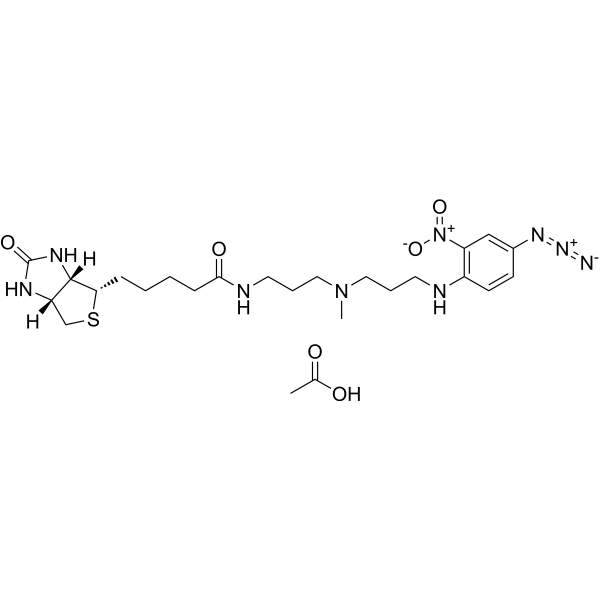
Photobiotin (acetate)It is a biological probe used to study biochemical processes such as protein interactions and enzymatic reactions. It is a molecule containing a photosensitive group, which can be combined with specific target molecules (such as proteins, nucleic acids, etc.) through photochemical cross-linking technology, so as to realize the labeling and detection of these molecules. During the photosensitive crosslinking process, Photobiotin (acetate)Can participate in the formation of covalent bonds and form stable compounds. In addition, the compound also has high biocompatibility and biological activity, so it is widely used in the field of biomedical research, such as enzymatic research, proteomics, western blotting and other aspects. Photobiotin (acetate) is a click chemistry reagent, it contains an Azide group and can undergo copper-catalyzed azide-alkyne cycloaddition reaction (CuAAc) with molecules containing Alkyne groups. It can also undergo strain-promoted alkyne-azide cycloaddition (SPAAC) reactions with molecules containing DBCO or BCN groups.
loading...
    loading...

