



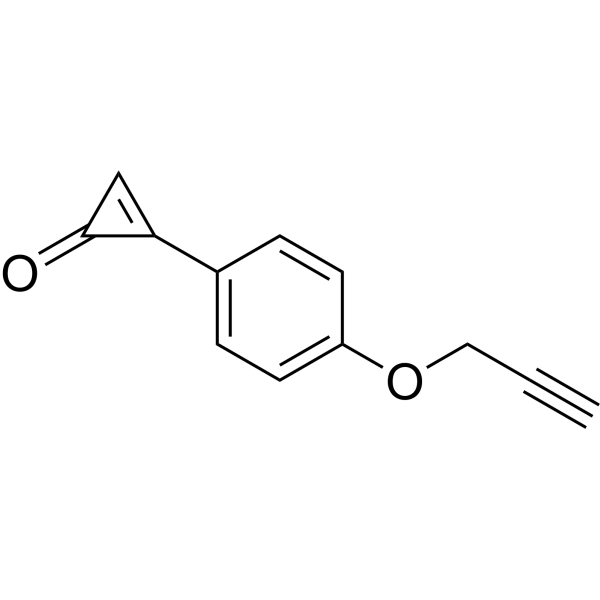
Cyclopropenone probe 1
Cyclopropenone probe 1 can specifically and efficiently modify a triple-negative breast cancer driver, glutathione S-transferase pi-1 (GSTP1), by covalently binding at the catalytic active site. Cyclopropenone probe 1 is a click chemistry reagent, it contains an Alkyne group and can undergo copper-catalyzed azide-alkyne cycloaddition (CuAAc) with molecules containing Azide groups.
商品は「研究用試薬」です。人や動物の医療用・臨床診断用・食品用の製品ではありません。
研究用途以外に使用した場合、当社は一切の責任を負いかねます。
- CAS 番号: 2771119-22-1
- 分子式: C12H8O2
- 分子量:184.19
-
保管条件:
Please store the product under the recommended conditions in the Certificate of Analysis.

To place orders, for customer services and technical support, please contact: MedChemExpress USA
Tel: 609-228-6898 E-mail: [email protected] [email protected]


-
 生物活性
生物活性
-
化学情報
- プロトコル
- 純度とドキュメンテーション
- 参考文献
-
 Help & FAQs




生物活性
製品説明
Cellular Effect
|
Cell Line

|
Type | Value | Description | References |
|---|---|---|---|---|
| Bcap37 | IC50 |
45 μM
Compound: CY-1
|
Antiproliferative activity against human BcaP37 cells assessed as cell viability incubated for 24 hrs by CCk8 assay
Antiproliferative activity against human BcaP37 cells assessed as cell viability incubated for 24 hrs by CCk8 assay
|
[PMID: 34623802] |
| MDA-MB-231 | IC50 |
0.78 μM
Compound: CY1
|
Antiproliferative activity against human MDA-MB-231 cells assessed as inhibition of cell growth incubated for 72 hrs by CCK8 assay
Antiproliferative activity against human MDA-MB-231 cells assessed as inhibition of cell growth incubated for 72 hrs by CCK8 assay
|
[PMID: 36762554] |


化学情報
-
CAS 番号 2771119-22-1
-
分子量 184.19
-
分子式 C12H8O2
-
SMILES
C#CCOC1=CC=C(C=C1)C2=CC2=O
-
輸送条件
Room temperature in continental US; may vary elsewhere.
-
保管条件
Please store the product under the recommended conditions in the Certificate of Analysis.


純度とドキュメンテーション
参考文献

Calculators
濃度 (開始) × 体積 (開始) = 濃度 (終了) × 体積 (終了)


Cyclopropenone probe 1 関連分類
HY-132913 関連分類
 Powered by Bioz