131 Results for "

complex-1

" in MedChemExpress (MCE) Product Catalog:
Products (131)

131 Results for "complex-1" in MCE Product Catalog:

Cat. No.: HY-161306
CAS No.: 2760854-72-4
Target:  

HDAC

Research Areas:  

Cancer

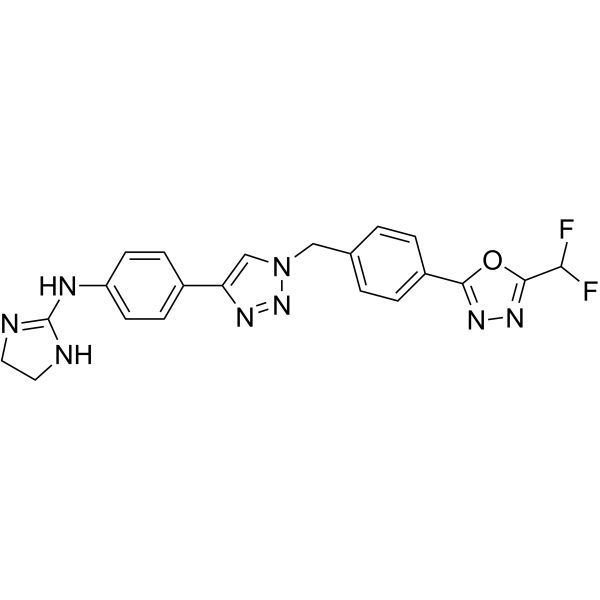
ITF5924 (compound 1) is a potent and highly selective HDAC6 inhibitor with an IC50 of 7.7 nM. ITF5924 shows greater than 104-fold selectivity for HDAC6 over all other HDAC subtypes. ITF5924 containing a difluoromethyl-1,3,4-oxadiazole (DFMO) moiety is slow-binding substrate analog of HDAC6 that undergo an enzyme-catalyzed ring opening reaction, forming a tight and long-lived enzyme-inhibitor complex .
loading...
    loading...
Cat. No.: HY-157966
Target:  

SARS-CoV

Research Areas:  

Infection

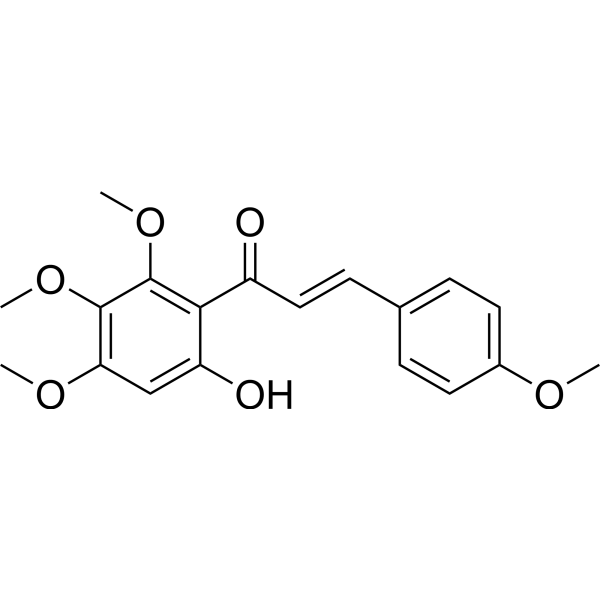
SARS-CoV-2 3CLpro-IN-23 (Compound Cd3) is a compound that can be isolated from Citrus depressa. SARS-CoV-2 3CLpro-IN-23 has good inhibitory activity to the SARS-CoV-2 spike protein, with KD of 0.79 μM. SARS-CoV-2 3CLpro-IN-23 can bind to key amino acid residue, disrupting the formation of the spike protein and h-ACE2 complex .
loading...
    loading...
Cat. No.: HY-W348485
CAS No.: 899937-47-4
Target:  

mTOR

Research Areas:  

Cancer

WRX606 is an orally active nonrapalog inhibitor for mTOR complex 1 (mTORC1M). WRX606 inhibits the phosphorylation of mTORC1 substrate S6 kinase 1 (S6K1) (IC50 = 10 nM) and eukaryotic translation initiation factor 4E binding protein (p-4E-BP1) (IC50 = 0.27 μM) in MCF-7 cells. WRX606 suppresses tumor growth in mice without promotion of metastasis. WRX606 can be studied in research as an antitumor agent [1] .
loading...
    loading...
Cat. No.: HY-P11743
Mitochondrial penetrating peptide is a peptide sequence (FrFKFrFK-CONH2) that selectively transports cargo into mitochondria. Mitochondrial penetrating peptide possesses special physicochemical properties, enabling it to selectively translocate dinuclear Ru (II) polypyridine complexes into mitochondria of living mammalian cells without the aid of solvents or membrane permeabilization treatments, thus achieving precise mitochondrial localization and enrichment of the complexes while excluding their distribution in the nucleus. Mitochondrial penetrating peptide enables dynamic monitoring of mitochondrial oxygen concentration and ROS production in living mammalian cells via changes in the luminescence lifetime of the coupled Ru (II) complex .
loading...
    loading...
Cat. No.: HY-P10409
CAS No.: 1191923-93-9
Synonyms: Small humanin-like peptide 2
SHLP2 (Small humanin-like peptide 2) is a small molecule peptide encoded by mitochondrial DNA, belonging to mitochondria derived peptide. SHLP2 has the activity of regulating apoptosis and inhibits cell death. SHLP2 binds to mitochondrial complex 1. SHLP2 improves mitochondrial metabolism by increasing respiration and biogenesis, reducing ROS, and decreasing mtDNA oxidation. SHLP2 also regulated energy homeostasis through the activation of hypothalamic neurons. SHLP2 can be used in the study of diseases related to mitochondrial dysfunction and anti-aging diseases, such as age-related macular degeneration and Parkinson’s disease [1] .
loading...
    loading...
Cat. No.: HY-181085
Target:  

DYRK

RD0448 is a potent inhibitor of DYRK1A, DYRK1B, and DYRK2. RD0448 selectively targets the non-native (folded intermediate) state of DYRK1A and DYRK1B. The binding site of RD0448 is hidden in the native state of DYRK1A and DYRK1B, and as a stabilizing binder, it binds tightly to both DYRK1A and DYRK1B, forming a stable complex with slow dissociation kinetics. In contrast, RD0448 targets the native state of DYRK2 without selectivity between its native and non-native states, acting as a weak binder with weaker binding affinity to DYRK2 and forming a rapidly dissociating complex .
loading...
    loading...
Cat. No.: HY-160924
Research Areas:  

Cancer

MS147 is a VHL-based PROTAC degrader of BMI1 and RING1B (polycomb repressive complex 1 core components). MS147 directly binds EED and VHL E3 ligase, recruiting the ligase to the EED-BMI1/RING1B complex to induce time-dependent, ubiquitination-mediated degradation of BMI1 and RING1B. MS147 reduces histone H2A Lys119 mono-ubiquitination without altering histone H3 Lys27 tri-methylation and inhibits cancer cells proliferation. MS147 can be used for the research of cancer, such as chronic myelogenous leukemia and b-cell lymphoma [1].
loading...
    loading...
Cat. No.: HY-W392912A
CAS No.: 2833-24-1
Synonyms: Methyl (2E)-4-oxopent-2-enoate
Research Areas:  

Others

Methyl trans-4-oxo-2-pentenoate (Methyl (2E)-4-oxopent-2-enoate) is a heterofunctionalized dienophile containing both ketone and ester functional groups. The enone structure within the Methyl trans-4-oxo-2-pentenoate molecule makes it a highly reactive Michael acceptor capable of regioselective conjugate addition, which is commonly used in reactions for constructing complex ring systems such as the Robinson annulation. Methyl trans-4-oxo-2-pentenoate can serve as a substrate in the synthesis of α-(alkylmethylene) butyrolactone derivatives. Methyl trans-4-oxo-2-pentenoate participates in asymmetric Diels-Alder reactions promoted by chiral palladium complexes .
loading...
    loading...
Cat. No.: HY-13631I
CAS No.: 2938875-54-6
Purity:  98.48%
Synonyms: (1S,9R)-DX8951f
Research Areas:  

Cancer

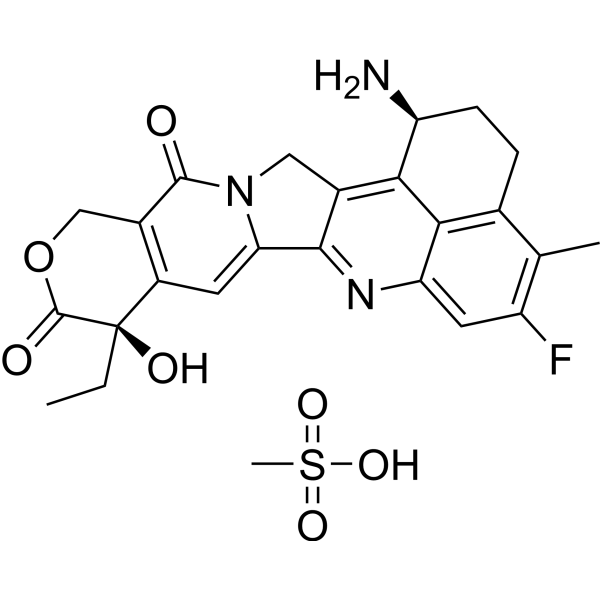
(1S,9R)-Exatecan mesylate ((1S,9R)-DX8951f) is a non-prodrug camptothecin derivative and a topoisomerase I inhibitor (IC50=0.975 μg/mL in mice and 0.82 μg/mL in humans). (1S,9R)-Exatecan mesylate blocks enzyme activity and induces apoptosis by stabilizing the enzyme-DNA cleavable complex. (1S,9R)-Exatecan mesylate not only effectively inhibits the proliferation of various malignant tumor cells and tumor growth, but also circumvents P-glycoprotein-mediated multidrug resistance. (1S,9R)-Exatecan mesylate is widely used in preclinical studies of various cancers such as pancreatic cancer, lung cancer, breast cancer, and leukemia [1] .
The chiral isomer of (1S,9R)-Exatecan mesylate is (1R,9R)-Exatecan mesylate (HY-13631J).
loading...
    loading...
Cat. No.: HY-13631J
CAS No.: 2938875-39-7
Purity:  99.94%
Synonyms: (1R,9R)-DX8951f
Research Areas:  

Cancer

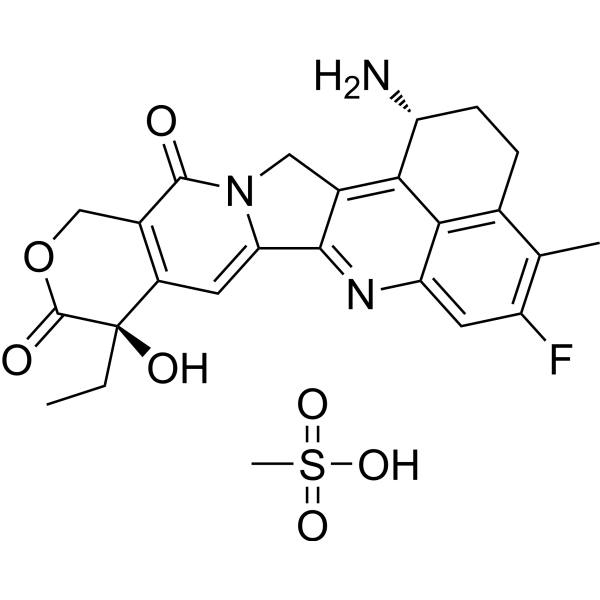
(1R,9R)-Exatecan mesylate ((1R,9R)-DX8951f) is a non-prodrug camptothecin derivative and a potent topoisomerase I inhibitor (IC50=0.975 μg/mL in mice and 0.82 μg/mL in humans). (1R,9R)-Exatecan mesylate blocks enzyme activity and induces apoptosis by stabilizing the enzyme-DNA cleavable complex. (1R,9R)-Exatecan mesylate not only effectively inhibits the proliferation of various malignant tumor cells and tumor growth, but also circumvents P-glycoprotein-mediated multidrug resistance. (1R,9R)-Exatecan mesylate is widely used in preclinical studies of multiple cancers including pancreatic cancer, lung cancer, breast cancer, and leukemia [1] . The low-activity isomer of (1R,9R)-Exatecan mesylate is (1S,9R)-Exatecan mesylate (HY-13631I).
loading...
    loading...
Cat. No.: HY-13631V
CAS No.: 2489613-15-0
Synonyms: (1R,9R)-DX-8951
Research Areas:  

Cancer

(1R,9R)-Exatecan ((1R,9R)-DX8951f) is a non-prodrug Camptothecin (HY-16560) derivative and a potent topoisomerase I (Topo I) inhibitor (IC50=0.975 μg/mL in mice and 0.82 μg/mL in humans). (1R,9R)-Exatecan blocks enzyme activity and induces apoptosis by stabilizing the enzyme-DNA cleavable complex. (1R,9R)-Exatecan not only effectively inhibits the proliferation of various malignant tumor cells and tumor growth, but also circumvents P-glycoprotein-mediated multidrug resistance. (1R,9R)-Exatecan is widely used in preclinical studies of multiple cancers including pancreatic cancer, lung cancer, breast cancer, and leukemia [1] . The low-activity isomer of (1R,9R)-Exatecan is (1S,9R)-Exatecan (HY-13631I).
loading...
    loading...

