1. Search Result
Search Result
Results for "

μ-receptor

" in MedChemExpress (MCE) Product Catalog:

9

Inhibitors & Agonists

2

Peptides

1

Recombinant Proteins

1

Antibodies

Cat. No. Product Name Target Research Areas Chemical Structure
  • HY-120613

    Opioid Receptor Neurological Disease
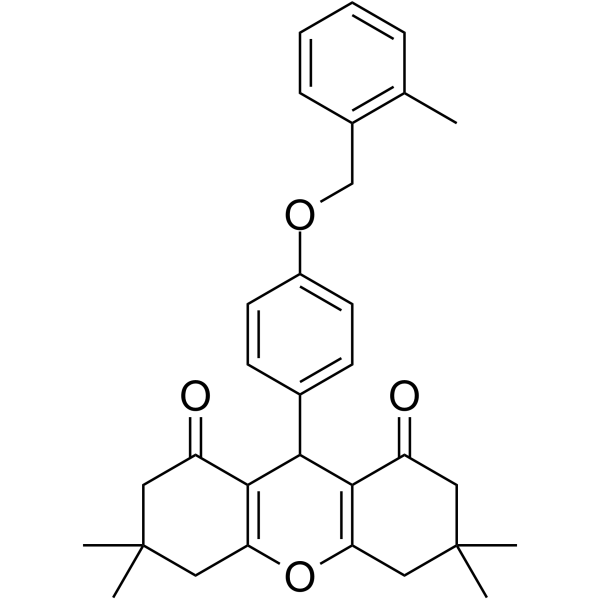
    BMS-986187 is an δ-opioid receptor-selective positive allosteric modulator (PAM) with an EC50 of 0.03 μM and a pKB of 6.02 (~1 μM). BMS-986187 has no observable PAM activity at the μ-receptor (EC50=3 μM) .
    BMS-986187
  • HY-P1701

    Opioid Receptor Cardiovascular Disease Neurological Disease
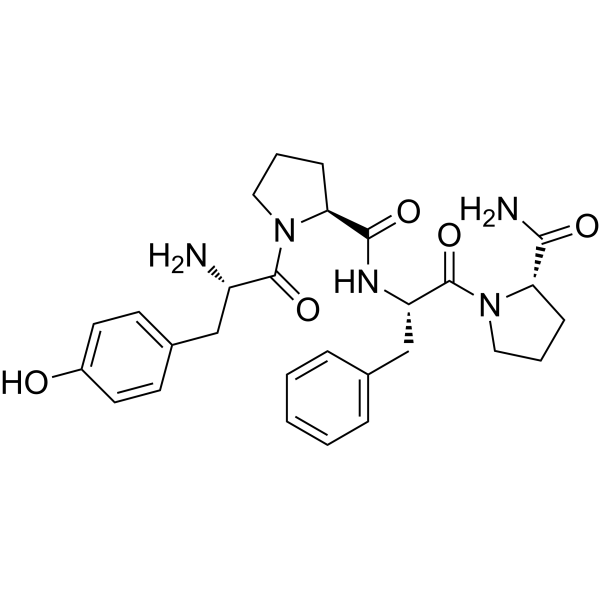
    Morphiceptin is a potent and specific agonist for morphine (μ) receptors. Morphiceptin, as a synthetic peptide, is the amide of a fragment of the milk protein β-casein. Morphiceptin has morphinelike activities and is highly specific for morphine (μ) receptors but not for Enkephalin receptors .
    Morphiceptin
  • HY-141515

    Opioid Receptor Neurological Disease
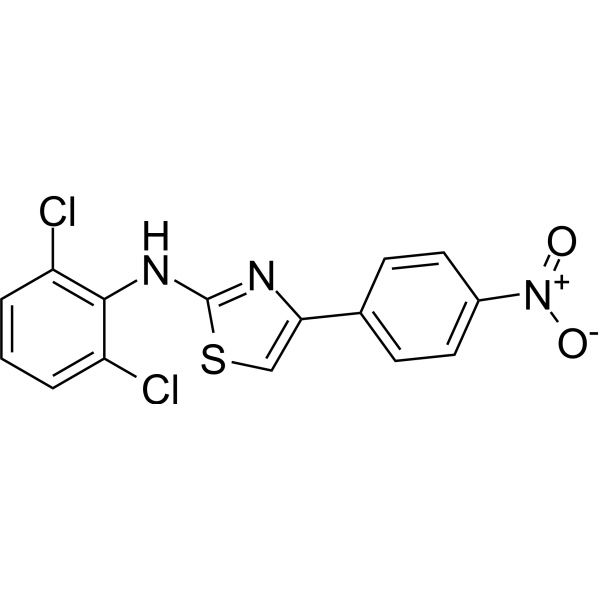
    BMS-986121 is a positive allosteric modulator (PAM) of the μ opioid receptor extracted from patent WO2014107344. BMS-986121 is built on a chemical scaffold representing a new chemotype for μ receptor PAMs .
    BMS-986121
  • HY-106601A

    LY-150720 hydrochloride

    Opioid Receptor Neurological Disease
    Picenadol (LY-150720) hydrochloride is an opioid mixed agonist-antagonist analgesic. Picenadol hydrochloride is an external racemic mixture, where its d-isomer (LY136596) is a potent μ-opioid receptor agonist, and the l-isomer (LY136595) is a weak μ-receptor competitive antagonist, which can inhibit the agonist effect and reduce the risk of dependence. Picenadol hydrochloride has anticholinergic activity .
    Picenadol hydrochloride
  • HY-P1617

    Endogenous Metabolite Neurological Disease
    LY 190388 is a penicillamine-containing enkefa peptide analog with μ receptor agonist activity. LY 190388 showed analgesic effect in inhibiting the writhing response in mice after intracerebroventricular administration. The analgesic effect of LY 190388 is not caused by its δ receptor agonist action, but by its μ receptor agonist activity. When LY 190388 is used together with the δ receptor antagonist ICI 174864, an additive analgesic effect is produced .
    LY 190388
  • HY-106601

    LY-150720

    Opioid Receptor Neurological Disease
    Picenadol (LY-150720) is an opioid mixed agonist-antagonist analgesic. Picenadol is an external racemic mixture, where its d-isomer (LY136596) is a potent μ-opioid receptor agonist, and the l-isomer (LY136595) is a weak μ-receptor competitive antagonist, which can inhibit the agonist effect and reduce the risk of dependence. Picenadol has anticholinergic activity .
    Picenadol
  • HY-101343

    5-HT Receptor Neurological Disease
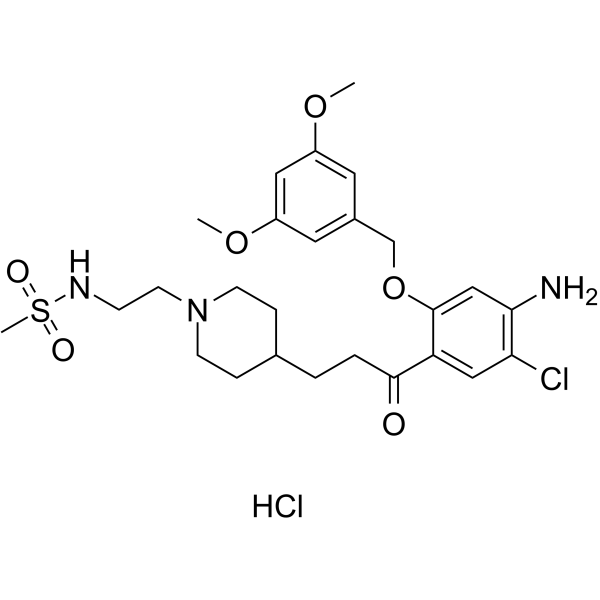
    RS 39604 is a potent, selective, and orally active 5-HT4 receptor antagonist with a pKi of 9.1 in guinea pig striatal membranes. RS 39604 displays a low affinity (pKi<6.5) for 5-HT1A, 5-HT2C, 5-HT3, α1c, D1, D2, M1, M2, AT1, B1 and opioid mu receptors and moderate affinity for δ1, (pKi=6.8) and δ2 (pKi=7.8) sites .
    RS 39604
  • HY-182563

    Opioid Receptor Endocrinology
    Tyr-Ala-N-(1,3-dimethylbutyl)glycinamide is a μ/δ opioid receptor ligand with high μ opioid receptor selectivity and agonist activity. Tyr-Ala-N-(1,3-dimethylbutyl)glycinamide has an IC50 of 237 nM for μ receptors and 1050 nM for δ receptors. Tyr-Ala-N-(1,3-dimethylbutyl)glycinamide shows Ki values of 17 nM for μ receptors and 480 nM for δ receptors. Tyr-Ala-N-(1,3-dimethylbutyl)glycinamide inhibits electrically evoked contractions of guinea pig ileum and mouse vas deferens. Tyr-Ala-N-(1,3-dimethylbutyl)glycinamide serves as a starting compound for structure-activity relationship investigations of μ receptor recognition .
    Tyr-Ala-N-(1,3-dimethylbutyl)glycinamide
  • HY-177218

    NSC 119910

    Phospholipase Opioid Receptor Neurological Disease
    M119 (NSC 119910) is a selective Gβγ-subunit inhibitor. M119 selectively potentiates μ-opioid-dependent antinociception. M119 inhibits μ-receptor-dependent phospholipase (PLC) activation. M119 can enhance opioid analgesia and attenuate its acute tolerance and dependence in mice. M119 can be used for pain research .
    M119

Inquiry Online

Your information is safe with us. * Required Fields.

Salutation


Country or Region *

Applicant Name *


Organization Name *

Department *


Email Address *


Product Name *

Cat. No.


Requested quantity *

Phone Number *


Remarks

Inquiry Online

Inquiry Information

Product Name:
Cat. No.:
Quantity:
MCE Japan Authorized Agent:

