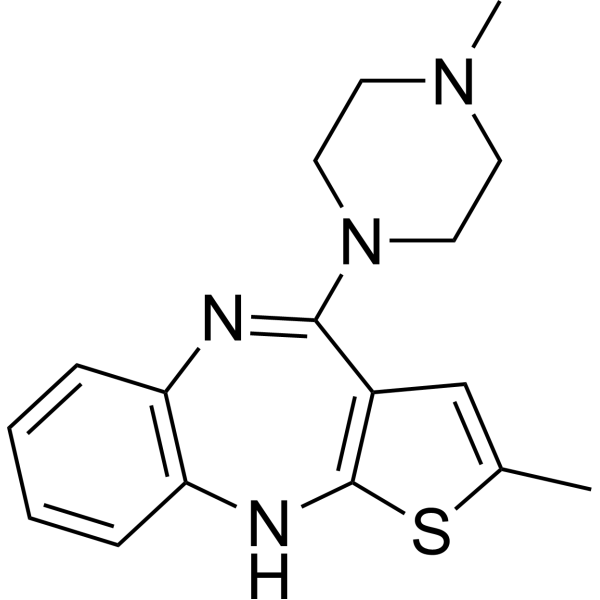
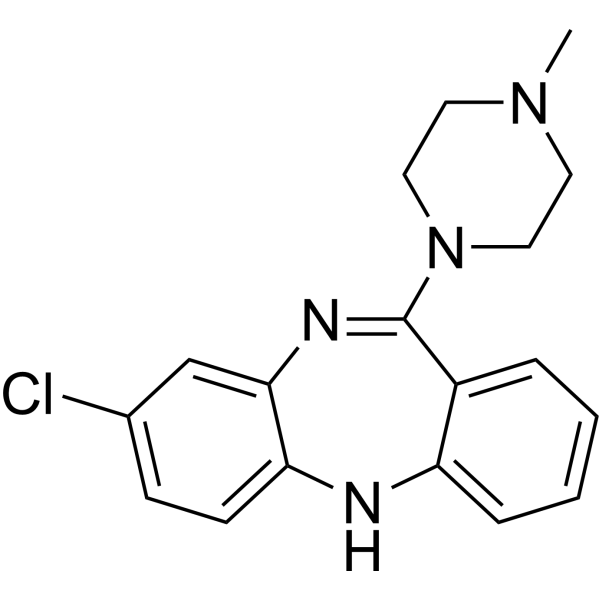
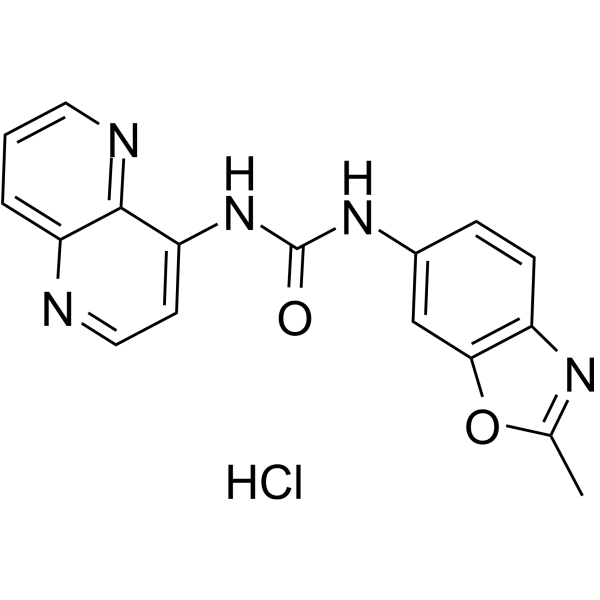
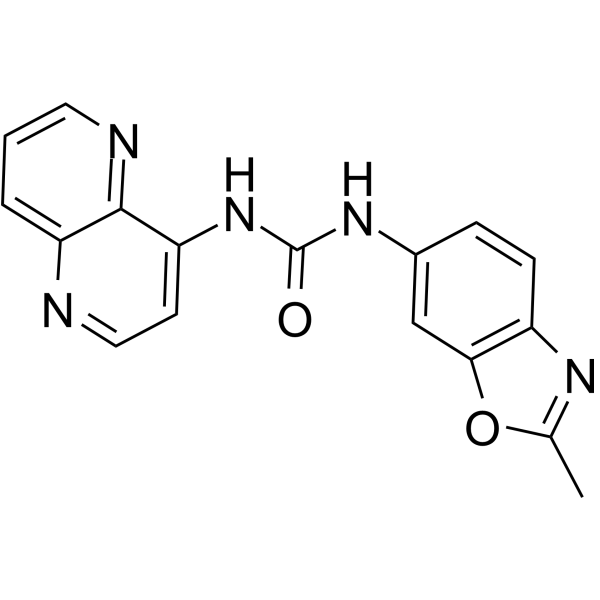
Search Result
Results for "
5-HT Receptor Antagonist
" in MedChemExpress (MCE) Product Catalog:
2
Biochemical Assay Reagents
93
Isotope-Labeled Compounds
| Cat. No. |
Product Name |
Target |
Research Areas |
Chemical Structure |
-
- HY-B0002B
-
|
GR 38032; SN 307
|
5-HT Receptor
|
Neurological Disease
|
|
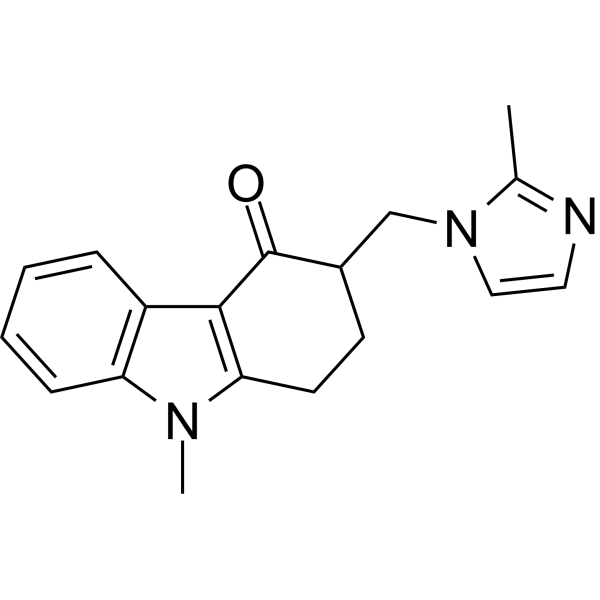
Ondansetron (GR 38032; SN 307) is a highly selective 5-HT3 receptor antagonist with an IC50 value of 103 pM. Ondansetron exerts its antiemetic effect by antagonizing 5-HT receptors located in localized neurons in the peripheral and central nervous systems. Ondansetron can inhibit nausea and vomiting induced by chemotherapy and radiotherapy .
|
-
-
- HY-14544
-
|
ICI204636
|
5-HT Receptor
Dopamine Receptor
|
Neurological Disease
|
|
Quetiapine (ICI204636) is a 5-HT receptors agonist with a pEC50 of 4.77 for human 5-HT1A receptor. Quetiapine is a dopamine receptor antagonist with a pIC50 of 6.33 for human D2 receptor. Quetiapine has moderate to high affinity for the human D2, HT1A, 5-HT2A, 5-HT2C receptor with pKis of 7.25, 5.74, 7.54, 5.55. Antidepressant and anxiolytic effects .
|
-
-
- HY-B0982
-
-
-
- HY-15370A
-
|
SB-269970A
|
5-HT Receptor
|
Neurological Disease
|
|
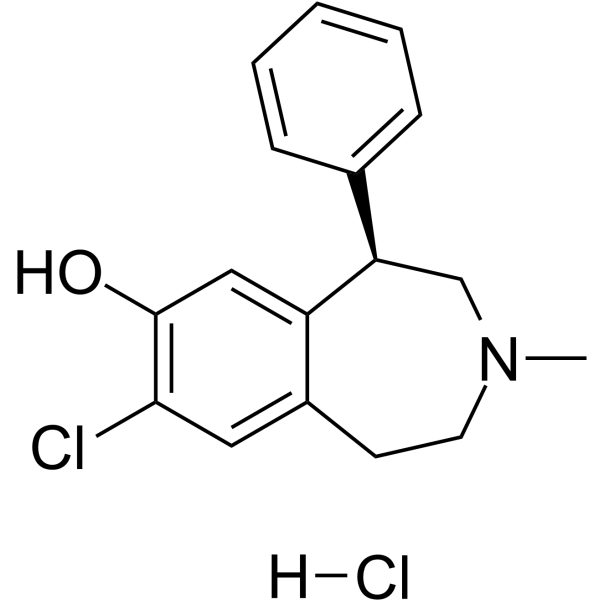
SB-269970 hydrochloride is a potent, selective and brain-penetrant 5-HT7 receptor antagonist with a pKi of 8.3. SB-269970 hydrochloride exhibits >50-fold selectivity against other 5-HT receptors .
|
-
-
- HY-B1033
-
|
|
5-HT Receptor
Dopamine Receptor
Sodium Channel
|
Neurological Disease
|
|
Metergoline is a serotonin (5-HT) receptor and dopamine receptors antagonist, with pKis of 8.64, 8.75 and 8.75 for 5-HT2A, 5-HT2B and 5-HT2C, respectively. Metergoline is a high-affinity ligand for the h5-HT7 receptor, with a Ki of 16 nM. Metergoline is also a reversible neural Na + channels inhibitor. Metergoline is commonly used for the research of seasonal affective disorder, prolactin hormone regulation .
|
-
-
- HY-14542
-
|
CP-88059
|
5-HT Receptor
Dopamine Receptor
|
Neurological Disease
|
|
Ziprasidone (CP-88059), an orally active antipsychotic agent, is a combined 5-HT and dopamine receptor antagonist . Ziprasidone mesylate trihydrate has affinities for Rat D2 (Ki=4.8 nM), 5-HT2A (Ki=0.42 nM) and 5-HT1A (Ki=3.4 nM) .
|
-
-
- HY-B0002
-
|
GR 38032 hydrochloride; SN 307 hydrochloride
|
5-HT Receptor
|
Neurological Disease
|
|
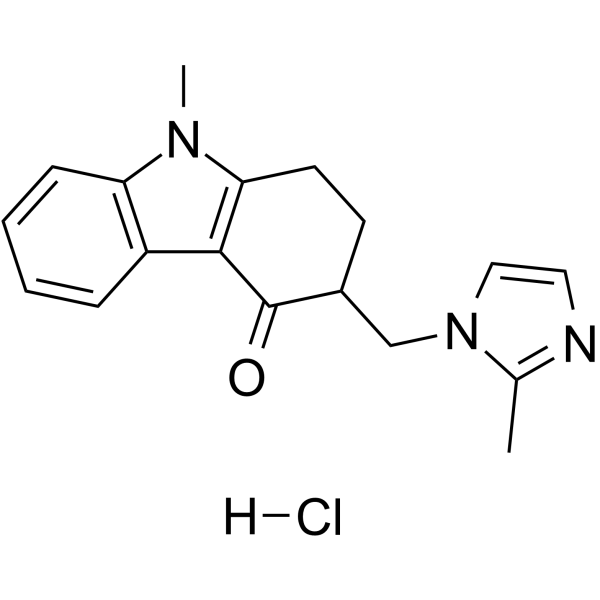
Ondansetron (GR 38032; SN 307) hydrochloride is a highly selective 5-HT3 receptor antagonist with an IC50 value of 103 pM. Ondansetron hydrochloride exerts its antiemetic effect by antagonizing 5-HT receptors located in localized neurons in the peripheral and central nervous systems. Ondansetron hydrochloride can inhibit nausea and vomiting induced by chemotherapy and radiotherapy .
|
-
-
- HY-17407
-
|
CP 88059 hydrochloride monohydrate
|
5-HT Receptor
Dopamine Receptor
|
Neurological Disease
|
|
Ziprasidone (CP-88059) hydrochloride monohydrate is an orally active combined 5-HT and dopamine receptor antagonist . Ziprasidone hydrochloride monohydrate has affinities for Rat D2 (Ki=4.8 nM), 5-HT2A (Ki=0.42 nM) and 5-HT1A (Ki=3.4 nM) .
|
-
-
- HY-B0031
-
|
|
5-HT Receptor
Dopamine Receptor
|
Neurological Disease
|
|
Quetiapine hemifumarate is a 5-HT receptors agonist with a pEC50 of 4.77 for human 5-HT1A receptor. Quetiapine hemifumarate is a dopamine receptor antagonist with a pIC50 of 6.33 for human D2 receptor. Quetiapine hemifumarate has moderate to high affinity for the human D2, HT1A, 5-HT2A, 5-HT2C receptor with pKis of 7.25, 5.74, 7.54, 5.55. Antidepressant and anxiolytic effects .
|
-
-
- HY-B0002A
-
|
GR 38032 hydrochloride dihydrate; SN 307 hydrochloride dihydrate
|
5-HT Receptor
|
Neurological Disease
|
|
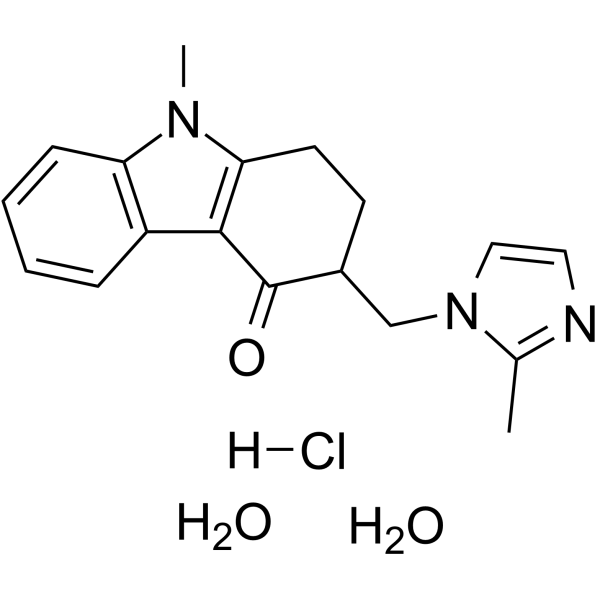
Ondansetron (GR 38032; SN 307) hydrochloride dehydrate is a highly selective 5-HT3 receptor antagonist with an IC50 value of 103 pM. Ondansetron hydrochloride dehydrate exerts its antiemetic effect by antagonizing 5-HT receptors located in localized neurons in the peripheral and central nervous systems. Ondansetron hydrochloride dehydrate can inhibit nausea and vomiting induced by chemotherapy and radiotherapy .
|
-
-
- HY-B1154
-
-
-
- HY-14542A
-
|
CP-88059 hydrochloride
|
5-HT Receptor
Dopamine Receptor
|
Neurological Disease
|
|
Ziprasidone (CP-88059) hydrochloride is an orally active combined 5-HT and dopamine receptor antagonist . Ziprasidone hydrochloride has affinities for Rat D2 (Ki=4.8 nM), 5-HT2A (Ki=0.42 nM) and 5-HT1A (Ki=3.4 nM) .
|
-
-
- HY-17390A
-
|
|
5-HT Receptor
Dopamine Receptor
|
Infection
Neurological Disease
|
|
Loxapine succinate is an orally active dopamine inhibitor, 5-HT receptor antagonist and also a dibenzoxazepine anti-psychotic agent. Loxapine can also suppresses bacterial efflux pump activity and inhibit intracellular multiple-antibiotic-resistant Salmonella enterica serovar Typhimurium in macrophages .
|
-
-
- HY-17390
-
-
-
- HY-100562
-
|
|
5-HT Receptor
COMT
|
Neurological Disease
|
|
Flopropione is a 5-HT receptor antagonist and also a catechol-o-methyltransferase (COMT) inhibitor . Flopropione also as an antispasmodic agent .
|
-
-
- HY-15370
-
|
|
5-HT Receptor
|
Neurological Disease
|
|
SB-269970 is a potent, selective and brain-penetrant 5-HT7 receptor antagonist with a pKi of 8.3. SB-269970 exhibits >50-fold selectivity against other 5-HT receptors .
|
-
-
- HY-109112
-
|
RP5063
|
Dopamine Receptor
5-HT Receptor
|
Neurological Disease
Inflammation/Immunology
|
|
Brilaroxazine (RP5603) is a potent and orally active multimodal dopamine (DA)/serotonin (5-HT) modulator. Brilaroxazine is a partial agonist of dopamine (DA) D2, D3, and D4 receptors, 5-HT1A (Ki=1.5 nM) and 5-HT2A (Ki=2.5 nM), and has antagonist activity at 5-HT2B (Ki=0.19 nM), and 5-HT7 (Ki=2.7 nM) receptors . Brilaroxazine is an atypical antipsychotic agent, and has the potential to improve cognitive impairments in neuropsychiatric and neurological diseases in vivo .
|
-
-
- HY-19818A
-
-
-
- HY-15574
-
|
SB-207266
|
5-HT Receptor
|
Cardiovascular Disease
|
|
Piboserod is an orally available selective antagonist of the 5-HT4 receptor, with a Ki value of approximately 0.1 nM for human 5-HT4 receptors. Piboserod can competitively bind to the 5-HT4 receptor and block the activation of the 5-HT4 receptor. Piboserod can inhibit the enhancing effect of 5-HT on the nerve-mediated contraction response of the human bladder detrusor muscle. Piboserod is mainly used in the research of urinary system diseases (such as overactive bladder) and cardiovascular diseases (such as chronic heart failure) .
|
-
-
- HY-G0014A
-
|
Quetiapine S-oxide dihydrochloride
|
Drug Metabolite
|
Neurological Disease
|
|
Quetiapine sulfoxide dihydrochloride (Quetiapine S-oxide dihydrochloride) is a main metabolite of Quetiapinem. Quetiapine is a second-generation antipsychotic . Quetiapine is a 5-HT receptors agonist and a dopamine receptor antagonist .
|
-
-
- HY-103156
-
|
|
5-HT Receptor
|
Neurological Disease
|
|
NAS181 is a potent and selective antagonist of rat 5-HT1B receptor, with a Ki of 47 nM. NAS181 shows 13-fold selectivity for r5-HT1B over bovine 5-HT1B receptor (Ki=630 nM). NAS181 increases the 5-HT turnover and the synaptic concentration of 5-HT by inhibiting terminal r5-HT1B autoreceptors .
|
-
-
- HY-131255
-
|
Ziprasidone Impurity C; Ziprasidone open ring impurity
|
5-HT Receptor
Dopamine Receptor
|
Neurological Disease
|
|
Ziprasidone amino acid (Ziprasidone Impurity C) is an impurity of Ziprasidone. Ziprasidone is a combined 5-HT (serotonin) and dopamine receptor antagonist. Ziprasidone exhibits potent effects of antipsychotic activity .
|
-
-
- HY-116790
-
|
(S)-Penbutolol; (-)-Isopenbutolol
|
Adrenergic Receptor
5-HT Receptor
|
Neurological Disease
|
|
(-)-Penbutolol ((S)-Penbutolol) is a potent β-adrenoceptor and 5-HT receptor antagonist with Ki values of 11.6 nM and 11.9 nM for 5-HT in rat cornu ammonis 1 (CA1) and human CA3 .
|
-
-
- HY-100851A
-
|
|
5-HT Receptor
|
Cardiovascular Disease
|
|
LY-272015 hydrochloride is an orally active, specific 5-HT2B receptor antagonist. LY-272015 hydrochloride completely inhibits the phosphorylation of ERK2 induced by 5-HT or BW723C86. LY-272015 hydrochloride is antihypertensive in Deoxycorticosterone Acetate (DOCA)-salt-hypertensive rats .
|
-
-
- HY-14544R
-
|
ICI204636 (Standard)
|
Reference Standards
5-HT Receptor
Dopamine Receptor
|
Neurological Disease
|
|
Quetiapine (Standard) is the analytical standard of Quetiapine. This product is intended for research and analytical applications. Quetiapine (ICI204636) is a 5-HT receptors agonist with a pEC50 of 4.77 for human 5-HT1A receptor. Quetiapine is a dopamine receptor antagonist with a pIC50 of 6.33 for human D2 receptor. Quetiapine has moderate to high affinity for the human D2, HT1A, 5-HT2A, 5-HT2C receptor with pKis of 7.25, 5.74, 7.54, 5.55. Antidepressant and anxiolytic effects .
|
-
-
- HY-101222
-
|
|
5-HT Receptor
|
Cardiovascular Disease
Neurological Disease
|
|
SB-203186 hydrochloride is a potent, selective and competitive 5-HT4 antagonist. SB-203186 hydrochloride antagonizes the 5-HT4 receptor-mediated relaxations of the carbachol-contracted rat isolated oesophagus against 5-HT with pKB values of 10.9 (rat oesophagus), 9.5 (guinea-pig ileum), and 9.0 (human colon) respectively .
|
-
-
- HY-B0031R
-
|
|
Reference Standards
5-HT Receptor
Dopamine Receptor
|
Neurological Disease
|
|
Quetiapine (hemifumarate) (Standard) is the analytical standard of Quetiapine (hemifumarate). This product is intended for research and analytical applications. Quetiapine hemifumarate is a 5-HT receptors agonist with a pEC50 of 4.77 for human 5-HT1A receptor. Quetiapine hemifumarate is a dopamine receptor antagonist with a pIC50 of 6.33 for human D2 receptor. Quetiapine hemifumarate has moderate to high affinity for the human D2, HT1A, 5-HT2A, 5-HT2C receptor with pKis of 7.25, 5.74, 7.54, 5.55. Antidepressant and anxiolytic effects .
|
-
-
- HY-B0031S1
-
|
|
5-HT Receptor
Dopamine Receptor
|
Neurological Disease
|
|
Quetiapine-d4 (hemifumarate) is the deuterium labeled Quetiapine hemifumarate. Quetiapine hemifumarate is a 5-HT receptors agonist and a dopamine receptor antagonist. Antidepressant and anxiolytic effects .
|
-
-
- HY-B0982R
-
|
LB-46 (Standard)
|
Reference Standards
5-HT Receptor
Adrenergic Receptor
|
Neurological Disease
|
|
Pindolol (Standard) is the analytical standard of Pindolol. This product is intended for research and analytical applications. Pindolol (LB-46) is the antagonist for 5-HT 1A (Ki=33 nM) and 5-HT 1B. Pindolol is the antagonist for β1/β2-adrenergic receptor. Pindolol exhibits anti-anxiety and antidepressant effects .
|
-
-
- HY-W016194
-
|
1-Carboxycyclohexaneacetic acid; Gabapentin Impurity E; Gabapentin Related Compound E
|
5-HT Receptor
|
Neurological Disease
|
|
1-(Carboxymethyl)cyclohexanecarboxylic acid (1-Carboxycyclohexaneacetic acid; Gabapentin Impurity E) is a potential impurity in commercial preparations of the antiepileptic agent Gabapentin (HY-A0057). It is also used as a precursor for the synthesis of a serotonin (5-HT) receptor subtype 5-HT2A antagonist.
|
-
-
- HY-101480
-
|
|
5-HT Receptor
|
Neurological Disease
|
|
Xylamidine is a peripheral 5-HT receptor antagonist used to investigate possible peripheral appetite suppressant effects of 5-hydroxytryptophan (5-HTP) and fenfluramine. In a 1-hour food intake test, xylamidine attenuated the decrease in food intake induced by 5-HT and 5-HTP, but had no effect on fenfluramine, suggesting that the appetite suppressant effect of 5-HTP is mediated in part through peripheral 5-HT receptors. Microstructural analysis revealed that 5-HTP and fenfluramine induced a decrease in food intake rate and a reduction in feeding batch size. Xylamidine reversed the effects of 5-HTP on food intake rate and induced a slight increase in feeding batch size itself, thus, the peripheral effect of 5-HTP appears to be to slow food intake rate. No effect of xylamidine on fenfluramine-induced changes in feeding was observed. The results suggest that the appetite suppressant effects of 5-HTP and fenfluramine are differentiated based on the peripheral effects of 5-HTP. The peripheral effects of 5-HTP are distinct from the previously reported 5-HT-induced decreases in feeding batch size and duration. Possible mechanisms underlying the differences in peripheral effects of 5-HT and 5-HTP are discussed.
|
-
-
- HY-B0002BS
-
|
GR 38032-d5; SN 307-d5
|
5-HT Receptor
Isotope-Labeled Compounds
|
Neurological Disease
|
|
Ondansetron-d5 is the deuterium labeled Ondansetron (HY-B0002B). Ondansetron (GR 38032; SN 307) is a highly selective 5-HT3 receptor antagonist with an IC50 value of 103 pM. Ondansetron exerts its antiemetic effect by antagonizing 5-HT receptors located in localized neurons in the peripheral and central nervous systems. Ondansetron can inhibit nausea and vomiting induced by chemotherapy and radiotherapy .
|
-
-
- HY-169127
-
|
|
5-HT Receptor
|
Neurological Disease
|
|
Seganserin is an orally active 5-HT receptor antagonist with a plasma half-life of 26.1 ± 12.9 (S.D.) h. Seganserin can be utilized in neurological research .
|
-
-
- HY-118557
-
|
S-MPEC
|
5-HT Receptor
|
Inflammation/Immunology
|
|
Iferanserin (S-MPEC) is a selective 5-HT receptor (serotonin receptor) antagonist with an affinity for 5-HT2A receptor. Iferanserin has the potential for internal hemorrhoid disease treatment .
|
-
-
- HY-B0031S
-
-
-
- HY-100648
-
-
-
- HY-156807
-
|
|
Serotonin Transporter
5-HT Receptor
|
Neurological Disease
|
LY 367265 is a 5-hydroxytryptamine transporter (SERT) inhibitor (IC₅₀ = 3.1 nM) and a 5-HT₂A receptor antagonist (Kᵢ = 0.81 nM). LY 367265 has the inhibitory activity on the norepinephrine transporter (NET) of extremely weak (IC₅₀ > 1000 nM); it has low affinity for subtypes such as 5-HT₁B (Kᵢ = 490 nM) and 5-HT₁D (Kᵢ = 81 nM), showing high selectivity. LY 367265 concentration-dependently enhances of [³H]5-HT efflux (EC₅₀ = 250 nM). LY 367265 antagonizes the contraction response of Sumatriptan (HY-B0121B), indicating its functional antagonistic activity on 5-HT₁D-like receptors. LY 367265 can be used for the study of diseases such as anxiety disorders and post-traumatic stress disorder .
|
-
-
- HY-B1213A
-
|
|
5-HT Receptor
Bacterial
|
Neurological Disease
|
|
Trimipramine is a 5-HT receptor antagonist, with pKi binding values of 6.39, 8.10, 4.66 for 5-HT1C, 5-HT2 and 5-HT1A, respectively. Trimipramine is also a potent and selective inhibitor targeting human noradrenaline (hNAT), serotonin (hSERT) and organic cation transporters (hOCT1, hOCT2) with IC50 values of 4.99 μM, 2.11 μM, 3.72 μM, 8.00 μM, respectively. Trimipramine has vascular activity and anxiolytic efficacy .
|
-
-
- HY-17390B
-
-
-
- HY-103089
-
|
|
5-HT Receptor
|
Neurological Disease
|
|
LY393558 is a potent and orally active inhibitor of the 5-HT transporter and an antagonist of 5-HT1B and 5-HT1D receptors. LY393558 increase the extracellular levels of 5-HT in mice model frontal cortex. LY393558 can be used for researching depression .
|
-
-
- HY-19417A
-
|
|
Serotonin Transporter
5-HT Receptor
|
Neurological Disease
|
|
Wf-516 is an inhibitor of 5-HT reuptake, and an antagonist of 5-HT1A and 5-HT2A receptors, with Ki of 5 nM and 40 nM for 5-HT1A receptor and 5-HT2A receptor in humans, respectively, and has potent antidepressant activity.
|
-
-
- HY-G0014
-
|
Quetiapine S-oxide
|
Drug Metabolite
|
Neurological Disease
|
|
Quetiapine sulfoxide (Quetiapine S-oxide) is a main metabolite of Quetiapinem. Quetiapine is a second-generation antipsychotic . Quetiapine is a 5-HT receptors agonist and a dopamine receptor antagonist .
|
-
-
- HY-101344
-
-
-
- HY-14542C
-
|
CP-88059 mesylate
|
5-HT Receptor
Dopamine Receptor
|
Neurological Disease
|
|
Ziprasidone (CP-88059) mesylate is an orally active combined 5-HT and dopamine receptor antagonist . Ziprasidone mesylate has affinities for Rat D2 (Ki=4.8 nM), 5-HT2A (Ki=0.42 nM) and 5-HT1A (Ki=3.4 nM) .
|
-
-
- HY-14542B
-
|
CP-88059 mesylate trihydrate
|
5-HT Receptor
Dopamine Receptor
|
Neurological Disease
|
|
Ziprasidone (CP-88059) mesylate trihydrate is an orally active combined 5-HT and dopamine receptor antagonist . Ziprasidone mesylate trihydrate has affinities for Rat D2 (Ki=4.8 nM), 5-HT2A (Ki=0.42 nM) and 5-HT1A (Ki=3.4 nM) .
|
-
-
- HY-B0031S2
-
|
|
Isotope-Labeled Compounds
5-HT Receptor
Dopamine Receptor
|
Neurological Disease
|
|
Quetiapine-d8 (fumarate) is the deuterium labeled Quetiapine. Quetiapine is a 5-HT receptors agonist with a pEC50 of 4.77 for human 5-HT1A receptor. Quetiapine is a dopamine receptor antagonist with a pIC50 of 6.33 for human D2 receptor. Quetiapine has moderate to high affinity for the human D2, HT1A, 5-HT2A, 5-HT2C receptor with pKis of 7.25, 5.74, 7.54, 5.55. Antidepressant and anxiolytic effects .
|
-
-
- HY-P3839
-
|
|
Opioid Receptor
|
Neurological Disease
|
|
Nocistatin, a neuropeptide, is an endogenous ligand for the orphan opioid receptor-like receptor. Nocistatin is also a functional antagonist of neuropeptide nociceptin or orphanin FQ (Noc/OFQ). Nocistatin inhibits 5-HT release via a Gi/o proteinmediated pathway. Nocistatin blocks Nociceptin (Nociceptin)-induced allodynia and hyperalgesia .
|
-
-
- HY-W982195
-
|
|
Adrenergic Receptor
5-HT Receptor
|
Neurological Disease
|
|
Napamezole hydrochloride is an orally active α-2 adrenergic receptor antagonist and serotonin (5-HT Receptor) reuptake inhibitor, with Ki values of 28 nM and 93 nM for rat α-2 and α-1 adrenergic receptors, respectively. Napamezole hydrochloride can be used for the research of depression .
|
-
-
- HY-106605
-
|
LY 120363
|
Dopamine Receptor
5-HT Receptor
|
Neurological Disease
|
|
Flumezapine (LY 120363) is a potent and balanced antagonist of the dopamine D2 receptor and the 5-hydroxytryptamine receptor (5-HT receptor). Flumezapine does not alter the increase in serum cortisol caused by κ-opioid receptor agonists. Flumezapine inhibits the conditioned avoidance response in rats and has a low risk of extrapyramidal side effects. Flumezapine can be used in antipsychotic research .
|
-
-
- HY-153091
-
|
|
Adrenergic Receptor
5-HT Receptor
Sigma Receptor
|
Neurological Disease
|
|
BMY 14802 is a sigma-1 receptor (σ1R) antagonist, as well as an agonist at serotonin (5-HT) 1A and adrenergic alpha-1 receptors. BMY 14802 inhibits abnormal involuntary movement (AIM) in rat Parkinson's disease (PD) model, with down-regulating the expression of AIM .
|
-
- HY-101630A
-
|
EGIS-3886 fumarate
|
5-HT Receptor
|
Others
|
|
Deramciclane fumarate is an antagonist of 5-HT Receptor. Deramciclane fumarate is an inverse agonist of 5-HT2C Receptor with an IC50 of 168 nM. Deramciclane fumarate also decreases basal phosphoinositide hydrolysis .
|
-
- HY-B0002BR
-
|
GR 38032 (Standard); SN 307 (Standard)
|
Reference Standards
5-HT Receptor
|
Neurological Disease
Cancer
|
|
Ondansetron (Standard) is the analytical standard of Ondansetron (HY-B0002B). This product is intended for research and analytical applications. Ondansetron (GR 38032; SN 307) is a highly selective 5-HT3 receptor antagonist with an IC50 value of 103 pM. Ondansetron exerts its antiemetic effect by antagonizing 5-HT receptors located in localized neurons in the peripheral and central nervous systems. Ondansetron can inhibit nausea and vomiting induced by chemotherapy and radiotherapy .
|
-
- HY-103136
-
-
- HY-19818
-
-
- HY-U00356
-
-
- HY-108227
-
|
|
5-HT Receptor
|
Neurological Disease
|
|
Quetiapine sulfone is a main metabolite of Quetiapine (HY-14544). Quetiapine is a 5-HT receptors agonist and a dopamine receptor antagonist .
|
-
- HY-133790
-
-
- HY-W615141
-
-
- HY-128715
-
|
NB 106-689
|
5-HT Receptor
|
Neurological Disease
|
|
Fluperlapine (NB 106-689) is a potent antagonist of 5-HT receptor. Fluperlapine can be used in antidepressant research .
|
-
- HY-106602
-
|
|
5-HT Receptor
|
Neurological Disease
|
|
Gevotroline has a high affinity for the 5-HT receptor. Gevotroline can be used in the research of antagonist psychotomimetic action .
|
-
- HY-106807
-
|
SL 81.0385
|
5-HT Receptor
|
Neurological Disease
|
|
Litoxetine (SL 81.0385) is a selective 5-HT uptake inhibitor. Litoxetine is a 5-HT3 receptor antagonist with a Ki of 85 nM for cerebral 5-HT3 receptors. Litoxetine is an antidepressant and has antiemetic properties .
|
-
- HY-117792
-
|
|
5-HT Receptor
|
Inflammation/Immunology
|
|
LY314228 is an aminoguanidine 5-HT2 antagonist with relative selectivity for 5-HT2A receptors (IC50: 147.9 nM). The Ki values of LY314228 targeting different 5-HT subtypes are 65 nM (5-HT 2A), 1214 nM (5-HT 2B), and 168 nM (5-HT 2C), respectively. LY314228 is an effective inhibitor of 5-HT-induced paw edema in rats with an ED50 of 6.4 mg/kg in ovariectomized female rats. .
|
-
- HY-100649
-
-
- HY-G0014B
-
|
Quetiapine S-oxide hydrochloride
|
Drug Metabolite
|
Neurological Disease
|
|
Quetiapine sulfoxide hydrochloride (Quetiapine S-oxide hydrochloride) is a main metabolite of Quetiapinem. Quetiapine is a second-generation antipsychotic . Quetiapine is a 5-HT receptors agonist and a dopamine receptor antagonist .
|
-
- HY-19417
-
|
|
Serotonin Transporter
5-HT Receptor
|
Neurological Disease
|
|
Wf-516 hydrochloride is an inhibitor of 5-HT reuptake, and an antagonist of 5-HT1A and 5-HT2A receptors, with Ki of 5 nM and 40 nM for 5-HT1A receptor and 5-HT2A receptor in humans, respectively.Wf-516 hydrochloride has potent antidepressant activity.
|
-
- HY-14542S
-
-
- HY-B1154R
-
|
(-)-Terbuclomine (Standard)
|
Reference Standards
Adrenergic Receptor
5-HT Receptor
|
Neurological Disease
|
|
Penbutolol (sulfate) (Standard) is the analytical standard of Penbutolol (sulfate). This product is intended for research and analytical applications. Penbutolol sulfate ((-)-Terbuclomine) is a potent β-adrenoceptor and 5-HT receptor antagonist with Ki of 11.6 nM and 11.9 nM for 5-HT in rat cornu ammonis 1 (CA1) and human CA3 .
|
-
- HY-19818AR
-
|
|
5-HT Receptor
|
Neurological Disease
|
|
NAN-190 (hydrobromide) (Standard) is the analytical standard of NAN-190 (hydrobromide). This product is intended for research and analytical applications. NAN-190 hydrobromide is a serotonin receptor 5-HT antagonist. NAN-190 is a selective antagonist of 5-HT1A .
|
-
- HY-B1213S
-
-
- HY-B0982S
-
-
- HY-135507A
-
|
|
5-HT Receptor
|
Neurological Disease
|
|
NAS181 free base is a potent and selective antagonist of rat 5-HT1B receptor, with a Ki of 47 nM. NAS181 free base shows 13-fold selectivity for r5-HT1B over bovine 5-HT1B receptor (Ki=630 nM). NAS181 free base increases the 5-HT turnover and the synaptic concentration of 5-HT by inhibiting terminal r5-HT1B autoreceptors .
|
-
- HY-16567S
-
|
Org 5222-13C,d3 hydrochloride
|
Isotope-Labeled Compounds
5-HT Receptor
Dopamine Receptor
|
Neurological Disease
|
|
Asenapine- 13C,d3 (hydrochloride) is the 13C- and deuterium labeled Asenapine (hydrochloride). Asenapine hydrochloride, an antipsychotic, is a 5-HT (1A, 1B, 2A, 2B, 2C, 5A, 6, 7) and Dopamine (D2, D3, D4) receptor antagonist with Ki values of 0.03-4.0 nM for 5-HT and 1.3, 0.42, 1.1 nM for Dopamine receptor, respectively.
|
-
- HY-G0014AR
-
|
Quetiapine S-oxide dihydrochloride (Standard)
|
Reference Standards
Drug Metabolite
|
Neurological Disease
|
|
Quetiapine sulfoxide (dihydrochloride) (Standard) is the analytical standard of Quetiapine sulfoxide (dihydrochloride). This product is intended for research and analytical applications. Quetiapine sulfoxide dihydrochloride (Quetiapine S-oxide dihydrochloride) is a main metabolite of Quetiapinem. Quetiapine is a second-generation antipsychotic[1]. Quetiapine is a 5-HT receptors agonist and a dopamine receptor antagonist[2].
|
-
- HY-17390R
-
-
- HY-14757
-
|
SL-650472
|
5-HT Receptor
|
Neurological Disease
|
|
Trelanserin (SL-650472) is a 5-HT receptor antagonist and also an effective in vitro smooth muscle contraction antagonist, competing against the contractions induced by sumatriptan (HY-B0121B) with a pA2 of 8.17±0.36 .
|
-
- HY-G0014S
-
|
|
Isotope-Labeled Compounds
Drug Metabolite
|
Neurological Disease
|
|
Quetiapine Sulfoxide-d8 is the deuterium labeled Quetiapine sulfoxide. Quetiapine sulfoxide (Quetiapine S-oxide) is a main metabolite of Quetiapinem. Quetiapine is a second-generation antipsychotic . Quetiapine is a 5-HT receptors agonist and a dopamine receptor antagonist .
|
-
- HY-100851
-
|
|
5-HT Receptor
|
Cardiovascular Disease
|
|
LY-272015 is an orally active, specific 5-HT2B receptor antagonist. LY-272015 completely inhibits the phosphorylation of ERK2 induced by 5-HT or BW723C86. LY-272015 is antihypertensive in Deoxycorticosterone Acetate (DOCA)-salt-hypertensive rats .
|
-
- HY-111291
-
|
|
5-HT Receptor
|
Neurological Disease
Endocrinology
|
|
ICI 169369 (free base) is an orally active, selective and non-competitive antagonist against 5HT receptor. ICI 169369 (free base) blunts the vasopressin (AVP), but not the ACTH, prolactin or growth hormone reponses to insulin-induced hypoglycaemia. ICI 169369 (free base) blocks centrally mediated 5-HT responses and lowers portal pressure in portal hypertensive rats .
|
-
- HY-164083
-
|
|
5-HT Receptor
|
Neurological Disease
|
|
GR65630 is a potent and selective 5-hydroxytryptamine (5-HT) type 3 receptor antagonist. GR65630 can be used to study the expression patterns of 5-HT3 receptors in different brain regions and their possible functions in the central nervous system. GR65630 and its radiolabeled form [ 3H]GR65630 can be used to study the distribution, density and affinity of the receptors .
|
-
- HY-B0031S3
-
|
|
Isotope-Labeled Compounds
5-HT Receptor
Dopamine Receptor
|
Neurological Disease
|
|
Quetiapine-d8 (hemifumarate) is the deuterium labeled Quetiapine hemifumarate. Quetiapine hemifumarate is a 5-HT receptors agonist with a pEC50 of 4.77 for human 5-HT1A receptor. Quetiapine hemifumarate is a dopamine receptor antagonist with a pIC50 of 6.33 for human D2 receptor. Quetiapine hemifumarate has moderate to high affinity for the human D2, HT1A, 5-HT2A, 5-HT2C receptor with pKis of 7.25, 5.74, 7.54, 5.55. Antidepressant and anxiolytic effects .
|
-
- HY-105699
-
|
|
Adrenergic Receptor
5-HT Receptor
|
Neurological Disease
|
|
Napamezole is an orally active α-2 adrenergic receptor antagonist and serotonin (5-HT Receptor) reuptake inhibitor, with Ki values of 28 nM and 93 nM for rat α-2 and α-1 adrenergic receptors, respectively. Napamezole can be used for the research of depression .
|
-
- HY-103117
-
|
|
5-HT Receptor
|
Neurological Disease
|
|
S 32212 hydrochloride is an inverse agonist of 5-HT receptors 5-HT2(CINI) and 5-HT2(CVSV) (Kis=6.6, 8.9 nM) and an antagonist of 5-HT2A and α2β-adrenergic receptors (Ki=5.8, 5.8 nM). S 32212 hydrochloride can reduce the binding of GTPγS to Gαq, and reduce the activity of phospholipase C (PLC) in HEK293 cells expressing 5-HT2(CINI) receptor and CHO cells expressing 5-HT2(CVSV) receptor (EC50=38 and 18.6 nM, respectively). S 32212 hydrochloride (2.5 mg/kg) reduces 5-HT receptor agonist-induced head twitches and penile erections in mice and rats. S 32212 hydrochloride (10, 40 mg/kg) reduces immobility time in the forced swim test and marble burying behavior in mice and rats, exerting antidepressant and anxiolytic activities.
|
-
- HY-B0031S4
-
|
|
Dopamine Receptor
5-HT Receptor
|
Neurological Disease
|
|
Quetiapine (hemifumarate)-d8 is the deuterium labeled Quetiapine hemifumarate . Quetiapine hemifumarate is a 5-HT receptors agonist with a pEC50 of 4.77 for human 5-HT1A receptor. Quetiapine hemifumarate is a dopamine receptor antagonist with a pIC50 of 6.33 for human D2 receptor. Quetiapine hemifumarate has moderate to high affinity for the human D2, HT1A, 5-HT2A, 5-HT2C receptor with pKis of 7.25, 5.74, 7.54, 5.55. Antidepressant and anxiolytic effects .
|
-
- HY-B0031S5
-
|
|
Dopamine Receptor
5-HT Receptor
Isotope-Labeled Compounds
|
Neurological Disease
|
|
Quetiapine-d4-1 fumarate is deuterated labeled Quetiapine (hemifumarate) (HY-B0031). Quetiapine hemifumarate is a 5-HT receptors agonist with a pEC50 of 4.77 for human 5-HT1A receptor. Quetiapine hemifumarate is a dopamine receptor antagonist with a pIC50 of 6.33 for human D2 receptor. Quetiapine hemifumarate has moderate to high affinity for the human D2, HT1A, 5-HT2A, 5-HT2C receptor with pKis of 7.25, 5.74, 7.54, 5.55. Antidepressant and anxiolytic effects .
|
-
- HY-17407R
-
|
CP 88059 hydrochloride monohydrate (Standard)
|
Reference Standards
5-HT Receptor
Dopamine Receptor
|
Neurological Disease
|
|
Ziprasidone (hydrochloride monohydrate) (Standard) is the analytical standard of Ziprasidone (hydrochloride monohydrate). This product is intended for research and analytical applications. Ziprasidone (CP-88059) hydrochloride monohydrate is an orally active combined 5-HT and dopamine receptor antagonist . Ziprasidone hydrochloride monohydrate has affinities for Rat D2 (Ki=4.8 nM), 5-HT2A (Ki=0.42 nM) and 5-HT1A (Ki=3.4 nM) .
|
-
- HY-117063
-
|
|
5-HT Receptor
|
Endocrinology
|
|
LEK 8841 methanesulfonate is a gastrointestinal calming agent with strong selective 5-HT2 receptor antagonist activity. The antipsychotic potential of LEK 8841 has made it the focus of research into alternative medicines. LEK 8841 behaves as a pure competitive antagonist in response to 5-HT and norepinephrine, with pA2 values of 7.93 and 6.45, respectively. The selectivity of LEK 8841 is better than that of the comparative drug ketanserin, making it an important reference value in corresponding receptor research. Studies related to structural modifications have shown that LEK 8841 exhibits high affinity for 5-HT2 receptors and low alpha-adrenergic receptor activity .
|
-
- HY-15574R
-
|
SB-207266 (Standard)
|
5-HT Receptor
Reference Standards
|
Cardiovascular Disease
|
|
Piboserod (Standard) is the analytical standard of Piboserod. This product is intended for research and analytical applications. Piboserod is an orally available selective antagonist of the 5-HT4 receptor, with a Ki value of approximately 0.1 nM for human 5-HT4 receptors. Piboserod can competitively bind to the 5-HT4 receptor and block the activation of the 5-HT4 receptor. Piboserod can inhibit the enhancing effect of 5-HT on the nerve-mediated contraction response of the human bladder detrusor muscle. Piboserod is mainly used in the research of urinary system diseases (such as overactive bladder) and cardiovascular diseases (such as chronic heart failure) .
|
-
- HY-B1033R
-
|
|
5-HT Receptor
Dopamine Receptor
Sodium Channel
Reference Standards
|
Neurological Disease
|
|
Metergoline (Standard) is the analytical standard of Metergoline. This product is intended for research and analytical applications. Metergoline is a serotonin (5-HT) receptor and dopamine receptors antagonist, with pKis of 8.64, 8.75 and 8.75 for 5-HT2A, 5-HT2B and 5-HT2C, respectively. Metergoline is a high-affinity ligand for the h5-HT7 receptor, with a Ki of 16 nM. Metergoline is also a reversible neural Na+ channels inhibitor. Metergoline is commonly used for the research of seasonal affective disorder, prolactin hormone regulation .
|
-
- HY-14542R
-
|
CP-88059 (Standard)
|
5-HT Receptor
Dopamine Receptor
Reference Standards
|
Neurological Disease
|
|
Ziprasidone (Standard) is the analytical standard of Ziprasidone. This product is intended for research and analytical applications. Ziprasidone (CP-88059), an orally active antipsychotic agent, is a combined 5-HT and dopamine receptor antagonist . Ziprasidone mesylate trihydrate has affinities for Rat D2 (Ki=4.8 nM), 5-HT2A (Ki=0.42 nM) and 5-HT1A (Ki=3.4 nM) .
|
-
- HY-14544AS
-
|
ICI204636-d4 hydrochloride
|
Isotope-Labeled Compounds
Dopamine Receptor
5-HT Receptor
|
Neurological Disease
|
|
Quetiapine-d4 (hydrochloride) (ICI204636-d4 (hydrochloride)) is deuterium labeled Quetiapine. Quetiapine (ICI204636) is a 5-HT receptors agonist with a pEC50 of 4.77 for human 5-HT1A receptor. Quetiapine is a dopamine receptor antagonist with a pIC50 of 6.33 for human D2 receptor. Quetiapine has moderate to high affinity for the human D2, HT1A, 5-HT2A, 5-HT2C receptor with pKis of 7.25, 5.74, 7.54, 5.55. Antidepressant and anxiolytic effects .
|
-
- HY-105449A
-
|
KB 6806 maleate
|
5-HT Receptor
|
Cardiovascular Disease
|
|
KB R6933 (KB 6806 maleate) is a potent, selective and orally active 5-HT3 receptor antagonist. KB R6933 can inhibit the diarrhea induced by 5-HT (HY-B1473A), but not that by Castor Oil (HY-107799) or prostaglandin E2 (PGE2) (HY-101952). KB R6933 can inhibit 5-HT-induced bradycardia .
|
-
- HY-134483
-
|
|
5-HT Receptor
|
Neurological Disease
|
|
5-HT7/5-HT2A receptor antagonist 1 is a high-affinity, orally active, brain-penetrant 5-HT7 and 5-HT2A receptor ligand having a pKi = 8.1 at both receptors. 5-HT7/5-HT2A receptor antagonist 1 behaves as an antagonist in an in vitro functional assay for 5-HT2A and as an inverse agonist in an in vitro functional assay for 5-HT7. 5-HT7/5-HT2A receptor antagonist 1 blockade of 5-Carboxamidotryptamine (5-CT) (HY-135555) induced hypothermia in rats, and blockade of 2,5-dimethoxy-4-iodoamphetamine (DOI) induced head-twitches in mice. 5-HT7/5-HT2A receptor antagonist 1 occupied 5-HT2A receptor binding sites in the frontal cortex of the rat brain. 5-HT7/5-HT2A receptor antagonist 1 can be used for the study of Neurological diseases .
|
-
- HY-135774R
-
|
|
Reference Standards
Drug Metabolite
Phosphatase
|
Cardiovascular Disease
|
|
1-(Carboxymethyl)cyclohexanecarboxylic acid (Standard) is the analytical standard of 1-(Carboxymethyl)cyclohexanecarboxylic acid. This product is intended for research and analytical applications. 1-(Carboxymethyl)cyclohexanecarboxylic acid (1-Carboxycyclohexaneacetic acid; Gabapentin Impurity E) is a potential impurity in commercial preparations of the antiepileptic agent Gabapentin (HY-A0057). It is also used as a precursor for the synthesis of a serotonin (5-HT) receptor subtype 5-HT2A antagonist.
|
-
- HY-W016194R
-
|
1-Carboxycyclohexaneacetic acid (Standard); Gabapentin Impurity E (Standard); Gabapentin Related Compound E (Standard)
|
5-HT Receptor
Reference Standards
|
Neurological Disease
|
|
1-(Carboxymethyl)cyclohexanecarboxylic acid (Standard) is the analytical standard of 1-(Carboxymethyl)cyclohexanecarboxylic acid. This product is intended for research and analytical applications. 1-(Carboxymethyl)cyclohexanecarboxylic acid (1-Carboxycyclohexaneacetic acid; Gabapentin Impurity E) is a potential impurity in commercial preparations of the antiepileptic agent Gabapentin (HY-A0057). It is also used as a precursor for the synthesis of a serotonin (5-HT) receptor subtype 5-HT2A antagonist.
|
-
- HY-118575
-
|
|
5-HT Receptor
|
Neurological Disease
|
|
DR-4004 is a 5-HT7 receptor antagonist that attenuates the decreased level of performance produced by mCPP and the performance levels after p-chloroamphetamine (PCA) lesion of the 5-HT system. DR-4004 also reverses amnesia induced by Scopolamine (HY-N0296) and Dizocilpine (HY-15084B). DR-4004 is promising for research of schizophrenia, cognitive deficits and atypical antipsychotic agents .
|
-
- HY-B0002BS1
-
|
GR 38032-d3; SN 307-d3
|
5-HT Receptor
Isotope-Labeled Compounds
|
Neurological Disease
|
|
Ondansetron-d3 is the deuterium labeled Ondansetron (HY-B0002B ). Ondansetron (GR 38032; SN 307) is a highly selective 5-HT3 receptor antagonist with an IC50 value of 103 pM. Ondansetron exerts its antiemetic effect by antagonizing 5-HT receptors located in localized neurons in the peripheral and central nervous systems. Ondansetron can inhibit nausea and vomiting induced by chemotherapy and radiotherapy .
|
-
- HY-109112R
-
|
RP5063 (Standard)
|
Reference Standards
Dopamine Receptor
5-HT Receptor
|
Neurological Disease
Inflammation/Immunology
|
|
Brilaroxazine (Standard) is the analytical standard of Brilaroxazine. This product is intended for research and analytical applications. Brilaroxazine (RP5603) is a potent and orally active multimodal dopamine (DA)/serotonin (5-HT) modulator. Brilaroxazine is a partial agonist of dopamine (DA) D2, D3, and D4 receptors, 5-HT1A (Ki=1.5 nM) and 5-HT2A (Ki=2.5 nM), and has antagonist activity at 5-HT2B (Ki=0.19 nM), and 5-HT7 (Ki=2.7 nM) receptors . Brilaroxazine is an atypical antipsychotic agent, and has the potential to improve cognitive impairments in neuropsychiatric and neurological diseases in vivo .
|
-
- HY-106605S
-
|
LY 120363-d8 hydrochloride
|
Isotope-Labeled Compounds
Dopamine Receptor
5-HT Receptor
|
Neurological Disease
|
|
Flumezapine-d8 (LY 120363-d8) hydrochloride is deuterated labeled Flumezapine hydrochloride. Flumezapine hydrochloride is a potent and balanced antagonist of the dopamine D2 receptor and the 5-hydroxytryptamine receptor (5-HT receptor). Flumezapine hydrochloride does not alter the increase in serum cortisol caused by κ-opioid receptor agonists. Flumezapine hydrochloride inhibits the conditioned avoidance response in rats and has a low risk of extrapyramidal side effects. Flumezapine hydrochloride can be used in antipsychotic research.
|
-
- HY-103156R
-
|
|
Reference Standards
5-HT Receptor
|
Neurological Disease
|
|
NAS-181 dimesylate (Standard) is the analytical standard of NAS-181 dimesylate (HY-103156). This product is intended for research and analytical applications. NAS181 is a potent and selective antagonist of rat 5-HT1B receptor, with a Ki of 47 nM. NAS181 shows 13-fold selectivity for r5-HT1B over bovine 5-HT1B receptor (Ki=630 nM). NAS181 increases the 5-HT turnover and the synaptic concentration of 5-HT by inhibiting terminal r5-HT1B autoreceptors .
|
-
- HY-182677
-
|
|
5-HT Receptor
Dopamine Receptor
|
Neurological Disease
|
|
EF-7412 is a dual antagonist of the 5-HT1A receptor and dopamine D2 receptor, with Ki values of 27 nM and 22 nM, respectively. EF-7412 acts as an antagonist at both pre- and postsynaptic 5-HT1A receptor sites, blocking 8-OH-DPAT (HY-112061)-induced hypothermia, behavioral syndrome, and corticosterone elevation in vivo. EF-7412 increases hypothalamic 5-HIAA/5-HT and DOPAC/DA ratios, alters 5-HT and DA neuronal activity, and slightly decreases spontaneous motor activity. EF-7412 can be used for research on 5-HT1A/D2 receptor regulation and related neural pathways .
|
-
- HY-W130288
-
|
|
5-HT Receptor
Adenylate Cyclase
Apoptosis
Reactive Oxygen Species (ROS)
|
Cancer
|
|
1-(1-Naphthyl)piperazine is a 5-HT receptor modulator that acts as both a 5-HT2A receptor antagonist and 5-HT1A receptor agonist, and binds to human 5-HT6 receptor with a Ki of 120 nM. 1-(1-Naphthyl)piperazine partially inhibits forskolin-stimulated adenylate cyclase activity in calf substantia nigra. 1-(1-Naphthyl)piperazine inhibits UV-induced immunosuppression. 1-(1-Naphthyl)piperazine induces S-phase cell cycle delay, apoptosis and increases ROS levels, leading to inhibit MNT-1 cell proliferation. 1-(1-Naphthyl)piperazine can be used for melanoma research .
|
-
- HY-B0002BS2
-
|
GR 38032-13C,d3; SN 307-13C,d3
|
Isotope-Labeled Compounds
5-HT Receptor
|
Neurological Disease
|
|
Ondansetron- 13C,d3 is the 13C- and deuterium labeled Ondansetron (HY-B0002B). Ondansetron (GR 38032; SN 307) is a highly selective 5-HT3 receptor antagonist with an IC50 value of 103 pM. Ondansetron exerts its antiemetic effect by antagonizing 5-HT receptors located in localized neurons in the peripheral and central nervous systems. Ondansetron can inhibit nausea and vomiting induced by chemotherapy and radiotherapy .
|
-
- HY-117046
-
|
|
5-HT Receptor
Histamine Receptor
Adrenergic Receptor
|
Neurological Disease
|
|
AVN-101 is a potent, brain-penetrant and orally active 5-HT7 receptor antagonist (Ki of 153 pM), with slightly lesser potency toward 5-HT6, 5-HT2A, and 5HT-2C receptors (Ki values of 2.04 nM, 1.56 nM, and 1.17 nM, respectively). AVN-101 also exhibits a rather high affinity toward histamine H1 (Ki of 0.58 nM) and adrenergic α2A, α2B, and α2C (Ki= 0.41-3.6 nM) receptors. AVN-101 can be studied in such diseases as general anxiety disorders, depression, schizophrenia, Alzheimer’s disease, and multiple sclerosis .
|
-
- HY-117046A
-
|
|
5-HT Receptor
Histamine Receptor
Adrenergic Receptor
|
Neurological Disease
|
|
AVN-101 hydrochloride is a potent, brain-penetrant and orally active 5-HT7 receptor antagonist (Ki of 153 pM), with slightly lesser potency toward 5-HT6, 5-HT2A, and 5HT-2C receptors (Ki values of 2.04 nM, 1.56 nM, and 1.17 nM, respectively). AVN-101 hydrochloride also exhibits a rather high affinity toward histamine H1 (Ki of 0.58 nM) and adrenergic α2A, α2B, and α2C (Ki= 0.41-3.6 nM) receptors. AVN-101 hydrochloride can be studied in such diseases as general anxiety disorders, depression, schizophrenia, Alzheimer’s disease, and multiple sclerosis .
|
-
- HY-B1213
-
|
|
5-HT Receptor
Bacterial
|
Neurological Disease
|
|
Trimipramine maleate is a 5-HT receptor antagonist, with blood-brain barrier permeability. Trimipramine maleate has pKi binding values of 6.39, 8.10, 4.66 for 5-HT1C, 5-HT2 and 5-HT1A, respectively. Trimipramine maleate is also a potent and selective inhibitor targeting human noradrenaline (hNAT), serotonin (hSERT) and organic cation transporters (hOCT1, hOCT2) with IC50 values of 4.99 μM, 2.11 μM, 3.72 μM, 8.00 μM, respectively. Trimipramine maleate has vascular activity and anxiolytic efficacy .
|
-
- HY-111283
-
|
(+)-AJ 76; (1S,2R)-AJ 76
|
Dopamine Receptor
|
Neurological Disease
|
|
AJ-76 ((+)-AJ 76; (1S,2R)-AJ 76) is a dopamine autoreceptor antagonist. AJ-76 can increase the synthesis and turnover of dopamine in the rat brain, while having little effect on the synthesis and turnover of serotonin (5-HT) and norepinephrine. AJ-76 can also antagonize the sedative effects of low-dose apomorphine and has a weak antagonistic effect on postsynaptic dopamine receptor .
|
-
- HY-17390AR
-
|
|
Reference Standards
5-HT Receptor
Dopamine Receptor
|
Infection
Neurological Disease
|
|
Loxapine (succinate) (Standard) is the analytical standard of Loxapine (succinate). This product is intended for research and analytical applications. Loxapine succinate is an orally active dopamine inhibitor, 5-HT receptor antagonist and also a dibenzoxazepine anti-psychotic agent. Loxapine can also suppresses bacterial efflux pump activity and inhibit intracellular multiple-antibiotic-resistant Salmonella enterica serovar Typhimurium in macrophages .
|
-
- HY-107613A
-
|
DKGI-I hydrochloride; Diacylglycerol kinase inhibitor I hydrochloride
|
PKC
5-HT Receptor
|
Infection
Inflammation/Immunology
Cancer
|
|
R 59-022 (DKGI-I) hydrochloride is a DGK inhibitor (IC50: 2.8 µM). R 59-022 hydrochloride inhibits the phosphorylation of OAG to OAPA. R 59-022 hydrochloride is a 5-HT Receptor antagonist, and activates protein kinase C (PKC). R 59-022 hydrochloride potentiates thrombin-induced diacylglycerol production in platelets and inhibits phosphatidic acid production in neutrophils .
|
-
- HY-107613
-
|
DKGI-I; Diacylglycerol kinase inhibitor I
|
PKC
5-HT Receptor
|
Inflammation/Immunology
|
|
R 59-022 (DKGI-I) is a DGK inhibitor (IC50: 2.8 µM). R 59-022 inhibits the phosphorylation of OAG to OAPA. R 59-022 is a 5-HT Receptor antagonist, and activates protein kinase C (PKC). R 59-022 potentiates thrombin-induced diacylglycerol production in platelets and inhibits phosphatidic acid production in neutrophils .
|
-
- HY-N6771
-
|
|
Calcium Channel
5-HT Receptor
MDM-2/p53
Apoptosis
RSV
|
Infection
|
|
Cyclopiazonic acid is an endoplasmic reticulum calcium ATPase (ECAs) inhibitor and human respiratory syncytial virus (RSV) inhibitor (EC50 value of 4.13 μ M), which can reduce the antagonistic effect of 5-HT receptors in rat thoracic aorta, induce p53 dependent cell apoptosis and reproductive toxicity in mouse testes, and inhibit the biological activation of aflatoxin B [1][4][5].
|
-
- HY-B1213AR
-
|
|
Reference Standards
5-HT Receptor
Bacterial
|
Neurological Disease
|
|
Trimipramine (Standard) is the analytical standard of Trimipramine. This product is intended for research and analytical applications. Trimipramine is a 5-HT receptor antagonist, with pKi binding values of 6.39, 8.10, 4.66 for 5-HT1C, 5-HT2 and 5-HT1A, respectively. Trimipramine is also a potent and selective inhibitor targeting human noradrenaline (hNAT), serotonin (hSERT) and organic cation transporters (hOCT1, hOCT2) with IC50 values of 4.99 μM, 2.11 μM, 3.72 μM, 8.00 μM, respectively. Trimipramine has vascular activity and anxiolytic efficacy .
|
-
- HY-N9418R
-
|
|
Phytohormone
Reference Standards
|
Others
|
|
Trimipramine (Standard) is the analytical standard of Trimipramine. This product is intended for research and analytical applications. Trimipramine is a 5-HT receptor antagonist, with pKi binding values of 6.39, 8.10, 4.66 for 5-HT1C, 5-HT2 and 5-HT1A, respectively. Trimipramine is also a potent and selective inhibitor targeting human noradrenaline (hNAT), serotonin (hSERT) and organic cation transporters (hOCT1, hOCT2) with IC50 values of 4.99 μM, 2.11 μM, 3.72 μM, 8.00 μM, respectively. Trimipramine has vascular activity and anxiolytic efficacy .
|
-
- HY-B1213R
-
|
|
Reference Standards
5-HT Receptor
Bacterial
|
Neurological Disease
|
|
Trimipramine (maleate) (Standard) is the analytical standard of Trimipramine (maleate). This product is intended for research and analytical applications. Trimipramine maleate is a 5-HT receptor antagonist, with pKi binding values of 6.39, 8.10, 4.66 for 5-HT1C, 5-HT2 and 5-HT1A, respectively . Trimipramine maleate is also a potent and selective inhibitor targeting human noradrenaline (hNAT), serotonin (hSERT) and organic cation transporters (hOCT1, hOCT2) with IC50 values of 4.99 μM, 2.11 μM, 3.72 μM, 8.00 μM, respectively . Trimipramine maleate has vascular activity and anxiolytic efficacy .
|
-
- HY-103134
-
|
|
5-HT Receptor
|
Inflammation/Immunology
|
|
5-HT4 antagonist 3 hydrochloride is a highly selective 5-hydroxytryptamine receptor (5-HT4) antagonist. 5-HT4 antagonist 3 (hydrochloride) blocks muscarine receptors and sodium channels. 5-HT4 antagonist 3 (hydrochloride) can be used to evaluate function of 5-HT4 receptor .
|
-
- HY-14690
-
|
SCH 39166
|
Dopamine Receptor
5-HT Receptor
Adrenergic Receptor
|
Neurological Disease
Metabolic Disease
|
|
Ecopipam (SCH 39166) is a potent, selective and orally active antagonist of dopamine D1/D5 receptor, with Kis of 1.2 nM and 2.0 nM, respectively. Ecopipam shows more than 40-flod selectivity over D2, D4, 5-HT, and α2a receptor (Ki=0.98, 5.52, 0.08, and 0.73 μM, respectively). Ecopipam can be used for the research of schizophrenia and obesity .
|
-
- HY-14689
-
|
SCH 39166 hydrochloride
|
Dopamine Receptor
5-HT Receptor
Adrenergic Receptor
|
Neurological Disease
Metabolic Disease
|
|
Ecopipam (SCH 39166) hydrochloride is a potent, selective and orally active antagonist of dopamine D1/D5 receptor, with Kis of 1.2 nM and 2.0 nM, respectively. Ecopipam hydrochloride shows more than 40-flod selectivity over D2, D4, 5-HT, and α2a receptor (Ki=0.98, 5.52, 0.08, and 0.73 μM, respectively). Ecopipam hydrochloride can be used for the research of schizophrenia and obesity .
|
-
- HY-103100
-
|
|
5-HT Receptor
Epigenetic Reader Domain
Akt
Ribosomal S6 Kinase (RSK)
FOXO
|
Neurological Disease
Metabolic Disease
Inflammation/Immunology
Cancer
|
|
SB-699551 is a selective and brain penetrant 5-HT5A receptor antagonist with a pKi of 8.2 nM. SB-699551 shows high selectivity over most other 5-HT receptor subtypes, dopamine receptors, and α1B adrenoceptor. SB-699551 disrupts Gαi/o-coupled and PI3K/AKT/mTOR signaling pathways, alters CREB, ATF1, AKT, PRAS40, S6K, and FOXO1 phosphorylation in breast tumor cells. SB-699551 can be used for the research of anxiety, breast cancer, and Alzheimer's disease .
|
-
- HY-173044
-
|
|
5-HT Receptor
Dopamine Receptor
|
Neurological Disease
|
|
5-HT1AR/5-HT6R ligand-1 (Compound PP13) is the ligand for 5-HT receptor that exhibits good affinity to 5-HT1AR, 5-HT6R and 5-HT7R (Ki of 19, 69 and 198 nM, respectively), thereby inhibiting the cAMP production in HEK293 cell with EC50 of 1535, 488 and 53 nM, respectively. 5-HT1AR/5-HT6R ligand-1 exhibits anti-proliferative activity against a variety of cancer cells (IC50 for 1321N1, U87MG, MCF7, and AsPC-1 is 9.6, 13.6, 19.3 and 14.6 μM, respectively). 5-HT1AR/5-HT6R ligand-1 also exhibits antagonist activity for dopamine receptor D2R with Ki of 1903 nM .
|
-
- HY-U00408
-
-
- HY-U00322
-
|
|
5-HT Receptor
|
Neurological Disease
|
|
5-HT3 antagonist 3 (Compound 15b) is a high-affinity 5-HT3 receptor antagonist. 5-HT3 antagonist 3 binds to 5-HT3 receptors in rat brain cortical membranes with Ki of 0.25 nM .
|
-
- HY-110033
-
|
SCH 39166 hydrobromide
|
Dopamine Receptor
5-HT Receptor
Adrenergic Receptor
|
Neurological Disease
Metabolic Disease
|
|
Ecopipam (SCH 39166) hydrobromide is a potent, selective and orally active antagonist of dopamine D1/D5 receptor, with Kis of 1.2 nM and 2.0 nM, respectively. Ecopipam hydrobromide shows more than 40-flod selectivity over D2, D4, 5-HT, and α2a receptor (Ki=0.98, 5.52, 0.08, and 0.73 μM, respectively). Ecopipam hydrobromide can be used for the research of schizophrenia and obesity .
|
-
- HY-100170
-
-
- HY-15472A
-
|
|
5-HT Receptor
p38 MAPK
TGF-β Receptor
FGFR
Apoptosis
Caspase
|
Cardiovascular Disease
Neurological Disease
Cancer
|
|
PRX-08066 maleate is a selective and orally active 5-hydroxytryptamine receptor 2B (5-HT2BR) antagonist with a Ki of 3.4 nM. PRX-08066 maleate inhibits the MAPK pathway, 5-HT release and fibrotic factor (TGFβ1, CTGF and FGF2) expression. PRX-08066 maleate inhibits the proliferation of KRJ-I cells and induces apoptosis (caspase-3 activation). PRX-08066 maleate inhibits pulmonary vascular remodeling. PRX-08066 maleate can be used of pulmonary Arterial Hypertension (PAH) and neuroendocrine tumor (NET) .
|
-
- HY-15472
-
|
|
5-HT Receptor
p38 MAPK
TGF-β Receptor
FGFR
Apoptosis
Caspase
|
Cardiovascular Disease
Neurological Disease
Cancer
|
|
PRX-08066 is a selective and orally active 5-hydroxytryptamine receptor 2B (5-HT2BR) antagonist with a Ki of 3.4 nM. PRX-08066 inhibits the MAPK pathway, 5-HT release and fibrotic factor (TGFβ1, CTGF and FGF2) expression. PRX-08066 inhibits the proliferation of KRJ-I cells and induces apoptosis (caspase-3 activation). PRX-08066 inhibits pulmonary vascular remodeling. PRX-08066 can be used of pulmonary Arterial Hypertension (PAH) and neuroendocrine tumor (NET) .
|
-
- HY-100057
-
|
6-Hydroxybuspirone; 6'-Hydroxybuspirone; BMS 528215
|
5-HT Receptor
Drug Metabolite
Dopamine Receptor
|
Neurological Disease
|
|
BMY 28674 (6-Hydroxybuspirone) is the active metabolite of the anxiolytic buspirone (HY-B1115A) and is metabolized by CYP3A4.4. BMY 28674 binds to the serotonin (5-HT) receptor subtype 5-HT1A in the rat hippocampus and dorsal raphe (EC50s are 4 and 1 μM, respectively) and is an antagonist of dopamine D2, D3, and D4 receptors (IC50s are 3.1, 4.9, and 0.85 μM, respectively). BMY 28674 also inhibits organic cation transporter 1 (OCT1), OCT2, and OCT3 expressing human transporters in S2 proximal tubule cells in a concentration-dependent manner.
|
-
- HY-U00368
-
-
- HY-147203
-
|
|
5-HT Receptor
|
Cardiovascular Disease
Metabolic Disease
Endocrinology
Cancer
|
|
5-HT2B antagonist-1 is an orally active 5-HT2B receptor antagonist with an IC50 value of 33.4 nM. 5-HT2B antagonist-1 can be used in studies of diseases characterized by 5-HT2B receptor signaling, such as hepatocellular carcinoma, cardiovascular disease or gastrointestinal disease .
|
-
- HY-14148
-
|
|
5-HT Receptor
|
Neurological Disease
|
|
Renzapride hydrochloride is a benzamide that inhibits irritable bowel syndrome and has antagonistic activity at 5-HT(3) receptors and agonistic activity at 5-HT(4) receptors. Renzapride hydrochloride also exhibits antagonistic activity at 5-HT(2B) receptors and has a certain affinity for 5-HT(2A) and 5-HT(2C) receptors .
|
-
- HY-N6771S
-
|
|
Isotope-Labeled Compounds
|
Infection
|
|
Cyclopiazonic acid- 13C20 is the 13C-labeled Cyclopiazonic acid (HY-N6771). Cyclopiazonic acid is an endoplasmic reticulum calcium ATPase (ECAs) inhibitor and human respiratory syncytial virus (RSV) inhibitor (EC50 value of 4.13 μ M), which can reduce the antagonistic effect of 5-HT receptors in rat thoracic aorta, induce p53 dependent cell apoptosis and reproductive toxicity in mouse testes, and inhibit the biological activation of aflatoxin B .
|
-
- HY-107613R
-
|
DKGI-I (Standard); Diacylglycerol kinase inhibitor I (Standard)
|
PKC
5-HT Receptor
Reference Standards
|
Inflammation/Immunology
|
|
R 59-022 (Standard) is the analytical standard of R 59-022. This product is intended for research and analytical applications. R 59-022 (DKGI-I) is a DGK inhibitor (IC50: 2.8 µM). R 59-022 inhibits the phosphorylation of OAG to OAPA. R 59-022 is a 5-HT Receptor antagonist, and activates protein kinase C (PKC). R 59-022 potentiates thrombin-induced diacylglycerol production in platelets and inhibits phosphatidic acid production in neutrophils .
|
-
- HY-136700
-
|
|
5-HT Receptor
Akt
|
Neurological Disease
Cancer
|
|
SB-699551 free base is a selective and brain penetrant 5-HT5A receptor antagonist with a pKi of 8.2 nM. SB-699551 free base shows high selectivity over most other 5-HT receptor subtypes, dopamine receptors, and α1B adrenoceptor. SB-699551 free base disrupts Gαi/o-coupled and PI3K/AKT/mTOR signaling pathways, alters CREB, ATF1, AKT, PRAS40, S6K, and FOXO1 phosphorylation in breast tumor cells. SB-699551 free base can be used for the research of anxiety, breast cancer, and Alzheimer's disease .
|
-
- HY-131954
-
|
|
5-HT Receptor
|
Neurological Disease
|
|
5-HT3 antagonist 4 is a 5-HT3 receptor (5HT3R) antagonist. 5-HT3 antagonist 4 prevents diabetes-induced depressive phenotypes in mice .
|
-
- HY-155316
-
-
- HY-100170R
-
|
|
5-HT Receptor
Reference Standards
|
Neurological Disease
|
|
5-HT4 antagonist 1 (Standard) is the analytical standard of 5-HT4 antagonist 1 (HY-100170). This product is intended for research and analytical applications. 5-HT4 antagonist 1 is a 5-HT4 receptor antagonist with a pKi of 9.6.
|
-
- HY-116581
-
|
|
5-HT Receptor
|
Neurological Disease
|
|
5-HT7R antagonist 4 (Compound 4) is a potent 5-HT7 receptor antagonist (Ki=2.6 nM) with low binding affinity for the 5-HT1A receptor (Ki= 476 nM). 5-HT7R antagonist 4 is promising for research of neurological diseases .
|
-
- HY-401563
-
|
|
5-HT Receptor
Dopamine Receptor
|
Neurological Disease
|
|
5-HT2A antagonist 4 methanesulfonate (Example 29) is a dopamine D2 receptor and serotonin 5HT2A receptor antagonist. 5-HT2A antagonist 4 methanesulfonate can be used for the study of central nervous system diseases .
|
-
- HY-182701
-
-
- HY-U00365
-
-
- HY-B1562C
-
|
(±)-Bopindolol fumarate
|
Adrenergic Receptor
Renin
5-HT Receptor
|
Cardiovascular Disease
Neurological Disease
|
|
Bopindolol ((±)-Bopindolol) fumarate is an orally active antagonist of β-adrenoceptors (ARs) with partial agonist activity. Bopindolol fumarate is non-selective for β1- and β2-ARs and has low affinity for β3-AR subtype. Bopindolol fumarate has intrinsic sympathomimetic as well as membrane stabilizing actions, inhibits renin secretion, and interacts with 5-HT receptors. Bopindolol fumarate is a proagent of Pindolol (HY-B0982). Bopindolol fumarate can be used for essential and renovascular hypertension research.
|
-
- HY-B1562
-
|
(±)-Bopindolol
|
Adrenergic Receptor
Renin
5-HT Receptor
|
Cardiovascular Disease
Neurological Disease
|
|
Bopindolol ((±)-Bopindolol) is an orally active antagonist of β-adrenoceptors (ARs) with partial agonist activity. Bopindolol is non-selective for β1- and β2-ARs and has low affinity for β3-AR subtype. Bopindolol has intrinsic sympathomimetic as well as membrane stabilizing actions, inhibits renin secretion, and interacts with 5-HT receptors. Bopindolol is a proagent of Pindolol (HY-B0982). Bopindolol can be used for essential and renovascular hypertension research.
|
-
- HY-107613AR
-
|
DKGI-I hydrochloride (Standard); Diacylglycerol kinase inhibitor I hydrochloride (Standard)
|
Reference Standards
PKC
5-HT Receptor
|
Infection
Inflammation/Immunology
Cancer
|
|
R 59-022 hydrochloride (Standard) is the analytical standard of R 59-022 (hydrochloride) (HY-107613A). This product is intended for research and analytical applications. R 59-022 (DKGI-I) hydrochloride is a DGK inhibitor (IC50: 2.8 µM). R 59-022 hydrochloride inhibits the phosphorylation of OAG to OAPA. R 59-022 hydrochloride is a 5-HT Receptor antagonist, and activates protein Kinase C (PKC). R 59-022 hydrochloride potentiates thrombin-induced diacylglycerol production in platelets and inhibits phosphatidic acid production in neutrophils .
|
-
- HY-44132
-
|
RS 42358-197
|
5-HT Receptor
|
Neurological Disease
|
|
Dehydro Palonosetron (RS 42358-197) is a potent, seslective and orally active 5-HT3 receptor antagonist. Dehydro Palonosetron has no effect on the activities of 5-HT1 receptors, 5-HT2 receptors or 5-HT4 receptors .
|
-
- HY-144764
-
|
|
5-HT Receptor
|
Neurological Disease
|
|
5-HT1A antagonist 1 (compound 6f) is a potent and selective antagonist of 5-HT1A receptor, with a Ki of 35 nM. 5-HT1A antagonist 1 can be used for the research of CNS diseases .
|
-
- HY-32329
-
|
Org-8282
|
5-HT Receptor
Adrenergic Receptor
|
Neurological Disease
|
|
Setiptiline (Org-8282) is a serotonin receptor antagonist. Setiptiline is a tetracyclic antidepressant (TeCA) which acts as a noradrenergic and specific serotonergic antidepressant (NaSSA). Setiptiline acts as a norepinephrine reuptake inhibitor, α2-adrenergic receptor antagonist, and serotonin receptor antagonist, likely at the 5-HT2A, 5-HT2C, and/or 5-HT3 subtypes, as well as an H1 receptor inverse agonist/antihistamine.
|
-
- HY-121906
-
-
- HY-110330
-
-
- HY-148038
-
|
|
5-HT Receptor
|
Neurological Disease
|
|
5-HT3 antagonist 5 is a quinoxalin-2-carboxamide compound, a 5-HT3 receptor antagonist. 5-HT3 antagonist 5 exerts antagonism on 5-HT3 agonist and 2-methyl-5-HT, and shows anti-depressant effect in mice .
|
-
- HY-105201A
-
|
FK1052
|
5-HT Receptor
|
Neurological Disease
Cancer
|
|
Fabesetron (FK1052) hydrochloride is an orally active 5-HT3 receptor antagonist with 5-HT4 receptor antagonistic activity. Fabesetron hydrochloride can be used in the study for both acute and delayed emesis induced by cancer chemotherapy .
|
-
- HY-171235
-
|
|
5-HT Receptor
|
Neurological Disease
|
|
5-HT2A antagonist 3 (Formula (III)) is a 5-HT2A receptor antagonist and inverse agonist with a pIC50 of 8.7 and a pKi of 9. 5-HT2A antagonist 3 can be utilized in neurological reesearch .
|
-
- HY-100925
-
-
- HY-101668
-
-
- HY-103099
-
-
- HY-32329A
-
|
MO-8282
|
5-HT Receptor
|
Neurological Disease
|
|
Setiptiline maleate (MO-8282 maleate) is a serotonin receptor antagonist. Setiptiline maleate is a tetracyclic antidepressant (TeCA) which acts as a noradrenergic and specific serotonergic antidepressant (NaSSA). Setiptiline maleate acts as a norepinephrine reuptake inhibitor, α2-adrenergic receptor antagonist, and serotonin receptor antagonist, likely at the 5-HT2A, 5-HT2C, and/or 5-HT3 subtypes, as well as an H1 receptor inverse agonist/antihistamine .
|
-
- HY-105201
-
|
FK1052 free base
|
5-HT Receptor
|
Neurological Disease
Cancer
|
|
Fabesetron (FK1052) is an orally active 5-HT3 receptor antagonist with 5-HT4 receptor antagonistic activity. Fabesetron (FK1052) can be used in the study for both acute and delayed emesis induced by cancer chemotherapy .
|
-
- HY-B1562B
-
|
(±)-Bopindolol malonate
|
Adrenergic Receptor
Renin
5-HT Receptor
|
Cardiovascular Disease
Neurological Disease
|
|
Bopindolol ((±)-Bopindolol) malonate is an orally active antagonist of β-adrenoceptors (ARs) with partial agonist activity. Bopindolol malonate is non-selective for β1- and β2-ARs and has low affinity for β3-AR subtype. Bopindolol malonate has intrinsic sympathomimetic as well as membrane stabilizing actions, inhibits renin secretion, and interacts with 5-HT receptors. Bopindolol malonate is a proagent of Pindolol (HY-B0982). Bopindolol malonate can be used for essential and renovascular hypertension research.
|
-
- HY-G0002
-
|
|
Drug Metabolite
Dopamine Receptor
5-HT Receptor
|
Neurological Disease
|
|
Lurasidone metabolite 14326 is a minor active metabolite of Lurasidone (HY-B0032A) generated via metabolism by CYP3A4. Lurasidone metabolite 14326 shares similar receptor-binding properties with Lurasidone, acting as an antagonist of the dopamine D2 receptor (dopamine D2 receptor), an antagonist of the serotonin 5-HT2A and 5-HT7 receptors (5-HT2A and 5-HT7 receptor), and a partial agonist of the serotonin 5-HT1A receptor. Lurasidone metabolite 14326 can be used in the research of schizophrenia and bipolar depression .
|
-
- HY-103148
-
|
|
5-HT Receptor
|
Neurological Disease
|
|
LY215840, a 5-HT7 receptor ligand and a 5-HT2 receptor antagonist, blocks serotonin-induced relaxation in canine coronary artery .
|
-
- HY-103104
-
|
RP 62203
|
5-HT Receptor
Dopamine Receptor
|
Neurological Disease
|
|
Fananserin (RP 62203) is an orally bioavailable, potent and selective 5-hydroxytryptamine2 (5-HT2) receptor antagonist, with a Ki of 0.37 nM for the rat 5-HT2A receptor. Fananserin also is a selective dopamine D4 receptor antagonist, with a Ki of 2.93 nM for the human dopamine D4 receptor .
|
-
- HY-109543A
-
-
- HY-B2073A
-
-
- HY-109543
-
|
|
5-HT Receptor
|
|
|
Indisetron is a 5-HT3 receptor antagonist with anti-emetic activity.
|
-
- HY-15574A
-
-
- HY-B2073
-
-
- HY-19684
-
-
- HY-117646
-
-
- HY-180466
-
|
|
5-HT Receptor
|
Neurological Disease
Endocrinology
|
|
5-HT2C antagonist 1 (Compound 45) is a selective and orally active 5-HT2C receptor antagonist with a pKi of 8.0. 5-HT2C antagonist 1 can effectively antagonize the erection of the rat penis induced by mCPP. 5-HT2C antagonist 1 can be used for the researches of neurological disease and endocrinology, such as anxiety .
|
-
- HY-101638
-
|
(±)-FK1052
|
5-HT Receptor
|
Neurological Disease
|
|
(±)-Fabesetron hydrochloride ((±)-FK1052) is the racemate of Fabesetron hydrochloride, which is a potent 5-HT3 and 5-HT4 receptor dual antagonist .
|
-
- HY-101630
-
|
EGIS-3886
|
5-HT Receptor
|
Neurological Disease
|
|
Deramciclane has a high affinity for 5-HT2A and 5-HT2C receptors; it acts as an antagonist at both receptor subtypes and has inverse agonist properties at the 5-HT2C receptors without direct stimulatory agonist.
|
-
- HY-16687A
-
|
DU 28853 hydrochloride
|
5-HT Receptor
|
Neurological Disease
|
|
Eltoprazine (DU 28853) hydrochloride is a 5-HT1A/5-HT1B receptors agonist and a 5-HT2C receptor antagonist. Eltoprazine hydrochloride shows antiaggressive and anxiogenic effects .
|
-
- HY-16687B
-
|
DU 28853 dihydrochloride
|
5-HT Receptor
|
Neurological Disease
|
|
Eltoprazine (DU 28853) dihydrochloride is a 5-HT1A/5-HT1B receptors agonist and a 5-HT2C receptor antagonist. Eltoprazine dihydrochloride shows antiaggressive and anxiogenic effects .
|
-
- HY-16687
-
|
DU 28853
|
5-HT Receptor
|
Neurological Disease
|
|
Eltoprazine (DU 28853) is a 5-HT1A/5-HT1B receptors agonist and a 5-HT2C receptor antagonist. Eltoprazine shows antiaggressive and anxiogenic effects .
|
-
- HY-B0500
-
-
- HY-B0500B
-
-
- HY-B0500A
-
-
- HY-12714
-
-
- HY-185345
-
|
|
5-HT Receptor
|
Others
|
|
GR119566X is a high-affinity 5HT3A receptor antagonist ligand, which is applicable to affinity purification experiments of 5-HT3 receptors .
|
-
- HY-B0781S
-
|
|
Histamine Receptor
|
Neurological Disease
Endocrinology
|
|
Promethazine-d4 (hydrochloride) is the deuterium labeled Promethazine hydrochloride. Promethazine hydrochloride is the first-generation antihistamine; strong antagonist of the H1 receptor and moderate mACh receptor antagonist, moderate affinity for 5-HT2A, 5-HT2C, D2 and α1-adrenergic receptors.
|
-
- HY-B0115
-
-
- HY-115724
-
|
|
5-HT Receptor
|
Neurological Disease
|
|
FPPQ is a dual-acting 5-HT3 (Ki = 0.9 nM) and 5-HT6 (Ki = 3 nM) receptor antagonist with antipsychotic and procognitive properties.
|
-
- HY-103152
-
-
- HY-70050CS
-
-
- HY-32329S
-
|
|
Isotope-Labeled Compounds
5-HT Receptor
Adrenergic Receptor
|
Neurological Disease
|
|
Setiptiline-d3 is the deuterium labeled Setiptiline. Setiptiline (Org-8282) is a serotonin receptor antagonist. Setiptiline is a tetracyclic antidepressant (TeCA) which acts as a noradrenergic and specific serotonergic antidepressant (NaSSA). Setiptiline acts as a norepinephrine reuptake inhibitor, α2-adrenergic receptor antagonist, and serotonin receptor antagonist, likely at the 5-HT2A, 5-HT2C, and/or 5-HT3 subtypes, as well as an H1 receptor inverse agonist/antihistamine .
|
-
- HY-32329R
-
|
Org-8282 (Standard)
|
5-HT Receptor
Adrenergic Receptor
Reference Standards
|
Neurological Disease
|
|
Setiptiline (Standard) is the analytical standard of Setiptiline. This product is intended for research and analytical applications. Setiptiline (Org-8282) is a serotonin receptor antagonist. Setiptiline is a tetracyclic antidepressant (TeCA) which acts as a noradrenergic and specific serotonergic antidepressant (NaSSA). Setiptiline acts as a norepinephrine reuptake inhibitor, α2-adrenergic receptor antagonist, and serotonin receptor antagonist, likely at the 5-HT2A, 5-HT2C, and/or 5-HT3 subtypes, as well as an H1 receptor inverse agonist/antihistamine.
|
-
- HY-120053
-
|
|
5-HT Receptor
|
Inflammation/Immunology
|
|
SC-53606 is a potent and selective 5-HT4 receptor antagonist, with a pA2 value of 8.13. SC-53606 acts as an antagonist of 5-HT4 receptor-mediated relaxation of Carbachol (HY-B1208)-induced contractions .
|
-
- HY-101622
-
-
- HY-103113
-
-
- HY-10560
-
-
- HY-10560A
-
-
- HY-117575
-
|
|
5-HT Receptor
|
Neurological Disease
|
|
WAY-100135 is a serotonergic compound belonging to the phenylpiperazine family, utilized in scientific research for its role as a strong antagonist of the 5-HT1A receptor and a partial agonist of the 5-HT1D receptor, with minimal activity at the 5-HT1B receptor.
|
-
- HY-101638A
-
|
(±)-FK1052 free base
|
5-HT Receptor
|
Neurological Disease
|
|
(±)-Fabesetron ((±)-FK1052 free base) is the racemate of Fabesetron, which is a potent 5-HT3 and 5-HT4 receptor dual antagonist .
|
-
- HY-70050AS
-
-
- HY-11018
-
-
- HY-B0115A
-
|
Pizotyline malate; BC-105 malate
|
5-HT Receptor
|
Neurological Disease
|
|
Pizotifen malate (Pizotyline malate) is a potent 5-HT2 receptor antagonist, with a high affinity for 5-HT1C binding site.
|
-
- HY-32329AR
-
|
MO-8282 (Standard)
|
5-HT Receptor
Reference Standards
|
Neurological Disease
|
|
Setiptiline (maleate) (Standard) is the analytical standard of Setiptiline (maleate). This product is intended for research and analytical applications. Setiptiline maleate (MO-8282 maleate) is a serotonin receptor antagonist. Setiptiline maleate is a tetracyclic antidepressant (TeCA) which acts as a noradrenergic and specific serotonergic antidepressant (NaSSA). Setiptiline maleate acts as a norepinephrine reuptake inhibitor, α2-adrenergic receptor antagonist, and serotonin receptor antagonist, likely at the 5-HT2A, 5-HT2C, and/or 5-HT3 subtypes, as well as an H1 receptor inverse agonist/antihistamine .
|
-
- HY-B0781
-
|
|
Histamine Receptor
mAChR
Adrenergic Receptor
|
Neurological Disease
Endocrinology
|
Promethazine hydrochloride is an orally active phenothiazine derivative with antihistaminic (H1), sedative, antiemetic, anticholinergic, and antimotion sickness properties. Promethazine hydrochloride is a potent H1 receptor antagonist and a mAChR antagonist. It also has a certain affinity for 5-HT2A and 5-HT2C receptors .
|
-
- HY-116076
-
|
|
5-HT Receptor
|
Neurological Disease
|
|
S-15535 is a highly selective 5-HT1A receptor ligand. S-15535 is an antagonist of postsynaptic 5-HT1A receptors and an agonist of presynaptic 5-HT1A receptors. S-15535 can be used in research on psychiatric disorders, such as anti-anxiety .
|
-
- HY-14940
-
|
MDL100907; M 100907
|
5-HT Receptor
|
Neurological Disease
|
|
Volinanserin is a potent and selective antagonist of 5-HT2 receptor, with a Ki of 0.36 nM, and shows 300-fold selectivity for 5-HT2 receptor over 5-HT1c, alpha-1 and DA D2 receptors. Volinanserin has antipsychotic activity.
|
-
- HY-120239
-
|
|
5-HT Receptor
|
Neurological Disease
|
|
Ro 63-0563 is a potent, competitive and selective 5-HT6 receptor antagonist with pKi values of 7.83 and 7.91 for rat and human 5-HT6 receptors, respectively. Ro 63-0563 has no affinity for other receptors .
|
-
- HY-14335
-
|
|
5-HT Receptor
|
Neurological Disease
|
|
Ro 04-6790 is a potent, competitive and selective 5-HT6 receptor antagonist with pKi values of 7.26, 7.35 for rat and human 5-HT6 receptors, respectively. Ro 04-6790 has no affinity at other receptors .
|
-
- HY-14335A
-
|
|
5-HT Receptor
|
Neurological Disease
|
|
Ro 04-6790 dihydrochloride is a potent, competitive and selective 5-HT6 receptor antagonist with pKi values of 7.26, 7.35 for rat and human 5-HT6 receptors, respectively. Ro 04-6790 dihydrochloride has no affinity at other receptors .
|
-
- HY-124117
-
|
|
5-HT Receptor
|
Neurological Disease
|
|
LY 278584 is a potent, highly selective 5-HT3 receptor antagonist with a Ki of 1.62 nM. LY 278584 has no activity on 5-HT1A, 5-HT1B, 5-HT1C, 5-HT1D, or 5-HT2 receptors .
|
-
- HY-136678
-
-
- HY-14337
-
-
- HY-11018A
-
-
- HY-146077
-
|
|
5-HT Receptor
|
Neurological Disease
|
|
5-HT6/5-HT2A receptor ligand-2 (compound 42) is a brain-penetrant dual 5-HT6/5-HT2A receptor antagonist, with a Ki of 25 nM and 32 nM, respectively. 5-HT6/5-HT2A receptor ligand-2 shows pro-cognitive properties .
|
-
- HY-146076
-
|
|
5-HT Receptor
|
Neurological Disease
|
|
5-HT6/5-HT2A receptor ligand-1 (compound 33) is a dual 5-HT6/5-HT2A receptor antagonist, with a Ki of 2 nM and 11 nM, respectively. 5-HT6/5-HT2A receptor ligand-1 has the potential for neurological and psychiatric disorders research .
|
-
- HY-116309
-
-
- HY-123829
-
-
- HY-136678A
-
-
- HY-101062
-
-
- HY-101105A
-
-
- HY-101619A
-
-
- HY-101619
-
-
- HY-103094
-
|
|
5-HT Receptor
|
Inflammation/Immunology
|
|
LY266097 hydrochloride is a selective 5-HT2B receptor antagonist with pKis of 7.7, 9.8, and 7.6 for 5-HT2A, 5-HT2B, 5-HT2C, respectively. 5-HT2B receptor blockade contributes to the research in depression .
|
-
- HY-103115
-
|
EMD 281014; LY 2422347 hydrochloride
|
5-HT Receptor
|
Neurological Disease
|
|
Pruvanserin hydrochloride (EMD 281014) is a selective serotonin 5-HT2A receptor antagonist with IC50 values of 0.35 nM and 1 nM for human and rat 5-HT2A receptors. Pruvanserin (hydrochloride) can be used for the research of schizophrenia .
|
-
- HY-11018B
-
-
- HY-101630R
-
|
EGIS-3886 (Standard)
|
Reference Standards
5-HT Receptor
|
Neurological Disease
|
|
Deramciclane (Standard) is the analytical standard of Deramciclane. This product is intended for research and analytical applications. Deramciclane has a high affinity for 5-HT2A and 5-HT2C receptors; it acts as an antagonist at both receptor subtypes and has inverse agonist properties at the 5-HT2C receptors without direct stimulatory agonist.
|
-
- HY-121562
-
|
|
5-HT Receptor
|
Neurological Disease
|
|
SB 714786 is a potent and selective 5-hydroxytryptamine 1D (5-HT1D) receptor antagonist. It was developed from the previously reported series of dual 5-HT1 selective 5-hydroxytryptamine reuptake inhibitors (5HT1-SSRIs). SB 714786 is the first reported highly potent and selective 5-HT1D receptor antagonist, providing an extremely useful pharmacological tool for further understanding the role of 5-HT1 receptor subtypes. It has no or very low intrinsic activity against all three receptors. SB 714786 has pKi values of 6.5, 6.7, 9.1 and 6.5 for 5-HT1A, 5-HT1B, 5-HT1D and SerT receptors, respectively, showing high selectivity for 5-HT1D receptors. These properties make SB 714786 a potential tool compound for studying the function of 5-HT1D receptors and the treatment of related diseases.
|
-
- HY-103104R
-
|
RP 62203 (Standard)
|
Reference Standards
5-HT Receptor
Dopamine Receptor
|
Neurological Disease
|
|
Fananserin (Standard) is the analytical standard of Fananserin (HY-103104). This product is intended for research and analytical applications. Fananserin (RP 62203) is an orally bioavailable, potent and selective 5-hydroxytryptamine2 (5-HT2) receptor antagonist, with a Ki of 0.37 nM for the rat 5-HT2A receptor. Fananserin also is a selective dopamine D4 receptor antagonist, with a Ki of 2.93 nM for the human dopamine D4 receptor .
|
-
- HY-117575A
-
|
|
5-HT Receptor
|
Neurological Disease
|
|
WAY-100135 dihydrochloride is a selective antagonist at presynaptic and postsynaptic 5-HT1A receptor, with an IC50 of 34 nM at the rat hippocampal 5-HT1A receptor. WAY-100135 dihydrochloride has potential antipsychotic properties .
|
-
- HY-10861
-
|
|
5-HT Receptor
Dopamine Receptor
|
Neurological Disease
|
|
D3/5-HT receptor modulator-1 (compound 5i) is a selective dopamine D3 receptor and 5-HT2A receptor antagonist and a partial 5-HT1A receptor agonist. D3/5-HT receptor modulator-1 shows Ki values of 4.5 nM, 11.9 nM, and 15.3 nM for dopamine D3, 5-HT2A, and 5-HT2A receptors. D3/5-HT receptor modulator-1 has a low affinity for dopamine D2 receptors, 5-HT2C receptors, and hERG channels. D3/5-HT receptor modulator-1 has an atypical antipsychotic profile .
|
-
- HY-121301
-
|
|
5-HT Receptor
|
Neurological Disease
|
|
Amperozide is an atypical antipsychotic that acts as an antagonist of the 5-HT2 receptor with a Ki value of 26 nM. Amperozide has a low affinity for D2 receptors .
|
-
- HY-101105
-
-
- HY-105109
-
-
- HY-105196
-
-
- HY-105108
-
|
|
5-HT Receptor
|
Neurological Disease
|
|
Cilansetron hydrochloride hydrate is a 5-HT3 receptor antagonist. Cilansetron hydrochloride hydrate can be used in studies of irritable bowel syndrome .
|
-
- HY-101668A
-
|
RS-100302 hydrochloride
|
5-HT Receptor
|
Inflammation/Immunology
|
|
Sulamserod hydrochloride is a 5-HT4 receptor antagonist. Sulamserod hydrochloride can be used in gastrointestinal disease related research .
|
-
- HY-103152R
-
|
|
Reference Standards
5-HT Receptor
|
Neurological Disease
Inflammation/Immunology
|
|
GR 113808 (Standard) is the analytical standard of GR 113808. This product is intended for research and analytical applications. GR 113808 is a potent and highly selective 5-HT4 receptor antagonist (pKb= 8.8). GR 113808 shows 300-fold selectivity over 5-HT1A, 5-HT1B, 5-HT2A, 5-HT2C and 5-HT3 receptors .
|
-
- HY-14940A
-
|
(S)-MDL100907; (S)-M 100907
|
5-HT Receptor
|
Neurological Disease
|
|
(S)-Volinanserin is an isform of Volinanserin (HY-14940). Volinanserin is a potent and selective antagonist of 5-HT2 receptor, with a Ki of 0.36 nM, and shows 300-fold selectivity for 5-HT2 receptor over 5-HT1c, alpha-1 and DA D2 receptors. Volinanserin has antipsychotic activity.
|
-
- HY-120738
-
|
|
5-HT Receptor
|
Neurological Disease
|
|
p-MPPI hydrochloride is a selective 5-HT1A receptor antagonist with high affinity for 5-HT1A receptors. p-MPPI hydrochloride can crosses the blood-brain barrier, and has clear antidepressant and anxiolytic-like effects .
|
-
- HY-103199
-
|
SDZ21009
|
5-HT Receptor
|
Neurological Disease
|
|
Carpindolol (SDZ21009) is a 5-HT1B receptor antagonist (pKd of 8.53 and pKB of 8.0) and a 5-HT1D receptor agonist (pEC50 of 5.91 and pKd of 6.37) .
|
-
- HY-117118A
-
-
- HY-109036
-
|
RO5025181; SYN120
|
5-HT Receptor
|
Neurological Disease
|
|
Landipirdine (RO5025181; SYN120) is an orally active 5-HT6 and 5-HT2A receptors antagonist. Landipirdine can be used for the study of Parkinson disease .
|
-
- HY-16687AR
-
|
DU 28853 hydrochloride (Standard)
|
5-HT Receptor
Reference Standards
|
Neurological Disease
|
|
Eltoprazine (hydrochloride) (Standard) is the analytical standard of Eltoprazine (hydrochloride). This product is intended for research and analytical applications. Eltoprazine (DU 28853) hydrochloride is a 5-HT1A/5-HT1B receptors agonist and a 5-HT2C receptor antagonist. Eltoprazine hydrochloride shows antiaggressive and anxiogenic effects .
|
-
- HY-110232
-
|
R 64 766-d4
|
5-HT Receptor
Dopamine Receptor
P-glycoprotein
|
Neurological Disease
|
|
Risperidone-d4 is the deuterium labeled Risperidone. Risperidone is a serotonin 5-HT2 receptor blocker, P-Glycoprotein inhibitor and potent dopamine D2 receptor antagonist, with Kis of 4.8, 5.9 nM for 5-HT2A and dopamine D2 receptor, respectively.
|
-
- HY-100552
-
|
|
5-HT Receptor
|
Neurological Disease
|
|
VUF10166 is a potent and high-affinity 5-HT3 receptor antagonist, with Ki values of 0.04 nM (5-HT3A) and 22 nM (5-HT3AB). VUF10166 inhibits 5-HT-induced responses at 5-HT3A and 5-HT3AB receptors at nanomolar concentrations. At 5-HT3 receptor, VUF10166 at higher concentrations also acts as a partial agonist, with an EC50 of 5.2 μM .
|
-
- HY-118775
-
|
|
5-HT Receptor
|
Others
|
|
LEK 8804 is a compound with 5-HT1A receptor agonist and 5-HT2 receptor antagonist properties, and has the activity of modulating related receptor-mediated behavioral responses. LEK 8804 can induce spontaneous tail-flick response in rats in a dose-dependent manner, showing complete 5-HT1A agonist activity, and can inhibit 5-HTP-induced head twitch response in mice, probably through antagonism of 5-HT2 receptors rather than agonism of 5-HT1A receptors.
|
-
- HY-B2089
-
-
- HY-14339
-
|
SB-742457; GSK-742457; RVT-101
|
5-HT Receptor
|
Neurological Disease
|
|
Intepirdine (SB742457) is a highly selective 5-HT6 receptor antagonist with pKi of 9.63; exhibits >100-fold selectivity over other receptors.
|
-
- HY-B0781S1
-
|
|
Isotope-Labeled Compounds
mAChR
Adrenergic Receptor
Histamine Receptor
|
Neurological Disease
Endocrinology
|
Promethazine-d3 (hydrochloride) is deuterium labeled Promethazine (hydrochloride). Promethazine hydrochloride is an orally active phenothiazine derivative with antihistaminic (H1), sedative, antiemetic, anticholinergic, and antimotion sickness properties. Promethazine hydrochloride is a potent H1 receptor antagonist and a mAChR antagonist. It also has a certain affinity for 5-HT2A and 5-HT2C receptors .
|
-
- HY-B1517B
-
|
|
5-HT Receptor
|
Cardiovascular Disease
Cancer
|
|
Alprenolol benzoate is an orally active non-selective β-adrenoceptor antagonist and an antagonist of 5-HT1A and 5-HT1B receptors. Alprenolol benzoate is used as an anti-hypertensive, anti-anginal and anti-arrhythmic agent .
|
-
- HY-U00234
-
-
- HY-103116
-
-
- HY-116554
-
-
- HY-106324A
-
-
- HY-121053A
-
|
WY-50324 hydrochloride; SEB-324 hydrochloride
|
5-HT Receptor
|
Neurological Disease
|
|
Adatanserin hydrochloride is a high affinity, selective and partial agonist for the 5-HT1A receptor with a Ki of 1 nM. Adatanserin hydrochloride is a moderate affinity 5-HT2 receptor antagonist with a Ki of 73 nM. Adatanserin hydrochloride shows significant anxiolytic and antidepressant activity in an animal conflict model .
|
-
- HY-103155
-
|
|
5-HT Receptor
|
Neurological Disease
|
|
SB 221284 is a selective 5-HT2C/2B receptor antagonist with pKi values are 6.4, 7.9 and 8.6 for 5-HT2A, 5-HT2B and 5-HT2C receptors, respectively. SB 221284 can be used for the research of neurological disease .
|
-
- HY-100794
-
|
|
5-HT Receptor
|
Neurological Disease
|
|
GR127935 hydrochloride is a potent and orally active 5-HT1D and 5-HT1B receptor antagonist with pKis of 8.5 for both isoforms. GR127935 hydrochloride has 100-fold selectivity for 5-HT1B/1D receptors over 5-HT1A, 5-HT2A, and 5-HT2C receptors. GR127935 hydrochloride can be used in neurological disease research .
|
-
- HY-123869
-
|
|
5-HT Receptor
|
Neurological Disease
|
|
GR127935 is a potent and orally active 5-HT1D and 5-HT1B receptor antagonist with pKis of 8.5 for both isoforms. GR127935 hydrochloride has 100-fold selectivity for 5-HT1B/1D receptors over 5-HT1A, 5-HT2A, and 5-HT2C receptors. GR127935 can be used in neurological disease research .
|
-
- HY-W742404
-
|
(±)-Bopindolol-d9
|
Isotope-Labeled Compounds
Adrenergic Receptor
5-HT Receptor
|
Neurological Disease
|
|
Bopindolol-d9 ((±)-Bopindolol-d9) is the deuterium labeled Bopindolol (HY-B1562). Bopindolol ((±)-Bopindolol) is an orally active antagonist of β-adrenoceptors (ARs) with partial agonist activity. Bopindolol is non-selective for β1- and β2-ARs and has low affinity for β3-AR subtype. Bopindolol has intrinsic sympathomimetic as well as membrane stabilizing actions, inhibits renin secretion, and interacts with 5-HT receptors. Bopindolol is a proagent of Pindolol (HY-B0982). Bopindolol can be used for essential and renovascular hypertension research.
|
-
- HY-105034
-
|
BMY 13859-1 free base
|
5-HT Receptor
|
Neurological Disease
|
|
Tiospirone is a 5-HT2 receptor antagonist with affinity for D2, 5-HT1a, and 5-HT7, and sigma receptors. Tiospirone decreases consumption of ethanol while increasing food intake of rats. Tiospirone can also reduce the reinforcing properties of Cocaine exhibited in the conditioned place preference paradigm .
|
-
- HY-13200B
-
|
|
5-HT Receptor
|
Neurological Disease
|
|
BRL-15572 is a selective antagonist of h5-HT1D, displays high affinity for h5-HT1D receptors. BRL-15572 could be useful pharmacological agents to characterise 5-HT1D receptor mediated responses .
|
-
- HY-13200A
-
|
|
5-HT Receptor
|
Neurological Disease
|
|
BRL-15572 hydrochloride is a selective antagonist of h5-HT1D, displays high affinity for h5-HT1D receptors. BRL-15572 hydrochloride could be useful pharmacological agents to characterise 5-HT1D receptor mediated responses .
|
-
- HY-13200
-
|
|
5-HT Receptor
|
Neurological Disease
|
|
BRL-15572 dihydrochloride is a selective antagonist of h5-HT1D, displays high affinity for h5-HT1D receptors. BRL-15572 dihydrochloride could be useful pharmacological agents to characterise 5-HT1D receptor mediated responses .
|
-
- HY-105479
-
|
|
5-HT Receptor
|
Others
|
|
KF 18259 is a 5-HT3-receptor antagonist. KF 18259 inhibits the wrap-restraint stress-induced propulsive motility of the proximal and distal colon .
|
-
- HY-105896
-
|
|
5-HT Receptor
|
Neurological Disease
|
|
SB399885 is a potent, selective, brain penetrant and orally active 5-HT6 receptor antagonist with pKi values 9.11 and 9.02 for human recombinant and native 5-HT6 receptors, respectively. SB399885 has cognitive enhancing properties .
|
-
- HY-135194
-
|
|
Drug Metabolite
|
Others
|
|
Risperidone E-oxime is an impurity of Risperidone . Risperidone is a serotonin 5-HT2 receptor blocker, P-Glycoprotein inhibitor and potent dopamine D2 receptor antagonist, with Kis of 4.8, 5.9 nM for 5-HT2A and dopamine D2 receptor, respectively .
|
-
- HY-B0071
-
|
BRL 43694
|
5-HT Receptor
|
Neurological Disease
|
|
Granisetron (BRL 43694) is a serotonin 5-HT3 receptor antagonist used as an antiemetic to treat nausea and vomiting following chemotherapy.
|
-
- HY-44132A
-
|
RS 42358-197 hydrochloride
|
5-HT Receptor
|
Cancer
|
|
Dehydro Palonosetron hydrochloride (RS 42358-197 hydrochloride) is a 5-HT3 receptor antagonist. Dehydro Palonosetron hydrochloride has an antiemetic effect .
|
-
- HY-B1737
-
-
- HY-118450
-
-
- HY-101322A
-
|
|
5-HT Receptor
|
Neurological Disease
|
|
MM 77 dihydrochloride is a potent postsynaptic antagonist of the 5-HT1A receptor. MM 77 dihydrochloride exhibits anxiolytic-like activity .
|
-
- HY-B1541
-
-
- HY-B0071A
-
|
BRL 43694A
|
5-HT Receptor
|
Neurological Disease
Cancer
|
|
Granisetron (Hydrochloride) (BRL 43694A) is a serotonin 5-HT3 receptor antagonist used as an antiemetic to treat nausea and vomiting following chemotherapy.
|
-
- HY-B1517A
-
|
(RS)-Alprenolol hydrochloride; dl-Alprenolol hydrochloride
|
5-HT Receptor
|
Cardiovascular Disease
Cancer
|
|
Alprenolol ((RS)-Alprenolol; dl-Alprenolol) hydrochloride is an orally active non-selective β-adrenoceptor antagonist and an antagonist of 5-HT1A and 5-HT1B receptors. Alprenolol hydrochloride is used as an anti-hypertensive, anti-anginal and anti-arrhythmic agent .
|
-
- HY-B1517
-
|
(RS)-Alprenolol; dl-Alprenolol
|
5-HT Receptor
|
Cardiovascular Disease
Cancer
|
|
Alprenolol ((RS)-Alprenolol; dl-Alprenolol) is an orally active non-selective β-adrenoceptor antagonist and an antagonist of 5-HT1A and 5-HT1B receptors. Alprenolol is used as an anti-hypertensive, anti-anginal and anti-arrhythmic agent .
|
-
- HY-123567
-
|
|
5-HT Receptor
|
Neurological Disease
|
|
LY86057 is an ergoline derivative without N1 substituents. It has higher affinity for porcine, squirrel monkey and human 5-HT2 receptors than rats and is an antagonist of 5-HT2 receptors. When studying the differences in recognition of a series of ergolines between species, LY86057 was found to be more selective for 5-HT2 receptors. Compared with LY53857, LY108742 resulted in a higher affinity for rat 5-HT2 receptors even when the N1 substituent was only methyl.
|
-
- HY-14940S
-
|
MDL100907-d4 hydrochloride; M 100907-d4 hydrochloride
|
5-HT Receptor
|
Neurological Disease
|
|
Volinanserin-d4 (hydrochloride) is the deuterium labeled Volinanserin hydrochlorid. Volinanserin is a potent and selective antagonist of 5-HT2 receptor, with a Ki of 0.36 nM, and shows 300-fold selectivity for 5-HT2 receptor over 5-HT1c, alpha-1 and DA D2 receptors. Volinanserin has antipsychotic activity .
|
-
- HY-118836
-
|
|
5-HT Receptor
|
Others
|
|
GSK215083 is a high affinity 5-HT6 receptor antagonist. GSK215083 can serves as a promising 5-HT6 radioligand candidate by radiolabeled with (11)C via methylation .
|
-
- HY-172258
-
|
|
5-HT Receptor
|
Cancer
|
|
5-HT2B antagonist-2 (Compound 19c) is a 5HT2B receptor antagonist with an IC50 of 1.09 nM. 5-HT2B antagonist-2 can downregulate the expression of fibrosis-related genes α-SMA, Timp1, Col1a1, and Col3a1, and significantly reduce the deposition of fibrosis, thereby reducing the fibrotic area and inhibiting the fibrotic process in CCl4-induced liver fibrosis mouse models. 5-HT2B antagonist-2 can be used in the study of immune inflammatory-related diseases, particularly in the research of pulmonary fibrosis diseases .
|
-
- HY-14336
-
|
|
5-HT Receptor
|
Neurological Disease
|
|
SB 271046 is a potent, selective, orally active and BBB-permeable 5-HT6 receptor antagonist with a pKi of 8.92-9.09. SB 271046 show >200-fold selective for the 5-HT6 receptor over other receptors, binding sites and ion channels. SB 271046 has anticonvulsant activity .
|
-
- HY-11018R
-
|
R 64 766 (Standard)
|
Dopamine Receptor
5-HT Receptor
P-glycoprotein
Reference Standards
|
Neurological Disease
|
|
Risperidone (Standard) is the analytical standard of Risperidone. This product is intended for research and analytical applications. Risperidone is a serotonin 5-HT2 receptor blocker, P-Glycoprotein inhibitor and potent dopamine D2 receptor antagonist, with Kis of 4.8, 5.9 nM for 5-HT2A and dopamine D2 receptor, respectively.
|
-
- HY-B0781R
-
|
|
Reference Standards
Histamine Receptor
mAChR
Adrenergic Receptor
|
Neurological Disease
Endocrinology
|
Promethazine (hydrochloride) (Standard) is the analytical standard of Promethazine (hydrochloride). This product is intended for research and analytical applications. Promethazine hydrochloride is an orally active phenothiazine derivative with antihistaminic (H1), sedative, antiemetic, anticholinergic, and antimotion sickness properties. Promethazine hydrochloride is a potent H1 receptor antagonist and a mAChR antagonist. It also has a certain affinity for 5-HT2A and 5-HT2C receptors .
|
-
- HY-121053
-
|
WY-50324; SEB-324
|
5-HT Receptor
|
Neurological Disease
|
|
Adatanserin (WY-50324) is a high affinity, selective and partial agonist for the 5-HT1A receptor with a Ki of 1 nM. Adatanserin is a moderate affinity 5-HT2 receptor antagonist with a Ki of 73 nM. Adatanserin shows significant anxiolytic and antidepressant activity in an animal conflict model .
|
-
- HY-123206
-
|
|
5-HT Receptor
|
Inflammation/Immunology
|
|
R-96544 (free base) is a potent, selective and competitive 5-HT2 receptor antagonist. R-96544 (free base) inhibits platelet aggregation induced by serotonin, and inhibits 5-HT2A receptor-mediated contraction of guinea pig trachea .
|
-
- HY-103143A
-
-
- HY-103143
-
|
|
5-HT Receptor
|
Neurological Disease
|
|
SDZ 205-557 hydrochloride is a selective 5-HT4 receptors antagonist. SDZ 205-557 hydrochloride can be used for neurological research .
|
-
- HY-19477
-
-
- HY-B0115R
-
|
Pizotyline (Standard); BC-105 (Standard)
|
Reference Standards
5-HT Receptor
|
Neurological Disease
|
|
Pizotifen (Standard) is the analytical standard of Pizotifen. This product is intended for research and analytical applications. Pizotifen (Pizotyline) is a potent 5-HT2 receptor antagonist, with a high affinity for 5-HT1C binding site.
|
-
- HY-19889
-
|
|
5-HT Receptor
|
Neurological Disease
|
|
JNJ-18038683 is a 5-Hydroxytryptamine Type 7 (5-HT7) receptor antagonist, with pKis of 8.19, 8.20 for rat and human 5-HT7 in HEK293 cells, respectively.
|
-
- HY-107018
-
|
AR-A 000002
|
5-HT Receptor
|
Neurological Disease
|
|
AR-A 2 is a selective 5-HT1B receptor antagonist, with high affinity to guinea pig cortex 5HT1B/1D and recombinant guinea pig 5-HT1B receptors (Ki=0.24 and 0.47 nM) and with 10-fold lower affinity to guinea pig 5-HT1D receptor (Ki, 5 nM), and shows an EC50 of 4.5 nM for the guinea pig 5-HT1B receptor; AR-A 2 can be used in the research of depression and anxiety.
|
-
- HY-101690
-
-
- HY-14147
-
|
BRL 24924
|
5-HT Receptor
|
Metabolic Disease
|
|
Renzapride (BRL 24924), a substituted benzamide, is a full 5-HT4 receptor agonist with a Ki value of 115 nM. Renzapride (BRL 24924) is also a 5HT2b and 5HT3 receptor antagonist . Renzapride could be used for constipation predominant irritable bowel syndrome (C-IBS) study .
|
-
- HY-21995
-
|
|
5-HT Receptor
Dopamine Receptor
|
Neurological Disease
|
|
BGC20-761 is a selecvtive 5-HT6 and dopamine receptor antagonist (human receptor Ki values: 5-HT6 (20 nM), 5-HT2A (69 nM), D2 (140 nM). BGC20-761, can enhance long-term memory. BGC20-761 has potential utility as an antipsychotic agent .
|
-
- HY-100971
-
|
AMI-193
|
5-HT Receptor
Dopamine Receptor
|
Neurological Disease
|
|
Spiramide (AMI-193) is a potent and selective antagonist of 5-HT2 and dopamine D2 receptor, with Kis of 2 nM and 3 nM, respectively. Spiramide has >2000-fold selectivity for 5-HT2 versus 5-HT1C (Ki=4300 nM) receptors. Spiramide exhibits antipsychotic activity .
|
-
- HY-B0731
-
|
SM-9018
|
5-HT Receptor
Dopamine Receptor
|
Neurological Disease
|
|
Perospirone hydrochloride (SM-9018) is an orally active antagonist of 5-HT2A receptor (Ki of 0.6 nM) and dopamine D2 receptor (Ki of 1.4 nM). Perospirone hydrochloride is also a partial agonist of 5-HT1A receptor (Ki of 2.9 nM). Perospirone hydrochloride is an atypical antipsychotic agent and has the potential for schizophrenic disease research .
|
-
- HY-105090
-
|
|
5-HT Receptor
|
Cardiovascular Disease
Neurological Disease
|
|
Lerisetron is a potent 5-HT3 antagonists and possess high-affinity binding for the 5-HT3 receptors with pKi value of 9.2. Lerisetron has a potent ability to inhibit the 5-HT-evoked reflex bradycardia in urethane-anesthetized rats .
|
-
- HY-106617A
-
|
|
5-HT Receptor
Adrenergic Receptor
|
Neurological Disease
|
|
Etoperidone hydrochloride, an antidepressant agent, is an orally active serotonin and nor-adrenaline re-uptake antagonist. Etoperidone hydrochloride shows Kd values of 36 nM, 38 nM, 85 nM, and 570 nM for 5-HT2 receptor, α1-adrenergic receptor, 5-HT1A receptor, and α2-adrenergic receptor, respectively .
|
-
- HY-106617
-
|
|
5-HT Receptor
Adrenergic Receptor
|
Neurological Disease
|
|
Etoperidone, an antidepressant agent, is an orally active serotonin and nor-adrenaline re-uptake antagonist. Etoperidone shows Kd values of 36 nM, 38 nM, 85 nM, and 570 nM for 5-HT2 receptor, α1-adrenergic receptor, 5-HT1A receptor, and α2-adrenergic receptor, respectively .
|
-
- HY-101367A
-
|
|
5-HT Receptor
|
Neurological Disease
|
|
GR 55562 dihydrochloride is a selective 5-HT1B receptor antagonist. GR 55562 dihydrochloride can be used for the research of nerve disease .
|
-
- HY-103114
-
-
- HY-B0716
-
-
- HY-120939
-
-
- HY-W010869
-
|
|
5-HT Receptor
|
Neurological Disease
|
|
GR 55562 hydrochloride is a selective 5-HT1B receptor antagonist. GR 55562 hydrochloride can be used for the research of nerve disease .
|
-
- HY-119946
-
-
- HY-101815
-
-
- HY-101367
-
-
- HY-B0115S
-
-
- HY-14264
-
|
|
5-HT Receptor
|
Neurological Disease
|
|
Cyamemazine is a neuroleptic agent that contains the phenothiazine chromophore. Cyamemazine is often used as an anxiolytic. Cyamemazine is a potent 5-HT3 (Ki of 12 nM), 5-HT2A (Ki = 1.5 nM) and 5-HT2C (Ki of 75 nM) receptors antagonist with antipsychotic activity .
|
-
- HY-123044
-
-
- HY-101365
-
|
|
5-HT Receptor
|
Neurological Disease
|
|
RS-102221 is a selective 5-HT2C receptor antagonist (Ki=10 nM). RS-102221 shows nearly 100-fold selectivity for the 5-HT2C receptor as compared to the 5-HT2A and 5-HT2B receptors. RS-102221 can promote the differentiation of new nerve cells. RS-102221 increases food-intake and weight-gain in rats .
|
-
- HY-101365A
-
|
|
5-HT Receptor
|
Neurological Disease
|
|
RS-102221 hydrochloride is a selective 5-HT2C receptor antagonist (Ki=10 nM). RS-102221 hydrochloride shows nearly 100-fold selectivity for the 5-HT2C receptor as compared to the 5-HT2A and 5-HT2B receptors. RS-102221 hydrochloride can promote the differentiation of new nerve cells. RS-102221 hydrochloride increases food-intake and weight-gain in rats .
|
-
- HY-101250
-
|
MDL11939
|
Serotonin Transporter
|
Neurological Disease
|
|
Glemanserin (MDL11939) is a potent and selective antagonist for serotonin receptor 5-HT2A (Ki=2.89, 0.54 and 2.5 nM for rat 5-HT2A, rabbit 5-HT2A and human 5-HT2A, respectively) .
|
-
- HY-15414
-
-
- HY-A0172
-
-
- HY-106909A
-
|
KAE-393
|
5-HT Receptor
|
Cardiovascular Disease
|
|
YM114 (KAE-393) is a highly potent and selective (5-HT)3-receptor antagonist that does not affect Veratridine (HY-N6691)- or electrical stimulation-induced bradycardia in anesthetized rats. YM114 inhibits 2-methyl-5-HT (HY-19358)-induced Bezold-Jarisch reflex, which originates from (5-HT)3-receptor located on the endings of vagal afferent nerves in the heart .
|
-
- HY-W795507
-
|
|
Adrenergic Receptor
5-HT Receptor
|
Neurological Disease
|
|
Cyanopindolol is an β3-adrenoceptor antagonist. Cyanopindolol is a potent and selective antagonist at the presynaptic serotonin autoreceptor in the rat brain cortex. Cyanopindolol has binding affinity for 5-HT1A and 5-HT1B receptor (Ki: 2.1 and 3 nM respectively) .
|
-
- HY-182373
-
|
|
5-HT Receptor
|
Metabolic Disease
|
|
5-HT2C agonist-13 is an orally active, selective and brain-penetrant 5-HT2C receptor agonist with human 5-HT2C receptor EC50 of 16 nM, Ki of 20 nM. 5-HT2C agonist-13 functionally activates 5-HT2C receptors, reduces food intake, reduces body weight gain, and exhibits effects reversible by a selective 5-HT2C antagonist. 5-HT2C agonist-13 can be used for the research of obesity .
|
-
- HY-19686A
-
|
TVX Q 7821
|
5-HT Receptor
|
Neurological Disease
|
|
Ipsapirone hydrochloride (TVX Q 7821) is an anxiolytic compound and a 5-HT1A receptor partial agonist. Ipsapirone hydrochloride (TVX Q 7821) also exhibits 5-HT1A receptor antagonistic effect, and only at high doses it can also produce an inhibitory effect on 5-HT2 and the α1-adrenergic function .
|
-
- HY-103137R
-
|
|
Reference Standards
5-HT Receptor
|
Cardiovascular Disease
Neurological Disease
|
|
Zacopride (hydrochloride) (Standard) is the analytical standard of Zacopride (hydrochloride). This product is intended for research and analytical applications. Zacopride hydrochloride is a highly potent 5-HT3 receptor antagonist with Kis of 0.38 and 373 nM for 5-HT3 and 5-HT4 receptor, respectively. Zacopride hydrochloride is also a moderate IK1 channel agonist. Zacopride hydrochloride exerts significant antiarrhythmic and cardiac protective effects .
|
-
- HY-19686
-
|
TVX Q 7821 free base
|
5-HT Receptor
|
Neurological Disease
|
|
Ipsapirone (TVX Q 7821) is an anxiolytic compound and a 5-HT1A receptor partial agonist. Ipsapirone (TVX Q 7821) also exhibits 5-HT1A receptor antagonistic effect, and only at high doses it can also produce an inhibitory effect on 5-HT2 and the α1-adrenergic function .
|
-
- HY-10349
-
|
|
5-HT Receptor
Dopamine Receptor
|
Neurological Disease
|
|
WAY-100635 is a potent and selective 5-HT1A Receptor antagonist with a pIC50 of 8.87, an apparent pA2 of 9.71.
WAY-100635 is a potent and selective 5-hydroxytryptamine 1A (5-HT1A) receptor antagonist with an IC50 value of 0.91 nM and Ki value of 0.39 nM. WAY-100635 has pIC50 values for 5-HT1A and α1-adrenergic receptors of 8.9 and 6.6, respectively. WAY-100635 is also a potent dopamine D4 receptor agonist .
|
-
- HY-116908
-
|
|
5-HT Receptor
|
Neurological Disease
|
|
SB-272183 is a selective 5-HT1A, 5-HT1B and 5-HT1D receptor antagonist. In addition, SB-272183 is also a potent and selective ligand for 5-HT1A, 5-HT1B and 5-HT1D receptors in human recombinant and native tissues with pKi values of 8.0, 8.1 and 8.7, respectively. SB-272183 can be used in antidepressant research .
|
-
- HY-14153AS
-
|
SDZ-HTF-919-13C,d3; HTF-919-13C,d3
|
Isotope-Labeled Compounds
5-HT Receptor
|
Neurological Disease
Metabolic Disease
|
|
Tegaserod- 13C,d3 (maleate) is the 13C- and deuterium labeled Tegaserod (maleate). Tegaserod maleate is a selective 5-HT4 receptor partial agonist and a 5-HT2B receptor antagonist. Tegaserod maleate exhibits a promotile effect throughout the gastrointestinal (GI) tract .
|
-
- HY-111156
-
|
|
Monoamine Oxidase
|
Neurological Disease
|
|
NW-1172 (free base) (compound 22b) is a 5-HT3 receptor antagonist with performance-enhancing activity in a delayed matching task in monkeys, with the (R) isomer producing more systematic improvements than the (S) isomer, a difference paralleled by the higher affinity of the (R) enantiomer for the 5-HT3 receptor.
|
-
- HY-A0095S
-
|
BIMT-17-d4; BIMT-17BS-d4
|
5-HT Receptor
|
Neurological Disease
|
|
Flibanserin-d4 is a deuterium labeled Flibanserin (BIMT-17). Flibanserin is a full agonist of the serotonin 5-HT1A receptor (Ki=1 nM) and an antagonist of 5-HT2A (49 nM) .
|
-
- HY-19889A
-
|
|
5-HT Receptor
|
Neurological Disease
|
|
JNJ-18038683 free base is a 5-Hydroxytryptamine Type 7 (5-HT7) receptor antagonist, with pKis of 8.19, 8.20 for rat and human 5-HT7 in HEK293 cells, respectively.
|
-
- HY-103149
-
|
SB-216641 hydrochloride
|
5-HT Receptor
|
Neurological Disease
|
|
SB-216641A (SB-216641 hydrochloride) is a selective antagonist of 5-HT1B/D receptor. SB-216641A shows high affinity and selectivity for h5-HT1B receptors over h5-HT1D receptors. SB-216641A inhibits the function of SKF-99101H .
|
-
- HY-W822786
-
|
|
5-HT Receptor
|
Neurological Disease
|
GR125487 is a highly selective and potent 5-HT4 receptor (5-HT4 receptor) antagonist with a Kd value of 0.1 nM. GR125487 has an extremely low affinity for 5-HT3 receptors (Kd > 1 μM). GR125487 completely antagonizes the memory-promoting effect of BIMU1, and its administration alone has no significant effect on basic social memory. GR125487 can be used for the study of social olfactory memory .
|
-
- HY-14782A
-
|
SLV313 hydrochloride
|
5-HT Receptor
Dopamine Receptor
|
|
|
Adoprazine (SLV313) hydrochloride is a full 5-HT1A receptor agonist with a pEC50 of 9 at cloned h5-HT1A receptors. Adoprazine hydrochloride is a full D2 and D3 receptor antagonist with pA2s of 9.3 and 8.9 at hD2 and hD3 receptors, respectively. Adoprazine has the characteristics of atypical antipsychotics .
|
-
- HY-B0716S1
-
-
- HY-116606
-
-
- HY-105109B
-
|
|
5-HT Receptor
|
Neurological Disease
|
|
(S)-Cilansetron is the S-isomer of Cilansetron. Cilansetron is a 5-HT3 receptor antagonist that can be used in research related to irritable bowel syndrome .
|
-
- HY-117799C
-
-
- HY-103094R
-
|
|
Reference Standards
5-HT Receptor
|
Inflammation/Immunology
|
|
LY266097 hydrochloride (Standard) is the analytical standard of LY266097 hydrochloride (HY-103094). This product is intended for research and analytical applications. LY266097 hydrochloride is a selective 5-HT2B receptor antagonist with pKis of 7.7, 9.8, and 7.6 for 5-HT2A, 5-HT2B, 5-HT2C, respectively. 5-HT2B receptor blockade contributes to the research in depression .
|
-
- HY-U00367
-
-
- HY-101755
-
-
- HY-100943
-
|
SQ 10643
|
5-HT Receptor
Influenza Virus
|
Infection
Inflammation/Immunology
|
|
Cinanserin hydrochloride (SQ 10643) is a potent, selective and highly affinity 5-HT2 receptor antagonist with a Ki of 41 nM. Cinanserin hydrochloride has a much higher binding affinity for the 5-HT2 than for the 5-HT1 receptor (Ki of 3500 nM). Cinanserin is also an inhibitor of 3C-like proteinase of severe acute respiratory syndrome coronavirus and strongly reduces virus replication in vitro .
|
-
- HY-15780A
-
|
OPC-34712 hydrochloride
|
5-HT Receptor
Dopamine Receptor
Adrenergic Receptor
|
Neurological Disease
|
|
Brexpiprazole (OPC-34712) hydrochloride, an atypical orally active antipsychotic agent, is a partial agonist of human 5-HT1A and dopamine D2L receptor with Kis of 0.12 nM and 0.3 nM, respectively. Brexpiprazole hydrochloride is also a 5-HT2A receptor antagonist with a Ki of 0.47 nM. Brexpiprazole hydrochloride also shows potent antagonist activity at human noradrenergic α1B (Ki=0.17 nM) and α2C receptors (Ki=0.59 nM) .
|
-
- HY-15780
-
|
OPC-34712
|
5-HT Receptor
Dopamine Receptor
Adrenergic Receptor
|
Neurological Disease
|
|
Brexpiprazole (OPC-34712), an atypical orally active antipsychotic agent, is a partial agonist of human 5-HT1A and dopamine D2L receptor with Kis of 0.12 nM and 0.3 nM, respectively. Brexpiprazole is also a 5-HT2A receptor antagonist with a Ki of 0.47 nM. Brexpiprazole also shows potent antagonist activity at human noradrenergic α1B (Ki=0.17 nM) and α2C receptors (Ki=0.59 nM) .
|
-
- HY-19733
-
|
ITI-007 tosylate
|
5-HT Receptor
Dopamine Receptor
|
Neurological Disease
Cancer
|
|
Lumateperone (ITI-007) tosylate is a 5-HT2A receptor antagonist (Ki = 0.54 nM), a partial agonist of presynaptic D2 receptors and an antagonist of postsynaptic D2 receptors (Ki = 32 nM), and a dopamine D1 receptor modulator. Lumateperone tosylate has anticancer activity and can also be used in studies of psychiatric disorders such as schizophrenia .
|
-
- HY-14147A
-
|
(S)-BRL 24924
|
5-HT Receptor
|
Metabolic Disease
|
|
(S)-Renzapride ((S)-BRL 24924) is the isomer of HY-14147 Renzapride. Renzapride is a 5-HT4 receptor agonist with a Ki value of 115 nM. Renzapride also is a 5HT2b and 5HT3 receptor antagonist. Renzapride can be used for constipation predominant irritable bowel syndrome (C-IBS) study .
|
-
- HY-123480
-
|
|
5-HT Receptor
|
Neurological Disease
|
|
EGIS-7625 is an orally active and selective competitive antagonist of 5-HT2B receptor, with a human Ki value of 1 nM. EGIS-7625 shows low affinity for 5-HT2A and 5-HT2C receptors. The pKi values of EGIS-7625 for human 5-HT2B, 5-HT2A and 5-HT2C are 9.0, 6.2 and 7.7, respectively. EGIS-7625 alleviates mCPP-induced hypoactivity .
|
-
- HY-U00443
-
|
|
5-HT Receptor
|
Neurological Disease
Cancer
|
|
SB 258719 is a selective 5-HT7 receptor antagonist with high affinity (pKi=7.5) for the receptor. SB 258719 can be used for the research of cancer and neurological disease .
|
-
- HY-172425
-
-
- HY-A0008
-
-
- HY-A0095B
-
|
BIMT-17 hydrochloride; BIMT-17BS hydrochloride
|
5-HT Receptor
Dopamine Receptor
|
Neurological Disease
|
|
Flibanserin hydrochloride (BIMT-17 hydrochloride) is an orally active 5-HT1A receptor agonist and 5-HT2A receptor antagonist with binding affinities Ki of 1 nM and 49 nM, respectively. Flibanserin hydrochloride also binds to dopamine D4 receptors with a Ki of 4-24 nM. Flibanserin hydrochloride has antidepressant and anxiolytic effects and can be used in the study of hypoactive sexual desire disorder (HSDD) .
|
-
- HY-14431A
-
|
SAM-531 hydrochloride; PF-05212365 hydrochloride
|
5-HT Receptor
|
Neurological Disease
|
|
Cerlapirdine hydrochloride is a selective and potent full antagonist of the 5-hydroxytryptamine 6 (5-HT6) receptor. Cerlapirdine hydrochloride has the potential for researching the Alzheimer's disease .
|
-
- HY-B0750B
-
|
MDL-73147EF hydrate
|
5-HT Receptor
|
Cancer
|
|
Dolasetron Mesylate hydrate (MDL-73147EF hydrate) is a serotonin 5-HT3 receptor antagonist used to treat nausea and vomiting following chemotherapy .
|
-
- HY-108081
-
|
|
5-HT Receptor
|
Neurological Disease
|
|
GSK-958108 is a highly selective 5-HT1A receptor antagonist. GSK-958108 is commonly used in the study of neurological conditions .
|
-
- HY-19199
-
-
- HY-B0750A
-
|
MDL-73147EF
|
5-HT Receptor
|
Cancer
|
|
Dolasetron Mesylate (MDL-73147EF) is a serotonin 5-HT3 receptor antagonist used to treat nausea and vomiting following chemotherapy .
|
-
- HY-171790
-
|
NSC 294839
|
5-HT Receptor
|
Neurological Disease
|
|
W-2451 (NSC 294839) is a selective serotonin 5-HT2 receptor antagonist. W-2451 is promising for research of neurological disorders .
|
-
- HY-W394935
-
|
Disulfide,bis(2,4-dimethylphenyl)
|
Biochemical Assay Reagents
|
Others
|
|
Dixylyl disulphide (Disulfide, bis(2,4-dimethylphenyl)) is a 1,2-bis(2,4-dimethylphenyl) thioether that can serve as an impurity reference standard for hydrobromide vortioxetine, used for monitoring impurities in the synthesis process. Hydrobromide vortioxetine is a 5-HT3, 5-HT7, and 5-HT1D receptor antagonist and a 5-HT1A receptor agonist, exhibiting antidepressant activity .
|
-
- HY-15414A
-
|
Lu AA21004 hydrobromide
|
5-HT Receptor
Serotonin Transporter
|
Neurological Disease
Cancer
|
|
Vortioxetine (Lu AA 21004) hydrobromide is an antagonist of 5-HT3A and 5-HT7 receptors (Ki: 3.7 nM, 19 nM) and an inhibitor of 5-hydroxytryptamine transporter (SERT) (Ki: 1.6 nM), as well as a 5-HT1A agonist and a partial 5-HT1B agonist (Ki: 15 nM, 33 nM) .
|
-
- HY-B2089R
-
-
- HY-19283
-
|
|
5-HT Receptor
|
Neurological Disease
|
|
DU125530 is a potent and selective5-HT1A receptor antagonist with Ki values of 0.7, 890, 1200, 240, 750, 1100 nM for 5-HT1A, 5-HT1B, 5-HT1D, 5-HT2A, 5-HT2C, 5-HT3, respectively. DU125530 shows antidepressant effects .
|
-
- HY-109167A
-
|
(R)-Amisulpride hydrochloride; (R)-Esamisulpride hydrochloride; (R)-DAN 2163 hydrochloride
|
Dopamine Receptor
5-HT Receptor
|
Neurological Disease
|
|
Aramisulpride hydrochloride is a 5-HT7 receptor antagonist with a Ki value of 22 nM. Aramisulpride hydrochloride is a D2/D3 receptor antagonist with a Ki value of 140 nM for D2R and a Ki value of 13.9 nM for D3R. Aramisulpride hydrochloride can be used in psychiatric research .
|
-
- HY-106805
-
|
|
5-HT Receptor
|
Others
|
|
ICI 169369 is an orally active, specific serotonin and 5-HT2/5-HT1C receptor competitive antagonist. ICI 169369 exhibits Ki values of 1.79 x 10 −8 and 1.58 x 10 −6 M for 5-HT2 and 5-HT1, respectively .
|
-
- HY-A0019
-
|
9-Hydroxyrisperidone
|
Drug Metabolite
Dopamine Receptor
5-HT Receptor
Adrenergic Receptor
|
Neurological Disease
|
|
Paliperidone (9-Hydroxyrisperidone), the major active metabolite of Risperidone, is a dopamine D2 antagonist and 5-HT2A antagonist. Paliperidone is also active as an antagonist at α1 and α2 adrenergic receptors and H1-histaminergic receptors. Paliperidone, a antipsychotic agent, shows efficacy against schizophrenia .
|
-
- HY-17637
-
|
ITI-007
|
Dopamine Receptor
5-HT Receptor
|
Neurological Disease
Cancer
|
|
Lumateperone (ITI-007) is an orally active 5-HT2A receptor antagonist (Ki = 0.54 nM), a partial agonist of presynaptic D2 receptors and an antagonist of postsynaptic D2 receptors (Ki = 32 nM), and a dopamine D1 receptor modulator. Lumateperone has anticancer activity and can also be used for the study of schizophrenia and bipolar depression .
|
-
- HY-164703
-
|
|
Drug Metabolite
Dopamine Receptor
5-HT Receptor
|
Neurological Disease
|
|
Lumateperone metabolite 1 (Formula T) is a metabolite of Lumateperone (HY-17637) . Lumateperone (ITI-007) is an orally active 5-HT2A receptor antagonist (Ki = 0.54 nM), a partial agonist of presynaptic D2 receptors and an antagonist of postsynaptic D2 receptors (Ki = 32 nM), and a dopamine D1 receptor modulator
|
-
- HY-103123
-
|
|
5-HT Receptor
|
Neurological Disease
Cancer
|
|
SB 258719 hydrochloride is a selective 5-HT7 receptor antagonist displayed high affnity (pKi=7.5) for the receptor. SB-258719 hydrochloride can be used for the research of cancer and neurological diseases .
|
-
- HY-101709
-
|
BRL-46470
|
5-HT Receptor
|
Neurological Disease
|
|
Ricasetron (BRL-46470) is a selective and orally active 5-HT3 receptor antagonist. Ricasetron displays little or no affinity for a variety of other neurotransmitter receptors. Ricasetron has anxiolytic and antiemetic effects .
|
-
- HY-119854
-
|
AY-28228
|
Adrenergic Receptor
5-HT Receptor
Histamine Receptor
|
Cardiovascular Disease
Neurological Disease
|
|
Atiprosine (AY-28228) is an orally effective selective α1-adrenergic receptor antagonist with a pA2 value of 8.11. Atiprosine exhibits antagonistic activity against α2-adrenergic receptors (α1-adrenergic receptor), 5-HT₂ receptors (5-HT₂ receptor), and H₁ receptors (H₁ receptor). The pA2 values for these receptors are 6.04, 6.87, and 7.32 respectively. Atiprosine has antihypertensive and hypotensive effects in rats, dogs, and monkeys. It can be used for research on cardiovascular and mental disorders.
|
-
- HY-14782
-
|
SLV313
|
5-HT Receptor
Dopamine Receptor
|
Neurological Disease
|
|
Adoprazine (SLV313) is a full 5-HT1A receptor agonist with a pEC50 of 9 at cloned h5-HT1A receptors. Adoprazine (SLV313) is a full D2 and D3 receptor antagonist with pA2s of 9.3 and 8.9 at hD2 and hD3 receptors, respectively. Adoprazine (SLV313) has the characteristics of atypical antipsychotics .
|
-
- HY-112538
-
|
1-NP hydrochloride; 1-NapHThylpiperazine hydrochloride
|
5-HT Receptor
Apoptosis
|
Inflammation/Immunology
Cancer
|
|
1-1-Naphthylpiperazine hydrochloride (1-NP hydrochloride; 1-Naphthylpiperazine hydrochloride) is a serotonergic derivative of quipazine, which is both an agonist for 5-HT1A receptor and an antagonist for 5-HT2A receptor. 1-1-Naphthylpiperazine hydrochloride induces cell apoptosis. 1-1-Naphthylpiperazine hydrochloride prevents the immunosuppression and photocarcinogenesis .
|
-
- HY-10847A
-
|
SB-277011A dihydrochloride
|
Dopamine Receptor
|
Neurological Disease
|
|
SB-277011 dihydrochloride (SB-277011A dihydrochloride) is a potent, selective, orally bioavailable and brain penetrate dopamine D3 receptor antagonist, with pKis of 8.0, 6.0, <5.2 and 5.9 for D3, D2, 5-HT1B, and 5-HT1D receptors, respectively.
|
-
- HY-103135
-
|
|
5-HT Receptor
|
Neurological Disease
|
|
SB 206553 hydrochloride is a high affinity, selective and orally active 5-HT2B / 5-HT2C receptor antagonist (rat 5-HT2B pA2 = 8.89, human 5-HT2C pKi = 7.92) . SB 206553 possesses anxiolytic-like properties .
|
-
- HY-10560R
-
|
APD791 (Standard)
|
Reference Standards
5-HT Receptor
|
Neurological Disease
|
|
Temanogrel (Standard) is the analytical standard of Temanogrel. This product is intended for research and analytical applications. Temanogrel is a highly selective 5-HT2A receptor antagonist with a Ki of 4.9 nM.
|
-
- HY-B0716S2
-
-
- HY-11018S2
-
|
R 64 766-d6
|
5-HT Receptor
Dopamine Receptor
P-glycoprotein
|
Neurological Disease
|
|
Risperidone-d6 (R 64 766-d6) is the deuterium labeled Risperidone (HY-11018). Risperidone is a serotonin 5-HT2 receptor blocker, P-Glycoprotein inhibitor and potent dopamine D2 receptor antagonist, with Kis of 4.8, 5.9 nM for 5-HT2A and dopamine D2 receptor, respectively .
|
-
- HY-B0731A
-
|
SM-9018 free base
|
5-HT Receptor
Dopamine Receptor
|
Neurological Disease
|
|
Perospirone (SM-9018 free base) is an orally active antagonist of 5-HT2A receptor (Ki=0.6 nM) and dopamine D2 receptor (Ki=1.4 nM), and also a partial agonist of 5-HT1A receptor (Ki=2.9 nM). Perospirone is an atypical antipsychotic agent and has the potential for schizophrenic disease research .
|
-
- HY-11018S1
-
-
- HY-14264S
-
|
|
Isotope-Labeled Compounds
5-HT Receptor
|
Neurological Disease
|
|
Cyamemazine-d6 is the deuterium labeled Cyamemazine. Cyamemazine is a neuroleptic agent that contains the phenothiazine chromophore. Cyamemazine is often used as an anxiolytic. Cyamemazine is a potent 5-HT3 (Ki of 12 nM), 5-HT2A (Ki = 1.5 nM) and 5-HT2C (Ki of 75 nM) receptors antagonist with antipsychotic activity .
|
-
- HY-101094
-
|
R79598
|
5-HT Receptor
Dopamine Receptor
|
Neurological Disease
|
|
Ocaperidone is an effective antipsychotic agent, acting as a potent 5-HT2 and dopamine D2 antagonist, and a 5-HT1A agonist, with Kis of 0.14 nM, 0.46 nM, 0.75 nM, 1.6 nM and 5.4 nM for 5-HT2, a1-adrenergic receptor, dopamine D2, histamine H1 and a2-adrenergic receptor, respectively, and a pEC50 and pKi of 7.60 and 8.08 for h5-HT1A.
|
-
- HY-B1517AR
-
|
(RS)-Alprenolol hydrochloride (Standard); dl-Alprenolol hydrochloride (Standard)
|
Reference Standards
5-HT Receptor
|
Cancer
|
|
Alprenolol (hydrochloride) (Standard) is the analytical standard of Alprenolol (hydrochloride). This product is intended for research and analytical applications. Alprenolol ((RS)-Alprenolol; dl-Alprenolol) hydrochloride is an orally active non-selective β-adrenoceptor antagonist and an antagonist of 5-HT1A and 5-HT1B receptors. Alprenolol hydrochloride is used as an anti-hypertensive, anti-anginal and anti-arrhythmic agent .
|
-
- HY-N0096
-
|
(-)-Tetrahydropalmatine; L-Tetrahydropalmatine
|
5-HT Receptor
Dopamine Receptor
|
Neurological Disease
|
|
Rotundine is an antagonist of dopamine D1, D2 and D3 receptors with IC50s of 166 nM, 1.4 μM and 3.3 μM, respectively. Rotundine is also an antagonist of 5-HT1A with an IC50 of 370 nM.
|
-
- HY-10564
-
|
MCI-9042
|
5-HT Receptor
|
Cardiovascular Disease
|
|
Sarpogrelate hydrochloride (MCI-9042) is a selective 5-HT2R antagonist, with pKis of 8.52, 6.57, and 7.43 for 5-HT2A, 5-HT2B, and 5-HT2C receptors, respectively. Sarpogrelate hydrochloride displays selectivity over 5-HT1, 5-HT3, 5-HT4, α1-, α2- and β-adrenoreceptor, histamine H1, H2 and muscarinic M3 receptors. Sarpogrelate hydrochloride can be used for the research of vascular disease associated with thrombosis .
|
-
- HY-18596
-
|
|
5-HT Receptor
|
Neurological Disease
|
|
SB-215505 is an orally active and subtype-selective 5-HT2B receptor antagonist with pKi values of 8.3, 6.77, 7.66 for 5-HT2B, 5-HT2A, 5-HT2C, respectively . SB-215505 increases wakefulness and motor activity in rats .
|
-
- HY-10792
-
|
SR-46349
|
5-HT Receptor
|
Neurological Disease
|
|
Eplivanserin (SR-46349) is a potent, selective and orally active 5-HT2A receptor antagonist, with an IC50 of 5.8 nM in rat cortical membrane, and a Kd of 1.14 nM. Eplivanserin displays >20-fold selectivity more selective for 5-HT2A than 5-HT2B and 5-HT2C .
|
-
- HY-103154
-
|
|
5-HT Receptor
|
Neurological Disease
|
|
SB228357 is a selective, potent and orall active 5-HT2C/2B receptor antagonist with pKi values of 6.9, 8.0 and 9.0 for 5-HT2A, 5-HT2B and 5-HT2C, respectively. SB228357 has antidepressant/anxiolytic effects .
|
-
- HY-103090
-
|
|
5-HT Receptor
|
Neurological Disease
|
|
NPS ALX Compound 4a is a potent and selective 5-hydroxytryptamine6 (5-HT6) receptor antagonist, with an IC50 of 7.2 nM and a Ki of 0.2 nM .
|
-
- HY-B0500R
-
|
NSC 35459 (Standard)
|
Reference Standards
5-HT Receptor
|
Metabolic Disease
|
|
Alverine (citrate) (Standard) is the analytical standard of Alverine (citrate). This product is intended for research and analytical applications. Alverine citrate is a 5-HT1A receptor antagonist, with an IC50 of 101 nM.
|
-
- HY-B0068
-
|
Y-25130 hydrochloride
|
5-HT Receptor
|
Neurological Disease
|
|
Azasetron (Y-25130) hydrochloride, a benzamide derivative, is a potent and selective 5-HT3 receptor antagonist. Azasetron is used in the study for Chemotherapy-induced nausea and vomiting (CINV) .
|
-
- HY-103090A
-
|
|
5-HT Receptor
|
Neurological Disease
|
|
NPS ALX Compound 4a dihydrochloride is a potent and selective 5-hydroxytryptamine6 (5-HT6) receptor antagonist, with an IC50 of 7.2 nM and a Ki of 0.2 nM .
|
-
- HY-10562
-
-
- HY-168333
-
|
|
5-HT Receptor
mTOR
CDK
|
Neurological Disease
|
|
5-HT6 inverse agonist 1 (Compound 33) is an antagonist for 5-HT6 receptor with a Ki of 23 nM and a Kb of 6.62 nM. 5-HT6 inverse agonist 1 inhibits the 5-HT6R mediated Cdk5 and mTOR signaling pathway. 5-HT6 inverse agonist 1 reduces tactile hypersensitivity in spinal nerve ligation (SNL)-induced rat model .
|
-
- HY-14153
-
|
|
5-HT Receptor
Apoptosis
|
Metabolic Disease
Cancer
|
|
Tegaserod is an orally active serotonin receptor 4 (HTR4; 5-HT4R) agonist and a 5-HT2B receptor antagonist. Tegaserod has pKis of 7.5, 8.4 and 7.0 for human recombinant 5-HT2A, 5-HT2B and 5-HT2C receptors, respectively. Tegaserod causes tumor cell apoptosis, blunts PI3K/Akt/mTOR signaling and decreases S6 phosphorylation. Tegaserod has anti-tumor activity and has the potential for irritable bowel syndrome (IBS) research .
|
-
- HY-123480A
-
|
|
5-HT Receptor
|
Neurological Disease
|
|
EGIS-7625 free base is an orally active and selective competitive antagonist of 5-HT2B receptor, with a human Ki value of 1 nM. EGIS-7625 free base shows low affinity for 5-HT2A and 5-HT2C receptors. The pKi values of EGIS-7625 free base for human 5-HT2B, 5-HT2A and 5-HT2C are 9.0, 6.2 and 7.7, respectively. EGIS-7625 free base alleviates mCPP-induced hypoactivity .
|
-
- HY-100658
-
|
|
5-HT Receptor
Dopamine Receptor
|
Neurological Disease
|
|
Didesmethyl cariprazine is an orally active, BBB-permeable metabolite of Cariprazine (HY-14763). Didesmethyl cariprazine is a partial agonist at the D2 and D3 receptors, full agonist at the 5-HT1A receptor, and antagonist at the human 5-HT2B receptor (Ki: 1.41 nM (human D2L), 0.056 nM (human D3), 1.7 nM (human 5-HT1A), 0.52 nM (human 5-HT2B)). Didesmethyl cariprazine dose-dependently inhibits the spontaneous activity of rat midbrain dopaminergic neurons .
|
-
- HY-101365AR
-
|
|
Reference Standards
5-HT Receptor
|
Neurological Disease
|
|
RS-102221 (hydrochloride) (Standard) is the analytical standard of RS-102221 (hydrochloride). This product is intended for research and analytical applications. RS-102221 hydrochloride is a selective 5-HT2C receptor antagonist (Ki=10 nM). RS-102221 hydrochloride shows nearly 100-fold selectivity for the 5-HT2C receptor as compared to the 5-HT2A and 5-HT2B receptors. RS-102221 hydrochloride can promote the differentiation of new nerve cells. RS-102221 hydrochloride increases food-intake and weight-gain in rats .
|
-
- HY-138176
-
|
7-RispOH
|
Drug Metabolite
|
Neurological Disease
|
|
7-Hydroxyrisperidone (7-RispOH) is a metabolite of Risperidone (HY-11018). Risperidone is a serotonin 5-HT2 receptor blocker, P-Glycoprotein inhibitor and potent dopamine D2 receptor antagonist .
|
-
- HY-15856
-
|
cis-(Z)-Flupenthixol dihydrochloride
|
Dopamine Receptor
5-HT Receptor
|
Neurological Disease
|
|
cis-(Z)-Flupentixol dihydrochloride is a potent and selective DA D1/D2 receptor antagonist, with Ki values of 0.38 nM and 7 nM for D2 receptor and 5-HT2A, respectively .
|
-
- HY-10349R
-
|
|
Reference Standards
5-HT Receptor
Dopamine Receptor
|
Neurological Disease
|
|
WAY-100635 (Standard) is the analytical standard of WAY-100635. This product is intended for research and analytical applications. WAY-100635 is a potent and selective 5-HT1A Receptor antagonist with a pIC50 of 8.87, an apparent pA2 of 9.71.
WAY-100635 is a potent and selective 5-hydroxytryptamine 1A (5-HT1A) receptor antagonist with an IC50 value of 0.91 nM and Ki value of 0.39 nM. WAY-100635 has pIC50 values for 5-HT1A and α1-adrenergic receptors of 8.9 and 6.6, respectively. WAY-100635 is also a potent dopamine D4 receptor agonist .
|
-
- HY-B0032A
-
|
SM-13496
|
5-HT Receptor
Dopamine Receptor
|
Neurological Disease
|
|
Lurasidone (SM-13496) is an antagonist of both dopamine D2 and 5-HT7 with IC50s of 1.68 and 0.495 nM, respectively. Lurasidone (SM-13496) is also a partial agonist of 5-HT1A receptor with an IC50 of 6.75 nM.
|
-
- HY-B0032
-
|
SM-13496 Hydrochloride
|
5-HT Receptor
Dopamine Receptor
|
Neurological Disease
|
|
Lurasidone (Hydrochloride) (SM-13496 (Hydrochloride)) is an antagonist of both dopamine D2 and 5-HT7 with IC50s of 1.68 and 0.495 nM, respectively. Lurasidone (Hydrochloride) (SM-13496 (Hydrochloride)) is also a partial agonist of 5-HT1A receptor with an IC50 of 6.75 nM.
|
-
- HY-14543
-
-
- HY-110129
-
|
SR-46349 hemifumarate; SR 46349B
|
5-HT Receptor
|
Neurological Disease
|
|
Eplivanserin (SR-46349) hemifumarate is a potent, selective and orally active 5-HT2A receptor antagonist, with an IC50 of 5.8 nM in rat cortical membrane, and a Kd of 1.14 nM. Eplivanserin hemifumarate displays >20-fold selectivity more selective for 5-HT2A than 5-HT2B and 5-HT2C .
|
-
- HY-101250R
-
|
MDL11939 (Standard)
|
Reference Standards
Serotonin Transporter
|
Neurological Disease
|
|
Glemanserin (Standard) is the analytical standard of Glemanserin. This product is intended for research and analytical applications. Glemanserin (MDL11939) is a potent and selective antagonist for serotonin receptor 5-HT2A (Ki=2.89, 0.54 and 2.5 nM for rat 5-HT2A, rabbit 5-HT2A and human 5-HT2A, respectively) .
|
-
- HY-15414R
-
|
Lu AA 21004 (Standard)
|
Reference Standards
5-HT Receptor
Serotonin Transporter
|
Neurological Disease
Cancer
|
|
Vortioxetine (Standard) is an analytical standard for Vortioxetine. This product is intended for research and analytical applications. Vortioxetine (Lu AA 21004) is an antagonist of 5-HT3A and 5-HT7 receptors (Ki: 3.7 nM, 19 nM) and an inhibitor of serotonin transporter (SERT) (Ki: 1.6 nM), as well as a 5-HT1A agonist and a partial 5-HT1B agonist (Ki: 15 nM, 33 nM) .
|
-
- HY-13527
-
-
- HY-124135
-
|
|
5-HT Receptor
|
Neurological Disease
|
|
SB-656104 is a potent antagonist of 5-HT7 receptor, with the pKi of 8.70, blocking 5-carboxamidotryptamine (5-CT) stimulated adenylyl cyclase activity .
|
-
- HY-B1107
-
|
Nafronyl oxalate salt
|
5-HT Receptor
|
Cardiovascular Disease
|
|
Naftidrofuryl oxalate (Nafronyl oxalate salt) is a drug used in the management of peripheral and cerebral vascular disorders as a vasodilator, enhance cellular oxidative capacity, and may also be a 5-HT2 receptor antagonist.
|
-
- HY-N0145R
-
-
- HY-B1371A
-
|
Spiroperidol hydrochloride
|
Dopamine Receptor
5-HT Receptor
Adrenergic Receptor
Chloride Channel
|
Neurological Disease
Inflammation/Immunology
|
|
Spiperone hydrochloride (Spiroperidol hydrochloride) is a selective dopamine D2 receptor (Ki values of 0.06 nM, 0.6 nM, 0.08 nM, ~350 nM, ~3500 nM for D2, D3, D4, D1 and D5 receptors, respectively) and 5-HT2A/5-HT1A receptor (Kis of 1 nM/49 nM) antagonist. Spiperone hydrochloride is also a selective α1B-adrenoceptor antagonist. Spiperone hydrochloride activates calcium-activated chloride channel (CaCC). Antipsychotic and anti-inflammatory activities .
|
-
- HY-101641
-
-
- HY-103112A
-
|
|
5-HT Receptor
|
Neurological Disease
|
|
SB 243213 dihydrochloride is an orally active, selective and high-affinity 5-HT2C receptor antagonist with a pKi of 9.37 and a pKb of 9.8 for human 5-HT2C receptor. SB 243213 dihydrochloride shows greater than a 100-fold selectivity over a wide range of neurotransmitter receptors, enzymes and ion channels. SB 243213 dihydrochloride has improved anxiolytic profile and has the potential for schizophrenia and motor disorders .
|
-
- HY-103112B
-
|
|
5-HT Receptor
|
Neurological Disease
|
|
SB 243213 is an orally active, selective and high-affinity 5-HT2C receptor antagonist with a pKi of 9.37 and a pKb of 9.8 for human 5-HT2C receptor. SB 243213 shows greater than a 100-fold selectivity over a wide range of neurotransmitter receptors, enzymes and ion channels. SB 243213 has improved anxiolytic profile and has the potential for schizophrenia and motor disorders .
|
-
- HY-14336A
-
|
SB 271046A
|
5-HT Receptor
|
Neurological Disease
|
|
SB 271046 Hydrochloride (SB 271046A) is a potent, selective, orally active and BBB-permeable 5-HT6 receptor antagonist with pKi of 9.02, 8.55, and 8.81 for rat, pig and human, respectively. SB 271046 Hydrochloride is over 200 fold selective for the 5-HT6 receptor vs 55 other receptors, binding sites and ion channels. Anticonvulsant activity (EC50=0.16 μM) .
|
-
- HY-B0731R
-
|
SM-9018 (Standard)
|
Reference Standards
5-HT Receptor
Dopamine Receptor
|
Neurological Disease
|
|
Perospirone (hydrochloride) (Standard) is the analytical standard of Perospirone (hydrochloride). This product is intended for research and analytical applications. Perospirone hydrochloride (SM-9018) is an orally active antagonist of 5-HT2A receptor (Ki of 0.6 nM) and dopamine D2 receptor (Ki of 1.4 nM). Perospirone hydrochloride is also a partial agonist of 5-HT1A receptor (Ki of 2.9 nM). Perospirone hydrochloride is an atypical antipsychotic agent and has the potential for schizophrenic disease research .
|
-
- HY-103112
-
|
|
5-HT Receptor
|
Neurological Disease
|
|
SB 243213 hydrochloride is an orally active, selective and high-affinity 5-HT2C receptor antagonist with a pKi of 9.37 and a pKb of 9.8 for human 5-HT2C receptor. SB 243213 hydrochloride shows greater than a 100-fold selectivity over a wide range of neurotransmitter receptors, enzymes and ion channels. SB 243213 hydrochloride has improved anxiolytic profile and has the potential for schizophrenia and motor disorders .
|
-
- HY-A0095
-
|
BIMT-17; BIMT-17BS
|
5-HT Receptor
|
Neurological Disease
Cancer
|
|
Flibanserin (BIMT-17; BIMT-17BS) is an orally active serotonin 5-HT1A receptor agonist and 5-HT2A receptor antagonist with Ki values of 1 nM and 49 nM, respectively. Flibanserin binds to dopamine D4 receptors with an Ki value of 4-24 nM. Flibanserin shows anti-depression and anti-anxiety effect, can be used to hypoactive sexual desire disorder (HSDD) research - .
|
-
- HY-135194R
-
|
|
Drug Metabolite
Reference Standards
|
Others
|
|
Risperidone E-oxime (Standard) is the analytical standard of Risperidone E-oxime. This product is intended for research and analytical applications. Risperidone E-oxime is an impurity of Risperidone . Risperidone is a serotonin 5-HT2 receptor blocker, P-Glycoprotein inhibitor and potent dopamine D2 receptor antagonist, with Kis of 4.8, 5.9 nM for 5-HT2A and dopamine D2 receptor, respectively .
|
-
- HY-176436S
-
-
- HY-10847
-
|
SB-277011A
|
Dopamine Receptor
|
Neurological Disease
|
|
SB-277011 is a potent and delective dopamine D3 receptor antagonist (pKi values are 8.0, 6.0, 5.0 and <5.2 for D3, D2, 5-HT1D and 5-HT1B respectively); brain penetrant.
|
-
- HY-14264R
-
|
|
5-HT Receptor
|
Neurological Disease
|
|
Cyamemazine (Standard) is the analytical standard of Cyamemazine. This product is intended for research and analytical applications. Cyamemazine is a neuroleptic agent that contains the phenothiazine chromophore. Cyamemazine is often used as an anxiolytic. Cyamemazine is a potent 5-HT3 (Ki of 12 nM), 5-HT2A (Ki = 1.5 nM) and 5-HT2C (Ki of 75 nM) receptors antagonist with antipsychotic activity .
|
-
- HY-125973
-
-
- HY-15419
-
|
|
5-HT Receptor
|
Neurological Disease
|
|
RS-127445 hydrochloride is a selective, high affinity, orally bioavailable 5-HT2B receptor antagonist with a pKi of 9.5. RS-127445 hydrochloride shows 1000 fold selectivity for this receptor as compared to numerous other receptor and ion channel binding sites .
|
-
- HY-183734
-
-
- HY-15419A
-
|
|
5-HT Receptor
|
Neurological Disease
|
|
RS-127445 is a selective, high affinity, orally bioavailable 5-HT2B receptor antagonist with a pKi of 9.5. RS-127445 shows 1000 fold selectivity for this receptor as compared to numerous other receptor and ion channel binding sites .
|
-
- HY-103129
-
|
|
5-HT Receptor
|
Neurological Disease
|
|
SB-200646A is the first selective 5-HT2B/2C over 5-HT2A receptor antagonist with pKi values of 7.5, 6.9 and 5.2 for 5-HT2B, 5-HT2C and 5-HT2A, respectively. SB-200646A is orally active and has electrophysiological and anxiolytic properties in vivo .
|
-
- HY-103129A
-
|
|
5-HT Receptor
|
Neurological Disease
|
|
SB-200646 is the first selective 5-HT2B/2C over 5-HT2A receptor antagonist with pKi values of 7.5, 6.9 and 5.2 for 5-HT2B, 5-HT2C and 5-HT2A, respectively. SB-200646 is orally active and has electrophysiological and anxiolytic properties in vivo .
|
-
- HY-105090R
-
|
|
Reference Standards
5-HT Receptor
|
Cardiovascular Disease
Neurological Disease
Cancer
|
|
Lerisetron (Standard) is the analytical standard of Lerisetron. This product is intended for research and analytical applications. Lerisetron is a potent 5-HT3 antagonists and possess high-affinity binding for the 5-HT3 receptors with pKi value of 9.2. Lerisetron has a potent ability to inhibit the 5-HT-evoked reflex bradycardia in urethane-anesthetized rats .
|
-
- HY-B1115A
-
-
- HY-133113
-
|
|
5-HT Receptor
|
Neurological Disease
|
|
7-Desmethyl-agomelatine is a metabolite of Agomelatine. Agomelatineis a potent agonist at melatonin receptors (MT1 and MT2), and also is an antagonist of 5-HT2C .
|
-
- HY-B0750
-
|
MDL-73147
|
5-HT Receptor
|
Cancer
|
|
Dolasetron (MDL-73147) is a serotonin 5-HT3 receptor antagonist. Dolasetron acts as an antiemetics agent and can be used for the research of chemotherapy-induced nausea and vomiting in cancer .
|
-
- HY-124911
-
|
|
5-HT Receptor
|
Infection
|
|
LY53857 free base is a selective 5-HT2 receptor antagonist with the ED50 of 17.5 nM. LY53857 free base shows antiviral activity against influenza A virus .
|
-
- HY-10564R
-
|
MCI-9042 (Standard)
|
Reference Standards
5-HT Receptor
|
Cardiovascular Disease
|
|
Sarpogrelate (hydrochloride) (Standard) is the analytical standard of Sarpogrelate (hydrochloride). This product is intended for research and analytical applications. Sarpogrelate hydrochloride (MCI-9042) is a selective 5-HT2R antagonist, with pKis of 8.52, 6.57, and 7.43 for 5-HT2A, 5-HT2B, and 5-HT2C receptors, respectively. Sarpogrelate hydrochloride displays selectivity over 5-HT1, 5-HT3, 5-HT4, α1-, α2- and β-adrenoreceptor, histamine H1, H2 and muscarinic M3 receptors. Sarpogrelate hydrochloride can be used for the research of vascular disease associated with thrombosis .
|
-
- HY-10564S
-
|
MCI-9042-d3
|
Isotope-Labeled Compounds
5-HT Receptor
|
Cardiovascular Disease
|
|
Sarpogrelate-d3 (hydrochloride) is the deuterium labeled Sarpogrelate hydrochloride. Sarpogrelate hydrochloride (MCI-9042) is a selective 5-HT2R antagonist, with pKis of 8.52, 6.57, and 7.43 for 5-HT2A, 5-HT2B, and 5-HT2C receptors, respectively. Sarpogrelate hydrochloride displays selectivity over 5-HT1, 5-HT3, 5-HT4, α1-, α2- and β-adrenoreceptor, histamine H1, H2 and muscarinic M3 receptors. Sarpogrelate hydrochloride can be used for the research of vascular disease associated with thrombosis .
|
-
- HY-103428
-
LE 300
2 Publications Verification
|
Dopamine Receptor
5-HT Receptor
|
Neurological Disease
|
|
LE 300 is a potent and selective dopamine D1-like receptor antagonist with Kis of 1.9 nM and 7.5 nM in CHO cell membranes expressing human dopamine D1 and D5 receptors, respectively. LE 300 is an antagonist of the 5-HT2A receptor with a pA2 of 8.32 in a rat tail artery assay .
|
-
- HY-106943
-
|
|
Dopamine Receptor
5-HT Receptor
|
Neurological Disease
|
|
1192U90 is an antipsychotic agent, dopamine D2 receptor antagonist as well as serotonin 5-HT1a receptor agonist. 1192U90 reduces the number of spontaneously firing neurons in the limbic dopamine system .
|
-
- HY-108400
-
|
R-(+)-SCH-23390 maleate
|
Dopamine Receptor
5-HT Receptor
Potassium Channel
|
Neurological Disease
|
|
SCH-23390 maleate (R-(+)-SCH-23390 maleate) is a potent and selective dopamine D1-like receptor antagonist with Kis of 0.2 nM and 0.3 nM for the D1 and D5 receptor, respectively. SCH-23390 maleate is a potent and high efficacy human 5-HT2C receptor agonist with a Ki of 9.3 nM. SCH-23390 maleate also binds with high affinity to the 5-HT2 and 5-HT1C receptors. SCH-23390 maleate inhibits G protein-coupled inwardly rectifying potassium (GIRK) channels with an IC50 of 268 nM .
|
-
- HY-19545A
-
|
R-(+)-SCH-23390 hydrochloride
|
Dopamine Receptor
5-HT Receptor
Potassium Channel
|
Neurological Disease
|
|
SCH-23390 hydrochloride (R-(+)-SCH-23390 hydrochloride) is a potent and selective dopamine D1-like receptor antagonist with Kis of 0.2 nM and 0.3 nM for the D1 and D5 receptor, respectively. SCH-23390 hydrochloride is a potent and high efficacy human 5-HT2C receptor agonist with a Ki of 9.3 nM. SCH-23390 hydrochloride also binds with high affinity to the 5-HT2 and 5-HT1C receptors. SCH-23390 hydrochloride inhibits G protein-coupled inwardly rectifying potassium (GIRK) channels with an IC50 of 268 nM .
|
-
- HY-19225A
-
|
KA-672; Anseculin
|
iGluR
5-HT Receptor
Adrenergic Receptor
Dopamine Receptor
|
Neurological Disease
|
|
Ensaculin free base (KA-672) is a NMDA antagonist and have high affinities to serotonergic 5-HT1A and 5-HT7 receptors, adrenergic α1, and dopaminergic D2 and D3 receptors. Ensaculin free base is a memory-enhancing agent. Ensaculin free base has the potential as an antidementia agent acting on various transmitter systems .
|
-
- HY-105896R
-
|
|
Reference Standards
5-HT Receptor
|
Neurological Disease
|
|
SB399885 (Standard) is the analytical standard of SB399885 (HY-105896). This product is intended for research and analytical applications. SB399885 is a potent, selective, brain penetrant and orally active 5-HT6 receptor antagonist with pKi values 9.11 and 9.02 for human recombinant and native 5-HT6 receptors, respectively. SB399885 has cognitive enhancing properties .
|
-
- HY-14153S
-
|
|
5-HT Receptor
Apoptosis
Isotope-Labeled Compounds
|
Metabolic Disease
Cancer
|
|
Tegaserod-d11 is deuterated labeled Tegaserod (HY-14153). Tegaserod is an orally active serotonin receptor 4 (HTR4; 5-HT4R) agonist and a 5-HT2B receptor antagonist. Tegaserod has pKis of 7.5, 8.4 and 7.0 for human recombinant 5-HT2A, 5-HT2B and 5-HT2C receptors, respectively. Tegaserod causes tumor cell apoptosis, blunts PI3K/Akt/mTOR signaling and decreases S6 phosphorylation. Tegaserod has anti-tumor activity and has the potential for irritable bowel syndrome (IBS) research .
|
-
- HY-14153A
-
|
SDZ-HTF-919; HTF-919
|
5-HT Receptor
Apoptosis
|
Neurological Disease
Metabolic Disease
Cancer
|
|
Tegaserod maleate (SDZ-HTF-919) is an orally active serotonin receptor 4 (HTR4; 5-HT4R) agonist and a 5-HT2B receptor antagonist. Tegaserod maleate has pKis of 7.5, 8.4 and 7.0 for human recombinant 5-HT2A, 5-HT2B and 5-HT2C receptors, respectively. Tegaserod maleate causes tumor cell apoptosis, blunts PI3K/Akt/mTOR signaling and decreases S6 phosphorylation. Tegaserod maleate has anti-tumor activity and has the potential for irritable bowel syndrome (IBS) research .
|
-
- HY-101009
-
|
Metitepine maleate; Ro-8-6837 maleate
|
5-HT Receptor
|
Neurological Disease
|
|
Methiothepin maleate is a potent and non-selective 5-HT2 receptor antagonist, with pKds of 7.10 (5-HT1A), 7.28 (5HT1B), 7.56 (5HT1C), 6.99 (5HT1D), 7.0 (5-HT5A), 7.8 (5-HT5B), 8.74 (5-HT6), and 8.99 (5-HT7), and pKis of 8.50 (5HT2A), 8.68 (5HT2B), and 8.35 (5HT2C).
|
-
- HY-15414S
-
|
Lu AA 21004 d8
|
Isotope-Labeled Compounds
5-HT Receptor
Serotonin Transporter
|
Neurological Disease
|
|
Vortioxetine-d8 (Lu AA 21004-d8) is a deuterated version of Vortioxetine. Vortioxetine (Lu AA 21004) is an antagonist of 5-HT3A and 5-HT7 receptors (Ki: 3.7 nM, 19 nM) and an inhibitor of 5-hydroxytryptamine transporter (SERT) (Ki: 1.6 nM), as well as a 5-HT1A agonist and a partial 5-HT1B agonist (Ki: 15 nM, 33 nM) .
|
-
- HY-15414S2
-
|
Lu AA 21004-d4
|
Isotope-Labeled Compounds
5-HT Receptor
Serotonin Transporter
|
Neurological Disease
|
|
Vortioxetine-d4 (Lu AA 21004-d4) is the deuterium labeled Vortioxetine (HY-15414). Vortioxetine is an antagonist of 5-HT3A and 5-HT7 receptors (Ki: 3.7 nM, 19 nM) and an inhibitor of serotonin transporter (SERT) (Ki: 1.6 nM), as well as a 5-HT1A agonist and a partial agonist of 5-HT1B (Ki: 15 nM, 33 nM) .
|
-
- HY-15414AS
-
|
Lu AA21004-d8 hydrobromide
|
Isotope-Labeled Compounds
5-HT Receptor
Serotonin Transporter
|
Neurological Disease
|
|
Vortioxetine-d8 (Lu AA 21004-d8) hydrobromide is the deuterated form of Vortioxetine. Vortioxetine (Lu AA 21004) is an antagonist of 5-HT3A and 5-HT7 receptors (Ki: 3.7 nM, 19 nM) and an inhibitor of 5-hydroxytryptamine transporter (SERT) (Ki: 1.6 nM), as well as a 5-HT1A agonist and a partial 5-HT1B agonist (Ki: 15 nM, 33 nM) .
|
-
- HY-15414AR
-
|
Lu AA21004 hydrobromide (Standard)
|
5-HT Receptor
Serotonin Transporter
Reference Standards
|
Neurological Disease
Cancer
|
|
Vortioxetine (hydrobromide) (Standard) is the analytical standard of Vortioxetine (hydrobromide). This product is intended for research and analytical applications. Vortioxetine (Lu AA 21004) hydrobromide is an antagonist of 5-HT3A and 5-HT7 receptors (Ki: 3.7 nM, 19 nM) and an inhibitor of 5-hydroxytryptamine transporter (SERT) (Ki: 1.6 nM), as well as a 5-HT1A agonist and a partial 5-HT1B agonist (Ki: 15 nM, 33 nM) .
|
-
- HY-A0019A
-
|
9-Hydroxyrisperidone palmitate
|
Dopamine Receptor
5-HT Receptor
|
Neurological Disease
|
|
Paliperidone palmitate is an orally effective competitive antagonist of dopamine D2 receptors and 5-hydroxytryptamine 2A (5-HT2A) receptors that can cross the blood-brain barrier. Paliperidone palmitate competitively inhibits the effects of dopamine and 5-hydroxytryptamine by binding to dopamine D2 receptors and 5-HT2A receptors, regulating the balance of the neurotransmitter system and thus exerting antipsychotic activity. Paliperidone palmitate is mainly used in the research field of schizophrenia .
|
-
- HY-15780R
-
|
OPC-34712 (Standard)
|
Reference Standards
5-HT Receptor
Dopamine Receptor
Adrenergic Receptor
|
Neurological Disease
|
|
Brexpiprazole (Standard) is the analytical standard of Brexpiprazole. This product is intended for research and analytical applications. Brexpiprazole (OPC-34712), an atypical orally active antipsychotic agent, is a partial agonist of human 5-HT1A and dopamine D2L receptor with Kis of 0.12 nM and 0.3 nM, respectively. Brexpiprazole is also a 5-HT2A receptor antagonist with a Ki of 0.47 nM. Brexpiprazole also shows potent antagonist activity at human noradrenergic α1B (Ki=0.17 nM) and α2C receptors (Ki=0.59 nM) .
|
-
- HY-106246
-
|
EMD 281014 free base; LY 2422347
|
5-HT Receptor
|
Neurological Disease
Metabolic Disease
|
|
Pruvanserin (EMD 281014 free base) is a selective 5-HT2A receptor antagonist. Pruvanserin alleviates tactile allodynia in diabetic rats. Pruvanserin can also be used for research of insomnia .
|
-
- HY-133111
-
|
|
5-HT Receptor
|
Neurological Disease
|
|
3-Hydroxy agomelatine is a metabolite of Agomelatine. 3-Hydroxy agomelatine is a 5-HT2C receptor antagonist with an IC50 of 3.2 μM and a Ki of 1.8 μM .
|
-
- HY-10792A
-
-
- HY-132348S
-
-
- HY-119061
-
|
|
5-HT Receptor
|
Neurological Disease
|
|
SB-357134 is a potent, selective, brain penetrant, and orally active 5-HT6 receptor antagonist. SB-357134 enhances memory and learning and increases seizure threshold in rats .
|
-
- HY-117574
-
|
|
5-HT Receptor
|
Cardiovascular Disease
|
|
SB 207710 is a highly selective antagonist of the 5-HT4 receptor that has been shown to effectively block the positive inotropic effect induced by serotonin in human right atrial appendage preparations .
|
-
- HY-110024
-
|
|
5-HT Receptor
Dopamine Receptor
|
Neurological Disease
|
|
S-14506 hydrochloride is a potent 5-HT1A agonist, as well as 5-HT2A/2C antagonist. S-14506 hydrochloride displays dopamine antagonist properties by blocking dopamine D2 receptors. S-14506 hydrochloride inhibits the in vivo binding of [3H]raclopride in striatum and olfactory bulbs. S-14506 hydrochloride has the potential for the research of anxiolytic agent .
|
-
- HY-137332
-
|
|
Dopamine Receptor
|
Neurological Disease
|
|
N-Methylspiroperidol is a D2 receptor antagonist. N-Methylspiroperidol can be labeled as [18F]N-Methylspiroperidol and used in PET (Positron Emission Tomography) to study how it binds to the 5-HT2C receptor and the competition and effects of neurotransmitters like dopamine on these receptors .
|
-
- HY-136281
-
|
|
Sigma Receptor
|
Neurological Disease
|
|
DuP 734 is a sigma receptor antagonist. DuP 734 is a selective and potent sigma and 5-HT2 receptor ligand with weak affinity for D2 receptors. DuP 734 may have antipsychotic activity without the liability of motor side effects typical of neuroleptics .
|
-
- HY-100658S
-
|
|
Isotope-Labeled Compounds
5-HT Receptor
Dopamine Receptor
|
Neurological Disease
|
|
Didesmethyl cariprazine-d8 is the deuterium labeled Didesmethyl cariprazine (HY-100658). Didesmethyl cariprazine is an orally active, BBB-permeable metabolite of Cariprazine (HY-14763). Didesmethyl cariprazine is a partial agonist at the D2 and D3 receptors, full agonist at the 5-HT1A receptor, and antagonist at the human 5-HT2B receptor (Ki: 1.41 nM (human D2L), 0.056 nM (human D3), 1.7 nM (human 5-HT1A), 0.52 nM (human 5-HT2B)). Didesmethyl cariprazine dose-dependently inhibits the spontaneous activity of rat midbrain dopaminergic neurons.
|
-
- HY-A0095S1
-
|
BIMT-17-d4-1; BIMT-17BS-d4-1
|
Isotope-Labeled Compounds
5-HT Receptor
|
Neurological Disease
|
|
Flibanserin-d4-1 is deuterium labeled Flibanserin. Flibanserin (BIMT-17) is a full agonist of the serotonin 5-HT1A receptor (Ki=1 nM) and an antagonist of 5-HT2A (49 nM). Flibanserin binds to dopamine D4 receptors (4-24 nM), and has negligible affinity for a variety of other neurotransmitter receptors and ion channels. Flibanserin is efficacious in treating hypoactive sexual desire disorder (HSDD) .
|
-
- HY-10349A
-
|
|
5-HT Receptor
Dopamine Receptor
|
Neurological Disease
|
|
WAY-100635 maleate is a potent and selective 5-hydroxytryptamine 1A (5-HT1A) receptor antagonist with an IC50 value of 0.91 nM and Ki value of 0.39 nM. WAY-100635 maleate has pIC50 values for 5-HT1A and α1-adrenergic receptors of 8.9 and 6.6, respectively. WAY-100635 maleate is also a potent dopamine D4 receptor agonist .
|
-
- HY-19927A
-
|
|
5-HT Receptor
|
Neurological Disease
Endocrinology
|
|
DA-6886 is a 5-Hydroxytryptamine receptor 4 (5-HT4) agonist. DA-6886 induces relaxation of the rat oesophagus preparation in a 5-HT4 receptor antagonist-sensitive manner. The evaluation of DA-6886 in CHO cells expressing hERG channels reveals that it inhibits hERG channel current with an pIC50 value of 4.3, indicating that the compound is 1000-fold more selective for the 5-HT4 receptor over hERG channels. DA-6886 can be used in the study of constipated irritable bowel syndrome .
|
-
- HY-121392
-
|
|
5-HT Receptor
|
Cardiovascular Disease
Neurological Disease
|
|
GR 125743 is a selective 5-HT1B/1D receptor antagonist, with pKis of 8.85 and 8.31 for wild-type h5-HT1B and wild-type h5-HT1D, respectively. GR 125743 is used for the research of Parkinson's disease and cardiovascular diseases .
|
-
- HY-133152
-
|
DM-3411
|
5-HT Receptor
Dopamine Receptor
|
Neurological Disease
|
|
Brexpiprazole S-oxide (DM-3411) is a main metabolite of Brexpiprazole and is metabolized by cytochrome P450 3A4 (CYP3A4). Brexpiprazole is an atypical antipsychotic agent and a partial agonist of human 5-HT1A and dopamine receptor with Kis of 0.12 nM and 0.3 nM, respectively. Brexpiprazole is also a 5-HT2A receptor antagonist with a Ki of 0.47 nM .
|
-
- HY-111491
-
|
Metitepine; Ro 8-6837
|
5-HT Receptor
|
Neurological Disease
|
|
Methiothepin (Metitepine; Ro 8-6837) is a potent and non-selective 5-HT2 receptor antagonist, with pKds of 7.10 (5-HT1A), 7.28 (5HT1B), 7.56 (5HT1C), 6.99 (5HT1D), 7.0 (5-HT5A), 7.8 (5-HT5B), 8.74 (5-HT6), and 8.99 (5-HT7), and pKis of 8.50 (5HT2A), 8.68 (5HT2B), and 8.35 (5HT2C).
|
-
- HY-107836
-
|
Metitepine mesylate; Ro 8-6837 mesylate
|
5-HT Receptor
|
Neurological Disease
|
|
Methiothepin (Metitepine) mesylate is a potent and non-selective 5-HT2 receptor antagonist, with pKds of 7.10 (5-HT1A), 7.28 (5HT1B), 7.56 (5HT1C), 6.99 (5HT1D), 7.0 (5-HT5A), 7.8 (5-HT5B), 8.74 (5-HT6), and 8.99 (5-HT7), and pKis of 8.50 (5HT2A), 8.68 (5HT2B), and 8.35 (5HT2C).
|
-
- HY-100943R
-
|
SQ 10643 (Standard)
|
5-HT Receptor
Reference Standards
Influenza Virus
|
Infection
Inflammation/Immunology
|
|
Cinanserin (hydrochloride) (Standard) is the analytical standard of Cinanserin (hydrochloride) (HY-100943). This product is intended for research and analytical applications. Cinanserin hydrochloride (SQ 10643) is a potent, selective and highly affinity 5-HT2 receptor antagonist with a Ki of 41 nM. Cinanserin hydrochloride has a much higher binding affinity for the 5-HT2 than for the 5-HT1 receptor (Ki of 3500 nM). Cinanserin is also an inhibitor of 3C-like proteinase of severe acute respiratory syndrome coronavirus and strongly reduces virus replication in vitro .
|
-
- HY-A0019S
-
|
|
Dopamine Receptor
5-HT Receptor
Adrenergic Receptor
|
Neurological Disease
|
|
Paliperidone-d4 is the deuterium labeled Paliperidone. Paliperidone (9-Hydroxyrisperidone), the major active metabolite of Risperidone, is a dopamine D2 antagonist and 5-HT2A antagonist. Paliperidone is also active as an antagonist at α1 and α2 adrenergic receptors and H1-histaminergic receptors. Paliperidone, a antipsychotic agent, shows efficacy against schizophrenia .
|
-
- HY-W011040
-
-
- HY-B1622
-
-
- HY-B0366A
-
|
Cyproheptadine HCl
|
5-HT Receptor
|
Cardiovascular Disease
Neurological Disease
Cancer
|
|
Cyproheptadine hydrochloride is a potent and orally active 5-HT2A receptor antagonist, with antidepressant and antiserotonergic effects. Cyproheptadine hydrochloride has antiplatelet and thromboprotective activities. Cyproheptadine hydrochloride can be used for the research of thromboembolic disorders .
|
-
- HY-B0071R
-
|
BRL 43694 (Standard)
|
Reference Standards
5-HT Receptor
|
Neurological Disease
Cancer
|
|
Granisetron (Standard) is the analytical standard of Granisetron. This product is intended for research and analytical applications. Granisetron (BRL 43694) is a serotonin 5-HT3 receptor antagonist used as an antiemetic to treat nausea and vomiting following chemotherapy.
|
-
- HY-10562A
-
-
- HY-B0071AR
-
|
BRL 43694A (Standard)
|
Reference Standards
5-HT Receptor
|
Neurological Disease
Cancer
|
|
Granisetron (Hydrochloride) (Standard) is the analytical standard of Granisetron (Hydrochloride). This product is intended for research and analytical applications. Granisetron (Hydrochloride) (BRL 43694A) is a serotonin 5-HT3 receptor antagonist used as an antiemetic to treat nausea and vomiting following chemotherapy.
|
-
- HY-14431
-
|
SAM-531; PF-05212365
|
5-HT Receptor
|
Neurological Disease
|
|
Cerlapirdine (SAM-531, PF-05212365) is a selective and potent full antagonist of the 5-hydroxytryptamine 6 (5-HT6) receptor. Cerlapirdine has the potential for researching the Alzheimer's disease .
|
-
- HY-105328
-
|
|
5-HT Receptor
|
Neurological Disease
|
|
S-14489 is an orally active selective postsynaptic 5-HT1A receptor antagonist with a pKi of 9.2. S-14489 can act as a 5-HT1A autoreceptor agonist and inhibit striatal 5-hydroxytryptophan accumulation. S-14489 can be used for the research of neurological disease .
|
-
- HY-101343
-
|
|
5-HT Receptor
|
Neurological Disease
|
|
RS 39604 is a potent, selective, and orally active 5-HT4 receptor antagonist with a pKi of 9.1 in guinea pig striatal membranes. RS 39604 displays a low affinity (pKi<6.5) for 5-HT1A, 5-HT2C, 5-HT3, α1c, D1, D2, M1, M2, AT1, B1 and opioid mu receptors and moderate affinity for δ1, (pKi=6.8) and δ2 (pKi=7.8) sites .
|
-
- HY-109167
-
|
(R)-Amisulpride; (R)-Esamisulpride; (R)-DAN 2163
|
Dopamine Receptor
5-HT Receptor
|
Neurological Disease
|
|
Aramisulpride (R-(+)-Amisulpride) is the R-isomer of Amisulpride (HY-14545). Aramisulpride is a 5-HT7 receptor antagonist with a Ki value of 22 nM. Aramisulpride is a D2/D3 receptor antagonist with a Ki value of 140 nM for D2R and a Ki value of 13.9 nM for D3R. Aramisulpride can be used in psychiatric research .
|
-
- HY-A0007
-
|
N-0923 Hydrochloride
|
Dopamine Receptor
Adrenergic Receptor
5-HT Receptor
|
Neurological Disease
|
|
Rotigotine Hydrochloride (N-0923 Hydrochloride) is a full agonist of dopamine receptor, a partial agonist of the 5-HT1A receptor, and an antagonist of the α2B-adrenergic receptor, with Ki of 0.71 nM, 4-15 nM, and 83 nM for the dopamine D3 receptor and D2, D5, D4 receptors, and dopamine D1 receptor.
|
-
- HY-10564S1
-
|
MCI-9042-d4
|
Isotope-Labeled Compounds
5-HT Receptor
|
Cardiovascular Disease
|
|
Sarpogrelate-d4 (MCI-9042-d4) hydrochloride is deuterium labeled Sarpogrelate (hydrochloride). Sarpogrelate hydrochloride (MCI-9042) is a selective 5-HT2R antagonist, with pKis of 8.52, 6.57, and 7.43 for 5-HT2A, 5-HT2B, and 5-HT2C receptors, respectively. Sarpogrelate hydrochloride displays selectivity over 5-HT1, 5-HT3, 5-HT4, α1-, α2- and β-adrenoreceptor, histamine H1, H2 and muscarinic M3 receptors. Sarpogrelate hydrochloride can be used for the research of vascular disease associated with thrombosis .
|
-
- HY-15414S3
-
-
- HY-146202
-
|
|
Phosphodiesterase (PDE)
|
Others
|
|
5-HT1A/5-HT7 receptor antagonist (5-HT1A Ki = 8 nM, Kb = 0.04 nM; 5-HT7 Ki = 451 nM, Kb = 460 nM) with PDE4B/PDE7A inhibitory activity (PDE4B IC50 = 80.4 μM; PDE7A IC50 = 151.3 μM) , its antidepressant like effect is stronger than that of escitalopram as a reference agent.
|
-
- HY-15414S1
-
|
Lu AA 21004-d6
|
Serotonin Transporter
5-HT Receptor
Isotope-Labeled Compounds
|
Neurological Disease
Cancer
|
|
Vortioxetine-d6 (Lu AA 21004-d6) is the deuterium labeled Vortioxetine (HY-B1490A). Vortioxetine (Lu AA 21004) is an antagonist of 5-HT3A and 5-HT7 receptors (Ki: 3.7 nM, 19 nM) and an inhibitor of serotonin transporter (SERT) (Ki: 1.6 nM), as well as a 5-HT1A agonist and a partial agonist of 5-HT1B (Ki: 15 nM, 33 nM) .
|
-
- HY-134807
-
|
|
P2X Receptor
5-HT Receptor
Autophagy
|
Cancer
|
|
Indophagolin is a potent, indoline-containing autophagy inhibitor (IC50=140 nM). Indophagolin antagonizes the purinergic receptor P2X4 as well as P2X1 and P2X3 with IC50s of 2.71, 2.40 and 3.49 μM, respectively. Indophagolin also antagonizes the Gq-protein-coupled P2Y4, P2Y6, and P2Y11 receptors (IC50s =3.4~15.4 μM). Indophagolin has a strong antagonistic effect on serotonin receptor 5-HT6 (IC50=1.0 μM) and a moderate effect on receptors 5-HT1B, 5-HT2B, 5-HT4e, and 5-HT7 .
|
-
- HY-118317
-
|
|
5-HT Receptor
|
Cardiovascular Disease
Neurological Disease
|
|
Zacopride is an orally active 5-HT3 receptor (Ki of 0.38 nM) antagonist and 5-HT4 receptor (Ki of 373 nM) agonist. Zacopride exhibits multiple activities, such as regulating gastrointestinal motility, affecting cardiac function, and exerting anxiolytic and antiemetic effects. Zacopride is currently mainly used in the research of gastrointestinal diseases, cardiovascular diseases, and psychiatric diseases such as anxiety .
|
-
- HY-103137
-
|
|
5-HT Receptor
|
Cardiovascular Disease
Neurological Disease
|
|
Zacopride hydrochloride is an orally active 5-HT3 receptor (Ki of 0.38 nM) antagonist and 5-HT4 receptor (Ki of 373 nM) agonist. Zacopride hydrochloride exhibits multiple activities, such as regulating gastrointestinal motility, affecting cardiac function, and exerting anxiolytic and antiemetic effects. Zacopride hydrochloride is currently mainly used in the research of gastrointestinal diseases, cardiovascular diseases, and psychiatric diseases such as anxiety .
|
-
- HY-113581
-
|
|
Calcium Channel
5-HT Receptor
|
Metabolic Disease
|
|
Levemopamil is a calcium channel blocker and 5-HT2 receptor antagonist. Levemopamil exerts renoprotective effects against ischemic acute kidney injury. Levemopamil is applicable to research related to ischemic acute renal failure .
|
-
- HY-13708
-
|
|
5-HT Receptor
|
Cardiovascular Disease
|
|
SUN C5174 is an antagonist for 5-HT2 receptor with a mild sympathomimetic efficacy. SUN C5174 attenuates disorders in various experimental models of peripheral circulatory disturbance, and exhibits good pharmacokinetic properties .
|
-
- HY-14559
-
|
|
5-HT Receptor
|
Neurological Disease
|
|
PRX-07034 hydrochloride is a highly selective and potent 5-HT6 receptor antagonist with a Ki= 4-8 nM and an IC50 of 19 nM. PRX-07034 can be used for the research of enhancing working memory and cognitive flexibility .
|
-
- HY-14338A
-
|
Lu AE58054 hydrochloride
|
5-HT Receptor
|
Neurological Disease
|
|
Idalopirdine hydrochloride (Lu AE58054 hydrochloride) is a potent, selective 5-HT6 receptor antagonist with a Ki value of 0.83 nM. Idalopirdine hydrochloride may be used in studies of Alzheimer's disease and schizophrenia, among other related disorders .
|
-
- HY-170387
-
|
|
5-HT Receptor
|
Cardiovascular Disease
|
|
MRS8209 is the antagonist for serotonin receptor with a Ki of 4.27 nM for 5-HT2BR. MRS8209 exhibits protective effect on pressure at airway opening (PAO), and can be used in research of pulmonary fibrosis .
|
-
- HY-10563
-
|
MCI-9042 free acid
|
5-HT Receptor
|
Infection
|
|
Sarpogrelate (MCI-9042) is a new, specific orally active 5-HT2 receptor antagonist, Sarpogrelate increases platelet aggregation and has hemostasis effect, and can be used for the research of Buerger’s disease .
|
-
- HY-W714110
-
|
|
5-HT Receptor
|
Neurological Disease
|
|
UH 301 hydrochloride is a 5-HT1A receptor antagonist. UH 301 hydrochloride modulates consolidation of learning in normal and cognitively impaired rats. UH 301 hydrochloride can be used for Alzheimer’s disease and amnesia research .
|
-
- HY-14338
-
|
Lu AE58054
|
5-HT Receptor
|
Neurological Disease
|
|
Idalopirdine (Lu AE58054 ) is a potent, selective 5-HT6 receptor antagonist with a Ki value of 0.83 nM. Idalopirdine may be used in studies of Alzheimer's disease and schizophrenia, among other related disorders .
|
-
- HY-B0002S
-
|
|
Isotope-Labeled Compounds
5-HT Receptor
|
Neurological Disease
|
|
Ondansetron-d3 (hydrochloride) is the deuterium labeled Ondansetron hydrochloride. Ondansetron hydrochloride (GR 38032 hydrochloride) is a serotonin 5-HT3 receptor antagonist used mainly as anantiemetic (to treat nausea and vomiting), often following chemotherapy .
|
-
- HY-17637R
-
|
ITI-007 (Standard)
|
Dopamine Receptor
5-HT Receptor
Reference Standards
|
Neurological Disease
Cancer
|
|
Lumateperone (Standard) is the analytical standard of Lumateperone. This product is intended for research and analytical applications. Lumateperone (ITI-007) is an orally active 5-HT2A receptor antagonist (Ki = 0.54 nM), a partial agonist of presynaptic D2 receptors and an antagonist of postsynaptic D2 receptors (Ki = 32 nM), and a dopamine D1 receptor modulator. Lumateperone has anticancer activity and can also be used for the study of schizophrenia and bipolar depression .
|
-
- HY-A0019R
-
|
9-Hydroxyrisperidone (Standard)
|
Drug Metabolite
Reference Standards
Dopamine Receptor
5-HT Receptor
Adrenergic Receptor
|
Neurological Disease
|
|
Paliperidone (Standard) is the analytical standard of Paliperidone. This product is intended for research and analytical applications. Paliperidone (9-Hydroxyrisperidone), the major active metabolite of Risperidone, is a dopamine D2 antagonist and 5-HT2A antagonist. Paliperidone is also active as an antagonist at α1 and α2 adrenergic receptors and H1-histaminergic receptors. Paliperidone, a antipsychotic agent, shows efficacy against schizophrenia .
|
-
- HY-19578A
-
|
(±)-Isamoltane hydrochloride
|
Adrenergic Receptor
5-HT Receptor
|
Neurological Disease
|
|
Isamoltan ((±)-Isamoltane) hydrochloride is a selective antagonist of 5-HT1B receptor, with an IC50 of 39 nM for inhibits the binding of [ 125I]ICYP to 5-HT1B recognition sites in rat brain membranes. Isamoltan hydrochloride is also a β-adrenoceptor ligand, with an IC50 of 8.4 nM. Isamoltan hydrochloride shows anxiolytic activity .
|
-
- HY-B0032AS
-
|
SM-13496-d8
|
5-HT Receptor
Dopamine Receptor
|
Neurological Disease
|
|
Lurasidone-d8 is deuterium labeled Lurasidone. Lurasidone (SM-13496) is an antagonist of both dopamine D2 and 5-HT7 with IC50s of 1.68 and 0.495 nM, respectively. Lurasidone (SM-13496) is also a partial agonist of 5-HT1A receptor with an IC50 of 6.75 nM.
|
-
- HY-19742A
-
|
SRA-333 hydrochloride
|
5-HT Receptor
|
Neurological Disease
|
|
Lecozotan (SRA-333) hydrochloride is an orally active and selective antagonist of 5-HT1A with a Ki of 4.5 nM for cloned human 5-HT1A receptor. Lecozotan hydrochloride enhances the stimulated release of glutamate and acetylcholine in the hippocampus and possesses cognitive-enhancing properties. Lecozotan hydrochloride has the potential for mild-to-moderate Alzheimer's disease (AD) research .
|
-
- HY-B1371
-
|
Spiroperidol
|
Dopamine Receptor
5-HT Receptor
Wnt
|
Neurological Disease
|
|
Spiperone (Spiroperidol) is a potent dopamine D2, serotonin 5-HT1A, and serotonin 5-HT2A antagonist. Spiperone is also a labelled ligand for neuroleptic receptors. Spiperone enhances intracellular calcium level and inhibits the Wnt signaling pathway. Spiperone has the potential for the research of neurology diseases .
|
-
- HY-15394
-
|
N-0437 hydrochloride
|
Dopamine Receptor
Adrenergic Receptor
5-HT Receptor
|
Neurological Disease
Endocrinology
|
|
(Rac)-Rotigotine hydrochloride is a racemate of Rotigotine. Rotigotine is a full agonist of dopamine receptor, a partial agonist of the 5-HT1A receptor, and an antagonist of the α2B-adrenergic receptor, with Kis of 0.71 nM, 4-15 nM, and 83 nM for the dopamine D3 receptor and D2, D5, D4 receptors, and dopamine D1 receptor.
|
-
- HY-120820
-
|
|
5-HT Receptor
|
Neurological Disease
|
|
LY320954 is a selective 5-HT2A receptor antagonist, with a Ki of 96 nM. LY320954 potently inhibits Ca 2+ influx in the functional assay (EC50 of 35.5 nM). LY320954 inhibits 5-HT-induced paw swelling in rats, with ED50 of 4.8 mg/kg .
|
-
- HY-101094R
-
|
R79598 (Standard)
|
5-HT Receptor
Reference Standards
Dopamine Receptor
|
Neurological Disease
|
|
Ocaperidone (Standard) is the analytical standard of Ocaperidone (HY-101094). This product is intended for research and analytical applications. Ocaperidone is an effective antipsychotic agent, acting as a potent 5-HT2 and dopamine D2 antagonist, and a 5-HT1A agonist, with Kis of 0.14 nM, 0.46 nM, 0.75 nM, 1.6 nM and 5.4 nM for 5-HT2, a1-adrenergic receptor, dopamine D2, histamine H1 and a2-adrenergic receptor, respectively, and a pEC50 and pKi of 7.60 and 8.08 for h5-HT1A.
|
-
- HY-135439
-
|
|
5-HT Receptor
|
Neurological Disease
|
|
SB-203186 is a highly selective 5-HT4 receptor antagonist. SB-203186 exhibits a potent competitive antagonistic effect, with its pKB value being 8.3 in the isolated right atrium model of piglets. SB-203186 can dose-dependently shift the 5-HT-induced tachycardia curve to the right, and does not inhibit the maximum response. SB-203186 is an efficient 5-HT₄ antagonist in pig and human atria, but has no significant inhibitory effect in rat atria. SB-203186 can be used for the study of diseases such as arrhythmias and abnormal myocardial contraction .
|
-
- HY-107836R
-
|
Metitepine mesylate (Standard); Ro 8-6837 mesylate (Standard)
|
5-HT Receptor
Reference Standards
|
Neurological Disease
|
|
Methiothepin (mesylate) (Standard) is the analytical standard of Methiothepin (mesylate). This product is intended for research and analytical applications. Methiothepin (Metitepine) mesylate is a potent and non-selective 5-HT2 receptor antagonist, with pKds of 7.10 (5-HT1A), 7.28 (5HT1B), 7.56 (5HT1C), 6.99 (5HT1D), 7.0 (5-HT5A), 7.8 (5-HT5B), 8.74 (5-HT6), and 8.99 (5-HT7), and pKis of 8.50 (5HT2A), 8.68 (5HT2B), and 8.35 (5HT2C).
|
-
- HY-17382A
-
|
|
5-HT Receptor
Dopamine Receptor
|
Endocrinology
|
|
Metoclopramide hydrochloride hydrate is a potent antagonist of 5-HT3 and dopamine D2 receptor, with IC50s of 308 nM and 483 nM, respectively. Metoclopramide hydrochloride hydrate can be used for the research of nausea and vomiting, gastro-oesophageal reflux, and gastroparesis .
|
-
- HY-44132AR
-
|
RS 42358-197 hydrochloride (Standard)
|
Reference Standards
5-HT Receptor
|
Cancer
|
|
Dehydro Palonosetron (hydrochloride) (Standard) is the analytical standard of Dehydro Palonosetron (hydrochloride). This product is intended for research and analytical applications. Dehydro Palonosetron hydrochloride (RS 42358-197 hydrochloride) is a 5-HT3 receptor antagonist. Dehydro Palonosetron hydrochloride has an antiemetic effect .
|
-
- HY-B0716R
-
-
- HY-17382
-
|
|
5-HT Receptor
Dopamine Receptor
|
Endocrinology
|
|
Metoclopramide is a potent antagonist of 5-HT3 and dopamine D2 receptor, with IC50s of 308 nM and 483 nM, respectively. Metoclopramide can be used for the research of nausea and vomiting, gastro-oesophageal reflux, and gastroparesis .
|
-
- HY-100658R
-
|
|
5-HT Receptor
Reference Standards
Dopamine Receptor
|
Neurological Disease
|
|
Didesmethyl cariprazine (Standard) is the analytical standard of Didesmethyl cariprazine (HY-100658). This product is intended for research and analytical applications. Didesmethyl cariprazine is an orally active, BBB-permeable metabolite of Cariprazine (HY-14763). Didesmethyl cariprazine is a partial agonist at the D2 and D3 receptors, full agonist at the 5-HT1A receptor, and antagonist at the human 5-HT2B receptor (Ki: 1.41 nM (human D2L), 0.056 nM (human D3), 1.7 nM (human 5-HT1A), 0.52 nM (human 5-HT2B)). Didesmethyl cariprazine dose-dependently inhibits the spontaneous activity of rat midbrain dopaminergic neurons .
|
-
- HY-106465
-
-
- HY-W744750
-
|
Tergurid-d10; Terguride-d10; trans-Dihydrolisuride-d10
|
Isotope-Labeled Compounds
Dopamine Receptor
5-HT Receptor
|
Neurological Disease
|
|
TDHL-d10 (Tergurid-d10; Terguride-d10; trans-Dihydrolisuride-d10) is the deuterium labeled TDHL (HY-12714). TDHL (Tergurid) is a dopamine receptor agonist with a Kd of 0.39 nM for D2 receptor and an orally available 5-HT-2 receptor antagonist.
|
-
- HY-117799
-
|
|
5-HT Receptor
|
Endocrinology
|
|
LY426965 is a potent arylpiperazine compound known for its role as a full antagonist of the serotonin 1A receptor, lacking partial agonist activity. It is identified as a selective 5-HT1A antagonist, showing promise in preclinical studies for treating conditions associated with serotonin dysregulation, such as smoking cessation and depression-related disorders .
|
-
- HY-106904
-
|
|
Calcium Channel
5-HT Receptor
Dopamine Receptor
|
Cardiovascular Disease
|
|
Nexopamil is a calcium antagonist of Ca 2+ channel, 5HT2, 5HT1A, 5HT1C and dopamine D2 receptors. Nexopamil exhibits vasodilatory, cardioprotective, and platelet aggregation inhibiting effects. Nexopamil can be used for researches of stable or unstable angina and possibly of peripheral arterial occlusive disease .
|
-
- HY-101435
-
|
CNPZ
|
5-HT Receptor
Adrenergic Receptor
|
Neurological Disease
|
|
Centpropazine (CNPZ) is a brain-penetrant and non-selective antagonist of serotonin (5-HT1/5-HT2) and adrenergic (α1) receptors. Centpropazine functions by modulating monoamine neurotransmission, particularly reducing serotonin and norepinephrine reuptake, to exert antidepressant effects. Centpropazine is promising for research of depression .
|
-
- HY-186169
-
|
|
5-HT Receptor
Drug Derivative
|
Neurological Disease
|
|
R-MDDMA, 4-methylenedioxymethamphetamine (MDMA) analogue, is a 5-HT2A/5-HT2C receptor modulator. R-MDDMA shows antagonistic activity against 5-HT2A/5-HT2C with IC50 values of 642 and 137 nM, and also shows partial agonist activity with EC50 values of 24.5 and 14.4 nM, but does not activate 5-HT2B receptors. R-MDDMA promotes cortical neuron growth. R-MDDMA facilitates fear extinction learning and produces antidepressant-like effects in preclinical rodent models. R-MDDMA can be used for the researches of post-traumatic stress disorder and depression .
|
-
- HY-103415
-
|
YM-09151-2; Emonapride
|
Dopamine Receptor
5-HT Receptor
|
Neurological Disease
|
|
Nemonapride is a highly potent dopamine D2 receptor antagonist with a Ki of 0.06 nM. Nemonapride also activates 5-HT1A receptor with an IC50 of 34 nM. Nemonapride is an antipsychotic that readily passes through the blood brain barrier and exhibits potent neuroleptic effects in animals .
|
-
- HY-A0008R
-
-
- HY-15780S
-
|
OPC-34712-d8
|
Isotope-Labeled Compounds
5-HT Receptor
Dopamine Receptor
Adrenergic Receptor
|
Neurological Disease
|
|
Brexpiprazole-d8 (OPC-34712-d8) is the deuterium labeled Brexpiprazole (HY-15780). Brexpiprazole (OPC-34712), an atypical orally active antipsychotic agent, is a partial agonist of human 5-HT1A and dopamine D2L receptor with Kis of 0.12 nM and 0.3 nM, respectively. Brexpiprazole is also a 5-HT2A receptor antagonist with a Ki of 0.47 nM. Brexpiprazole also shows potent antagonist activity at human noradrenergic α1B (Ki=0.17 nM) and α2C receptors (Ki=0.59 nM) .
|
-
- HY-15780S1
-
|
OPC-34712-d8-1
|
Isotope-Labeled Compounds
Dopamine Receptor
Adrenergic Receptor
5-HT Receptor
|
Neurological Disease
|
|
Brexpiprazole-d8-1 (OPC-34712-d8-1) is the deuterium labeled Brexpiprazole (HY-15780) . Brexpiprazole (OPC-34712), an atypical orally active antipsychotic agent, is a partial agonist of human 5-HT1A and dopamine D2L receptor with Kis of 0.12 nM and 0.3 nM, respectively. Brexpiprazole is also a 5-HT2A receptor antagonist with a Ki of 0.47 nM. Brexpiprazole also shows potent antagonist activity at human noradrenergic α1B (Ki=0.17 nM) and α2C receptors (Ki=0.59 nM) .
|
-
- HY-101755R
-
|
Lu AA24530 hydrobromide (Standard)
|
Reference Standards
5-HT Receptor
Adrenergic Receptor
|
Neurological Disease
Endocrinology
|
|
Tedatioxetine hydrobromide (Standard) (Lu AA24530 hydrobromide (Standard)) is the analytical standard of Tedatioxetine hydrobromide (HY-101755). This product is intended for research and analytical applications. Tedatioxetine (Lu AA24530) hydrobromide acts as a serotonin and norepinephrine (NE)-preferring triple reuptake inhibitor (TRI) and 5-HT2A, 5-HT2C, 5-HT3 and α1A-adrenergic receptor antagonist .
,
|
-
- HY-B0032R
-
|
SM-13496 Hydrochloride (Standard)
|
Reference Standards
5-HT Receptor
Dopamine Receptor
|
Neurological Disease
|
|
Lurasidone (Hydrochloride) (Standard) is the analytical standard of Lurasidone (Hydrochloride). This product is intended for research and analytical applications. Lurasidone (Hydrochloride) (SM-13496 (Hydrochloride)) is an antagonist of both dopamine D2 and 5-HT7 with IC50s of 1.68 and 0.495 nM, respectively. Lurasidone (Hydrochloride) (SM-13496 (Hydrochloride)) is also a partial agonist of 5-HT1A receptor with an IC50 of 6.75 nM.
|
-
- HY-19578B
-
|
(±)-Isamoltane hemifumarate
|
5-HT Receptor
Adrenergic Receptor
|
Neurological Disease
|
|
Isamoltane hemifumarate is a selective antagonist of 5-HT1B receptor, with an IC50 of 39 nM for inhibits the binding of [ 125I]ICYP to 5-HT1B recognition sites in rat brain membranes. Isamoltane hemifumarate is also a β-adrenoceptor ligand, with an IC50 of 8.4 nM. Isamoltane hemifumarate shows anxiolytic activity .
|
-
- HY-B0032AR
-
|
SM-13496 (Standard)
|
Reference Standards
5-HT Receptor
Dopamine Receptor
|
Neurological Disease
|
|
Lurasidone (Standard) is the analytical standard of Lurasidone. This product is intended for research and analytical applications. Lurasidone (SM-13496) is an antagonist of both dopamine D2 and 5-HT7 with IC50s of 1.68 and 0.495 nM, respectively. Lurasidone (SM-13496) is also a partial agonist of 5-HT1A receptor with an IC50 of 6.75 nM.
|
-
- HY-14543R
-
-
- HY-B0352
-
-
- HY-W654010
-
|
SM-13496-d8-1 hydrochloride
|
Isotope-Labeled Compounds
5-HT Receptor
Dopamine Receptor
|
Neurological Disease
|
|
Lurasidone-d8-1 (hydrochloride) is deuterium labeled Lurasidone (Hydrochloride). Lurasidone (Hydrochloride) (SM-13496 (Hydrochloride)) is an antagonist of both dopamine D2 and 5-HT7 with IC50s of 1.68 and 0.495 nM, respectively. Lurasidone (Hydrochloride) (SM-13496 (Hydrochloride)) is also a partial agonist of 5-HT1A receptor with an IC50 of 6.75 nM .
|
-
- HY-119800
-
|
|
5-HT Receptor
Dopamine Receptor
|
Neurological Disease
|
|
Setoperone is an orally active and potent 5-HT₂ receptor antagonist and a moderate dopamine D₂ receptor blocker. Setoperone dissociates from the receptors relatively quickly, but it is easily "captured" by serotonin receptors in the body, resulting in persistent receptor inhibition even after elution. Setoperone can be used to study the negative symptoms of type II schizophrenia and associated mood disorders .
|
-
- HY-B0071S1
-
|
BRL 43694-d4
|
Isotope-Labeled Compounds
|
Neurological Disease
Cancer
|
|
Granisetron-d4 (BRL 43694-d4) is deuterium labeled Granisetron. Granisetron (BRL 43694) is a serotonin 5-HT3 receptor antagonist used as an antiemetic to treat nausea and vomiting following chemotherapy.
|
-
- HY-B0071S2
-
-
- HY-B0071AS
-
|
BRL 43694A-d6
|
Isotope-Labeled Compounds
5-HT Receptor
|
Neurological Disease
Cancer
|
|
Granisetron-d6 (Hydrochloride) (BRL 43694A-d6) is deuterium labeled Granisetron (Hydrochloride). Granisetron (Hydrochloride) (BRL 43694A) is a serotonin 5-HT3 receptor antagonist used as an antiemetic to treat nausea and vomiting following chemotherapy.
|
-
- HY-114232
-
|
|
5-HT Receptor
|
Metabolic Disease
|
|
BVT-74316 is a 5-HT6 receptor antagonist. BVT-74316 can reduce food intake and bodyweight gain in rodent models. BVT-74316 can be used for the research of metabolic disease, such as obesity .
|
-
- HY-15394A
-
|
N-0437
|
Adrenergic Receptor
5-HT Receptor
Dopamine Receptor
|
Neurological Disease
Endocrinology
|
|
(Rac)-Rotigotine (N-0437) is a racemate of Rotigotine. Rotigotine is a full agonist of dopamine receptor, a partial agonist of the 5-HT1A receptor, and an antagonist of the α2B-adrenergic receptor, with Kis of 0.71 nM, 4-15 nM, and 83 nM for the dopamine D3 receptor and D2, D5, D4 receptors, and dopamine D1 receptor.
|
-
- HY-107847
-
|
|
5-HT Receptor
Adrenergic Receptor
|
Neurological Disease
|
|
2-(2-Methoxyphenoxy)ethylamine hydrochloride (Compound 2b) is a mixed agonist/antagonist. 2-(2-Methoxyphenoxy)ethylamine hydrochloride is a5-HT1A receptor partial agonist and a α1-adrenergic receptor antagonist. 2-(2-Methoxyphenoxy)ethylamine hydrochloride can be used for neurological diseases research, such as anxiety, depression and psychosis .
|
-
- HY-126068
-
|
(S)-Amisulpride; (S)-Aramisulpride; (S)-DAN 2163
|
Dopamine Receptor
5-HT Receptor
|
Neurological Disease
|
|
Esamisulpride ((S)-Amisulpride) is the S-isomer of Amisulpride (HY-14545). Esamisulpride is a potent dopamine D2/D3 receptor antagonist with Ki values of 4.43 nM for D2R and 0.72 nM for D3R. Esamisulpride is a 5-HT7 receptor antagonist with a Ki of 900 nM. Esamisulpride can be used in the research of schizophrenia and depression .
|
-
- HY-103109
-
|
|
5-HT Receptor
Dopamine Receptor
Adrenergic Receptor
Cytochrome P450
|
Neurological Disease
|
|
Melperone hydrochloride is a butyrophenone with atypical antipsychotic properties. Melperone hydrochloride is a multireceptor antagonist with Kds of 102 nM, 180 nM, 180 nM, and 150 nM for 5-HT2A, dopamine D2, α1-adrenergic, and α2-adrenergic receptors, respectively. Melperone hydrochloride has weak binding to histamine H1, 5-HT2C, 5-HT1A, 5-HT1D, and muscarinic receptors, with Kd values of 580 nM, 2100 nM, 2200 nM, 3400 nM, >10000 nM, respectively. Melperone hydrochloride is also a CYP2D6 inhibitor. Melperone hydrochloride can be used for the study of schizophrenia, and agitation in the elderly .
|
-
- HY-B2169
-
|
|
5-HT Receptor
Dopamine Receptor
Adrenergic Receptor
Cytochrome P450
|
Neurological Disease
|
|
Melperone is a butyrophenone with atypical antipsychotic properties. Melperone is a multireceptor antagonist with Kds of 102 nM, 180 nM, 180 nM, and 150 nM for 5-HT2A, dopamine D2, α1-adrenergic, and α2-adrenergic receptors, respectively. Melperone has weak binding to histamine H1, 5-HT2C, 5-HT1A, 5-HT1D, and muscarinic receptors, with Kd values of 580 nM, 2100 nM, 2200 nM, 3400 nM, >10000 nM, respectively. Melperone is also a CYP2D6 inhibitor. Melperone can be used for the study of schizophrenia, and agitation in the elderly .
|
-
- HY-W052508R
-
|
N-Desalkylquetiapine (Standard)
|
5-HT Receptor
Reference Standards
|
Neurological Disease
|
|
Norquetiapine is an antidepressant and neuroprotective agent and is the active metabolic component of Quetiapine (HY-14544). Norquetiapine is also a partial 5-HT1A receptor agonist, and a presynaptic α2, 5-HT2C and 5-HT7 b> Receptor antagonist. Norquetiapine can also selectively inhibit norepinephrine transporter (NET), inhibit norepinephrine reuptake, and has potential inhibitory effects on bipolar depression, major depressive disorder, and generalized anxiety disorder. Norquetiapine demonstrated in vivo activity in forced swimming in mice and learned helplessness tests in rats .
|
-
- HY-12560A
-
|
|
nAChR
5-HT Receptor
|
Neurological Disease
|
|
PNU-282987 is a potent α7 nicotinic acetylcholine receptor (nAChR) agonist with an EC50 of 154 nM. PNU-282987 is also a functional antagonist of the 5-HT3 receptor with an IC50 of 4541 nM. PNU-282987 can be used for the research of central and peripheral nervous systems .
|
-
- HY-19372
-
|
|
Dopamine Receptor
5-HT Receptor
|
Neurological Disease
|
|
SSR-181507 hydrochloride is a dopamine D2 receptor antagonist and 5-HT1A receptor agonist. SSR-181507 antagonizes Apomorphine (HY-12723)-induced climbing in mice and stereotypies in rats. SSR-181507 hydrochloride can be used in the research of depression and anxiety .
|
-
- HY-10791
-
-
- HY-17582
-
|
UCB-1402; NSC289116
|
Histamine Receptor
5-HT Receptor
|
Inflammation/Immunology
|
|
Decloxizine (UCB-1402; NSC289116) is an orally active bronchodilator that can penetrate the blood-brain barrier. Decloxizine is a piperazine-type H1 histamine receptor antagonist. Decloxizine selectively blocks H1 histamine receptors, inhibiting histamine-induced capillary dilation, edema, and itching. Decloxizine has some 5-HT2 receptor antagonistic activity. Decloxizine can be used in studies of urticaria, allergic rhinitis, and bronchial asthma .
|
-
- HY-100703
-
|
Floropipamide; McN-JR 3345; R 3345
|
5-HT Receptor
Dopamine Receptor
|
Neurological Disease
|
|
Pipamperone (Floropipamide) is a butyrophenone derivative and high-affinity antagonist of 5-HT2A receptor (pKi=8.2) and D4 receptor (pKi=8.0). Pipamperone is also a low-affinity antagonist of D2 receptor (pKi=6.7). Pipamperone affects neurotransmitter functions and exerts antipsychotic activity. Pipamperone is used in the research of mental disorders such as autism-related behavioral disorders and Alzheimer's disease .
|
-
- HY-A0075
-
|
UCB 1402 dihydrochloride; NSC289116 dihydrochloride
|
Histamine Receptor
5-HT Receptor
|
Inflammation/Immunology
|
|
Decloxizine (UCB-1402; NSC289116) dihydrochloride is an orally active bronchodilator that can penetrate the blood-brain barrier. Decloxizine dihydrochloride is a piperazine-type H1 histamine receptor antagonist. Decloxizine dihydrochloride selectively blocks H1 histamine receptors, inhibiting histamine-induced capillary dilation, edema, and itching. Decloxizine dihydrochloride has some 5-HT2 receptor antagonistic activity. Decloxizine dihydrochloride can be used in studies of urticaria, allergic rhinitis, and bronchial asthma .
|
-
- HY-100703A
-
|
Floropipamide dihydrochloride; McN-JR 3345 dihydrochloride; R 3345 dihydrochloride
|
Dopamine Receptor
5-HT Receptor
|
Neurological Disease
|
|
Pipamperone dihydrochloride (Floropipamide dihydrochloride) is a butyrophenone derivative and high-affinity antagonist of 5-HT2A receptor (pKi=8.2) and D4 receptor (pKi=8.0). Pipamperone dihydrochloride is also a low-affinity antagonist of D2 receptor (pKi=6.7). Pipamperone dihydrochloride affects neurotransmitter functions and exerts antipsychotic activity. Pipamperone dihydrochloride is used in the research of mental disorders such as autism-related behavioral disorders and Alzheimer's disease .
|
-
- HY-A0095R
-
|
BIMT-17 (Standard); BIMT-17BS (Standard)
|
Reference Standards
5-HT Receptor
|
Neurological Disease
Cancer
|
|
Flibanserin (Standard) is the analytical standard of Flibanserin. This product is intended for research and analytical applications. Flibanserin (BIMT-17; BIMT-17BS) is an orally active serotonin 5-HT1A receptor agonist and 5-HT2A receptor antagonist with Ki values of 1 nM and 49 nM, respectively. Flibanserin binds to dopamine D4 receptors with an Ki value of 4-24 nM. Flibanserin shows anti-depression and anti-anxiety effect, can be used to hypoactive sexual desire disorder (HSDD) research - .
|
-
- HY-17038A
-
|
S-20098 hydrochloride
|
Melatonin Receptor
5-HT Receptor
Endogenous Metabolite
|
Neurological Disease
|
|
Agomelatine hydrochloride (S-20098 hydrochloride) is a specific agonist of MT1 and MT2 receptors with Kis of 0.1, 0.06, 0.12, and 0.27 nM for CHO-hMT1, HEK-hMT1, CHO-hMT2, and HEK-hMT2, respectively . Agomelatine hydrochloride is a selective 5-HT2C receptor antagonist with pKis of 6.4 and 6.2 at native (porcine) and cloned, human 5-HT2C receptors, respectively .
|
-
- HY-A0095A
-
|
BIMT-17 hydrochloride (propan-2-ol) hydrate; BIMT-17BS hydrochloride (propan-2-ol) hydrate
|
5-HT Receptor
|
Neurological Disease
Cancer
|
|
Flibanserin (BIMT-17) hydrochloride (propan-2-ol) hydrate is an orally active serotonin 5-HT1A receptor agonist and 5-HT2A receptor antagonist with Ki values of 1 nM and 49 nM, respectively. Flibanserin hydrochloride (propan-2-ol) hydrate binds to dopamine D4 receptors with an Ki value of 4-24 nM. Flibanserin hydrochloride (propan-2-ol) hydrate shows anti-depression and anti-anxiety effect, can be used to hypoactive sexual desire disorder (HSDD) research - .
|
-
- HY-17038
-
|
S-20098
|
Melatonin Receptor
5-HT Receptor
Endogenous Metabolite
|
Neurological Disease
|
|
Agomelatine (S-20098) is a specific agonist of MT1 and MT2 receptors with Kis of 0.1, 0.06, 0.12, and 0.27 nM for CHO-hMT1, HEK-hMT1, CHO-hMT2, and HEK-hMT2, respectively . Agomelatine is a selective 5-HT2C receptor antagonist with pKis of 6.4 and 6.2 at native (porcine) and cloned, human 5-HT2C receptors, respectively .
|
-
- HY-14336AR
-
|
SB 271046A (Standard)
|
5-HT Receptor
Reference Standards
|
Neurological Disease
|
|
SB 271046 (Hydrochloride) (Standard) is the analytical standard of SB 271046 (Hydrochloride). This product is intended for research and analytical applications. SB 271046 Hydrochloride (SB 271046A) is a potent, selective, orally active and BBB-permeable 5-HT6 receptor antagonist with pKi of 9.02, 8.55, and 8.81 for rat, pig and human, respectively. SB 271046 Hydrochloride is over 200 fold selective for the 5-HT6 receptor vs 55 other receptors, binding sites and ion channels. Anticonvulsant activity (EC50=0.16 μM) .
|
-
- HY-B0731AS
-
|
SM-9018-d8 free base
|
Isotope-Labeled Compounds
5-HT Receptor
Dopamine Receptor
|
Neurological Disease
|
|
Perospirone-d8 (SM-9018-d8 (free base)) is deuterium labeled Perospirone. Perospirone (SM-9018 free base) is an orally active antagonist of 5-HT2A receptor (Ki=0.6 nM) and dopamine D2 receptor (Ki=1.4 nM), and also a partial agonist of 5-HT1A receptor (Ki=2.9 nM). Perospirone is an atypical antipsychotic agent and has the potential for schizophrenic disease research .
|
-
- HY-17637S2
-
|
ITI-007-d4
|
Isotope-Labeled Compounds
Dopamine Receptor
5-HT Receptor
|
Neurological Disease
Cancer
|
|
Lumateperone-d4 (ITI-007-d4) is deuterium labeled Lumateperone. Lumateperone (ITI-007) is an orally active 5-HT2A receptor antagonist (Ki = 0.54 nM), a partial agonist of presynaptic D2 receptors and an antagonist of postsynaptic D2 receptors (Ki = 32 nM), and a dopamine D1 receptor modulator. Lumateperone has anticancer activity and can also be used for the study of schizophrenia and bipolar depression .
|
-
- HY-B1101
-
|
Pimetixene
|
5-HT Receptor
Histamine Receptor
|
Neurological Disease
Endocrinology
|
|
Pimethixene is antihistamine and antiserotonergic compound, acts as an antimigraine agent.
Pimethixene is a highly potent antagonist of 5-HT1A, 5-HT2A, 5-HT2B, 5-HT2C, histamine H1, dopamine D2 and D4.4 as well as muscarinic M1 and M2 receptors, with pKis of 7.63, 10.22, 10.44, 8.42, 10.14, 8.19, 7.54, 8.61 and 9.38, respectively .
|
-
- HY-B1101A
-
|
Pimetixene maleate
|
5-HT Receptor
Histamine Receptor
|
Neurological Disease
Endocrinology
|
|
Pimethixene maleate is antihistamine and antiserotonergic compound, acts as an antimigraine agent.
Pimethixene maleate is a highly potent antagonist of 5-HT1A, 5-HT2A, 5-HT2B, 5-HT2C, histamine H1, dopamine D2 and D4.4 as well as muscarinic M1 and M2 receptors, with pKis of 7.63, 10.22, 10.44, 8.42, 10.14, 8.19, 7.54, 8.61 and 9.38, respectively .
|
-
- HY-B0002S1
-
|
GR 38032-d6 hydrochloride; SN 307-d6 hydrochloride
|
5-HT Receptor
|
Neurological Disease
|
|
Ondansetron-d6 (hydrochloride) is the deuterium labeled Ondansetron hydrochloride . Ondansetron hydrochloride is a serotonin 5-HT3 receptor antagonist used mainly as anantiemetic (to treat nausea and vomiting), often following chemotherapy .
|
-
- HY-17382B
-
|
|
5-HT Receptor
Dopamine Receptor
|
Neurological Disease
|
|
Metoclopramide hydrochloride is a potent and orally active antagonist of 5-HT3 and dopamine D2 receptor, with IC50s of 308 nM and 483 nM, respectively. Metoclopramide hydrochloride can be used for the research of nausea and vomiting, gastro-oesophageal reflux, and gastroparesis .
|
-
- HY-101105AR
-
|
SB-224289A (Standard)
|
5-HT Receptor
Reference Standards
|
Neurological Disease
|
|
SB-224289 (hydrochloride) (Standard) is the analytical standard of SB-224289 (hydrochloride) (HY-101105A). This product is intended for research and analytical applications. SB-224289 hydrochloride is a selective 5-HT1B receptor antagonist, with anxiolytic effect.
|
-
- HY-B0352B
-
|
(R)-Org3770; (R)-6-Azamianserin
|
5-HT Receptor
|
Neurological Disease
|
|
(R)-Mirtazapine ((R)-Org3770) is a R( )-enantiomer of Mirtazapine with antinociceptive properties in an animal model of acute thermal nociception. (R)-Mirtazapine is a 5-HT3 receptor antagonist. (R)-Mirtazapine is mainly metabolized by CYP3A4 .
|
-
- HY-N0049
-
|
|
Parasite
5-HT Receptor
Dopamine Receptor
|
Neurological Disease
|
|
Nuciferine is an antagonist at 5-HT2A (IC50=478 nM), 5-HT2C (IC50=131 nM), and 5-HT2B (IC50=1 μM), an inverse agonist at 5-HT7 (IC50=150 nM), a partial agonist at D2 (EC50=64 nM), D5 (EC50=2.6 μM) and 5-HT6 (EC50=700 nM), an agonist at 5-HT1A (EC50=3.2 μM) and D4 (EC50=2 μM) receptor.
|
-
- HY-103093
-
|
|
5-HT Receptor
Histamine Receptor
Adrenergic Receptor
Dopamine Receptor
|
Neurological Disease
|
|
Zotepine, an antipsychotic agent, is a potent antagonist of 5-HT2A, 5-HT2C, Histamine H1, α1-adrenergic and Dopamine D2 receptors, with Kds of 2.6 nM, 3.2 nM, 3.3 nM, 7.3 nM and 8 nM, respectively. Zotepine exhibits antidepressive and anxiolytic effects in vivo .
|
-
- HY-117799A
-
|
|
5-HT Receptor
|
Endocrinology
|
|
LY-426965 hydrochloride is a potent arylpiperazine compound known for its role as a full antagonist of the serotonin 1A receptor, lacking partial agonist activity. It is identified as a selective 5-HT1A antagonist, showing promise in preclinical studies for treating conditions associated with serotonin dysregulation, such as smoking cessation and depression-related disorders .
|
-
- HY-19029
-
|
|
5-HT Receptor
Dopamine Receptor
|
Neurological Disease
|
|
SDZ 208-912 is a dual-action 5-HT1A/2 receptor agonist and dopamine D1 receptor antagonist. SDZ 208-912 exhibits partial dopamine agonism and atypical neurosedative effects in rodent models. SDZ 208-912 can be used in research on neurological disorders such as schizophrenia .
|
-
- HY-19100
-
|
CEE 03-310; NNC 687
|
Dopamine Receptor
Adenylate Cyclase
|
Neurological Disease
|
|
ADX-10061 (compound NNC 687) is a dopamine D1 receptor antagonist with the Ki values of 9.1 nM, 5.8 nM, > 10 000 nM and 355 nM for adenylyl cyclase, D1, D2 and 5-HT2 receptor, respectively. ADX-10061 can be used for study of schizophrenia .
|
-
- HY-108509
-
|
BMY-14802-1; BMS 181100 hydrochloride
|
Sigma Receptor
5-HT Receptor
Adrenergic Receptor
|
Neurological Disease
|
|
BMY-14802 hydrochloride (BMY-14802-1) is a selective and orally active sigma receptor antagonist with an IC50 of 112 nM. BMY-14802 hydrochloride is also a 5-HT1A and adrenergic α1 receptors agonist. BMY-14802 hydrochloride has antipsychotic effects .
|
-
- HY-A0019AR
-
|
9-Hydroxyrisperidone palmitate (Standard)
|
Dopamine Receptor
5-HT Receptor
Reference Standards
|
Neurological Disease
|
|
Paliperidone palmitate (Standard) is the analytical standard of Paliperidone palmitate. This product is intended for research and analytical applications. Paliperidone palmitate is an orally effective competitive antagonist of dopamine D2 receptors and 5-hydroxytryptamine 2A (5-HT2A) receptors that can cross the blood-brain barrier. Paliperidone palmitate competitively inhibits the effects of dopamine and 5-hydroxytryptamine by binding to dopamine D2 receptors and 5-HT2A receptors, regulating the balance of the neurotransmitter system and thus exerting antipsychotic activity. Paliperidone palmitate is mainly used in the research field of schizophrenia .
|
-
- HY-19297
-
|
|
5-HT Receptor
|
Cardiovascular Disease
|
|
SB-247853 is a highly specific 5-HT2c receptor antagonist. SB-247853 induces orthostatic intolerance during head-up tilting. SB-247853 can be used in the research of cardiovascular diseases .
|
-
- HY-167639
-
|
(S)-YM060 free base
|
5-HT Receptor
|
Metabolic Disease
|
|
(S)-Ramosetron ((S)-YM060 free base) is an orally active antagonist of the 5-hydroxytryptamine 5-HT3 receptor. (S)-Ramosetron is promising for research of diseases related to nausea and vomiting, irritable bowel syndrome (IBS) .
|
-
- HY-19692
-
|
DA 6215; U98079A
|
5-HT Receptor
|
Neurological Disease
|
|
Itasetron (DA 6215) is a selective 5-HT3 receptor antagonist. Itasetron improves spatial learning and memory abilities in the aged rat. Itasetron has potent antiemetic properties. Itasetron is used for age-related memory degeneration in rodents .
|
-
- HY-101339A
-
|
|
5-HT Receptor
|
Others
|
|
(R)-RS 56812 hydrochloride is a 5-HT3 receptor antagonist that enhances performance in monkeys on a delayed matching task. The (R) isomer produces more systematic improvements than the (S) isomer and has potential inhibitory effects in diseases involving cognitive decline.
|
-
- HY-101339
-
|
|
Others
|
Others
|
|
(R)-RS 56812 is a 5-HT3 receptor antagonist that enhances performance in monkeys on a delayed matching task. The (R) isomer produces more systematic improvements than the (S) isomer and has potential inhibitory effects in diseases involving cognitive decline.
|
-
- HY-14325
-
|
|
Dopamine Receptor
|
Neurological Disease
|
|
L-745870 is a potent, selective, brain-penetrant and orally active dopamine D4 receptor antagonist with a Ki of 0.43 nM. L-745870 shows weaker affinity for D2 (Ki of 960 nM) and D3 (Ki of 2300 nM) receptors, and exhibits moderate affinity for 5-HT2 receptors, sigma sites and α-adrenoceptors .
|
-
- HY-14325A
-
|
|
Dopamine Receptor
|
Neurological Disease
|
|
L-745870 trihydrochloride is a potent, selective, brain-penetrant and orally active dopamine D4 receptor antagonist with a Ki of 0.43 nM. L-745870 trihydrochloride shows weaker affinity for D2 (Ki of 960 nM) and D3 (Ki of 2300 nM) receptors, and exhibits moderate affinity for 5-HT2 receptors, sigma sites and α-adrenoceptors .
|
-
- HY-14325B
-
|
|
Dopamine Receptor
|
Neurological Disease
|
|
L-745870 hydrochloride is a potent, selective, brain-penetrant and orally active dopamine D4 receptor antagonist with a Ki of 0.43 nM. L-745870 hydrochloride shows weaker affinity for D2 (Ki of 960 nM) and D3 (Ki of 2300 nM) receptors, and exhibits moderate affinity for 5-HT2 receptors, sigma sites and α-adrenoceptors .
|
-
- HY-109118A
-
|
SUVN-502 mesylate
|
5-HT Receptor
|
Neurological Disease
|
|
Masupirdine mesylate (SUVN-502 mesylate) is a potent, selective, orally active, and brain-penetrating 5-HT6 receptor antagonist (Ki of 2.04 nM for human 5-HT6 receptor). Masupirdine mesylate has pro-cognitive effects on all stages of cognition (acquisition, consolidation, and retention), and can reverse Scopolamine (HY-N0296), MK-801 (HY-15084B)-induced and aging-related memory deficits. Masupirdine mesylate can be used in the research of Alzheimer's disease .
|
-
- HY-106136
-
|
PD-6735; LY-156735
|
Melatonin Receptor
5-HT Receptor
|
Neurological Disease
|
|
TIK-301 (PD-6735) is a chlorinated melatonin derivative and a potent, high-affinity and orally active melatonin MT1 and MT2 receptors agonist with Kis of 0.081 nM and 0.042 nM, respectively. TIK-301 is also a 5-HT2B/5-HT2C receptors antagonist with antidepressant action. TIK-301 has the potential for sleep disorders and other circadian rhythm disorders treatment .
|
-
- HY-B0020
-
|
SDZ-ICS-930
|
5-HT Receptor
nAChR
|
Neurological Disease
Inflammation/Immunology
Cancer
|
|
Tropisetron Hydrochloride (SDZ-ICS-930) is an effective neuroprotective agent that acts as a 5-HT3 receptor antagonist, a calmodulin inhibitor, and an α7-nAChRreceptor agonist, with an IC50 of 70.1 nM for the 5-HT3 receptor. Tropisetron Hydrochloride has anti-inflammatory properties and immune-regulating functions, effectively alleviating symptoms associated with chemotherapy and post-surgery. Tropisetron Hydrochloride reduces Ab (HY-P4867)-induced hippocampal neuroinflammation .
|
-
- HY-17038S1
-
|
S-20098-d4
|
Isotope-Labeled Compounds
Melatonin Receptor
5-HT Receptor
Endogenous Metabolite
|
Neurological Disease
|
|
Agomelatine-d4 is the deuterium labeled Agomelatine. Agomelatine (S-20098) is a specific agonist of MT1 and MT2 receptors with Kis of 0.1, 0.06, 0.12, and 0.27 nM for CHO-hMT1, HEK-hMT1, CHO-hMT2, and HEK-hMT2, respectively . Agomelatine is a selective 5-HT2C receptor antagonist with pKis of 6.4 and 6.2 at native (porcine) and cloned, human 5-HT2C receptors, respectively .
|
-
- HY-17038B
-
|
S-20098 L(+)-Tartaric acid
|
Melatonin Receptor
5-HT Receptor
Endogenous Metabolite
|
Neurological Disease
|
|
Agomelatine L(+)-Tartaric acid (S-20098 L(+)-Tartaric acid) is a specific agonist of MT1 and MT2 receptors with Kis of 0.1, 0.06, 0.12, and 0.27 nM for CHO-hMT1, HEK-hMT1, CHO-hMT2, and HEK-hMT2, respectively . Agomelatine L(+)-Tartaric acid is a selective 5-HT2C receptor antagonist with pKis of 6.4 and 6.2 at native (porcine) and cloned, human 5-HT2C receptors, respectively .
|
-
- HY-17038S2
-
|
S-20098-d3
|
Melatonin Receptor
5-HT Receptor
Endogenous Metabolite
|
Neurological Disease
|
|
Agomelatine-d3 is the deuterium labeled Agomelatine. Agomelatine (S-20098) is a specific agonist of MT1 and MT2 receptors with Kis of 0.1, 0.06, 0.12, and 0.27 nM for CHO-hMT1, HEK-hMT1, CHO-hMT2, and HEK-hMT2, respectively . Agomelatine is a selective 5-HT2C receptor antagonist with pKis of 6.4 and 6.2 at native (porcine) and cloned, human 5-HT2C receptors, respectively .
|
-
- HY-19733S
-
|
ITI-007-13C,d3 tosylate
|
Isotope-Labeled Compounds
Dopamine Receptor
5-HT Receptor
|
Neurological Disease
Cancer
|
|
Lumateperone- 13C,d3 (ITI-007- 13C,d3) tosylate is 13C and deuterium labeled Lumateperone (tosylate). Lumateperone (ITI-007) tosylate is a 5-HT2A receptor antagonist (Ki = 0.54 nM), a partial agonist of presynaptic D2 receptors and an antagonist of postsynaptic D2 receptors (Ki = 32 nM), and a dopamine D1 receptor modulator. Lumateperone tosylate has anticancer activity and can also be used in studies of psychiatric disorders such as schizophrenia .
|
-
- HY-133111S
-
|
|
5-HT Receptor
|
Neurological Disease
|
|
3-Hydroxy agomelatine-d3 is a deuterium labeled 3-Hydroxy agomelatine. 3-Hydroxy agomelatine is a 5-HT2C receptor antagonist with an IC50 of 3.2 μM and a Ki of 1.8 μM .
|
-
- HY-10562R
-
-
- HY-B0068R
-
|
|
5-HT Receptor
Reference Standards
|
Neurological Disease
|
|
Azasetron (hydrochloride) (Standard) is the analytical standard of Azasetron (hydrochloride). This product is intended for research and analytical applications. Azasetron (Y-25130) hydrochloride, a benzamide derivative, is a potent and selective 5-HT3 receptor antagonist. Azasetron is used in the study for Chemotherapy-induced nausea and vomiting (CINV) .
|
-
- HY-19136
-
|
|
5-HT Receptor
|
Neurological Disease
|
|
WAY-100289 is an orally active antagonist for 5-HT3 receptor, that exhibits high affinity to the isolated rat vagus nerves with pA2 of 8.9. WAY-100289 inhibits the Bezold-Jarisch reflex in anesthetized and awake rats .
|
-
- HY-B2169R
-
|
|
5-HT Receptor
Reference Standards
Dopamine Receptor
Adrenergic Receptor
Cytochrome P450
|
Neurological Disease
|
|
Melperone (Standard) is the analytical standard of Melperone (HY-B2169). This product is intended for research and analytical applications. Melperone is a butyrophenone with atypical antipsychotic properties. Melperone is a multireceptor antagonist with Kds of 102 nM, 180 nM, 180 nM, and 150 nM for 5-HT2A, dopamine D2, α1-adrenergic, and α2-adrenergic receptors, respectively. Melperone has weak binding to histamine H1, 5-HT2C, 5-HT1A, 5-HT1D, and muscarinic receptors, with Kd values of 580 nM, 2100 nM, 2200 nM, 3400 nM, >10000 nM, respectively. Melperone is also a CYP2D6 inhibitor. Melperone can be used for the study of schizophrenia, and agitation in the elderly.
|
-
- HY-B2169S2
-
|
|
Isotope-Labeled Compounds
5-HT Receptor
Dopamine Receptor
Adrenergic Receptor
Cytochrome P450
|
Neurological Disease
|
|
Melperone-d4 hydrochloride is the deuterium labeled Melperone hydrochloride (HY-103109) . Melperone hydrochloride is a butyrophenone with atypical antipsychotic properties. Melperone hydrochloride is a multireceptor antagonist with Kds of 102 nM, 180 nM, 180 nM, and 150 nM for 5-HT2A, dopamine D2, α1-adrenergic, and α2-adrenergic receptors, respectively. Melperone hydrochloride has weak binding to histamine H1, 5-HT2C, 5-HT1A, 5-HT1D, and muscarinic receptors, with Kd values of 580 nM, 2100 nM, 2200 nM, 3400 nM, >10000 nM, respectively. Melperone hydrochloride is also a CYP2D6 inhibitor. Melperone hydrochloride can be used for the study of schizophrenia, and agitation in the elderly .
|
-
- HY-17410A
-
-
- HY-101050
-
|
MDL 72422
|
5-HT Receptor
|
Cardiovascular Disease
|
|
Tropanserin is a serotoninergic active compound, as well as a 5HT3 receptor antagonist. Tropanserin modulates Cardio-respiratory reflex effects of an exogenous serotonin challenge .
|
-
- HY-17410
-
-
- HY-N0049R
-
|
|
Reference Standards
5-HT Receptor
Dopamine Receptor
|
Neurological Disease
|
|
Nuciferine (Standard) is the analytical standard of Nuciferine. This product is intended for research and analytical applications. Nuciferine is an antagonist at 5-HT2A (IC50=478 nM), 5-HT2C (IC50=131 nM), and 5-HT2B (IC50=1 μM), an inverse agonist at 5-HT7 (IC50=150 nM), a partial agonist at D2 (EC50=64 nM), D5 (EC50=2.6 μM) and 5-HT6 (EC50=700 nM), an agonist at 5-HT1A (EC50=3.2 μM) and D4 (EC50=2 μM) receptor.
|
-
- HY-70050C
-
|
GR 68755C; GR 68755 Hydrochloride; GR 68755X Hydrochloride
|
5-HT Receptor
|
Neurological Disease
|
|
Alosetron Hydrochloride (GR 68755C) is a potent and highly selective serotonin 5-HT3 receptor antagonist. Alosetron Hydrochloride is used for the research of irritable bowel syndrome (IBS). Alosetron blocks the fast 5HT3-mediated depolarisation of guinea-pig myenteric and submucosal neurons, with IC50 at ~55 nM. Alosetron Hydrochloride attenuates the visceral nociceptive effect of rectal distension in conscious or anaesthetised dogs. Anti-inflammatory effects .
|
-
- HY-70050A
-
|
GR 68755; GR 68755X
|
5-HT Receptor
|
Neurological Disease
Inflammation/Immunology
|
|
Alosetron (GR 68755) is a potent and highly selective serotonin 5-HT3 receptor antagonist. Alosetron is used for the research of irritable bowel syndrome (IBS). Alosetron blocks the fast 5HT3-mediated depolarisation of guinea-pig myenteric and submucosal neurons, with IC50 at ~55 nM. Alosetron attenuates the visceral nociceptive effect of rectal distension in conscious or anaesthetised dogs. Anti-inflammatory effects .
|
-
- HY-B0352S2
-
-
- HY-75813
-
|
|
Biochemical Assay Reagents
Akt
5-HT Receptor
|
Neurological Disease
Cancer
|
|
2-Aminonicotinaldehyde is a synthetic intermediate. 2-Aminonicotinaldehyde can be used for the synthesis of 5-HT3 receptor antagonists, AKT inhibitors, and other compounds. 2-Aminonicotinaldehyde is applicable to research on depression and cancers (including hepatocellular carcinoma) .
|
-
- HY-183136
-
|
BMY 25801
|
5-HT Receptor
|
Cancer
|
|
Batanopride (BMY 25801) is a selective 5-HT3 receptor antagonist. Batanopride inhibits chemotherapy-induced emesis, and prevents Cisplatin (HY-17394)-, Cyclophosphamide (HY-17420)-, Doxorubicin (HY-15142A)-, and total body irradiation-induced emesis .
|
-
- HY-106407
-
|
Org 4428; ADL 6906
|
Adrenergic Receptor
5-HT Receptor
|
Neurological Disease
|
|
Beloxepin (Org 4428) is an orally active synaptosomal noradrenalin reuptake inhibitor and a 5-HT2 receptor antagonist. Beloxepin shows about 100-fold less affine for other monoamine carriers. Beloxepin has antidepressant and pain-relieving effects .
|
-
- HY-75502
-
|
N-0923; (-)-N 0437
|
Dopamine Receptor
Adrenergic Receptor
5-HT Receptor
|
Neurological Disease
Endocrinology
|
|
Rotigotine is a potent dopamine receptor agonist with Ki values of 0.71 nM, 4-15 nM, and 83 nM for the dopamine D3 receptor and D2, D5, D4 receptors and dopamine D1 receptor. Rotigotine a partial agonist of the 5-HT1A receptor, and an antagonist of the α2B-adrenergic receptor. Rotigotine can be used for parkinson's disease (PD) research .
|
-
- HY-A0007R
-
|
N-0923 Hydrochloride (Standard)
|
Reference Standards
Dopamine Receptor
Adrenergic Receptor
5-HT Receptor
|
Neurological Disease
|
|
Rotigotine (Hydrochloride) (Standard) is the analytical standard of Rotigotine (Hydrochloride). This product is intended for research and analytical applications. Rotigotine Hydrochloride (N-0923 Hydrochloride) is a full agonist of dopamine receptor, a partial agonist of the 5-HT1A receptor, and an antagonist of the α2B-adrenergic receptor, with Ki of 0.71 nM, 4-15 nM, and 83 nM for the dopamine D3 receptor and D2, D5, D4 receptors, and dopamine D1 receptor.
|
-
- HY-121675
-
|
BOL-148; Bromolysergide
|
5-HT Receptor
G protein-coupled Bile Acid Receptor 1
|
Neurological Disease
|
|
2-Bromo-LSD (BOL-148) is a blood-brain barrier-permeable 5-HT2A partial agonist and competitive partial antagonist. 2-Bromo-LSD acts as both a potent partial agonist (with an EC50 of 0.81 nM for Gq dissociation) and a potent partial antagonist (with a KB of 0.18 nM for Gq dissociation) at the 5-HT2A receptor. 2-Bromo-LSD exhibits partial agonist activity at multiple aminergic GPCRs, including 5-HT2A. 2-Bromo-LSD lacks 5-HT2B agonist activity. 2-Bromo-LSD induces dendritogenesis and spinogenesis. 2-Bromo-LSD reverses the behavioral effects of chronic stress and increases active coping behaviors in mice .
|
-
- HY-10349AR
-
|
|
Reference Standards
5-HT Receptor
Dopamine Receptor
|
Neurological Disease
|
|
WAY-100635 (maleate) (Standard) is the analytical standard of WAY-100635 (maleate). This product is intended for research and analytical applications. WAY-100635 maleate is a potent and selective 5-hydroxytryptamine 1A (5-HT1A) receptor antagonist with an IC50 value of 0.91 nM and Ki value of 0.39 nM. WAY-100635 maleate has pIC50 values for 5-HT1A and α1-adrenergic receptors of 8.9 and 6.6, respectively. WAY-100635 maleate is also a potent dopamine D4 receptor agonist .
|
-
- HY-103112BR
-
|
|
Reference Standards
5-HT Receptor
|
Neurological Disease
|
|
SB 243213 (Standard) is the analytical standard of SB 243213 (HY-103112B). This product is intended for research and analytical applications. SB 243213 is an orally active, selective and high-affinity 5-HT2C receptor antagonist with a pKi of 9.37 and a pKb of 9.8 for human 5-HT2C receptor. SB 243213 shows greater than a 100-fold selectivity over a wide range of neurotransmitter receptors, enzymes and ion channels. SB 243213 has improved anxiolytic profile and has the potential for schizophrenia and motor disorders .
|
-
- HY-10847B
-
|
SB-277011A hydrochloride
|
Dopamine Receptor
5-HT Receptor
|
Neurological Disease
|
|
SB-277011 hydrochloride (SB-277011A hydrochloride) is a potent, selective, orally bioavailable and brain penetrate dopamine D3 receptor (D3R) antagonist with Ki values of 10.7 nM and 11.2 nM at rodent and human D3R, respectively. SB-277011 hydrochloride displays 80- to 100-fold selectivity over other dopamine receptors with pKis of 8.0, 6.0, <5.2, and 5.9 for D3, D2, 5-HT1B, and 5-HT1D receptors, respectively .
|
-
- HY-17038R
-
|
S-20098 (Standard)
|
Reference Standards
Melatonin Receptor
5-HT Receptor
Endogenous Metabolite
|
Neurological Disease
|
|
Agomelatine (Standard) is the analytical standard of Agomelatine. This product is intended for research and analytical applications. Agomelatine (S-20098) is a specific agonist of MT1 and MT2 receptors with Kis of 0.1, 0.06, 0.12, and 0.27 nM for CHO-hMT1, HEK-hMT1, CHO-hMT2, and HEK-hMT2, respectively . Agomelatine is a selective 5-HT2C receptor antagonist with pKis of 6.4 and 6.2 at native (porcine) and cloned, human 5-HT2C receptors, respectively .
|
-
- HY-17038AR
-
|
S-20098 hydrochloride (Standard)
|
Melatonin Receptor
5-HT Receptor
Endogenous Metabolite
Reference Standards
|
Neurological Disease
|
|
Agomelatine (hydrochloride) (Standard) is the analytical standard of Agomelatine (hydrochloride). This product is intended for research and analytical applications. Agomelatine hydrochloride (S-20098 hydrochloride) is a specific agonist of MT1 and MT2 receptors with Kis of 0.1, 0.06, 0.12, and 0.27 nM for CHO-hMT1, HEK-hMT1, CHO-hMT2, and HEK-hMT2, respectively . Agomelatine hydrochloride is a selective 5-HT2C receptor antagonist with pKis of 6.4 and 6.2 at native (porcine) and cloned, human 5-HT2C receptors, respectively .
|
-
- HY-B0020R
-
|
SDZ-ICS-930 (Standard)
|
5-HT Receptor
Reference Standards
nAChR
|
Neurological Disease
Cancer
|
|
Tropisetron (Hydrochloride) (Standard) is the analytical standard of Tropisetron (Hydrochloride). Tropisetron Hydrochloride (SDZ-ICS-930) is an effective neuroprotective agent that acts as a 5-HT3 receptor antagonist, a calmodulin inhibitor, and an α7-nAChRreceptor agonist, with an IC50 of 70.1 nM for the 5-HT3 receptor. Tropisetron Hydrochloride has anti-inflammatory properties and immune-regulating functions, effectively alleviating symptoms associated with chemotherapy and post-surgery. Tropisetron Hydrochloride reduces Ab (HY-P4867)-induced hippocampal neuroinflammation .
|
-
- HY-133152S
-
|
DM-3411 d8
|
Isotope-Labeled Compounds
5-HT Receptor
Dopamine Receptor
|
Neurological Disease
|
|
Brexpiprazole S-oxide-d8 (DM-3411 D8) is a deuterium labeled Brexpiprazole S-oxide (HY-133152). Brexpiprazole S-oxide is a main metabolite of Brexpiprazole and is metabolized by cytochrome P450 3A4 (CYP3A4). Brexpiprazole is an atypical antipsychotic agent and a partial agonist of human 5-HT1A and dopamine receptor with Kis of 0.12 nM and 0.3 nM, respectively. Brexpiprazole is also a 5-HT2A receptor antagonist with a Ki of 0.47 nM .
|
-
- HY-12560
-
|
|
nAChR
5-HT Receptor
|
Neurological Disease
|
|
PNU-282987 (free base) is a potent α7 nicotinic acetylcholine receptor (nAChR) agonist with an EC50 of 154 nM. PNU-282987 (free base) is also a functional antagonist of the 5-HT3 receptor with an IC50 of 4541 nM. PNU-282987 (free base) can be used for the research of central and peripheral nervous systems .
|
-
- HY-12709
-
-
- HY-B1115AR
-
-
- HY-B0352A
-
|
(S)-Org3770; (S)-6-Azamianserin
|
5-HT Receptor
|
Neurological Disease
|
|
(S)-Mirtazapine ((S)-Org3770) is a S(+)-enantiomer of Mirtazapine with pronociceptive properties in an animal model of acute thermal nociception. (S)-Mirtazapine is a stereoselective 5-HT2 receptor antagonist. (S)-Mirtazapine is metabolized by CYP2D6 and CYP1A2 .
|
-
- HY-N0145
-
-
- HY-182695
-
|
|
5-HT Receptor
|
Neurological Disease
Cancer
|
|
AS2030680 is a blood-brain barrier-permeable, orally active 5-HT5A receptor antagonist. AS2030680 regulates 5-HT5A-related downstream signaling pathways, reduces the frequency of tumorsphere-initiating cells in breast cancer cells, and exerts procognitive activity in animal models. AS2030680 can be used to study cognitive impairments associated with dementia and schizophrenia, as well as breast cancer .
|
-
- HY-B0352S3
-
-
- HY-B1371R
-
|
Spiroperidol (Standard)
|
Dopamine Receptor
5-HT Receptor
Wnt
Reference Standards
|
Neurological Disease
|
|
Spiperone (Standard) is the analytical standard of Spiperone. This product is intended for research and analytical applications. Spiperone (Spiroperidol) is a potent dopamine D2, serotonin 5-HT1A, and serotonin 5-HT2A antagonist. Spiperone is also a labelled ligand for neuroleptic receptors. Spiperone enhances intracellular calcium level and inhibits the Wnt signaling pathway. Spiperone has the potential for the research of neurology diseases .
|
-
- HY-B0352R
-
-
- HY-186170
-
|
|
5-HT Receptor
|
Neurological Disease
|
|
R-MDMA, 4-methylenedioxymethamphetamine (MDMA) isomer, is a 5-HT2A/5-HT2C receptor antagonist with an IC50 of 629 and 61.4 nM. R-MDMA promotes cortical neuron growth. R-MDMA facilitates fear extinction learning and produces antidepressant-like effects in preclinical rodent models. R-MDMA can be used for the researches of post-traumatic stress disorder and depression .
|
-
- HY-15419R
-
|
|
5-HT Receptor
|
Neurological Disease
|
|
RS-127445 (hydrochloride) (Standard) is the analytical standard of RS-127445 (hydrochloride). This product is intended for research and analytical applications. RS-127445 hydrochloride is a selective, high affinity, orally bioavailable 5-HT2B receptor antagonist with a pKi of 9.5. RS-127445 hydrochloride shows 1000 fold selectivity for this receptor as compared to numerous other receptor and ion channel binding sites .
|
-
- HY-A0019AS
-
|
9-Hydroxyrisperidone palmitate-d4
|
Isotope-Labeled Compounds
Dopamine Receptor
5-HT Receptor
|
Neurological Disease
|
|
Paliperidone palmitate-d4 (9-Hydroxyrisperidone palmitate-d4) is the deuterium labeled Paliperidone palmitate (HY-A0019A). Paliperidone palmitate is an orally effective competitive antagonist of dopamine D2 receptors and 5-hydroxytryptamine 2A (5-HT2A) receptors that can cross the blood-brain barrier. Paliperidone palmitate competitively inhibits the effects of dopamine and 5-hydroxytryptamine by binding to dopamine D2 receptors and 5-HT2A receptors, regulating the balance of the neurotransmitter system and thus exerting antipsychotic activity. Paliperidone palmitate is mainly used in the research field of schizophrenia .
|
-
- HY-17582R
-
|
UCB-1402 (Standard); NSC289116 (Standard)
|
Reference Standards
Histamine Receptor
5-HT Receptor
|
Metabolic Disease
Inflammation/Immunology
|
|
Decloxizine (UCB-1402; NSC289116) (Standard) is the analytical standard of Decloxizine. This product is intended for research and analytical applications.Decloxizine is an orally active bronchodilator that can penetrate the blood-brain barrier. Decloxizine is a piperazine-type H1 histamine receptor antagonist. Decloxizine selectively blocks H1 histamine receptors, inhibiting histamine-induced capillary dilation, edema, and itching. Decloxizine has some 5-HT2 receptor antagonistic activity. Decloxizine can be used in studies of urticaria, allergic rhinitis, and bronchial asthma.
|
-
- HY-A0075R
-
|
UCB 1402 dihydrochloride (Standard); NSC289116 dihydrochloride (Standard)
|
Reference Standards
Histamine Receptor
5-HT Receptor
|
Metabolic Disease
Inflammation/Immunology
|
|
Decloxizine (UCB-1402; NSC289116) dihydrochloride (Standard) is the analytical standard of Decloxizine dihydrochloride. This product is intended for research and analytical applications. Decloxizine dihydrochloride is an orally active bronchodilator that can penetrate the blood-brain barrier. Decloxizine dihydrochloride is a piperazine-type H1 histamine receptor antagonist. Decloxizine dihydrochloride selectively blocks H1 histamine receptors, inhibiting histamine-induced capillary dilation, edema, and itching. Decloxizine dihydrochloride has some 5-HT2 receptor antagonistic activity. Decloxizine dihydrochloride can be used in studies of urticaria, allergic rhinitis, and bronchial asthma.
|
-
- HY-B1101AR
-
|
Pimetixene maleate (Standard)
|
Reference Standards
5-HT Receptor
Histamine Receptor
|
Neurological Disease
Endocrinology
|
|
Pimethixene maleate (Standard) is the analytical standard of Pimethixene maleate. This product is intended for research and analytical applications. Pimethixene maleate is antihistamine and antiserotonergic compound, acts as an antimigraine agent.
Pimethixene maleate is a highly potent antagonist of 5-HT1A, 5-HT2A, 5-HT2B, 5-HT2C, histamine H1, dopamine D2 and D4.4 as well as muscarinic M1 and M2 receptors, with pKis of 7.63, 10.22, 10.44, 8.42, 10.14, 8.19, 7.54, 8.61 and 9.38, respectively .
|
-
- HY-18276
-
|
|
5-HT Receptor
|
Neurological Disease
|
|
SUVN-507 is a 5-HT6 receptor antagonist. SUVN-507 can reverse cognitive impairments and enhance excitatory neural transmission while weakening inhibitory neural transmission. SUVN-507 can be used for the research of neurological disease, such as Alzheimer's disease .
|
-
- HY-13575A
-
-
- HY-17382S
-
|
|
Isotope-Labeled Compounds
5-HT Receptor
Dopamine Receptor
|
Endocrinology
|
|
Metoclopramide-d3 is deuterium labeled Metoclopramide. Metoclopramide is a potent antagonist of 5-HT3 and dopamine D2 receptor, with IC50s of 308 nM and 483 nM, respectively. Metoclopramide can be used for the research of nausea and vomiting, gastro-oesophageal reflux, and gastroparesis .
|
-
- HY-15394S1
-
|
N-0437-d3 hydrochloride
|
Isotope-Labeled Compounds
Adrenergic Receptor
Dopamine Receptor
5-HT Receptor
|
Endocrinology
|
|
(Rac)-Rotigotine-d3 hydrochloride is a deuterium labeled (Rac)-Rotigotine (hydrochloride) (HY-15394). (Rac)-Rotigotine hydrochloride is a racemate of Rotigotine. Rotigotine is a full agonist of dopamine receptor, a partial agonist of the 5-HT1A receptor, and an antagonist of the α2B-adrenergic receptor, with Kis of 0.71 nM, 4-15 nM, and 83 nM for the dopamine D3 receptor and D2, D5, D4 receptors, and dopamine D1 receptor.
|
-
- HY-15394R
-
|
N-0437 hydrochloride (Standard)
|
Dopamine Receptor
Adrenergic Receptor
5-HT Receptor
Reference Standards
|
Neurological Disease
Endocrinology
|
|
(Rac)-Rotigotine (hydrochloride) (Standard) is the analytical standard of (Rac)-Rotigotine (hydrochloride). This product is intended for research and analytical applications. (Rac)-Rotigotine hydrochloride is a racemate of Rotigotine. Rotigotine is a full agonist of dopamine receptor, a partial agonist of the 5-HT1A receptor, and an antagonist of the α2B-adrenergic receptor, with Kis of 0.71 nM, 4-15 nM, and 83 nM for the dopamine D3 receptor and D2, D5, D4 receptors, and dopamine D1 receptor.
|
-
- HY-15394S
-
|
N-0437-d7 hydrochloride
|
Isotope-Labeled Compounds
Dopamine Receptor
Adrenergic Receptor
5-HT Receptor
|
Neurological Disease
Endocrinology
|
|
(Rac)-Rotigotine-d7 (hydrochloride) is deuterium labeled (Rac)-Rotigotine (hydrochloride). (Rac)-Rotigotine hydrochloride is a racemate of Rotigotine. Rotigotine is a full agonist of dopamine receptor, a partial agonist of the 5-HT1A receptor, and an antagonist of the α2B-adrenergic receptor, with Kis of 0.71 nM, 4-15 nM, and 83 nM for the dopamine D3 receptor and D2, D5, D4 receptors, and dopamine D1 receptor.
|
-
- HY-B0750BR
-
|
MDL-73147EF hydrate (Standard)
|
Reference Standards
5-HT Receptor
|
Cancer
|
|
Dolasetron Mesylate hydrate (MDL-73147EF hydrate) (Standard) is the analytical standard of Dolasetron Mesylate hydrate (HY-B0750B). This product is intended for research and analytical applications. Dolasetron Mesylate hydrate is a serotonin 5-HT3 receptor antagonist used to treat nausea and vomiting following chemotherapy .
|
-
- HY-B0750S1
-
|
MDL-73147-d5
|
5-HT Receptor
Isotope-Labeled Compounds
|
Cancer
|
|
Dolasetron (MDL-73147)-d5 is deuterated labeled Dolasetron (HY-B0750). Dolasetron is a serotonin 5-HT3 receptor antagonist. Dolasetron acts as an antiemetics agent and can be used for the research of chemotherapy-induced nausea and vomiting in cancer .
|
-
- HY-106418A
-
|
|
Adrenergic Receptor
5-HT Receptor
|
Cardiovascular Disease
|
|
SGB-1534 hydrochloride is an orally active, selective and competitive antagonist of the alpha 1-adrenoceptor and the 5-HT2 receptor. SGB-1534 hydrochloride can inhibit vasoconstriction and lower blood pressure. SGB-1534 hydrochloride can be used for the research of cardiovascular disease, such as hypertension .
|
-
- HY-B1622R
-
|
|
Reference Standards
5-HT Receptor
Apoptosis
|
Cardiovascular Disease
Neurological Disease
|
|
Cyproheptadine (Standard) is the analytical standard of Cyproheptadine. This product is intended for research and analytical applications. Cyproheptadine is a potent and orally active 5-HT2A receptor antagonist, with antidepressant and antiserotonergic effects. Cyproheptadine has antiplatelet and thromboprotective activities. Cyproheptadine can be used for the research of thromboembolic disorders .
|
-
- HY-14827
-
|
Lu 31-130
|
Dopamine Receptor
5-HT Receptor
|
Neurological Disease
|
|
Zicronapine is an antipsychotic agent with a strong pro-cognitive effect in animal models and the potential to treat a number of neurological and psychiatric diseases. Zicronapine has potent antagonistic effects at dopamine D1/D2, and serotonin 5-HT2A receptors .
|
-
- HY-B0366AR
-
|
Cyproheptadine HCl (Standard)
|
Reference Standards
5-HT Receptor
|
Cardiovascular Disease
Neurological Disease
Cancer
|
|
Cyproheptadine (hydrochloride) (Standard) is the analytical standard of Cyproheptadine (hydrochloride). This product is intended for research and analytical applications. Cyproheptadine hydrochloride is a potent and orally active 5-HT2A receptor antagonist, with antidepressant and antiserotonergic effects. Cyproheptadine hydrochloride has antiplatelet and thromboprotective activities. Cyproheptadine hydrochloride can be used for the research of thromboembolic disorders .
|
-
- HY-B0750S
-
|
MDL-73147-d4
|
Isotope-Labeled Compounds
5-HT Receptor
|
Cancer
|
|
Dolasetron (MDL-73147)-d4 is deuterium labeled Dolasetron (HY-B0750). Dolasetron is a serotonin 5-HT3 receptor antagonist. Dolasetron acts as an antiemetics agent and can be used for the research of chemotherapy-induced nausea and vomiting in cancer .
|
-
- HY-13409A
-
|
|
5-HT Receptor
|
Neurological Disease
Metabolic Disease
|
|
SB 242084 dihydrochloride is a selective, competitive and high-affinity (pKi=9.0) 5-HT2C receptor antagonist (crosses the blood-brain barrier). SB 242084 dihydrochloride increases basal activity of dopaminergic neurons in the ventral tegmental area (VTA) of the midbrain and dopamine release in the vomeronasal nucleus. SB 242084 dihydrochloride also increases mitochondrial gene expression and oxidative metabolism via 5-HT2A receptor. SB 242084 dihydrochloride has good research potential in the negative symptoms of anxiety, depression and schizophrenia, as well as in acute organ damage .
|
-
- HY-13409
-
|
|
5-HT Receptor
|
Neurological Disease
Metabolic Disease
|
|
SB 242084 is a selective, competitive and high-affinity (pKi=9.0) 5-HT2C receptor antagonist (crosses the blood-brain barrier). SB 242084 increases basal activity of dopaminergic neurons in the ventral tegmental area (VTA) of the midbrain and dopamine release in the vomeronasal nucleus. SB 242084 also increases mitochondrial gene expression and oxidative metabolism via 5-HT2A receptor. SB 242084 has good research potential in the negative symptoms of anxiety, depression and schizophrenia, as well as in acute organ damage .
|
-
- HY-109118
-
|
SUVN-502 free base
|
5-HT Receptor
|
Neurological Disease
|
|
Masupirdine free base (SUVN-502 free base) is a potent, selective, orally active, and brain-penetrating 5-HT6 receptor antagonist (Ki of 2.04 nM for human 5-HT6 receptor). Masupirdine free base has pro-cognitive effects on all stages of cognition (acquisition, consolidation, and retention), and can reverse Scopolamine (HY-N0296), MK-801 (HY-15084B)-induced and aging-related memory deficits. Masupirdine free base can be used in the research of Alzheimer's disease .
|
-
- HY-14545
-
|
(Rac)-Aramisulpride; (Rac)-Esamisulpride; DAN 2163
|
Dopamine Receptor
5-HT Receptor
|
Neurological Disease
|
|
Amisulpride ((Rac)-Aramisulpride) is a racemic (50:50) mixture of the R-Amisulpride (HY-109167) and S-Amisulpride (HY-126068). Amisulpride is a dopamine D2/D3 receptor antagonist with Ki values of 2.8 and 3.2 nM for human dopamine b>D2 and b>D3, respectively. Amisulpride is a 5-HT7 receptor antagonist with a Ki of 44 nM. Amisulpride can be used in psychiatric research .
|
-
- HY-13575S
-
-
- HY-103093R
-
|
|
Reference Standards
5-HT Receptor
Histamine Receptor
Adrenergic Receptor
Dopamine Receptor
|
Neurological Disease
|
|
Zotepine (Standard) is the analytical standard of Zotepine. This product is intended for research and analytical applications. Zotepine, an antipsychotic agent, is a potent antagonist of 5-HT2A, 5-HT2C, Histamine H1, α1-adrenergic and Dopamine D2 receptors, with Kds of 2.6 nM, 3.2 nM, 3.3 nM, 7.3 nM and 8 nM, respectively. Zotepine exhibits antidepressive and anxiolytic effects in vivo .
|
-
- HY-W744038
-
|
|
Isotope-Labeled Compounds
Dopamine Receptor
Histamine Receptor
Adrenergic Receptor
5-HT Receptor
|
Neurological Disease
|
|
Zotepine-d6 is the deuterium labeled Zotepine (HY-103093). Zotepine, an antipsychotic agent, is a potent antagonist of 5-HT2A, 5-HT2C, Histamine H1, α1-adrenergic and Dopamine D2 receptors, with Kds of 2.6 nM, 3.2 nM, 3.3 nM, 7.3 nM and 8 nM, respectively. Zotepine exhibits antidepressive and anxiolytic effects in vivo .
|
-
- HY-105285
-
|
Neu-P11
|
Melatonin Receptor
5-HT Receptor
P2X Receptor
TRP Channel
Sodium Channel
|
Neurological Disease
|
|
Piromelatine (Neu-P11) is a melatonin MT1/MT2 receptor agonist, serotonin 5-HT1A/5-HT1D agonist, and serotonin 5-HT2B antagonist. Piromelatine (Neu-P11) possesses sleep promoting, analgesic, anti-neurodegenerative, anxiolytic and antidepressant potentials. Piromelatine (Neu-P11) also possesses pain-related P2X3, TRPV1, and Nav1.7 channel-inhibition capacities .
|
-
- HY-106246R
-
|
EMD 281014 free base (Standard); LY 2422347 (Standard)
|
Reference Standards
5-HT Receptor
|
Neurological Disease
Metabolic Disease
|
|
Pruvanserin (Standard) is the analytical standard of Pruvanserin (HY-106246). This product is intended for research and analytical applications. Pruvanserin (EMD 281014 free acid) is a selective 5-HT2A receptor antagonist. Pruvanserin alleviates tactile allodynia in diabetic rats. Pruvanserin can also be used for research of insomnia .
|
-
- HY-14338AR
-
|
Lu AE58054 hydrochloride (Standard)
|
5-HT Receptor
Reference Standards
|
Neurological Disease
|
|
Idalopirdine (hydrochloride) (Standard) is the analytical standard of Idalopirdine (hydrochloride). This product is intended for research and analytical applications. Idalopirdine hydrochloride (Lu AE58054 hydrochloride) is a potent, selective 5-HT6 receptor antagonist with a Ki value of 0.83 nM. Idalopirdine hydrochloride may be used in studies of Alzheimer's disease and schizophrenia, among other related disorders .
|
-
- HY-13575
-
-
- HY-165594A
-
|
|
5-HT Receptor
|
Cardiovascular Disease
|
|
AT-1015 is a selective and orally active 5-HT2A serotonin receptor antagonist. AT-1015 exhibits antithrombotic effect. AT-1015 prolongs the time needed to occlusion of the artery with thrombus. AT-1015 impairs platelet aggregation and vasoconstriction .
|
-
- HY-136487
-
|
Bu N-oxide
|
Drug Metabolite
|
Neurological Disease
|
|
Buspirone N-oxide (Bu N-oxide) is a metabolite of Buspirone (HY-B1115A). Buspirone is an orally active 5-HT1A receptor agonist, and a dopamine D2 autoreceptorsant antagonist. Buspirone is an anxiolytic agent, and can be used for the generalized anxiety disorder research .
|
-
- HY-B0352BS
-
|
(R)-Org3770 d3; (R)-6-Azamianserin d3
|
Isotope-Labeled Compounds
5-HT Receptor
|
Neurological Disease
|
|
(R)-Mirtazapine-d3 is a deuterium labeled (R)-Mirtazapine. (R)-Mirtazapine is a R(−)-enantiomer of Mirtazapine with antinociceptive properties in an animal model of acute thermal nociception. (R)-Mirtazapine is a 5-HT3 receptor antagonist. (R)-Mirtazapine is mainly metabolized by CYP3A4[1].
|
-
- HY-101172
-
|
EP-A-501322
|
5-HT Receptor
|
Cardiovascular Disease
|
|
RS 23597-190 (EP-A-501322) is a high affinity and selective 5-HT4 receptor antagonist. RS 23597-190 inhibits Serotonin (HY-B1473A)-induced tachycardia. RS 23597-190 significantly inhibits superoxide production in high glucose .
|
-
- HY-121129
-
|
FLB-131
|
Dopamine Receptor
|
Neurological Disease
|
|
Eticlopride, a selective dopamine D2‐like receptor antagonist, exhibits high affinity for dopamine D2, α1‐adrenergic, α2‐adrenergic, 5HT1, 5HT2 receptors with Kis of 0.09, 112, 699, 6220, and 830 nM, respectively. Eticlopride is an antipsychotic agent .
|
-
- HY-10791R
-
-
- HY-116680
-
|
|
5-HT Receptor
|
Cardiovascular Disease
Neurological Disease
|
|
LY53857 is a potent antagonist of vasoconstriction and serotonin-mediated 5-HT2 receptors. LY53857 did not reduce mean arterial blood pressure in spontaneously hypertensive rats (SHR) at doses that blocked the depressor response to serotonin and blocked central serotonin receptors. In addition, LY53857 was able to enhance neurotransmitter release in rat vas deferens and guinea pig ileal nerves .
|
-
- HY-103413
-
|
|
Dopamine Receptor
|
Neurological Disease
|
|
Eticlopride hydrochloride, a selective dopamine D2‐like receptor antagonist, exhibits high affinity for dopamine D2, α1-adrenergic, α2-adrenergic, 5HT1, 5HT2 receptors with Kis of 0.09, 112, 699, 6220, and 830 nM, respectively. Eticlopride hydrochloride is an antipsychotic agent .
|
-
- HY-A0077
-
-
- HY-A0077A
-
-
- HY-13256R
-
|
OSI-420 (Standard); CP-373420 hydrochloride (Standard)
|
Reference Standards
Drug Metabolite
|
Cancer
|
|
Metoclopramide (hydrochloride hydrate) (Standard) is the analytical standard of Metoclopramide (hydrochloride hydrate). This product is intended for research and analytical applications. Metoclopramide hydrochloride hydrate is a potent antagonist of 5-HT3 and dopamine D2 receptor, with IC50s of 308 nM and 483 nM, respectively. Metoclopramide hydrochloride hydrate can be used for the research of nausea and vomiting, gastro-oesophageal reflux, and gastroparesis .
|
-
- HY-17382AR
-
|
|
Reference Standards
5-HT Receptor
Dopamine Receptor
|
Endocrinology
|
|
Metoclopramide (hydrochloride hydrate) (Standard) is the analytical standard of Metoclopramide (hydrochloride hydrate). This product is intended for research and analytical applications. Metoclopramide hydrochloride hydrate is a potent antagonist of 5-HT3 and dopamine D2 receptor, with IC50s of 308 nM and 483 nM, respectively. Metoclopramide hydrochloride hydrate can be used for the research of nausea and vomiting, gastro-oesophageal reflux, and gastroparesis .
|
-
- HY-10800
-
|
|
5-HT Receptor
Potassium Channel
|
Neurological Disease
|
|
GSK-588045 is a potent 5-HT(1A/B/D) receptor antagonist. GSK-588045 shows high degree of selectivity over human ether-a-go-go related gene (hERG) potassium channels. GSK-588045 can be used for the research of neurological disease, such as depression and anxiety .
|
-
- HY-10562AR
-
|
R41468 tartrate (Standard)
|
Reference Standards
5-HT Receptor
Potassium Channel
Autophagy
|
Neurological Disease
|
|
Ketanserin (tartrate) (Standard) is the analytical standard of Ketanserin (tartrate). This product is intended for research and analytical applications. Ketanserin (R41468) tartrate is a selective 5-HT2 receptor antagonist. Ketanserin tartrate also blocks hERG current (IhERG) in a concentration-dependent manner (IC50=0.11 μM).
|
-
- HY-N7541R
-
|
|
HCV Protease
Reference Standards
|
Inflammation/Immunology
|
|
Metoclopramide (Standard) is the analytical standard of Metoclopramide. This product is intended for research and analytical applications. Metoclopramide is a potent antagonist of 5-HT3 and dopamine D2 receptor, with IC50s of 308 nM and 483 nM, respectively. Metoclopramide can be used for the research of nausea and vomiting, gastro-oesophageal reflux, and gastroparesis .
|
-
- HY-108057
-
|
RG3487 free base
|
nAChR
5-HT Receptor
|
Neurological Disease
|
|
Facinicline (RG3487) is an orally active nicotinic α7 receptor partial agonist, with a Ki of 6 nM for α7 human nAChR. Facinicline improves cognition and sensorimotor gating in rodents. Facinicline hydrochloride shows high affinity (antagonist) to 5-HT3Rs with a Ki value of 1.2 nM .
|
-
- HY-17382R
-
|
|
Reference Standards
5-HT Receptor
Dopamine Receptor
|
Endocrinology
|
|
Metoclopramide (Standard) is the analytical standard of Metoclopramide. This product is intended for research and analytical applications. Metoclopramide is a potent antagonist of 5-HT3 and dopamine D2 receptor, with IC50s of 308 nM and 483 nM, respectively. Metoclopramide can be used for the research of nausea and vomiting, gastro-oesophageal reflux, and gastroparesis .
|
-
- HY-G0003A
-
|
(S)-Hydroxy Iloperidone; VHX-896
|
Drug Metabolite
Dopamine Receptor
5-HT Receptor
|
Neurological Disease
|
|
Milsaperidone ((S)-Hydroxy Iloperidone) is an active metabolite of the antipsychotic agent Iloperidone (HY-17410). Milsaperidone is a dopamine D2 and 5-HT2A receptor antagonist. Milsaperidone rapidly converts to Iloperidone when taken orally. Milsaperidone can be used in the research of mental illnesses such as depression .
|
-
- HY-119389
-
-
- HY-13409B
-
|
|
5-HT Receptor
|
Neurological Disease
Metabolic Disease
|
|
SB 242084 monohydrochloride is a selective, competitive and high-affinity (pKi=9.0) 5-HT2C receptor antagonist (crosses the blood-brain barrier). SB 242084 monohydrochloride increases basal activity of dopaminergic neurons in the ventral tegmental area (VTA) of the midbrain and dopamine release in the vomeronasal nucleus. SB 242084 also increases mitochondrial gene expression and oxidative metabolism via 5-HT2A receptor. SB 242084 monohydrochloride has good research potential in the negative symptoms of anxiety, depression and schizophrenia, as well as in acute organ damage .
|
-
- HY-75502R
-
|
N-0923 (Standard); (-)-N 0437 (Standard)
|
Reference Standards
Dopamine Receptor
Adrenergic Receptor
5-HT Receptor
|
Neurological Disease
Endocrinology
|
|
Rotigotine (Standard) is the analytical standard of Rotigotine. This product is intended for research and analytical applications. Rotigotine is a potent dopamine receptor agonist with Ki values of 0.71 nM, 4-15 nM, and 83 nM for the dopamine D3 receptor and D2, D5, D4 receptors and dopamine D1 receptor. Rotigotine a partial agonist of the 5-HT1A receptor, and an antagonist of the α2B-adrenergic receptor. Rotigotine can be used for parkinson's disease (PD) research .
|
-
- HY-W040555
-
|
N-Desalkylquetiapine dihydrochloride
|
Drug Metabolite
5-HT Receptor
HCN Channel
Serotonin Transporter
|
Neurological Disease
|
|
Norquetiapine ( N-Desalkylauetiapine) dihydrochloride, a metabolite of Quetiapine (HY-14544), is a selective HCN1 channel inhibitor, with an IC50 of 13.9 μM. Norquetiapine dihydrochloride selectively inhibits noradrenaline reuptake, is a partial 5-HT1A (Ki = 45 nM) receptor agonist, and acts as an antagonist at presynapticα2 (Ki = 237 nM), 5-HT2C(Ki = 107 nM), and 5-HT7 (Ki = 76 nM) receptors. Norquetiapine dihydrochloride blocks the human cardiac sodium channel Nav1.5 in a state-dependent manner. Norquetiapine dihydrochloride shows partial anti-inflammatory effects in LPS (HY-D1056) injected C57BL/6 mice. Norquetiapine dihydrochloride can be used for the study of depression and inflammation .
|
-
- HY-W052508
-
|
N-Desalkylquetiapine
|
Drug Metabolite
5-HT Receptor
HCN Channel
Serotonin Transporter
|
Neurological Disease
|
|
Norquetiapine ( N-Desalkylauetiapine), a metabolite of Quetiapine (HY-14544), is a selective HCN1 channel inhibitor, with an IC50 of 13.9 μM. Norquetiapine selectively inhibits noradrenaline reuptake, is a partial 5-HT1A (Ki = 45 nM) receptor agonist, and acts as an antagonist at presynapticα2 (Ki = 237 nM), 5-HT2C(Ki = 107 nM), and 5-HT7 (Ki = 76 nM) receptors. Norquetiapine blocks the human cardiac sodium channel Nav1.5 in a state-dependent manner. Norquetiapine shows partial anti-inflammatory effects in LPS (HY-D1056) injected C57BL/6 mice. Norquetiapine can be used for the study of depression and inflammation .
|
-
- HY-121675A
-
|
BOL-148 D-Tartrate; Bromolysergide D-Tartrate
|
5-HT Receptor
G protein-coupled Bile Acid Receptor 1
|
Neurological Disease
|
|
2-Bromo-LSD D-Tartrate (BOL-148 D-Tartrate) is a blood-brain barrier-permeable 5-HT2A partial agonist and competitive partial antagonist. 2-Bromo-LSD D-Tartrate acts as both a potent partial agonist (with an EC50 of 0.81 nM for Gq dissociation) and a potent partial antagonist (with a KB of 0.18 nM for Gq dissociation) at the 5-HT2A receptor. 2-Bromo-LSD D-Tartrate exhibits partial agonist activity at multiple aminergic GPCRs, including 5-HT2A. 2-Bromo-LSD D-Tartrate lacks 5-HT2B agonist activity. 2-Bromo-LSD D-Tartrate induces dendritogenesis and spinogenesis. 2-Bromo-LSD D-Tartrate reverses the behavioral effects of chronic stress and increases active coping behaviors in mice .
|
-
- HY-14541A
-
|
LY170053 hydrochloride
|
5-HT Receptor
Dopamine Receptor
mAChR
Adrenergic Receptor
Autophagy
Mitophagy
Apoptosis
|
Neurological Disease
Cancer
|
|
Olanzapine hydrochloride is a selective, orally active monoaminergic antagonist with high affinity binding to serotonin H1, 5HT2A/2C, 5HT3, 5HT6 (Ki=7, 4, 11, 57, and 5 nM, respectively), dopamine D1-4 (Ki=11 to 31 nM), muscarinic M1-5 (Ki=1.9-25 nM), and adrenergic α1 receptor (Ki=19 nM). Olanzapine hydrochloride is an atypical antipsychotic .
|
-
- HY-70050CR
-
|
GR 68755C (Standard); GR 68755 Hydrochloride (Standard); GR 68755X Hydrochloride (Standard)
|
Reference Standards
5-HT Receptor
|
Neurological Disease
|
|
Alosetron (Hydrochloride) (Standard) is the analytical standard of Alosetron (Hydrochloride). This product is intended for research and analytical applications. Alosetron Hydrochloride (GR 68755C) is a potent and highly selective serotonin 5-HT3 receptor antagonist. Alosetron Hydrochloride is used for the research of irritable bowel syndrome (IBS). Alosetron blocks the fast 5HT3-mediated depolarisation of guinea-pig myenteric and submucosal neurons, with IC50 at ~55 nM. Alosetron Hydrochloride attenuates the visceral nociceptive effect of rectal distension in conscious or anaesthetised dogs. Anti-inflammatory effects .
|
-
- HY-18099A
-
|
E-52862 hydrochloride
|
Sigma Receptor
5-HT Receptor
|
Neurological Disease
|
|
S1RA (E-52862) hydrochloride is an orally active and selective sigma-1 receptor (σ1R) antagonist with a Ki value of 17 nM. S1RA hydrochloride shows good selectivity against σ2R (Ki >1000 nM). S1RA hydrochloride is a human 5-HT2B receptor antagonist with an IC50 value of 4.7 μM. S1RA hydrochloride inhibits neuropathic pain and activity-induced spinal sensitization .
|
-
- HY-19682A
-
|
|
5-HT Receptor
Adrenergic Receptor
|
Neurological Disease
|
|
Enciprazine dihydrochloride is an orally active non-benzodiazepine anxiolytic. Enciprazine dihydrochloride acts as an agonist of 5-HT1A receptor (5-HT1AR) and an antagonist of α1-adrenergic receptor (α1-adrenergic receptor) . Enciprazine dihydrochloride induces drug-related electroencephalogram changes by reducing the average power of δ waves and θ waves, and increasing the average power of α waves and fast β waves. Enciprazine dihydrochloride exhibits anti-aggressive activity, with only weak sedative and ataxic effects. Enciprazine dihydrochloride regulates plasma corticosterone levels and activates the hypothalamic-pituitary-adrenal axis. Enciprazine dihydrochloride can be used in research related to anxiety disorders, generalized anxiety syndrome and psychosis .
|
-
- HY-10847BR
-
|
SB-277011A hydrochloride (Standard)
|
Reference Standards
Dopamine Receptor
5-HT Receptor
|
Neurological Disease
|
|
SB-277011 hydrochloride (Standard) is the analytical standard of SB-277011 (hydrochloride) (HY-10847B). This product is intended for research and analytical applications. SB-277011 hydrochloride (SB-277011A hydrochloride) is a potent, selective, orally bioavailable and brain penetrate dopamine D3 receptor (D3R) antagonist with Ki values of 10.7 nM and 11.2 nM at rodent and human D3R, respectively. SB-277011 hydrochloride displays 80- to 100-fold selectivity over other dopamine receptors with pKis of 8.0, 6.0, <5.2, and 5.9 for D3, D2, 5-HT1B, and 5-HT1D receptors, respectively .
|
-
- HY-19682
-
|
|
5-HT Receptor
Adrenergic Receptor
|
Neurological Disease
|
|
Enciprazine is an orally active non-benzodiazepine anxiolytic. Enciprazine acts as an agonist of 5-HT1A receptor (5-HT1AR) and an antagonist of α1-adrenergic receptor (α1-adrenergic receptor) . Enciprazine induces drug-related electroencephalogram changes by reducing the average power of δ waves and θ waves, and increasing the average power of α waves and fast β waves. Enciprazine exhibits anti-aggressive activity, with only weak sedative and ataxic effects. Enciprazine regulates plasma corticosterone levels and activates the hypothalamic-pituitary-adrenal axis. Enciprazine can be used in research related to anxiety disorders, generalized anxiety syndrome and psychosis .
|
-
- HY-B0352AS
-
|
(S)-Org3770 d3; (S)-6-Azamianserin d3
|
5-HT Receptor
|
Neurological Disease
|
|
(S)-Mirtazapine-d3 is a deuterium labeled (S)-Mirtazapine. (S)-Mirtazapine is a S(+)-enantiomer of Mirtazapine with pronociceptive properties in an animal model of acute thermal nociception.(S)-Mirtazapine is a stereoselective 5-HT2 receptor antagonist. (S)-Mirtazapine is metabolized by CYP2D6 and CYP1A2[1].
|
-
- HY-100703S
-
|
Floropipamide-d10 dihydrochloride; McN-JR 3345-d10 dihydrochloride; R 3345-d10 dihydrochloride
|
Isotope-Labeled Compounds
Dopamine Receptor
5-HT Receptor
|
Neurological Disease
|
|
Pipamperone-d10 (Floropipamide-d10) dihydrochloride is a deuterated Pipamperone dihydrochloride (HY-100703A). Pipamperone dihydrochloride (Floropipamide dihydrochloride) is a butyrophenone derivative and high-affinity antagonist of 5-HT2A receptor (pKi=8.2) and D4 receptor (pKi=8.0). Pipamperone dihydrochloride is also a low-affinity antagonist of D2 receptor (pKi=6.7). Pipamperone dihydrochloride affects neurotransmitter functions and exerts antipsychotic activity. Pipamperone dihydrochloride is used in the research of mental disorders such as autism-related behavioral disorders and Alzheimer's disease .
|
-
- HY-100703R
-
|
Floropipamide (Standard); McN-JR 3345 (Standard); R 3345 (Standard)
|
Reference Standards
5-HT Receptor
Dopamine Receptor
|
Neurological Disease
|
|
Pipamperone (Standard) is the analytical standard of Pipamperone (HY-100703). This product is intended for research and analytical applications. Pipamperone (Floropipamide) is a butyrophenone derivative and high-affinity antagonist of 5-HT2A receptor (pKi=8.2) and D4 receptor (pKi=8.0). Pipamperone is also a low-affinity antagonist of D2 receptor (pKi=6.7). Pipamperone affects neurotransmitter functions and exerts antipsychotic activity. Pipamperone is used in the research of mental disorders such as autism-related behavioral disorders and Alzheimer's disease .
|
-
- HY-179684
-
|
|
CGRP Receptor
5-HT Receptor
ERK
Epigenetic Reader Domain
|
Neurological Disease
|
|
PCC0105005 is a dual-target CGRP Receptor antagonist (IC50 = 1.01 nM) and a partial agonist of 5-HT1F Receptor (EC50 = 77.91 nM). PCC0105005 shows significant efficacy in the rat model of migraine. PCC0105005 significantly reduces the expression of CGRP and c-Fos proteins, and inhibits the phosphorylation levels of ERK and CREB. PCC0105005 can be used for research on migraine .
|
-
- HY-A0007S
-
|
N-0923 D7 Hydrochloride
|
Isotope-Labeled Compounds
Dopamine Receptor
|
Neurological Disease
|
|
Rotigotine-d7 (N-0923-d7) hydrochloride is the deuterium labeled Rotigotine(HY-75502). Rotigotine is a potent dopamine receptor agonist with Ki values of 0.71 nM, 4-15 nM, and 83 nM for the dopamine D3 receptor and D2, D5, D4 receptors and dopamine D1 receptor. Rotigotine a partial agonist of the 5-HT1A receptor, and an antagonist of the α2B-adrenergic receptor. Rotigotine can be used for parkinson's disease (PD) research.
|
-
- HY-W052508S
-
|
N-Desalkylquetiapine-d8
|
Isotope-Labeled Compounds
|
Others
Neurological Disease
Inflammation/Immunology
|
|
Norquetiapine-d8 (N-Desalkylquetiapine-d8) is the deuterium labeled Norquetiapine.Norquetiapine ( N-Desalkylauetiapine), a metabolite of Quetiapine (HY-14544), is a selective HCN1 channel inhibitor, with an IC50 of 13.9 μM. Norquetiapine selectively inhibits noradrenaline reuptake, is a partial 5-HT1A (Ki = 45 nM) receptor agonist, and acts as an antagonist at presynapticα2 (Ki = 237 nM), 5-HT2C(Ki = 107 nM), and 5-HT7 (Ki = 76 nM) receptors. Norquetiapine blocks the human cardiac sodium channel Nav1.5 in a state-dependent manner. Norquetiapine shows partial anti-inflammatory effects in LPS (HY-D1056) injected C57BL/6 mice. Norquetiapine can be used for the study of depression and inflammation .
|
-
- HY-10895
-
|
SB 334867A
|
Orexin Receptor (OX Receptor)
|
Neurological Disease
Endocrinology
|
|
SB-334867 (SB 334867A) is an excellent,selective and blood-brain barrier permeable orexin-1 (OX1) receptor antagonist, shows selectivity over OX2 (pKb=7.4), 100-fold over 5-HT2B, 5-HT2C with pKi values of 5.4 and 5.3, respectively . SB-334867 reduces ethanol consumption and inhibits the acquisition of morphine-induced sensitization to locomotor activity in vivo .
|
-
- HY-14541
-
|
LY170053
|
5-HT Receptor
Dopamine Receptor
mAChR
Adrenergic Receptor
Autophagy
Mitophagy
Apoptosis
|
Neurological Disease
Cancer
|
|
Olanzapine (LY170053) is a selective, orally active monoaminergic antagonist with high affinity binding to serotonin H1, 5HT2A/2C, 5HT3, 5HT6 (Ki=7, 4, 11, 57, and 5 nM, respectively), dopamine D1-4 (Ki=11 to 31 nM), muscarinic M1-5 (Ki=1.9-25 nM), and adrenergic α1 receptor (Ki=19 nM). Olanzapine is an atypical antipsychotic .
|
-
- HY-171794
-
|
|
5-HT Receptor
|
Neurological Disease
|
|
AZD1134 is an orally active, brain-penetrant and highly selective 5-HT1B receptor antagonist with IC50 values of 2.9 nM (human) and 0.108 nM (guinea pig), respectively. AZD1134 increases synaptic serotonin levels in guinea pigs. AZD1134 is promising for research of psychiatric disorders, such as depression and anxiety .
|
-
- HY-14827A
-
|
Lu 31-130 fumarate
|
Dopamine Receptor
5-HT Receptor
|
Neurological Disease
|
|
Zicronapine (Lu 31-130) fumarate is an antipsychotic agent with a strong pro-cognitive effect in animal models and the potential to treat a number of neurological and psychiatric diseases. Zicronapine (Lu 31-130) fumarate has potent antagonistic effects at dopamine D1/D2, and serotonin 5-HT2A receptors .
|
-
- HY-W745430
-
|
Cyproheptadine HCl-d3
|
Isotope-Labeled Compounds
5-HT Receptor
|
Cardiovascular Disease
Neurological Disease
Cancer
|
|
Cyproheptadine hydrochloride-d3 (Cyproheptadine HCl-d3) is the deuterium labeled Cyproheptadine hydrochloride (HY-B0366A). Cyproheptadine hydrochloride is a potent and orally active 5-HT2A receptor antagonist, with antidepressant and antiserotonergic effects. Cyproheptadine hydrochloride has antiplatelet and thromboprotective activities. Cyproheptadine hydrochloride can be used for the research of thromboembolic disorders .
|
-
- HY-103337
-
|
Arachidonyl serotonin; AA-5-HT
|
FAAH
TRP Channel
|
Neurological Disease
|
|
N-Arachidonoylserotonin (Arachidonyl serotonin; AA-5-HT) is a potent fatty acid amide hydrolase (FAAH) inhibitor with an IC50 value of 1~12 µM. N-Arachidonoylserotonin acts also as an antagonist of transient receptor potential vanilloid-type 1 (TRPV1) channels (IC50=70~100 nM). N-Arachidonoylserotonin is analgesic in rodents .
|
-
- HY-108057A
-
|
RG3487 hydrochloride
|
nAChR
5-HT Receptor
|
Neurological Disease
|
Facinicline hydrochloride (RG3487 hydrochloride) is an orally active nicotinic α7 receptor partial agonist, with a Ki of 6 nM for α7 human nAChR. Facinicline hydrochloride (RG3487 hydrochloride) improves cognition and sensorimotor gating in rodents. Facinicline hydrochloride (RG3487 hydrochloride) shows high affinity (antagonist) to 5-HT3Rs with a Ki value of 1.2 nM .
|
-
- HY-107847R
-
|
|
Reference Standards
5-HT Receptor
Adrenergic Receptor
|
Neurological Disease
|
|
2-(2-Methoxyphenoxy)ethylamine hydrochloride (Standard) is the analytical standard of 2-(2-Methoxyphenoxy)ethylamine (hydrochloride) (HY-107847). This product is intended for research and analytical applications. 2-(2-Methoxyphenoxy)ethylamine hydrochloride (Compound 2b) is a mixed agonist/antagonist. 2-(2-Methoxyphenoxy)ethylamine hydrochloride is a5-HT1A receptor partial agonist and a α1-adrenergic receptor antagonist. 2-(2-Methoxyphenoxy)ethylamine hydrochloride can be used for neurological diseases research, such as anxiety, depression and psychosis .
|
-
- HY-14325R
-
|
|
Dopamine Receptor
|
Neurological Disease
|
|
L-745870 (Standard) is the analytical standard of L-745870. This product is intended for research and analytical applications. L-745870 is a potent, selective, brain-penetrant and orally active dopamine D4 receptor antagonist with a Ki of 0.43 nM. L-745870 shows weaker affinity for D2 (Ki of 960 nM) and D3 (Ki of 2300 nM) receptors, and exhibits moderate affinity for 5-HT2 receptors, sigma sites and α-adrenoceptors .
|
-
- HY-14325BR
-
|
|
Dopamine Receptor
|
Neurological Disease
|
|
L-745870 (hydrochloride) (Standard) is the analytical standard of L-745870 (hydrochloride). This product is intended for research and analytical applications. L-745870 hydrochloride is a potent, selective, brain-penetrant and orally active dopamine D4 receptor antagonist with a Ki of 0.43 nM. L-745870 hydrochloride shows weaker affinity for D2 (Ki of 960 nM) and D3 (Ki of 2300 nM) receptors, and exhibits moderate affinity for 5-HT2 receptors, sigma sites and α-adrenoceptors .
|
-
- HY-A0077S2
-
-
- HY-147276
-
|
JW1601
|
Histamine Receptor
|
Inflammation/Immunology
|
|
Izuforant (JW1601) (Compound 24) is an orally active histamine H4 receptor (H4R) antagonist with an IC50 of 36 nM against human H4R. Izuforant also shows binding affinity of human serotonin 3 receptor (h5-HT3R) with an IC50 of 9.1 μM. Izuforant exhibits strong anti-pruritic and anti-inflammatory efficacies .
|
-
- HY-106874A
-
|
RS-15385-197 hydrochloride
|
Adrenergic Receptor
|
Neurological Disease
|
|
Delequamine (RS-15385-197) hydrochloride is an orally active and selective α2-adrenergic receptor antagonist with a pKi of 9.5 for α2-adrenoceptors in rat cortex. Delequamine hydrochloride shows >1000 fold selectivity against 5-HT1A receptors and α1-adrenoceptors. Delequamine hydrochloride can be used for the study of erectile dysfunction .
|
-
- HY-106874
-
|
RS-15385-197
|
Adrenergic Receptor
|
Neurological Disease
|
|
Delequamine (RS-15385-197) is an orally active and selective α2-adrenergic receptor antagonist with a pKi of 9.5 for α2-adrenoceptors in rat cortex. Delequamine shows >1000 fold selectivity against 5-HT1A receptors and α1-adrenoceptors. Delequamine can be used for the study of erectile dysfunction .
|
-
- HY-17410S
-
-
- HY-105285R
-
|
Neu-P11 (Standard)
|
Reference Standards
Melatonin Receptor
5-HT Receptor
P2X Receptor
TRP Channel
Sodium Channel
|
Neurological Disease
|
|
Piromelatine (Standard) is the analytical standard of Piromelatine. This product is intended for research and analytical applications. Piromelatine (Neu-P11) is a melatonin MT1/MT2 receptor agonist, serotonin 5-HT1A/5-HT1D agonist, and serotonin 5-HT2B antagonist. Piromelatine (Neu-P11) possesses sleep promoting, analgesic, anti-neurodegenerative, anxiolytic and antidepressant potentials. Piromelatine (Neu-P11) also possesses pain-related P2X3, TRPV1, and Nav1.7 channel-inhibition capacities .
|
-
- HY-13409AR
-
|
|
5-HT Receptor
|
Neurological Disease
Metabolic Disease
|
|
SB 242084 (dihydrochloride) (Standard) is the analytical standard of SB 242084 (dihydrochloride). This product is intended for research and analytical applications. SB 242084 dihydrochloride is a selective, competitive and high-affinity (pKi=9.0) 5-HT2C receptor antagonist (crosses the blood-brain barrier). SB 242084 dihydrochloride increases basal activity of dopaminergic neurons in the ventral tegmental area (VTA) of the midbrain and dopamine release in the vomeronasal nucleus. SB 242084 dihydrochloride also increases mitochondrial gene expression and oxidative metabolism via 5-HT2A receptor. SB 242084 dihydrochloride has good research potential in the negative symptoms of anxiety, depression and schizophrenia, as well as in acute organ damage .
|
-
- HY-13409R
-
|
|
5-HT Receptor
|
Neurological Disease
Metabolic Disease
|
|
SB 242084 (Standard) is the analytical standard of SB 242084. This product is intended for research and analytical applications. SB 242084 is a selective, competitive and high-affinity (pKi=9.0) 5-HT2C receptor antagonist (crosses the blood-brain barrier). SB 242084 increases basal activity of dopaminergic neurons in the ventral tegmental area (VTA) of the midbrain and dopamine release in the vomeronasal nucleus. SB 242084 also increases mitochondrial gene expression and oxidative metabolism via 5-HT2A receptor. SB 242084 has good research potential in the negative symptoms of anxiety, depression and schizophrenia, as well as in acute organ damage .
|
-
- HY-110024A
-
|
|
5-HT Receptor
|
Neurological Disease
|
|
S-14506 hydrochloride is a potent 5-HT1A agonist. S-14506 hydrochloride displays dopamine antagonist properties by blocking dopamine D2 receptors. S-14506 hydrochloride inhibits the in vivo binding of [3H]raclopride in striatum and olfactory bulbs. S-14506 hydrochloride has the potential for the research of anxiolytic agent .
|
-
- HY-165440
-
|
MK130
|
5-HT Receptor
Parasite
|
Infection
Neurological Disease
|
|
Cyclobenzaprine (MK130) is an orally active 5-HT2 receptor antagonist. Cyclobenzaprine acts centrally, providing skeletal muscle relaxation, alleviating muscle spasms, and reducing pain. Cyclobenzaprine also possesses antiparasitic activity. Cyclobenzaprine holds promise for research in the fields of acute, painful skeletal muscle disorders and infectious diseases .
|
-
- HY-B0740
-
|
MK130 hydrochloride
|
5-HT Receptor
Parasite
|
Infection
Neurological Disease
|
|
Cyclobenzaprine (MK130) hydrochloride is an orally active 5-HT2 receptor antagonist. Cyclobenzaprine hydrochloride acts centrally, providing skeletal muscle relaxation, alleviating muscle spasms, and reducing pain. Cyclobenzaprine hydrochloride also possesses antiparasitic activity. Cyclobenzaprine hydrochloride holds promise for research in the fields of acute, painful skeletal muscle disorders and infectious diseases .
|
-
- HY-B0354A
-
-
- HY-12697
-
|
|
Dopamine Receptor
|
Neurological Disease
|
|
NGB 2904 is a potent, selective, orally active and brain-penetrated antagonist of dopamine D3 receptor, with a Ki of 1.4 nM. NGB 2904 shows selectivity for D3 over D2, 5-HT2, α1, D4, D1 and D5 receptors (Kis=217, 223, 642, >5000, >10000 and >10000 nM, respectively). NGB 2904 antagonizes Quinpirole-stimulated mitogenesis .
|
-
- HY-180379
-
|
|
5-HT Receptor
Adrenergic Receptor
|
Cardiovascular Disease
|
|
Pelanserin (Compound 1) is an orally active antihypertensive agent. Pelanserin is a potent 5-HT2 receptor antagonist. Pelanserin has the ability to block the activity of α-adrenergic receptor, with its ED50 being 0.03 μg/mL. Pelanserin has vasodilatory activity, with its ED100 being 5 μg. Pelanserin exhibits antihypertensive activity in hypertensive rats and renal hypertensive dog breeds. Pelanserin can be used for research on hypertension .
|
-
- HY-12709R
-
|
|
Adrenergic Receptor
5-HT Receptor
|
Neurological Disease
|
|
ARC 239 (Standard) is the analytical standard of ARC 239. This product is intended for research and analytical applications. ARC 239 is an α2B/C-adrenergic receptor antagonist with pKi of 7.06 and 6.95 for rat kidney α2B and human α2C, respectively. ARC 239 also inhibits 5-HT1A receptor with a Ki of 63.1 nM .
|
-
- HY-14564A
-
|
DMXB-A; DMBX-anabaseine
|
nAChR
5-HT Receptor
|
Inflammation/Immunology
|
|
GTS-21 dihydrochloride is a selective alpha7 nicotinic acetylcholine receptor (α7-nAChR) agonist with anti inflammatory and cognition enhancing activities. GTS-21 dihydrochloride is also a α4β2 (Ki=20 nM for humanα4β2) and 5-HT3A receptor (IC50=3.1 μM) antagonist .
|
-
- HY-108509R
-
|
BMY-14802-1 (Standard); BMS 181100 hydrochloride (Standard)
|
Reference Standards
Sigma Receptor
5-HT Receptor
Adrenergic Receptor
|
Neurological Disease
|
|
BMY-14802 hydrochloride (Standard) is the analytical standard of BMY-14802 (hydrochloride) (HY-108509). This product is intended for research and analytical applications. BMY-14802 hydrochloride (BMY-14802-1) is a selective and orally active sigma receptor antagonist with an IC50 of 112 nM. BMY-14802 hydrochloride is also a 5-HT1A and adrenergic α1 receptors agonist. BMY-14802 hydrochloride has antipsychotic effects .
|
-
- HY-12697A
-
|
|
Dopamine Receptor
|
Neurological Disease
|
|
NGB 2904 hydrochloride is a potent, selective, orally active and brain-penetrated antagonist of dopamine D3 receptor, with a Ki of 1.4 nM. NGB 2904 hydrochloride shows selectivity for D3 over D2, 5-HT2, α1, D4, D1 and D5 receptors (Kis=217, 223, 642, >5000, >10000 and >10000 nM, respectively). NGB 2904 hydrochloride antagonizes Quinpirole-stimulated mitogenesis .
|
-
- HY-121299
-
|
mCPBG
|
5-HT Receptor
|
Neurological Disease
|
|
m-Chlorophenylbiguanide (mCPBG) is a potent high-affinity agonist of the 5-HT3 receptor, exhibiting an inhibitory effect on long-term potentiation (LTP) in the mossy fiber-CA3 system. mCPBG attenuates the magnitude of LTP at concentrations of 0.3-1 microM, demonstrating its role in modulating synaptic plasticity. Additionally, the impact of mCPBG on LTP is reversible by the GABAA receptor antagonist bicuculline, indicating a connection between its action and GABAergic neurotransmission.
|
-
- HY-12560C
-
|
|
nAChR
5-HT Receptor
|
Neurological Disease
|
|
(S)-PNU-282987 hydrochloride is an isoform of PNU-282987 (HY-12560). PNU-282987 (free base) is a potent α7 nicotinic acetylcholine receptor (nAChR) agonist with an EC50 of 154 nM. PNU-282987 (free base) is also a functional antagonist of the 5-HT3 receptor with an IC50 of 4541 nM. PNU-282987 (free base) can be used for the research of central and peripheral nervous systems .
|
-
- HY-70050B
-
|
GR 68755 ((Z)-2-butenedioate); GR 68755X ((Z)-2-butenedioate)
|
5-HT Receptor
|
Neurological Disease
Inflammation/Immunology
|
|
Alosetron (GR 68755) (Z)-2-butenedioate is a potent and highly selective serotonin 5-HT3 receptor antagonist. Alosetron (Z)-2-butenedioate is used for the research of irritable bowel syndrome (IBS). Alosetron (Z)-2-butenedioate blocks the fast 5HT3-mediated depolarisation of guinea-pig myenteric and submucosal neurons, with IC50 at ~55 nM. Alosetron (Z)-2-butenedioate attenuates the visceral nociceptive effect of rectal distension in conscious or anaesthetised dogs. Anti-inflammatory effects .
|
-
- HY-70050
-
|
GR 68755 (Hydrochloride(1:X)); GR 68755X (Hydrochloride(1:X))
|
5-HT Receptor
|
Neurological Disease
Inflammation/Immunology
|
|
Alosetron (GR 68755) Hydrochloride(1:X) is a potent and highly selective serotonin 5-HT3 receptor antagonist. Alosetron Hydrochloride(1:X) is used for the research of irritable bowel syndrome (IBS). Alosetron Hydrochloride(1:X) blocks the fast 5HT3-mediated depolarisation of guinea-pig myenteric and submucosal neurons, with IC50 at ~55 nM. Alosetron Hydrochloride(1:X) attenuates the visceral nociceptive effect of rectal distension in conscious or anaesthetised dogs. Anti-inflammatory effects .
|
-
- HY-10895A
-
|
SB334867A free base
|
Orexin Receptor (OX Receptor)
|
Neurological Disease
Endocrinology
|
|
SB-334867 free base (SB334867A free base) is an excellent, selective and blood–brain barrier permeable orexin-1 (OX1) receptor antagonist, shows selectivity over OX2 (pKb=7.4), 100-fold over 5-HT2B, 5-HT2C with pKi values of 5.4 and 5.3, respectively . SB-334867 reduces ethanol consumption and inhibits the acquisition of morphine-induced sensitization to locomotor activity in vivo .
|
-
- HY-18099
-
S1RA
3 Publications Verification
E-52862
|
Sigma Receptor
5-HT Receptor
|
Neurological Disease
|
|
S1RA (E-52862) is a highly selective σ1 receptor (σ1R) antagonist with Kis of 17 nM and 23.5 nM for human σ1R and guinea pig σ1R, respectively. S1RA has Moderate antagonistic activity for human 5-HT2B receptor (Ki= 328 nM). S1RA has antinociceptive effects in neuropathic pain models. S1RA prevents mechanical and cold hypersensitivity in Oxaliplatin (HY-17371)-treated mice .
|
-
- HY-116941
-
|
|
Dopamine Receptor
|
Neurological Disease
|
|
A-381393 is a potent, selective, brain penetrate dopamine D4 receptor antagonist, with Kis of 1.5, 1.9 and 1.6 nM for human dopamine D4.4, D4.2, and D4.7 receptor, respectively, >2700-fold selectivity over D1, D2, D3 and D5 dopamine receptors. A-381393 shows moderate affinity for 5-HT2A (Ki, 370 nM) .
|
-
- HY-A0077R
-
-
- HY-14348
-
|
|
5-HT Receptor
|
Neurological Disease
|
|
GSK163090 is a potent, selective and orally active 5-HT1A/1B/1D receptor antagonist with pKi values of 9.4, 8.5 and 9.7, respectively. GSK163090 inhibits the functional activity of serotonin reuptake transporter (SerT) with a pKi value of 6.1. GSK163090 has antidepressant and anxiolytic activities .
|
-
- HY-B0002AR
-
|
GR 38032 hydrochloride dihydrate (Standard); SN 307 hydrochloride dihydrate (Standard)
|
Reference Standards
5-HT Receptor
|
Neurological Disease
|
|
Ondansetron (hydrochloride dihydrate) (Standard) is the analytical standard of Ondansetron (hydrochloride dihydrate). This product is intended for research and analytical applications. Ondansetron (GR 38032) hydrochloride dehydrate is an orally active, highly selective and competitive 5-HT3 receptor antagonist (crosses the blood-brain barrier). Ondansetron hydrochloride dehydrate can be used in studies of preventing nausea and vomiting associated with cancer chemotherapy, radiation therapy and surgery .
|
-
- HY-17410R
-
|
HP 873 (Standard)
|
5-HT Receptor
Dopamine Receptor
Reference Standards
|
Neurological Disease
|
|
Iloperidone (Standard) is the analytical standard of Iloperidone. This product is intended for research and analytical applications. Iloperidone (HP 873) is a D2/5-HT2 receptor antagonist. Iloperidone is an atypical antipsychotic for the schizophrenia symptoms .
|
-
- HY-17410S1
-
-
- HY-14541R
-
|
LY170053 (Standard)
|
Reference Standards
5-HT Receptor
Dopamine Receptor
mAChR
Adrenergic Receptor
Autophagy
Mitophagy
Apoptosis
|
Neurological Disease
Cancer
|
|
Olanzapine (Standard) is the analytical standard of Olanzapine. This product is intended for research and analytical applications. Olanzapine (LY170053) is a selective, orally active monoaminergic antagonist with high affinity binding to serotonin H1, 5HT2A/2C, 5HT3, 5HT6 (Ki=7, 4, 11, 57, and 5 nM, respectively), dopamine D1-4 (Ki=11 to 31 nM), muscarinic M1-5 (Ki=1.9-25 nM), and adrenergic α1 receptor (Ki=19 nM). Olanzapine is an atypical antipsychotic .
|
-
- HY-14541S2
-
|
LY170053-d8
|
Isotope-Labeled Compounds
Apoptosis
Dopamine Receptor
Autophagy
mAChR
Mitophagy
5-HT Receptor
Adrenergic Receptor
|
Neurological Disease
|
|
Olanzapine-d8 is a deuterated labeled Olanzapine . Olanzapine (LY170053) is a selective, orally active monoaminergic antagonist with high affinity binding to serotonin H1, 5HT2A/2C, 5HT3, 5HT6 (Ki=7, 4, 11, 57, and 5 nM, respectively), dopamine D1-4 (Ki=11 to 31 nM), muscarinic M1-5 (Ki=1.9-25 nM), and adrenergic α1 receptor (Ki=19 nM). Olanzapine is an atypical antipsychotic .
|
-
- HY-13575R
-
|
AD-5423 (Standard)
|
Reference Standards
5-HT Receptor
Dopamine Receptor
Adrenergic Receptor
Sigma Receptor
|
Neurological Disease
|
|
Blonanserin (Standard) is the analytical standard of Blonanserin. This product is intended for research and analytical applications. Blonanserin (AD-5423) is a potent and orally active 5-HT2A (Ki=0.812 nM) and dopamine D2 receptor (Ki =0.142 nM) antagonist. Blonanserin is usually acts as an atypical antipsychotic agent and can be used for the research of extrapyramidal symptoms, excessive sedation, or hypotension .
|
-
- HY-14349
-
|
|
5-HT Receptor
Dopamine Receptor
|
Neurological Disease
|
|
GSK-163090 dihydrochloride is a potent, selective and orally active 5-HT1A/1B/1D receptor antagonist with pKi values of 9.4, 8.5 and 9.7, respectively. GSK-163090 dihydrochloride inhibits the functional activity of serotonin reuptake transporter (SerT) with a pKi value of 6.1. GSK-163090 dihydrochloride has antidepressant and anxiolytic activities .
|
-
- HY-B2065
-
|
(-)-Scopolamine hydrochloride; Hyoscine hydrochloride
|
mAChR
5-HT Receptor
|
Neurological Disease
|
|
Scopolamine (Hyoscine) hydrochloride is a high-affinity muscarinic antagonist that can cross the blood-brain barrier. Scopolamine hydrochloride competitively antagonizes 5-HT3 receptors with an IC50 of 2.09 μM. Scopolamine hydrochloride can induce cognitive and memory deficits in animals. Scopolamine hydrochloride can be used in the research of preventing postoperative nausea and vomiting, motion sickness, nervous system diseases, etc .
|
-
- HY-10895R
-
|
SB 334867A (Standard)
|
Orexin Receptor (OX Receptor)
Reference Standards
|
Neurological Disease
Endocrinology
|
|
SB-334867 (Standard) is the analytical standard of SB-334867. This product is intended for research and analytical applications. SB-334867 (SB 334867A) is an excellent,selective and blood-brain barrier permeable orexin-1 (OX1) receptor antagonist, shows selectivity over OX2 (pKb=7.4), 100-fold over 5-HT2B, 5-HT2C with pKi values of 5.4 and 5.3, respectively . SB-334867 reduces ethanol consumption and inhibits the acquisition of morphine-induced sensitization to locomotor activity in vivo .
|
-
- HY-14541S
-
|
LY170053-d3
|
Isotope-Labeled Compounds
5-HT Receptor
Dopamine Receptor
mAChR
Adrenergic Receptor
Autophagy
Mitophagy
Apoptosis
|
Neurological Disease
Cancer
|
|
Olanzapine-d3 (LY170053-d3) is the deuterium labeled Olanzapine. Olanzapine is a selective, orally active monoaminergic antagonist with high affinity binding to serotonin H1, 5HT2A/2C, 5HT3, 5HT6 (Ki=7, 4, 11, 57, and 5 nM, respectively), dopamine D1-4 (Ki=11 to 31 nM), muscarinic M1-5 (Ki=1.9-25 nM), and adrenergic α1 receptors (Ki=19 nM). Olanzapine is an atypical antipsychotic .
|
-
- HY-162677
-
|
|
Adrenergic Receptor
5-HT Receptor
|
Cardiovascular Disease
|
|
MT-1207 is an orally active and selective adrenergic α1 and 5-HT2A receptor antagonist. MT-1207 shows IC50<0.1 nM, 0.15 nM, 1.40 nM and 0.27 nM for α1A, α1B, α1D and 5-HT2A, respectively. MT-1207 achieves an effective blood pressure (BP) reduction in the 2K2C rat model without damaging renal function. MT-1207 is a potent multitarget inhibitor with the potential for vasodilatation research .
|
-
- HY-B0019
-
|
(Rac)-SENS-401 free base
|
5-HT Receptor
|
Neurological Disease
|
|
Azasetron ((Rac)-SENS-401 free base) is an antiemetic drug with 5-HT3 receptor antagonist activity. Azasetron is often used as a preventive measure for postoperative nausea and vomiting or chemotherapy-induced nausea and vomiting. Azasetron does not impair neutrophil chemotaxis or phagocytosis and does not scavenge O(-)(2) or H(2)O(2) generated by cell-free systems .
|
-
- HY-172678
-
|
|
5-HT Receptor
mTOR
Autophagy
|
Neurological Disease
|
|
PUC-10 is a 5-HT6 receptor antagonist with a Ki of 14.6 nM and an IC50 of 32 nM. In silico predictions suggest that PUC-10 is orally active and can cross the blood-brain barrier. PUC-10 can induce autophagy in SH-SY5Y cells by inhibiting the mTOR pathway. PUC-10 can be used in the research of neurological disorders .
|
-
- HY-W751350
-
|
|
Isotope-Labeled Compounds
5-HT Receptor
Parasite
|
Infection
Neurological Disease
|
|
Cyclobenzaprine-d6 is the deuterium labeled Cyclobenzaprine. Cyclobenzaprine (MK130) hydrochloride is an orally active 5-HT2 receptor antagonist. Cyclobenzaprine hydrochloride acts centrally, providing skeletal muscle relaxation, alleviating muscle spasms, and reducing pain. Cyclobenzaprine hydrochloride also possesses antiparasitic activity. Cyclobenzaprine hydrochloride holds promise for research in the fields of acute, painful skeletal muscle disorders and infectious diseases .
|
-
- HY-B0354AR
-
|
|
Reference Standards
5-HT Receptor
Adrenergic Receptor
|
Cardiovascular Disease
Endocrinology
|
|
Urapidil (hydrochloride) (Standard) is the analytical standard of Urapidil (hydrochloride). This product is intended for research and analytical applications. Urapidil hydrochloride is an orally active α1-adrenoceptor antagonist and 5-HT1A receptor agonist with a pIC50 of 6.13 and 4.38 against α1- and α2-adrenoceptor, respectively. Urapidil hydrochloride shows antihypertensive effect .
|
-
- HY-121311
-
|
|
Serotonin Transporter
Adrenergic Receptor
|
Cardiovascular Disease
|
|
Metrenperone is an inhibitor for 5-HT2 receptor. Metrenperone exhibits α1 and α2 antagonist activity as well as anti-H1 and anti-dopaminergic efficacy. Metrenperone can lower the blood pressure, enhances bradycardia in peripheral ischemia, inhibits serotonin-induced platelet aggregation, and antagonizes serotonin-mediated vasoconstriction. Metrenperone promotes the repair of acutely damaged collagen tissue .
|
-
- HY-103430A
-
|
|
Dopamine Receptor
5-HT Receptor
Adenylate Cyclase
|
Neurological Disease
|
|
SKF-83566 is a potent, blood-brain permeable and orally active D1-like dopamine receptor (D1DR) antagonist and a weaker competitive antagonist at the vascular 5-HT2 receptor (Ki=11 nM) . SKF-83566 is a competitive DAT (dopamine transporter) inhibitor with an IC50 of 5.7 μM . SKF-83566 also shows selective inhibition for adenylyl cyclase 2 (AC2) over AC1 and AC5 in the isolated rabbit thoracic aorta . SKF-83566 can be used for research of parkinson’s disease and nicotine craving alleviation .
|
-
- HY-101198
-
|
|
Histamine Receptor
Apoptosis
|
Neurological Disease
Cancer
|
|
Clobenpropit dihydrobromide is a potent histamine H3R antagonist/inverse agonist with a pEC50 of 8.07 for histamine H3LR . Clobenpropit dihydrobromide acts as partial agonist at histamine H4 receptors (Ki 13 nM). Clobenpropit dihydrobromide also binds to serotonin 5-HT3 receptors (Ki 7.4 nM) and α2A/α2C adrenoceptors (Ki 17.4/7.8 nM) . Clobenpropit dihydrobromide increases apoptosis .
|
-
- HY-13575S1
-
-
- HY-B0740R
-
|
MK130 hydrochloride (Standard)
|
Reference Standards
5-HT Receptor
|
Neurological Disease
|
|
Cyclobenzaprine (MK130) hydrochloride (Standard) is the analytical standard of Cyclobenzaprine (MK130) hydrochloride. This product is intended for research and analytical applications. Cyclobenzaprine hydrochloride is an orally active 5-HT2 receptor antagonist. Cyclobenzaprine hydrochloride acts centrally, providing skeletal muscle relaxation, alleviating muscle spasms, and reducing pain. Additionally, Cyclobenzaprine hydrochloride has antiprotozoal activity. Additionally, Cyclobenzaprine hydrochloride also possesses antiparasitic activity. Cyclobenzaprine hydrochloride holds promise for research in the fields of acute, painful skeletal muscle disorders and infectious diseases
|
-
- HY-178323
-
|
|
5-HT Receptor
Arrestin
|
Neurological Disease
|
|
MW073 is a highly selective and orally active 5-HT2BR antagonist (IC50 =70 nM). MW073 exerts its effects by concentration-dependently inhibiting receptor activity and β-arrestin-1 recruitment. MW073 ameliorates synaptic plasticity and behavioral deficits, including aggression, in Alzheimer’s disease (AD) mouse models. MW073 can be used for Alzheimer’s disease (AD) research [1][2].
|
-
- HY-108057AR
-
|
RG3487 hydrochloride (Standard)
|
Reference Standards
nAChR
5-HT Receptor
|
Neurological Disease
|
Facinicline hydrochloride (Standard) is the analytical standard of Facinicline (hydrochloride) (HY-108057A). This product is intended for research and analytical applications. Facinicline hydrochloride (RG3487 hydrochloride) is an orally active nicotinic α7 receptor partial agonist, with a Ki of 6 nM for α7 human nAChR. Facinicline hydrochloride (RG3487 hydrochloride) improves cognition and sensorimotor gating in rodents. Facinicline hydrochloride (RG3487 hydrochloride) shows high affinity (antagonist) to 5-HT3Rs with a Ki value of 1.2 nM .
|
-
- HY-123138
-
|
|
5-HT Receptor
|
Neurological Disease
|
|
LY206130 free base is a 5-HT1A receptor antagonist with the activity of enhancing exogenous serotonin levels. LY206130 free base, when used concomitantly with fluoxetine, may enhance the appetite-suppressing effects of fluoxetine. LY206130 free base was shown to significantly reduce sweetened milk concentrate consumption in a dietary model. Clinical application of LY206130 free base may be beneficial in curbing eating disorders and obesity .
|
-
- HY-W010892
-
|
Hyoscine hydrobromide trihydrate
|
mAChR
5-HT Receptor
|
Neurological Disease
|
|
Scopolamine (Hyoscine) hydrobromide trihydrate is a high-affinity muscarinic antagonist that can cross the blood-brain barrier. Scopolamine hydrobromide trihydrate competitively antagonizes 5-HT3 receptors with an IC50 of 2.09 μM. Scopolamine hydrobromide trihydrate can induce cognitive and memory deficits in animals. Scopolamine hydrobromide trihydrate can be used in the research of preventing postoperative nausea and vomiting, motion sickness, nervous system diseases, etc .
|
-
- HY-101172R
-
|
EP-A-501322 (Standard)
|
5-HT Receptor
Reference Standards
|
Cardiovascular Disease
|
|
RS 23597-190 (Standard) is the analytical standard of RS 23597-190 (HY-101172). This product is intended for research and analytical applications. RS 23597-190 (EP-A-501322) is a high affinity and selective 5-HT4 receptor antagonist. RS 23597-190 inhibits Serotonin (HY-B1473A)-induced tachycardia. RS 23597-190 significantly inhibits superoxide production in high glucose .
|
-
- HY-106379
-
|
GR-87442
|
5-HT Receptor
|
Neurological Disease
|
|
Lurosetron (GR-87442) is a 6-fluoro analogue of Alosetron (HY-70050A). Lurosetron is a serotonin 5-HT3 receptor antagonist. Lurosetron inhibits recombinant (rbt) CYP1A2, with an IC50 of 0.1 μM. Lurosetron also inhibits other CYP isoforms, including rbtCYP2C9 and rbtCYP3A4 with IC50s ranging between 3.5 μM and 16 μM. .
|
-
- HY-182440
-
|
|
5-HT Receptor
|
Neurological Disease
|
|
AZD3783 is an orally active, blood-brain barrier-penetrant 5-HT1B receptor antagonist. AZD3783 reverses agonist-induced hypothermia, inhibits separation-induced vocalizations in guinea pig pups, and acts as a moderately permeable glycoprotein substrate with moderate clearance. AZD3783 inhibits hERG channel activity. AZD3783 is applicable for research on depression, anxiety disorders, and other psychiatric diseases associated with serotonergic neurotransmission .
|
-
- HY-165527
-
|
|
Dopamine Receptor
5-HT Receptor
|
Neurological Disease
|
|
S18327 is a multi-target antipsychotic agent. S18327 exerts its efficacy by acting on multiple neurotransmitter systems in the brain, and it has antagonistic effects on dopamine receptors (particularly the D2 receptor) and 5-hydroxytryptamine 2A receptors (5-HT2A receptor). S18327 can counteract excessive dopamine activity and hypo-function of glutamate. S18327 exhibits a multi-parameter pharmacological profile that is highly similar to that of Clozapine (HY-14539). S18327 can produce the same discriminative stimulus as Clozapine, improve cognitive filtering deficits associated with schizophrenia, and display anxiolytic properties. S18327 has relatively weak affinity for histaminergic receptors and muscarinic receptors, which avoids the side effects of Clozapine .
|
-
- HY-103430
-
|
|
Dopamine Receptor
5-HT Receptor
Adenylate Cyclase
|
Neurological Disease
|
|
SKF-83566 hydrobromide is a potent, blood-brain permeable and orally active D1-like dopamine receptor (D1DR) antagonist and a weaker competitive antagonist at the vascular 5-HT2 receptor (Ki=11 nM) . SKF-83566 is a competitive DAT (dopamine transporter) inhibitor with an IC50 of 5.7 μM . SKF-83566 also shows selective inhibition for adenylyl cyclase 2 (AC2) over AC1 and AC5 in the isolated rabbit thoracic aorta . SKF-83566 can be used for the research of parkinson’s disease and nicotine craving alleviation .
|
-
- HY-14564
-
|
|
nAChR
5-HT Receptor
|
Inflammation/Immunology
|
|
GTS-21 dihydrochloride is a selective alpha7 nicotinic acetylcholine receptor (α7-nAChR) agonist with anti inflammatory and cognition enhancing activities. GTS-21 dihydrochloride is also a α4β2 (Ki=20 nM for humanα4β2) and 5-HT3A receptor (IC50=3.1 μM) antagonist. GTS-21 can be used in age-associated memory impairment (AAMI) and Alzheimer's disease research .
|
-
- HY-W010892S
-
|
Hyoscine-d3 hydrobromide
|
Isotope-Labeled Compounds
mAChR
5-HT Receptor
|
Neurological Disease
|
|
Scopolamine-d3 hydrobromide is the deuterium labeled Scopolamine hydrobromide (HY-B2065). Scopolamine (Hyoscine) hydrochloride is a high-affinity muscarinic antagonist that can cross the blood-brain barrier. Scopolamine hydrochloride competitively antagonizes 5-HT3 receptors with an IC50 of 2.09 μM. Scopolamine hydrochloride can induce cognitive and memory deficits in animals. Scopolamine hydrochloride can be used in the research of preventing postoperative nausea and vomiting, motion sickness, nervous system diseases, etc .
|
-
- HY-14539B
-
|
HF 1854 dihydrochloride
|
Dopamine Receptor
mAChR
Adrenergic Receptor
5-HT Receptor
|
Neurological Disease
Cancer
|
|
Clozapine (HF 1854) dihydrochloride is an antipsychotic used for the research of schizophrenia. Clozapine has high affinity for a number of neuroreceptors. Clozapine is a potent antagonist of dopamine D2 with a Ki of 75 nM. Clozapine inhibits the muscarinic M1 receptor and serotonin 5HT2A receptor with Kis of 9.5 nM and 4 nM, respectively . Clozapine is also a potent and selective agonist at the muscarinic M4 receptor (EC50=11 nM) .
|
-
- HY-14539
-
|
HF 1854; ZINC000019796155
|
Dopamine Receptor
mAChR
Adrenergic Receptor
5-HT Receptor
Ligands for E3 Ligase
|
Neurological Disease
Cancer
|
|
Clozapine (HF 1854) is an antipsychotic used for the research of schizophrenia. Clozapine has high affinity for a number of neuroreceptors. Clozapine is a potent antagonist of dopamine D2 with a Ki of 75 nM. Clozapine inhibits the muscarinic M1 receptor and serotonin 5HT2A receptor with Kis of 9.5 nM and 4 nM, respectively . Clozapine is also a potent and selective agonist at the muscarinic M4 receptor (EC50=11 nM) .
|
-
- HY-14539A
-
|
HF 1854 hydrochloride
|
Dopamine Receptor
mAChR
Adrenergic Receptor
5-HT Receptor
|
Neurological Disease
|
|
Clozapine hydrochloride (HF 1854 hydrochloride) is an antipsychotic used for the research of schizophrenia. Clozapine hydrochloride has high affinity for a number of neuroreceptors. Clozapine hydrochloride is a potent antagonist of dopamine D2 with a Ki of 75 nM. Clozapine hydrochloride inhibits the muscarinic M1 receptor and serotonin 5HT2A receptor with Kis of 9.5 nM and 4 nM, respectively . Clozapine hydrochloride is also a potent and selective agonist at the muscarinic M4 receptor (EC50=11 nM) .
|
-
- HY-N1957
-
|
γ-Mangostin
|
5-HT Receptor
COX
Transthyretin (TTR)
|
Metabolic Disease
Inflammation/Immunology
Cancer
|
|
Gamma-Mangostin is a novel competitive 5-hydroxytryptamine 2A (5-HT2A) receptor antagonist and potent epoxidase 2 (COX-2) inhibitor, as well as a transthyroxin protein (TTR) profibrosis inhibitor. Gamma-Mangostin binds to the thyroxine (T4)-binding sites and stabilized the TTR tetramer . Gamma-Mangostin inhibits [3 H] spiperone binding to cultured rat aortic myocytes (IC50=3.5 nM) and reduces The perfusion pressure response of rat coronary artery to 5-HT2A (IC50=0.32 μM). Gamma-Mangostin has anti-inflammatory, antibacterial, antioxidant and anticancer activities, and can be used in the study of metabolic disorders such as diabetes .
|
-
- HY-17410S2
-
-
- HY-Y1191
-
-
- HY-105998
-
|
|
5-HT Receptor
|
Neurological Disease
|
|
AVN-211 (CD-008-0173) is a selective and orally active 5HT6R antagonist with an IC50 of 2.34 nM and a Ki of 1.09 nM. AVN-211 exhibits 5K-fold higher 5HT6R selectivity over other 65 receptors, enzymes, and ion channels. AVN-211 significantly improves cognitive and anxiety behaviors in various AD animal models, and has good safety profiles. AVN-211 can be used for the study of Alzheimer's dementia .
|
-
- HY-103430AR
-
|
|
Reference Standards
Dopamine Receptor
5-HT Receptor
Adenylate Cyclase
|
Neurological Disease
|
|
SKF-83566 (Standard) is the analytical standard of SKF-83566 (HY-103430A). This product is intended for research and analytical applications. SKF-83566 is a potent, blood-brain permeable and orally active D1-like dopamine receptor (D1DR) antagonist and a weaker competitive antagonist at the vascular 5-HT2 receptor (Ki=11 nM) . SKF-83566 is a competitive DAT (dopamine transporter) inhibitor with an IC50 of 5.7 μM . SKF-83566 also shows selective inhibition for adenylyl cyclase 2 (AC2) over AC1 and AC5 in the isolated rabbit thoracic aorta . SKF-83566 can be used for research of parkinson’s disease and nicotine craving alleviation .
|
-
- HY-B0072S
-
-
- HY-W777959
-
|
|
Isotope-Labeled Compounds
5-HT Receptor
|
Neurological Disease
|
|
Azasetron Hydrochloride- 13C,d3 is the deuterium and 13C-labeled Azasetron (HY-B0019). Azasetron ((Rac)-SENS-401 free base) is an antiemetic drug with 5-HT3 receptor antagonist activity. Azasetron is often used as a preventive measure for postoperative nausea and vomiting or chemotherapy-induced nausea and vomiting. Azasetron does not impair neutrophil chemotaxis or phagocytosis and does not scavenge O(-)(2) or H(2)O(2) generated by cell-free systems .
|
-
- HY-109067A
-
|
VVZ-149 hydrochloride
|
GlyT
5-HT Receptor
P2X Receptor
|
Neurological Disease
|
|
Opiranserin (VVZ-149) hydrochloride, a non-opioid and non-NSAID analgesic candidate, is a dual antagonist of glycine transporter type 2 (GlyT2) and serotonin receptor 2A (5HT2A), with IC50s of 0.86 and 1.3 μM, respectively. Opiranserin hydrochloride shows antagonistic activity on rP2X3 (IC50=0.87 μM). Opiranserin hydrochloride is development as an injectable agent for the treatment of postoperative pain .
|
-
- HY-109067
-
|
VVZ-149
|
GlyT
5-HT Receptor
P2X Receptor
|
Neurological Disease
|
|
Opiranserin (VVZ-149), a non-opioid and non-NSAID analgesic candidate, is a dual antagonist of glycine transporter type 2 (GlyT2) and serotonin receptor 2A (5HT2A), with IC50s of 0.86 and 1.3 μM, respectively. Opiranserin shows antagonistic activity on rP2X3 (IC50=0.87 μM). Opiranserin is development as an injectable agent for the treatment of postoperative pain .
|
-
- HY-14539R
-
|
HF 1854 (Standard)
|
Reference Standards
Dopamine Receptor
mAChR
Adrenergic Receptor
5-HT Receptor
|
Neurological Disease
|
|
Clozapine (Standard) is the analytical standard of Clozapine. This product is intended for research and analytical applications. Clozapine (HF 1854) is an antipsychotic used for the research of schizophrenia. Clozapine has high affinity for a number of neuroreceptors. Clozapine is a potent antagonist of dopamine D2 with a Ki of 75 nM. Clozapine inhibits the muscarinic M1 receptor and serotonin 5HT2A receptor with Kis of 9.5 nM and 4 nM, respectively . Clozapine is also a potent and selective agonist at the muscarinic M4 receptor (EC50=11 nM) .
|
-
- HY-N1957R
-
|
γ-Mangostin (Standard)
|
Reference Standards
5-HT Receptor
COX
Transthyretin (TTR)
|
Metabolic Disease
Inflammation/Immunology
Cancer
|
|
Gamma-Mangostin (Standard) is the analytical standard of Gamma-Mangostin. This product is intended for research and analytical applications. Gamma-Mangostin is a novel competitive 5-hydroxytryptamine 2A (5-HT2A) receptor antagonist and potent epoxidase 2 (COX-2) inhibitor, as well as a transthyroxin protein (TTR) profibrosis inhibitor. Gamma-Mangostin binds to the thyroxine (T4)-binding sites and stabilized the TTR tetramer . Gamma-Mangostin inhibits [3H] spiperone binding to cultured rat aortic myocytes (IC50=3.5 nM) and reduces The perfusion pressure response of rat coronary artery to 5-HT2A (IC50=0.32 μM). Gamma-Mangostin has anti-inflammatory, antibacterial, antioxidant and anticancer activities, and can be used in the study of metabolic disorders such as diabetes .
|
-
- HY-W010892R
-
|
Hyoscine hydrobromide trihydrate (Standard)
|
mAChR
Reference Standards
5-HT Receptor
|
Neurological Disease
|
|
Scopolamine hydrobromide trihydrate (Standard) is the analytical standard of Scopolamine hydrobromide trihydrate (HY-W010892). This product is intended for research and analytical applications. Scopolamine (Hyoscine) hydrobromide is a high-affinity muscarinic antagonist that can cross the blood-brain barrier. Scopolamine hydrobromide competitively antagonizes 5-HT3 receptors with an IC50 of 2.09 μM. Scopolamine hydrobromide can induce cognitive and memory deficits in animals. Scopolamine hydrobromide can be used in the research of preventing postoperative nausea and vomiting, motion sickness, nervous system diseases, etc .
|
-
- HY-B0740S3
-
|
MK130-d3-1 hydrochloride
|
Isotope-Labeled Compounds
5-HT Receptor
Parasite
|
Infection
Neurological Disease
|
|
Cyclobenzaprine-d3-1 hydrochloride (MK130-d3-1 hydrochloride) is the deuterium labeled Cyclobenzaprine hydrochloride (HY-B0740). Cyclobenzaprine (MK130) hydrochloride is an orally active 5-HT2 receptor antagonist. Cyclobenzaprine hydrochloride acts centrally, providing skeletal muscle relaxation, alleviating muscle spasms, and reducing pain. Additionally, Cyclobenzaprine hydrochloride has antiprotozoal activity. Additionally, Cyclobenzaprine hydrochloride also possesses antiparasitic activity. Cyclobenzaprine hydrochloride holds promise for research in the fields of acute, painful skeletal muscle disorders and infectious diseases
|
-
- HY-14539S3
-
|
HF 1854-d3
|
Isotope-Labeled Compounds
5-HT Receptor
Adrenergic Receptor
Dopamine Receptor
mAChR
|
Neurological Disease
Cancer
|
|
Clozapine-d3 (HF 1854-d3) is deuterium labeled Clozapine. Clozapine (HF 1854) is an antipsychotic used for the research of schizophrenia. Clozapine has high affinity for a number of neuroreceptors. Clozapine is a potent antagonist of dopamine D2 with a Ki of 75 nM. Clozapine inhibits the muscarinic M1 receptor and serotonin 5HT2A receptor with Kis of 9.5 nM and 4 nM, respectively . Clozapine is also a potent and selective agonist at the muscarinic M4 receptor (EC50=11 nM) .
|
-
- HY-100554
-
|
|
Adrenergic Receptor
5-HT Receptor
|
Cardiovascular Disease
|
|
BMY 7378 is a selective antagonist of α1D-adrenoceptor (α1D-AR). BMY 7378 binds to membranes expressing the cloned rat α1D-AR with a >100-fold higher affinity (Ki=2 nM) than binding to either the cloned rat α1A-AR (Ki=800 nM) or the hamster α1B-AR (Ki=600 nM). BMY 7378 is a 5-HT1A receptor partial agonist .
|
-
- HY-109067AR
-
|
VVZ-149 hydrochloride (Standard)
|
Reference Standards
GlyT
5-HT Receptor
P2X Receptor
|
Neurological Disease
|
|
Opiranserin hydrochloride (Standard) is the analytical standard of Opiranserin (hydrochloride) (HY-109067A). This product is intended for research and analytical applications. Opiranserin (VVZ-149) hydrochloride, a non-opioid and non-NSAID analgesic candidate, is a dual antagonist of glycine transporter type 2 (GlyT2) and serotonin receptor 2A (5HT2A), with IC50s of 0.86 and 1.3 μM, respectively. Opiranserin hydrochloride shows antagonistic activity on rP2X3 (IC50=0.87 μM). Opiranserin hydrochloride is development as an injectable agent for the treatment of postoperative pain .
|
-
- HY-46286
-
|
N-(4-tert-butyl-1,3-thiazol-2-yl)-3-fluorobenzamide
|
5-HT Receptor
nAChR
GABA Receptor
Glycine Receptor (GlyR)
|
Neurological Disease
|
|
TTFB (N-(4-tert-butyl-1,3-thiazol-2-yl)-3-fluorobenzamide) is a selective, non-competitive zinc-activated channel (ZAC) antagonist. TTFB inhibits Zn 2+- and H +-induced ZAC currents with IC50 values of 3 μM and 8.5 μM, respectively, and has an IC50 of 4.7 μM against spontaneous activity. TTFB shows no significant agonistic, antagonistic or modulatory activity towards representative classical Cys-loop receptors including m5-HT3AR, hα3β4 nAChR, hα1β2γ2S GABAAR and hα1 GlyR. TTFB can be used to investigate the physiological and pathological functions of ZAC.
|
-
- HY-116982
-
|
|
Adrenergic Receptor
5-HT Receptor
|
|
|
BMY 7378 (free base) is a selective antagonist of α1D-adrenoceptor (α1D-AR). BMY 7378 (free base) binds to membranes expressing the cloned rat α1D-AR with a >100-fold higher affinity (Ki=2 nM) than binding to either the cloned rat α1A-AR (Ki=800 nM) or the hamster α1B-AR (Ki=600 nM). BMY 7378 (free base) is a 5-HT1A receptor partial agonist .
|
-
- HY-100554R
-
|
|
Adrenergic Receptor
Reference Standards
5-HT Receptor
|
Cardiovascular Disease
|
|
BMY 7378 (Standard) is the analytical standard of BMY 7378 (HY-100554). This product is intended for research and analytical applications. BMY 7378 is a selective antagonist of α1D-adrenoceptor (α1D-AR). BMY 7378 binds to membranes expressing the cloned rat α1D-AR with a >100-fold higher affinity (Ki=2 nM) than binding to either the cloned rat α1A-AR (Ki=800 nM) or the hamster α1B-AR (Ki=600 nM). BMY 7378 is a 5-HT1A receptor partial agonist .
|
-
| Cat. No. |
Product Name |
Type |
-
- HY-Y1191
-
|
EEDQ
|
Biochemical Assay Reagents
|
|
EEDQ is a carboxylate activator and irreversible antagonist of 5HT2c receptors. EEDQ reduces [ 3H]β-CIT binding to the dopamine transporter (DAT) in rat caudate-putamen (CPu) homogenates (IC50 = 78.3 μM). EEDQ inhibits contralateral rotation behavior .
|
-
- HY-75813
-
|
|
Biochemical Assay Reagents
|
|
2-Aminonicotinaldehyde is a synthetic intermediate. 2-Aminonicotinaldehyde can be used for the synthesis of 5-HT3 receptor antagonists, AKT inhibitors, and other compounds. 2-Aminonicotinaldehyde is applicable to research on depression and cancers (including hepatocellular carcinoma) .
|
| Cat. No. |
Product Name |
Target |
Research Area |
-
- HY-P3839
-
|
|
Opioid Receptor
|
Neurological Disease
|
|
Nocistatin, a neuropeptide, is an endogenous ligand for the orphan opioid receptor-like receptor. Nocistatin is also a functional antagonist of neuropeptide nociceptin or orphanin FQ (Noc/OFQ). Nocistatin inhibits 5-HT release via a Gi/o proteinmediated pathway. Nocistatin blocks Nociceptin (Nociceptin)-induced allodynia and hyperalgesia .
|
| Cat. No. |
Product Name |
Category |
Target |
Chemical Structure |
-
- HY-N0145
-
-
-
- HY-N6771
-
-
-
- HY-N1957
-
-
-
- HY-W010892
-
|
Hyoscine hydrobromide trihydrate
|
Alkaloids
Other Alkaloids
Datura metel L.
Solanaceae
Plants
Source Classification
|
mAChR
5-HT Receptor
|
|
Scopolamine (Hyoscine) hydrobromide trihydrate is a high-affinity muscarinic antagonist that can cross the blood-brain barrier. Scopolamine hydrobromide trihydrate competitively antagonizes 5-HT3 receptors with an IC50 of 2.09 μM. Scopolamine hydrobromide trihydrate can induce cognitive and memory deficits in animals. Scopolamine hydrobromide trihydrate can be used in the research of preventing postoperative nausea and vomiting, motion sickness, nervous system diseases, etc .
|
-
-
- HY-A0019
-
-
-
- HY-17038
-
-
-
- HY-N0049
-
-
-
- HY-N0096
-
-
-
- HY-B2065
-
|
(-)-Scopolamine hydrochloride; Hyoscine hydrochloride
|
Alkaloids
Other Alkaloids
Atropa belladonna Linn.
Solanaceae
Plants
Source Classification
|
mAChR
5-HT Receptor
|
|
Scopolamine (Hyoscine) hydrochloride is a high-affinity muscarinic antagonist that can cross the blood-brain barrier. Scopolamine hydrochloride competitively antagonizes 5-HT3 receptors with an IC50 of 2.09 μM. Scopolamine hydrochloride can induce cognitive and memory deficits in animals. Scopolamine hydrochloride can be used in the research of preventing postoperative nausea and vomiting, motion sickness, nervous system diseases, etc .
|
-
-
- HY-N0145R
-
-
-
- HY-100971
-
-
-
- HY-17038A
-
-
-
- HY-17038B
-
-
-
- HY-17038R
-
-
-
- HY-N1957R
-
|
γ-Mangostin (Standard)
|
Structural Classification
Xanthones
Guttiferae
Phenols
Polyphenols
Garcinia mangostana Linn.
Plants
|
Reference Standards
5-HT Receptor
COX
Transthyretin (TTR)
|
|
Gamma-Mangostin (Standard) is the analytical standard of Gamma-Mangostin. This product is intended for research and analytical applications. Gamma-Mangostin is a novel competitive 5-hydroxytryptamine 2A (5-HT2A) receptor antagonist and potent epoxidase 2 (COX-2) inhibitor, as well as a transthyroxin protein (TTR) profibrosis inhibitor. Gamma-Mangostin binds to the thyroxine (T4)-binding sites and stabilized the TTR tetramer . Gamma-Mangostin inhibits [3H] spiperone binding to cultured rat aortic myocytes (IC50=3.5 nM) and reduces The perfusion pressure response of rat coronary artery to 5-HT2A (IC50=0.32 μM). Gamma-Mangostin has anti-inflammatory, antibacterial, antioxidant and anticancer activities, and can be used in the study of metabolic disorders such as diabetes .
|
-
-
- HY-W010892R
-
|
Hyoscine hydrobromide trihydrate (Standard)
|
Alkaloids
Structural Classification
Other Alkaloids
Datura metel L.
Solanaceae
Plants
Source Classification
|
mAChR
Reference Standards
5-HT Receptor
|
|
Scopolamine hydrobromide trihydrate (Standard) is the analytical standard of Scopolamine hydrobromide trihydrate (HY-W010892). This product is intended for research and analytical applications. Scopolamine (Hyoscine) hydrobromide is a high-affinity muscarinic antagonist that can cross the blood-brain barrier. Scopolamine hydrobromide competitively antagonizes 5-HT3 receptors with an IC50 of 2.09 μM. Scopolamine hydrobromide can induce cognitive and memory deficits in animals. Scopolamine hydrobromide can be used in the research of preventing postoperative nausea and vomiting, motion sickness, nervous system diseases, etc .
|
-
-
- HY-N9418R
-
|
|
Rosaceae
Plants
Rosa canina Gremli ex Christ
Source Classification
|
Phytohormone
Reference Standards
|
|
Trimipramine (Standard) is the analytical standard of Trimipramine. This product is intended for research and analytical applications. Trimipramine is a 5-HT receptor antagonist, with pKi binding values of 6.39, 8.10, 4.66 for 5-HT1C, 5-HT2 and 5-HT1A, respectively. Trimipramine is also a potent and selective inhibitor targeting human noradrenaline (hNAT), serotonin (hSERT) and organic cation transporters (hOCT1, hOCT2) with IC50 values of 4.99 μM, 2.11 μM, 3.72 μM, 8.00 μM, respectively. Trimipramine has vascular activity and anxiolytic efficacy .
|
-
-
- HY-A0019R
-
-
-
- HY-N0049R
-
|
|
Alkaloids
other families
Plants
Source Classification
|
Reference Standards
5-HT Receptor
Dopamine Receptor
|
|
Nuciferine (Standard) is the analytical standard of Nuciferine. This product is intended for research and analytical applications. Nuciferine is an antagonist at 5-HT2A (IC50=478 nM), 5-HT2C (IC50=131 nM), and 5-HT2B (IC50=1 μM), an inverse agonist at 5-HT7 (IC50=150 nM), a partial agonist at D2 (EC50=64 nM), D5 (EC50=2.6 μM) and 5-HT6 (EC50=700 nM), an agonist at 5-HT1A (EC50=3.2 μM) and D4 (EC50=2 μM) receptor.
|
-
-
- HY-17038AR
-
-
-
- HY-N7541R
-
|
|
Microorganisms
Ketones, Aldehydes, Acids
Source Classification
|
HCV Protease
Reference Standards
|
|
Metoclopramide (Standard) is the analytical standard of Metoclopramide. This product is intended for research and analytical applications. Metoclopramide is a potent antagonist of 5-HT3 and dopamine D2 receptor, with IC50s of 308 nM and 483 nM, respectively. Metoclopramide can be used for the research of nausea and vomiting, gastro-oesophageal reflux, and gastroparesis .
|
-
| Cat. No. |
Product Name |
Chemical Structure |
-
- HY-15780S1
-
|
|
|
Brexpiprazole-d8-1 (OPC-34712-d8-1) is the deuterium labeled Brexpiprazole (HY-15780) . Brexpiprazole (OPC-34712), an atypical orally active antipsychotic agent, is a partial agonist of human 5-HT1A and dopamine D2L receptor with Kis of 0.12 nM and 0.3 nM, respectively. Brexpiprazole is also a 5-HT2A receptor antagonist with a Ki of 0.47 nM. Brexpiprazole also shows potent antagonist activity at human noradrenergic α1B (Ki=0.17 nM) and α2C receptors (Ki=0.59 nM) .
|
-
-
- HY-110232
-
|
|
|
Risperidone-d4 is the deuterium labeled Risperidone. Risperidone is a serotonin 5-HT2 receptor blocker, P-Glycoprotein inhibitor and potent dopamine D2 receptor antagonist, with Kis of 4.8, 5.9 nM for 5-HT2A and dopamine D2 receptor, respectively.
|
-
-
- HY-14940S
-
|
|
|
Volinanserin-d4 (hydrochloride) is the deuterium labeled Volinanserin hydrochlorid. Volinanserin is a potent and selective antagonist of 5-HT2 receptor, with a Ki of 0.36 nM, and shows 300-fold selectivity for 5-HT2 receptor over 5-HT1c, alpha-1 and DA D2 receptors. Volinanserin has antipsychotic activity .
|
-
-
- HY-133111S
-
|
|
|
3-Hydroxy agomelatine-d3 is a deuterium labeled 3-Hydroxy agomelatine. 3-Hydroxy agomelatine is a 5-HT2C receptor antagonist with an IC50 of 3.2 μM and a Ki of 1.8 μM .
|
-
-
- HY-B0031S1
-
|
|
|
Quetiapine-d4 (hemifumarate) is the deuterium labeled Quetiapine hemifumarate. Quetiapine hemifumarate is a 5-HT receptors agonist and a dopamine receptor antagonist. Antidepressant and anxiolytic effects .
|
-
-
- HY-B0002BS
-
|
|
|
Ondansetron-d5 is the deuterium labeled Ondansetron (HY-B0002B). Ondansetron (GR 38032; SN 307) is a highly selective 5-HT3 receptor antagonist with an IC50 value of 103 pM. Ondansetron exerts its antiemetic effect by antagonizing 5-HT receptors located in localized neurons in the peripheral and central nervous systems. Ondansetron can inhibit nausea and vomiting induced by chemotherapy and radiotherapy .
|
-
-
- HY-B0781S
-
|
|
|
Promethazine-d4 (hydrochloride) is the deuterium labeled Promethazine hydrochloride. Promethazine hydrochloride is the first-generation antihistamine; strong antagonist of the H1 receptor and moderate mACh receptor antagonist, moderate affinity for 5-HT2A, 5-HT2C, D2 and α1-adrenergic receptors.
|
-
-
- HY-15780S
-
|
|
|
Brexpiprazole-d8 (OPC-34712-d8) is the deuterium labeled Brexpiprazole (HY-15780). Brexpiprazole (OPC-34712), an atypical orally active antipsychotic agent, is a partial agonist of human 5-HT1A and dopamine D2L receptor with Kis of 0.12 nM and 0.3 nM, respectively. Brexpiprazole is also a 5-HT2A receptor antagonist with a Ki of 0.47 nM. Brexpiprazole also shows potent antagonist activity at human noradrenergic α1B (Ki=0.17 nM) and α2C receptors (Ki=0.59 nM) .
|
-
-
- HY-W052508S
-
|
|
|
Norquetiapine-d8 (N-Desalkylquetiapine-d8) is the deuterium labeled Norquetiapine.Norquetiapine ( N-Desalkylauetiapine), a metabolite of Quetiapine (HY-14544), is a selective HCN1 channel inhibitor, with an IC50 of 13.9 μM. Norquetiapine selectively inhibits noradrenaline reuptake, is a partial 5-HT1A (Ki = 45 nM) receptor agonist, and acts as an antagonist at presynapticα2 (Ki = 237 nM), 5-HT2C(Ki = 107 nM), and 5-HT7 (Ki = 76 nM) receptors. Norquetiapine blocks the human cardiac sodium channel Nav1.5 in a state-dependent manner. Norquetiapine shows partial anti-inflammatory effects in LPS (HY-D1056) injected C57BL/6 mice. Norquetiapine can be used for the study of depression and inflammation .
|
-
-
- HY-14541S
-
|
|
|
Olanzapine-d3 (LY170053-d3) is the deuterium labeled Olanzapine. Olanzapine is a selective, orally active monoaminergic antagonist with high affinity binding to serotonin H1, 5HT2A/2C, 5HT3, 5HT6 (Ki=7, 4, 11, 57, and 5 nM, respectively), dopamine D1-4 (Ki=11 to 31 nM), muscarinic M1-5 (Ki=1.9-25 nM), and adrenergic α1 receptors (Ki=19 nM). Olanzapine is an atypical antipsychotic .
|
-
-
- HY-B0031S
-
|
|
|
Quetiapine-d4 (fumarate) is the deuterium labeled Quetiapine fumarate. Quetiapine fumarate is a 5-HT receptors agonist and a dopamine receptor antagonist. Antidepressant and anxiolytic effects .
|
-
-
- HY-B0716S2
-
|
|
|
Urapidil-d4 is the deuterium labeled Urapidil . Urapidil is an α1 adrenoreceptor antagonist and a 5-HT1A receptor agonist .
|
-
-
- HY-15414S
-
|
|
|
Vortioxetine-d8 (Lu AA 21004-d8) is a deuterated version of Vortioxetine. Vortioxetine (Lu AA 21004) is an antagonist of 5-HT3A and 5-HT7 receptors (Ki: 3.7 nM, 19 nM) and an inhibitor of 5-hydroxytryptamine transporter (SERT) (Ki: 1.6 nM), as well as a 5-HT1A agonist and a partial 5-HT1B agonist (Ki: 15 nM, 33 nM) .
|
-
-
- HY-A0019S
-
|
|
|
Paliperidone-d4 is the deuterium labeled Paliperidone. Paliperidone (9-Hydroxyrisperidone), the major active metabolite of Risperidone, is a dopamine D2 antagonist and 5-HT2A antagonist. Paliperidone is also active as an antagonist at α1 and α2 adrenergic receptors and H1-histaminergic receptors. Paliperidone, a antipsychotic agent, shows efficacy against schizophrenia .
|
-
-
- HY-17038S2
-
|
|
|
Agomelatine-d3 is the deuterium labeled Agomelatine. Agomelatine (S-20098) is a specific agonist of MT1 and MT2 receptors with Kis of 0.1, 0.06, 0.12, and 0.27 nM for CHO-hMT1, HEK-hMT1, CHO-hMT2, and HEK-hMT2, respectively . Agomelatine is a selective 5-HT2C receptor antagonist with pKis of 6.4 and 6.2 at native (porcine) and cloned, human 5-HT2C receptors, respectively .
|
-
-
- HY-133152S
-
|
|
|
Brexpiprazole S-oxide-d8 (DM-3411 D8) is a deuterium labeled Brexpiprazole S-oxide (HY-133152). Brexpiprazole S-oxide is a main metabolite of Brexpiprazole and is metabolized by cytochrome P450 3A4 (CYP3A4). Brexpiprazole is an atypical antipsychotic agent and a partial agonist of human 5-HT1A and dopamine receptor with Kis of 0.12 nM and 0.3 nM, respectively. Brexpiprazole is also a 5-HT2A receptor antagonist with a Ki of 0.47 nM .
|
-
-
- HY-17410S
-
|
|
|
Iloperidone-d3 is the deuterium labeled Iloperidone. Iloperidone (HP 873) is a D2/5-HT2 receptor antagonist. Iloperidone is an atypical antipsychotic for the schizophrenia symptoms .
|
-
-
- HY-13575S1
-
|
|
|
Blonanserin-d5 (AD-5423-d5) is a deuterium labeled Blonanserin (HY-13575). Blonanserin is a dopamine D2/5-HT2 receptor antagonist and an atypical antipsychotic .
|
-
-
- HY-B0031S2
-
|
|
|
Quetiapine-d8 (fumarate) is the deuterium labeled Quetiapine. Quetiapine is a 5-HT receptors agonist with a pEC50 of 4.77 for human 5-HT1A receptor. Quetiapine is a dopamine receptor antagonist with a pIC50 of 6.33 for human D2 receptor. Quetiapine has moderate to high affinity for the human D2, HT1A, 5-HT2A, 5-HT2C receptor with pKis of 7.25, 5.74, 7.54, 5.55. Antidepressant and anxiolytic effects .
|
-
-
- HY-70050AS
-
|
|
|
Alosetron-d3 is a deuterium labeled Alosetron. Alosetron is a serotonin 5HT3-receptor antagonist .
|
-
-
- HY-11018S2
-
|
|
|
Risperidone-d6 (R 64 766-d6) is the deuterium labeled Risperidone (HY-11018). Risperidone is a serotonin 5-HT2 receptor blocker, P-Glycoprotein inhibitor and potent dopamine D2 receptor antagonist, with Kis of 4.8, 5.9 nM for 5-HT2A and dopamine D2 receptor, respectively .
|
-
-
- HY-15414AS
-
|
|
|
Vortioxetine-d8 (Lu AA 21004-d8) hydrobromide is the deuterated form of Vortioxetine. Vortioxetine (Lu AA 21004) is an antagonist of 5-HT3A and 5-HT7 receptors (Ki: 3.7 nM, 19 nM) and an inhibitor of 5-hydroxytryptamine transporter (SERT) (Ki: 1.6 nM), as well as a 5-HT1A agonist and a partial 5-HT1B agonist (Ki: 15 nM, 33 nM) .
|
-
-
- HY-B0032AS
-
|
|
|
Lurasidone-d8 is deuterium labeled Lurasidone. Lurasidone (SM-13496) is an antagonist of both dopamine D2 and 5-HT7 with IC50s of 1.68 and 0.495 nM, respectively. Lurasidone (SM-13496) is also a partial agonist of 5-HT1A receptor with an IC50 of 6.75 nM.
|
-
-
- HY-17637S2
-
|
|
|
Lumateperone-d4 (ITI-007-d4) is deuterium labeled Lumateperone. Lumateperone (ITI-007) is an orally active 5-HT2A receptor antagonist (Ki = 0.54 nM), a partial agonist of presynaptic D2 receptors and an antagonist of postsynaptic D2 receptors (Ki = 32 nM), and a dopamine D1 receptor modulator. Lumateperone has anticancer activity and can also be used for the study of schizophrenia and bipolar depression .
|
-
-
- HY-B0002S1
-
|
|
|
Ondansetron-d6 (hydrochloride) is the deuterium labeled Ondansetron hydrochloride . Ondansetron hydrochloride is a serotonin 5-HT3 receptor antagonist used mainly as anantiemetic (to treat nausea and vomiting), often following chemotherapy .
|
-
-
- HY-17038S1
-
|
|
|
Agomelatine-d4 is the deuterium labeled Agomelatine. Agomelatine (S-20098) is a specific agonist of MT1 and MT2 receptors with Kis of 0.1, 0.06, 0.12, and 0.27 nM for CHO-hMT1, HEK-hMT1, CHO-hMT2, and HEK-hMT2, respectively . Agomelatine is a selective 5-HT2C receptor antagonist with pKis of 6.4 and 6.2 at native (porcine) and cloned, human 5-HT2C receptors, respectively .
|
-
-
- HY-B2169S2
-
|
|
|
Melperone-d4 hydrochloride is the deuterium labeled Melperone hydrochloride (HY-103109) . Melperone hydrochloride is a butyrophenone with atypical antipsychotic properties. Melperone hydrochloride is a multireceptor antagonist with Kds of 102 nM, 180 nM, 180 nM, and 150 nM for 5-HT2A, dopamine D2, α1-adrenergic, and α2-adrenergic receptors, respectively. Melperone hydrochloride has weak binding to histamine H1, 5-HT2C, 5-HT1A, 5-HT1D, and muscarinic receptors, with Kd values of 580 nM, 2100 nM, 2200 nM, 3400 nM, >10000 nM, respectively. Melperone hydrochloride is also a CYP2D6 inhibitor. Melperone hydrochloride can be used for the study of schizophrenia, and agitation in the elderly .
|
-
-
- HY-B0352S3
-
|
|
|
Mirtazapine-d4 hydrochloride is deuterated labeled Mirtazapine (HY-B0352). Mirtazapine (Org3770) is a potent and orally active noradrenergic and specific serotonergic antidepressant (NaSSA) agent. Mirtazapine is also a 5-HT2, 5-HT3, histamine H1 receptor and α2-adrenoceptor antagonist with pKi values of 8.05, 8.1, 9.3 and 6.95, respectively .
|
-
-
- HY-A0019AS
-
|
|
|
Paliperidone palmitate-d4 (9-Hydroxyrisperidone palmitate-d4) is the deuterium labeled Paliperidone palmitate (HY-A0019A). Paliperidone palmitate is an orally effective competitive antagonist of dopamine D2 receptors and 5-hydroxytryptamine 2A (5-HT2A) receptors that can cross the blood-brain barrier. Paliperidone palmitate competitively inhibits the effects of dopamine and 5-hydroxytryptamine by binding to dopamine D2 receptors and 5-HT2A receptors, regulating the balance of the neurotransmitter system and thus exerting antipsychotic activity. Paliperidone palmitate is mainly used in the research field of schizophrenia .
|
-
-
- HY-15394S
-
|
|
|
(Rac)-Rotigotine-d7 (hydrochloride) is deuterium labeled (Rac)-Rotigotine (hydrochloride). (Rac)-Rotigotine hydrochloride is a racemate of Rotigotine. Rotigotine is a full agonist of dopamine receptor, a partial agonist of the 5-HT1A receptor, and an antagonist of the α2B-adrenergic receptor, with Kis of 0.71 nM, 4-15 nM, and 83 nM for the dopamine D3 receptor and D2, D5, D4 receptors, and dopamine D1 receptor.
|
-
-
- HY-A0007S
-
|
|
|
Rotigotine-d7 (N-0923-d7) hydrochloride is the deuterium labeled Rotigotine(HY-75502). Rotigotine is a potent dopamine receptor agonist with Ki values of 0.71 nM, 4-15 nM, and 83 nM for the dopamine D3 receptor and D2, D5, D4 receptors and dopamine D1 receptor. Rotigotine a partial agonist of the 5-HT1A receptor, and an antagonist of the α2B-adrenergic receptor. Rotigotine can be used for parkinson's disease (PD) research.
|
-
-
- HY-W010892S
-
|
|
|
Scopolamine-d3 hydrobromide is the deuterium labeled Scopolamine hydrobromide (HY-B2065). Scopolamine (Hyoscine) hydrochloride is a high-affinity muscarinic antagonist that can cross the blood-brain barrier. Scopolamine hydrochloride competitively antagonizes 5-HT3 receptors with an IC50 of 2.09 μM. Scopolamine hydrochloride can induce cognitive and memory deficits in animals. Scopolamine hydrochloride can be used in the research of preventing postoperative nausea and vomiting, motion sickness, nervous system diseases, etc .
|
-
-
- HY-14542S
-
|
|
|
Ziprasidone-d88 is deuterium labeled Ziprasidone, which is a combined 5-HT (serotonin) and dopamine receptor antagonist which exhibits potent effects of antipsychotic activity.
|
-
-
- HY-B1213S
-
|
|
|
Trimipramine-d3 (maleate) is the deuterium labeled Trimipramine maleate. Trimipramine maleate is a 5-HT receptor antagonist, with pKis of 6.39, 8.10, 4.66 for 5-HT1C, 5-HT2 and 5-HT1A, respectively .
|
-
-
- HY-B0982S
-
|
|
|
Pindolol-d7 (LB-46-d7) is the deuterium labeled Pindolol. Pindolol (LB-46) is the antagonist for 5-HT 1A (Ki=33 nM) and 5-HT 1B. Pindolol is the antagonist for β1/β2-adrenergic receptor. Pindolol exhibits anti-anxiety and antidepressant effects .
|
-
-
- HY-16567S
-
|
|
|
Asenapine- 13C,d3 (hydrochloride) is the 13C- and deuterium labeled Asenapine (hydrochloride). Asenapine hydrochloride, an antipsychotic, is a 5-HT (1A, 1B, 2A, 2B, 2C, 5A, 6, 7) and Dopamine (D2, D3, D4) receptor antagonist with Ki values of 0.03-4.0 nM for 5-HT and 1.3, 0.42, 1.1 nM for Dopamine receptor, respectively.
|
-
-
- HY-G0014S
-
|
|
|
Quetiapine Sulfoxide-d8 is the deuterium labeled Quetiapine sulfoxide. Quetiapine sulfoxide (Quetiapine S-oxide) is a main metabolite of Quetiapinem. Quetiapine is a second-generation antipsychotic . Quetiapine is a 5-HT receptors agonist and a dopamine receptor antagonist .
|
-
-
- HY-B0031S3
-
|
|
|
Quetiapine-d8 (hemifumarate) is the deuterium labeled Quetiapine hemifumarate. Quetiapine hemifumarate is a 5-HT receptors agonist with a pEC50 of 4.77 for human 5-HT1A receptor. Quetiapine hemifumarate is a dopamine receptor antagonist with a pIC50 of 6.33 for human D2 receptor. Quetiapine hemifumarate has moderate to high affinity for the human D2, HT1A, 5-HT2A, 5-HT2C receptor with pKis of 7.25, 5.74, 7.54, 5.55. Antidepressant and anxiolytic effects .
|
-
-
- HY-B0031S4
-
|
|
|
Quetiapine (hemifumarate)-d8 is the deuterium labeled Quetiapine hemifumarate . Quetiapine hemifumarate is a 5-HT receptors agonist with a pEC50 of 4.77 for human 5-HT1A receptor. Quetiapine hemifumarate is a dopamine receptor antagonist with a pIC50 of 6.33 for human D2 receptor. Quetiapine hemifumarate has moderate to high affinity for the human D2, HT1A, 5-HT2A, 5-HT2C receptor with pKis of 7.25, 5.74, 7.54, 5.55. Antidepressant and anxiolytic effects .
|
-
-
- HY-B0031S5
-
|
|
|
Quetiapine-d4-1 fumarate is deuterated labeled Quetiapine (hemifumarate) (HY-B0031). Quetiapine hemifumarate is a 5-HT receptors agonist with a pEC50 of 4.77 for human 5-HT1A receptor. Quetiapine hemifumarate is a dopamine receptor antagonist with a pIC50 of 6.33 for human D2 receptor. Quetiapine hemifumarate has moderate to high affinity for the human D2, HT1A, 5-HT2A, 5-HT2C receptor with pKis of 7.25, 5.74, 7.54, 5.55. Antidepressant and anxiolytic effects .
|
-
-
- HY-14544AS
-
|
|
|
Quetiapine-d4 (hydrochloride) (ICI204636-d4 (hydrochloride)) is deuterium labeled Quetiapine. Quetiapine (ICI204636) is a 5-HT receptors agonist with a pEC50 of 4.77 for human 5-HT1A receptor. Quetiapine is a dopamine receptor antagonist with a pIC50 of 6.33 for human D2 receptor. Quetiapine has moderate to high affinity for the human D2, HT1A, 5-HT2A, 5-HT2C receptor with pKis of 7.25, 5.74, 7.54, 5.55. Antidepressant and anxiolytic effects .
|
-
-
- HY-B0002BS1
-
|
|
|
Ondansetron-d3 is the deuterium labeled Ondansetron (HY-B0002B ). Ondansetron (GR 38032; SN 307) is a highly selective 5-HT3 receptor antagonist with an IC50 value of 103 pM. Ondansetron exerts its antiemetic effect by antagonizing 5-HT receptors located in localized neurons in the peripheral and central nervous systems. Ondansetron can inhibit nausea and vomiting induced by chemotherapy and radiotherapy .
|
-
-
- HY-106605S
-
|
|
|
Flumezapine-d8 (LY 120363-d8) hydrochloride is deuterated labeled Flumezapine hydrochloride. Flumezapine hydrochloride is a potent and balanced antagonist of the dopamine D2 receptor and the 5-hydroxytryptamine receptor (5-HT receptor). Flumezapine hydrochloride does not alter the increase in serum cortisol caused by κ-opioid receptor agonists. Flumezapine hydrochloride inhibits the conditioned avoidance response in rats and has a low risk of extrapyramidal side effects. Flumezapine hydrochloride can be used in antipsychotic research.
|
-
-
- HY-B0002BS2
-
|
|
|
Ondansetron- 13C,d3 is the 13C- and deuterium labeled Ondansetron (HY-B0002B). Ondansetron (GR 38032; SN 307) is a highly selective 5-HT3 receptor antagonist with an IC50 value of 103 pM. Ondansetron exerts its antiemetic effect by antagonizing 5-HT receptors located in localized neurons in the peripheral and central nervous systems. Ondansetron can inhibit nausea and vomiting induced by chemotherapy and radiotherapy .
|
-
-
- HY-70050CS
-
|
|
|
Alosetron-d3 (hydrochloride) is deuterium labeled Alosetron, which is a serotonin 5HT3-receptor antagonist.
|
-
-
- HY-32329S
-
|
|
|
Setiptiline-d3 is the deuterium labeled Setiptiline. Setiptiline (Org-8282) is a serotonin receptor antagonist. Setiptiline is a tetracyclic antidepressant (TeCA) which acts as a noradrenergic and specific serotonergic antidepressant (NaSSA). Setiptiline acts as a norepinephrine reuptake inhibitor, α2-adrenergic receptor antagonist, and serotonin receptor antagonist, likely at the 5-HT2A, 5-HT2C, and/or 5-HT3 subtypes, as well as an H1 receptor inverse agonist/antihistamine .
|
-
-
- HY-B0781S1
-
|
|
Promethazine-d3 (hydrochloride) is deuterium labeled Promethazine (hydrochloride). Promethazine hydrochloride is an orally active phenothiazine derivative with antihistaminic (H1), sedative, antiemetic, anticholinergic, and antimotion sickness properties. Promethazine hydrochloride is a potent H1 receptor antagonist and a mAChR antagonist. It also has a certain affinity for 5-HT2A and 5-HT2C receptors .
|
-
-
- HY-W742404
-
|
|
|
Bopindolol-d9 ((±)-Bopindolol-d9) is the deuterium labeled Bopindolol (HY-B1562). Bopindolol ((±)-Bopindolol) is an orally active antagonist of β-adrenoceptors (ARs) with partial agonist activity. Bopindolol is non-selective for β1- and β2-ARs and has low affinity for β3-AR subtype. Bopindolol has intrinsic sympathomimetic as well as membrane stabilizing actions, inhibits renin secretion, and interacts with 5-HT receptors. Bopindolol is a proagent of Pindolol (HY-B0982). Bopindolol can be used for essential and renovascular hypertension research.
|
-
-
- HY-B0115S
-
|
|
|
Pizotyline-d3 is deuterated labeled Pizotifen (HY-B0115). Pizotifen (Pizotyline) is a potent 5-HT2 receptor antagonist, with a high affinity for 5-HT1C binding site.
|
-
-
- HY-14153AS
-
|
|
|
Tegaserod- 13C,d3 (maleate) is the 13C- and deuterium labeled Tegaserod (maleate). Tegaserod maleate is a selective 5-HT4 receptor partial agonist and a 5-HT2B receptor antagonist. Tegaserod maleate exhibits a promotile effect throughout the gastrointestinal (GI) tract .
|
-
- HY-A0095S
-
|
|
|
Flibanserin-d4 is a deuterium labeled Flibanserin (BIMT-17). Flibanserin is a full agonist of the serotonin 5-HT1A receptor (Ki=1 nM) and an antagonist of 5-HT2A (49 nM) .
|
-
- HY-B0716S1
-
|
|
|
Urapidil-d3 is the deuterium labeled Urapidil. Urapidil is an α1 adrenoreceptor antagonist and a 5-HT1A receptor agonist.
|
-
- HY-11018S1
-
|
|
|
Risperidone-d4-1 (R 64 766-d4-1) is the deuterium labeled Risperidone (HY-11018). Risperidone is a serotonin 5-HT2 receptor blocker, P-Glycoprotein inhibitor and potent dopamine D2 receptor antagonist, with Kis of 4.8, 5.9 nM for 5-HT2A and dopamine D2 receptor, respectively.
|
-
- HY-14264S
-
|
|
|
Cyamemazine-d6 is the deuterium labeled Cyamemazine. Cyamemazine is a neuroleptic agent that contains the phenothiazine chromophore. Cyamemazine is often used as an anxiolytic. Cyamemazine is a potent 5-HT3 (Ki of 12 nM), 5-HT2A (Ki = 1.5 nM) and 5-HT2C (Ki of 75 nM) receptors antagonist with antipsychotic activity .
|
-
- HY-176436S
-
|
|
|
GW-117 is a 5-HT2C receptor antagonist and a melatonin (MT1/MT2) receptor agonist. GW-117 shows antidepressant-like and anxiolytic-like effects .
|
-
- HY-10564S
-
|
|
|
Sarpogrelate-d3 (hydrochloride) is the deuterium labeled Sarpogrelate hydrochloride. Sarpogrelate hydrochloride (MCI-9042) is a selective 5-HT2R antagonist, with pKis of 8.52, 6.57, and 7.43 for 5-HT2A, 5-HT2B, and 5-HT2C receptors, respectively. Sarpogrelate hydrochloride displays selectivity over 5-HT1, 5-HT3, 5-HT4, α1-, α2- and β-adrenoreceptor, histamine H1, H2 and muscarinic M3 receptors. Sarpogrelate hydrochloride can be used for the research of vascular disease associated with thrombosis .
|
-
- HY-14153S
-
|
|
|
Tegaserod-d11 is deuterated labeled Tegaserod (HY-14153). Tegaserod is an orally active serotonin receptor 4 (HTR4; 5-HT4R) agonist and a 5-HT2B receptor antagonist. Tegaserod has pKis of 7.5, 8.4 and 7.0 for human recombinant 5-HT2A, 5-HT2B and 5-HT2C receptors, respectively. Tegaserod causes tumor cell apoptosis, blunts PI3K/Akt/mTOR signaling and decreases S6 phosphorylation. Tegaserod has anti-tumor activity and has the potential for irritable bowel syndrome (IBS) research .
|
-
- HY-15414S2
-
|
|
|
Vortioxetine-d4 (Lu AA 21004-d4) is the deuterium labeled Vortioxetine (HY-15414). Vortioxetine is an antagonist of 5-HT3A and 5-HT7 receptors (Ki: 3.7 nM, 19 nM) and an inhibitor of serotonin transporter (SERT) (Ki: 1.6 nM), as well as a 5-HT1A agonist and a partial agonist of 5-HT1B (Ki: 15 nM, 33 nM) .
|
-
- HY-132348S
-
|
|
|
Granisetron-d3 is the deuterium labeled Granisetron. Granisetron (BRL 43694) is a serotonin 5-HT3 receptor antagonist used as an antiemetic to treat nausea and vomiting following chemotherapy .
|
-
- HY-A0095S1
-
|
|
|
Flibanserin-d4-1 is deuterium labeled Flibanserin. Flibanserin (BIMT-17) is a full agonist of the serotonin 5-HT1A receptor (Ki=1 nM) and an antagonist of 5-HT2A (49 nM). Flibanserin binds to dopamine D4 receptors (4-24 nM), and has negligible affinity for a variety of other neurotransmitter receptors and ion channels. Flibanserin is efficacious in treating hypoactive sexual desire disorder (HSDD) .
|
-
- HY-10564S1
-
|
|
|
Sarpogrelate-d4 (MCI-9042-d4) hydrochloride is deuterium labeled Sarpogrelate (hydrochloride). Sarpogrelate hydrochloride (MCI-9042) is a selective 5-HT2R antagonist, with pKis of 8.52, 6.57, and 7.43 for 5-HT2A, 5-HT2B, and 5-HT2C receptors, respectively. Sarpogrelate hydrochloride displays selectivity over 5-HT1, 5-HT3, 5-HT4, α1-, α2- and β-adrenoreceptor, histamine H1, H2 and muscarinic M3 receptors. Sarpogrelate hydrochloride can be used for the research of vascular disease associated with thrombosis .
|
-
- HY-15414S3
-
|
|
|
Vortioxetine-d3 (Lu AA 21004-d3) is a deuterium labeled Vortioxetine (HY-15414). Vortioxetine (Lu AA 21004) is an antagonist of 5-HT3A and 5-HT7 receptors (Ki: 3.7 nM, 19 nM) and an inhibitor of serotonin transporter (SERT) (Ki: 1.6 nM), as well as a 5-HT1A agonist and a partial agonist of 5-HT1B (Ki: 15 nM, 33 nM) .
|
-
- HY-15414S1
-
|
|
|
Vortioxetine-d6 (Lu AA 21004-d6) is the deuterium labeled Vortioxetine (HY-B1490A). Vortioxetine (Lu AA 21004) is an antagonist of 5-HT3A and 5-HT7 receptors (Ki: 3.7 nM, 19 nM) and an inhibitor of serotonin transporter (SERT) (Ki: 1.6 nM), as well as a 5-HT1A agonist and a partial agonist of 5-HT1B (Ki: 15 nM, 33 nM) .
|
-
- HY-B0002S
-
|
|
|
Ondansetron-d3 (hydrochloride) is the deuterium labeled Ondansetron hydrochloride. Ondansetron hydrochloride (GR 38032 hydrochloride) is a serotonin 5-HT3 receptor antagonist used mainly as anantiemetic (to treat nausea and vomiting), often following chemotherapy .
|
-
- HY-W744750
-
|
|
|
TDHL-d10 (Tergurid-d10; Terguride-d10; trans-Dihydrolisuride-d10) is the deuterium labeled TDHL (HY-12714). TDHL (Tergurid) is a dopamine receptor agonist with a Kd of 0.39 nM for D2 receptor and an orally available 5-HT-2 receptor antagonist.
|
-
- HY-W654010
-
|
|
|
Lurasidone-d8-1 (hydrochloride) is deuterium labeled Lurasidone (Hydrochloride). Lurasidone (Hydrochloride) (SM-13496 (Hydrochloride)) is an antagonist of both dopamine D2 and 5-HT7 with IC50s of 1.68 and 0.495 nM, respectively. Lurasidone (Hydrochloride) (SM-13496 (Hydrochloride)) is also a partial agonist of 5-HT1A receptor with an IC50 of 6.75 nM .
|
-
- HY-B0071S2
-
|
|
|
Granisetron-d6 (BRL 43694-d6) is deuterium labeled Granisetron. Granisetron (BRL 43694) is a serotonin 5-HT3 receptor antagonist used as an antiemetic to treat nausea and vomiting following chemotherapy.
|
-
- HY-B0071AS
-
|
|
|
Granisetron-d6 (Hydrochloride) (BRL 43694A-d6) is deuterium labeled Granisetron (Hydrochloride). Granisetron (Hydrochloride) (BRL 43694A) is a serotonin 5-HT3 receptor antagonist used as an antiemetic to treat nausea and vomiting following chemotherapy.
|
-
- HY-B0731AS
-
|
|
|
Perospirone-d8 (SM-9018-d8 (free base)) is deuterium labeled Perospirone. Perospirone (SM-9018 free base) is an orally active antagonist of 5-HT2A receptor (Ki=0.6 nM) and dopamine D2 receptor (Ki=1.4 nM), and also a partial agonist of 5-HT1A receptor (Ki=2.9 nM). Perospirone is an atypical antipsychotic agent and has the potential for schizophrenic disease research .
|
-
- HY-19733S
-
|
|
|
Lumateperone- 13C,d3 (ITI-007- 13C,d3) tosylate is 13C and deuterium labeled Lumateperone (tosylate). Lumateperone (ITI-007) tosylate is a 5-HT2A receptor antagonist (Ki = 0.54 nM), a partial agonist of presynaptic D2 receptors and an antagonist of postsynaptic D2 receptors (Ki = 32 nM), and a dopamine D1 receptor modulator. Lumateperone tosylate has anticancer activity and can also be used in studies of psychiatric disorders such as schizophrenia .
|
-
- HY-B0352S2
-
|
|
|
Mirtazapine-d4 is deuterium labeled Mirtazapine. Mirtazapine (Org3770) is a potent and orally active noradrenergic and specific serotonergic antidepressant (NaSSA) agent. Mirtazapine is also a 5-HT2, 5-HT3, histamine H1 receptor and α2-adrenoceptor antagonist with pKi values of 8.05, 8.1, 9.3 and 6.95, respectively .
|
-
- HY-17382S
-
|
|
|
Metoclopramide-d3 is deuterium labeled Metoclopramide. Metoclopramide is a potent antagonist of 5-HT3 and dopamine D2 receptor, with IC50s of 308 nM and 483 nM, respectively. Metoclopramide can be used for the research of nausea and vomiting, gastro-oesophageal reflux, and gastroparesis .
|
-
- HY-15394S1
-
|
|
|
(Rac)-Rotigotine-d3 hydrochloride is a deuterium labeled (Rac)-Rotigotine (hydrochloride) (HY-15394). (Rac)-Rotigotine hydrochloride is a racemate of Rotigotine. Rotigotine is a full agonist of dopamine receptor, a partial agonist of the 5-HT1A receptor, and an antagonist of the α2B-adrenergic receptor, with Kis of 0.71 nM, 4-15 nM, and 83 nM for the dopamine D3 receptor and D2, D5, D4 receptors, and dopamine D1 receptor.
|
-
- HY-B0750S1
-
|
|
|
Dolasetron (MDL-73147)-d5 is deuterated labeled Dolasetron (HY-B0750). Dolasetron is a serotonin 5-HT3 receptor antagonist. Dolasetron acts as an antiemetics agent and can be used for the research of chemotherapy-induced nausea and vomiting in cancer .
|
-
- HY-B0750S
-
|
|
|
Dolasetron (MDL-73147)-d4 is deuterium labeled Dolasetron (HY-B0750). Dolasetron is a serotonin 5-HT3 receptor antagonist. Dolasetron acts as an antiemetics agent and can be used for the research of chemotherapy-induced nausea and vomiting in cancer .
|
-
- HY-13575S
-
|
|
|
Blonanserin-d8 is a deuterium labeled Blonanserin. Blonanserin is a dopamine D2/5-HT2 receptor antagonist and an atypical antipsychotic .
|
-
- HY-W744038
-
|
|
|
Zotepine-d6 is the deuterium labeled Zotepine (HY-103093). Zotepine, an antipsychotic agent, is a potent antagonist of 5-HT2A, 5-HT2C, Histamine H1, α1-adrenergic and Dopamine D2 receptors, with Kds of 2.6 nM, 3.2 nM, 3.3 nM, 7.3 nM and 8 nM, respectively. Zotepine exhibits antidepressive and anxiolytic effects in vivo .
|
-
- HY-B0352BS
-
|
|
|
(R)-Mirtazapine-d3 is a deuterium labeled (R)-Mirtazapine. (R)-Mirtazapine is a R(−)-enantiomer of Mirtazapine with antinociceptive properties in an animal model of acute thermal nociception. (R)-Mirtazapine is a 5-HT3 receptor antagonist. (R)-Mirtazapine is mainly metabolized by CYP3A4[1].
|
-
- HY-B0352AS
-
|
|
|
(S)-Mirtazapine-d3 is a deuterium labeled (S)-Mirtazapine. (S)-Mirtazapine is a S(+)-enantiomer of Mirtazapine with pronociceptive properties in an animal model of acute thermal nociception.(S)-Mirtazapine is a stereoselective 5-HT2 receptor antagonist. (S)-Mirtazapine is metabolized by CYP2D6 and CYP1A2[1].
|
-
- HY-100703S
-
|
|
|
Pipamperone-d10 (Floropipamide-d10) dihydrochloride is a deuterated Pipamperone dihydrochloride (HY-100703A). Pipamperone dihydrochloride (Floropipamide dihydrochloride) is a butyrophenone derivative and high-affinity antagonist of 5-HT2A receptor (pKi=8.2) and D4 receptor (pKi=8.0). Pipamperone dihydrochloride is also a low-affinity antagonist of D2 receptor (pKi=6.7). Pipamperone dihydrochloride affects neurotransmitter functions and exerts antipsychotic activity. Pipamperone dihydrochloride is used in the research of mental disorders such as autism-related behavioral disorders and Alzheimer's disease .
|
-
- HY-W745430
-
|
|
|
Cyproheptadine hydrochloride-d3 (Cyproheptadine HCl-d3) is the deuterium labeled Cyproheptadine hydrochloride (HY-B0366A). Cyproheptadine hydrochloride is a potent and orally active 5-HT2A receptor antagonist, with antidepressant and antiserotonergic effects. Cyproheptadine hydrochloride has antiplatelet and thromboprotective activities. Cyproheptadine hydrochloride can be used for the research of thromboembolic disorders .
|
-
- HY-A0077S2
-
|
|
|
Perphenazine-d6 (fumarate) is a deuterated labeled Perphenazine . Perphenazine is an orally active dopamine receptor and histamine-1 receptor antagonist, with Ki values of 0.56 nM (D2), 0.43 nM (D3), 6 nM (5-HT2A), respectively. Perphenazine also binds to Alpha-1A adrenergic receptor. Perphenazine inhibits cancer cell proliferation, and induces apoptosis. Perphenazine can be used in the research of mental disease, cancer, inflammation .
|
-
- HY-17410S1
-
|
|
|
Iloperidone-d3 hydrochloride is deuterated labeled Iloperidone (HY-17410). Iloperidone (HP 873) is a D2/5-HT2 receptor antagonist. Iloperidone is an atypical antipsychotic for the schizophrenia symptoms .
|
-
- HY-14541S2
-
|
|
|
Olanzapine-d8 is a deuterated labeled Olanzapine . Olanzapine (LY170053) is a selective, orally active monoaminergic antagonist with high affinity binding to serotonin H1, 5HT2A/2C, 5HT3, 5HT6 (Ki=7, 4, 11, 57, and 5 nM, respectively), dopamine D1-4 (Ki=11 to 31 nM), muscarinic M1-5 (Ki=1.9-25 nM), and adrenergic α1 receptor (Ki=19 nM). Olanzapine is an atypical antipsychotic .
|
-
- HY-17410S2
-
|
|
|
Iloperidone- 13C,d3 (HP 873- 13C,d3) is 13C labeled Iloperidone. Iloperidone (HP 873) is a D2/5-HT2 receptor antagonist. Iloperidone is an atypical antipsychotic for the schizophrenia symptoms .
|
-
- HY-B0072S
-
|
|
|
Tropisetron-d5 (SDZ-ICS-930-d5 (free base)) is deuterium labeled Tropisetron. Tropisetron (SDZ-ICS-930 free base) is an orally active anti-inflammatory and antiemetic agent. Tropisetron is 5-HT3R antagonists with a Ki of 5.3 nM. Tropisetron is also a partial agonist of α7 nicotinic receptor (α7 nAChR) with an EC50 of 1.3 μM. In addition, Tropisetron has antitumor and neuroprotective effects .
|
-
- HY-W777959
-
|
|
|
Azasetron Hydrochloride- 13C,d3 is the deuterium and 13C-labeled Azasetron (HY-B0019). Azasetron ((Rac)-SENS-401 free base) is an antiemetic drug with 5-HT3 receptor antagonist activity. Azasetron is often used as a preventive measure for postoperative nausea and vomiting or chemotherapy-induced nausea and vomiting. Azasetron does not impair neutrophil chemotaxis or phagocytosis and does not scavenge O(-)(2) or H(2)O(2) generated by cell-free systems .
|
-
- HY-B0740S3
-
|
|
|
Cyclobenzaprine-d3-1 hydrochloride (MK130-d3-1 hydrochloride) is the deuterium labeled Cyclobenzaprine hydrochloride (HY-B0740). Cyclobenzaprine (MK130) hydrochloride is an orally active 5-HT2 receptor antagonist. Cyclobenzaprine hydrochloride acts centrally, providing skeletal muscle relaxation, alleviating muscle spasms, and reducing pain. Additionally, Cyclobenzaprine hydrochloride has antiprotozoal activity. Additionally, Cyclobenzaprine hydrochloride also possesses antiparasitic activity. Cyclobenzaprine hydrochloride holds promise for research in the fields of acute, painful skeletal muscle disorders and infectious diseases
|
-
- HY-14539S3
-
|
|
|
Clozapine-d3 (HF 1854-d3) is deuterium labeled Clozapine. Clozapine (HF 1854) is an antipsychotic used for the research of schizophrenia. Clozapine has high affinity for a number of neuroreceptors. Clozapine is a potent antagonist of dopamine D2 with a Ki of 75 nM. Clozapine inhibits the muscarinic M1 receptor and serotonin 5HT2A receptor with Kis of 9.5 nM and 4 nM, respectively . Clozapine is also a potent and selective agonist at the muscarinic M4 receptor (EC50=11 nM) .
|
-
- HY-N6771S
-
|
|
|
Cyclopiazonic acid- 13C20 is the 13C-labeled Cyclopiazonic acid (HY-N6771). Cyclopiazonic acid is an endoplasmic reticulum calcium ATPase (ECAs) inhibitor and human respiratory syncytial virus (RSV) inhibitor (EC50 value of 4.13 μ M), which can reduce the antagonistic effect of 5-HT receptors in rat thoracic aorta, induce p53 dependent cell apoptosis and reproductive toxicity in mouse testes, and inhibit the biological activation of aflatoxin B .
|
-
- HY-100658S
-
|
|
|
Didesmethyl cariprazine-d8 is the deuterium labeled Didesmethyl cariprazine (HY-100658). Didesmethyl cariprazine is an orally active, BBB-permeable metabolite of Cariprazine (HY-14763). Didesmethyl cariprazine is a partial agonist at the D2 and D3 receptors, full agonist at the 5-HT1A receptor, and antagonist at the human 5-HT2B receptor (Ki: 1.41 nM (human D2L), 0.056 nM (human D3), 1.7 nM (human 5-HT1A), 0.52 nM (human 5-HT2B)). Didesmethyl cariprazine dose-dependently inhibits the spontaneous activity of rat midbrain dopaminergic neurons.
|
-
- HY-B0071S1
-
|
|
|
Granisetron-d4 (BRL 43694-d4) is deuterium labeled Granisetron. Granisetron (BRL 43694) is a serotonin 5-HT3 receptor antagonist used as an antiemetic to treat nausea and vomiting following chemotherapy.
|
-
- HY-W751350
-
|
|
|
Cyclobenzaprine-d6 is the deuterium labeled Cyclobenzaprine. Cyclobenzaprine (MK130) hydrochloride is an orally active 5-HT2 receptor antagonist. Cyclobenzaprine hydrochloride acts centrally, providing skeletal muscle relaxation, alleviating muscle spasms, and reducing pain. Cyclobenzaprine hydrochloride also possesses antiparasitic activity. Cyclobenzaprine hydrochloride holds promise for research in the fields of acute, painful skeletal muscle disorders and infectious diseases .
|
-
Your information is safe with us. * Required Fields.
Inquiry Information
- Product Name:
- Cat. No.:
- Quantity:
- MCE Japan Authorized Agent:

