
1. Search Result
Search Result
Results for "

BR-3

" in MedChemExpress (MCE) Product Catalog:

10

Inhibitors & Agonists

1

Fluorescent Dyes

1

Peptides

2

Inhibitory Antibodies

1

Natural
Products

13

Recombinant Proteins

2

Click Chemistry

Cat. No. Product Name Target Research Areas Chemical Structure
  • HY-P99487

    BR 3FC

    ADC Antibody Inflammation/Immunology
    Briobacept (BR 3FC) is a recombinant glucoprotein, consists of 2 molecules from the BLyS receptor (BR3)and a Fc domain of human IgG1. Briobacept selectively targets to BLyS (BAFF), induces B cells apoptosis. Briobacept can be used in studies of rheumatoid arthritis (RA) .
    Briobacept
  • HY-150401

    ADC Payload Topoisomerase Cancer
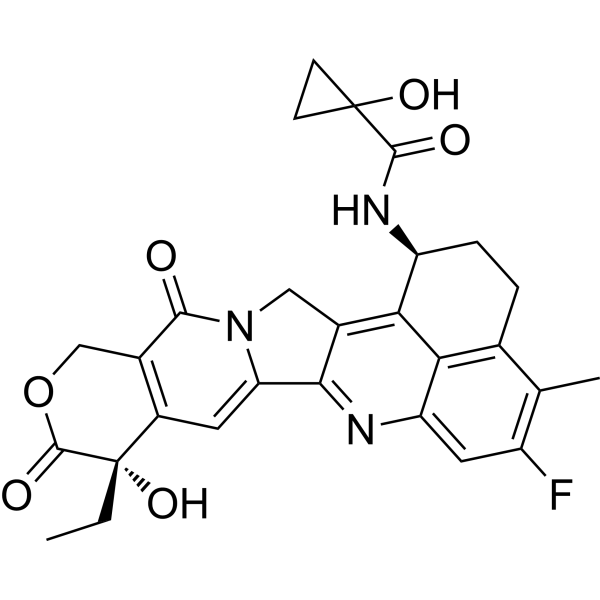
    Exatecan-amide-cyclopropanol (compound 1) is a anticancer agent. Exatecan-amide-cyclopropanol shows anti-proliferation activity against SK-BR-3 and U87 cells, with IC50 values of 0.12 and 0.23 nM, respectively .
    Exatecan-amide-cyclopropanol
  • HY-W190881

    Biochemical Assay Reagents Others
    N3-PEG11-CH2CH2Br is a PEG linker containing a bromine and an azide group. The hydrophilic PEG spacer increases solubility in aqueous media. The azide group can react with alkyne, BCN, DBCO via Click Chemistry to yield a stable triazole linkage. The bromine (Br) is a very good leaving group for nucleophilic substitution reactions.
    N3-PEG11-CH2CH2Br
  • HY-10062

    EBP-921

    Akt Farnesyl Transferase Cancer
    AZD3409 is a prenyl inhibitor that exhibits inhibitory activity against both farnesyl transferase and geranylgeranyl transferase I. AZD3409 inhibits the growth of breast cancer cells, with IC50s of 220 nM (MDA-MB-468), 180 nM (MDA-MB-361), and 290 nM (SK-Br-3). AZD3409 significantly reduces the activation level of AKT in breast cancer cell lines. AZD3409 induces G0/G1 phase arrest in MDA-MB-468 cells, causes G2/M phase arrest in MDA-MB-361 cells. AZD3409 can be used for the study of breast cancer .
    AZD3409
  • HY-151615

    Fluorescent Dye Neurological Disease
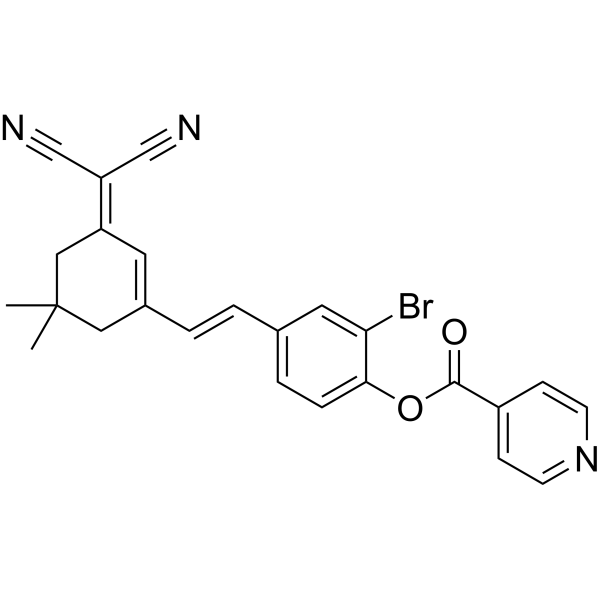
    DCI-Br-3 is a rapid, highly sensitive, and selective probe to monitor thiols in the epileptic brain. (λex=537 nm, λem=675 nm).DCI-Br-3 can effectively cross the blood-brain barrier (BBB) .
    DCI-Br-3
  • HY-P992424

    TNF Receptor Inflammation/Immunology
    NMB04 is a recombinant anti-Human CD257 (BAFF) (BLyS) antibody. NMB04 binds with specificity and high affinity to soluble and membrane-bound Blys, and blocks Blys binding to receptors TACI, BCMA, and BR-3. NMB04 can be used for the research of autoimmune diseases .
    NMB04
  • HY-N1265

    Others Cancer
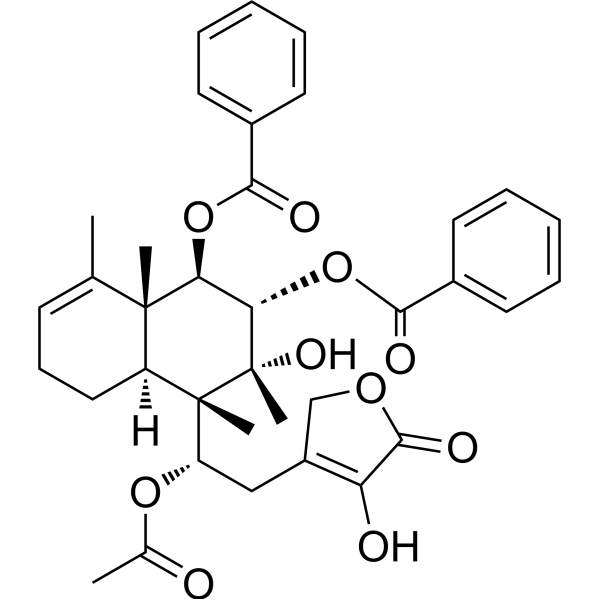
    Scutebata A is a diterpenoid isolated from Scutellaria barbata that exhibits antitumor activity. Scutebata A is weakly cytotoxic against SK-BR-3 with an IC50 value of 15.2 μM .
    Scutebata A
  • HY-173640

    Androgen Receptor Phosphodiesterase (PDE) Cancer
    ID11916 is an orally active androgen receptor (AR) antagonist and a phosphodiesterase 5 (PDE5) inhibitor. ID11916 blocks androgen binding to AR, nuclear translocation, and androgen-dependent transcriptional activity of AR, while increasing intracellular cGMP levels and activating PKG via inhibition. ID11916 shows potent anti-cancer effect in prostate cancer cell lines VCaP and 22Rv1 and in AR-positive breast cancer cell lines SK-BR-3 .
    ID11916
  • HY-P10393

    ERα (295-311)

    Apoptosis Cancer
    ERα17p (ERα 295-311) is the epitope of the CaM binding site on the estrogen receptor α (ER), which interacts with calmodulin (CaM) in a calcium-dependent manner. ERα17p regulates the migration of cancer cells MCF-7, SK-BR-3, T47D, and MDA-MB-231 through Rho/ROCK and PI3K/Akt signaling pathways. ERα17p inhibits proliferations of breast cancer cells, induces apoptosis, and inhibits tumor growth in mouse models [3].
    ERα17p
  • HY-159519

    Apoptosis EGFR Cancer
    EGFR/HER2-IN-16 (compound 12K) is an effective dual-target inhibitor of EGFR (IC50=6.15 nM) and HER-2 (IC50=9.78 nM) with anti-tumor activity. EGFR/HER2-IN-16 can inhibit the migration of SK-BR-3 cells, arrest the cell cycle in the G0/G1 phase, and induce apoptosis. EGFR/HER2-IN-16 exhibits good anti-proliferative activity against tumor cell models and has little damage to healthy cells. EGFR/HER2-IN-16 can be used in breast cancer research .
    EGFR/HER2-IN-16

Inquiry Online

Your information is safe with us. * Required Fields.

Salutation


Country or Region *

Applicant Name *


Organization Name *

Department *


Email Address *


Product Name *

Cat. No.


Requested quantity *

Phone Number *


Remarks

Inquiry Online

Inquiry Information

Product Name:
Cat. No.:
Quantity:
MCE Japan Authorized Agent:

