1. Search Result
Search Result
Results for "

Basidiomycete fungi

" in MedChemExpress (MCE) Product Catalog:

10

Inhibitors & Agonists

2

Natural
Products

Cat. No. Product Name Target Research Areas Chemical Structure
  • HY-126224

    Biochemical Assay Reagents Others
    Driselase, Basidiomycetes sp, a complex mixt. of wall-digesting enzymes, is a specific commercial fungal protoplasting enzyme preparation. Driselase can be used in combination with lyase to promote protoplast formation in fungi. Driselase is by far the most potent of the enzymes tested for polysaccharide digestion and greatly increases both tensile and indentation compliances, yet it does not induce wall creep, even after 6 h of digestion .
    Driselase, Basidiomycetes sp
  • HY-A0278

    (-)-Hexaconazol

    Environmental Pollutants Reactive Oxygen Species (ROS) Fungal SOD Infection Endocrinology
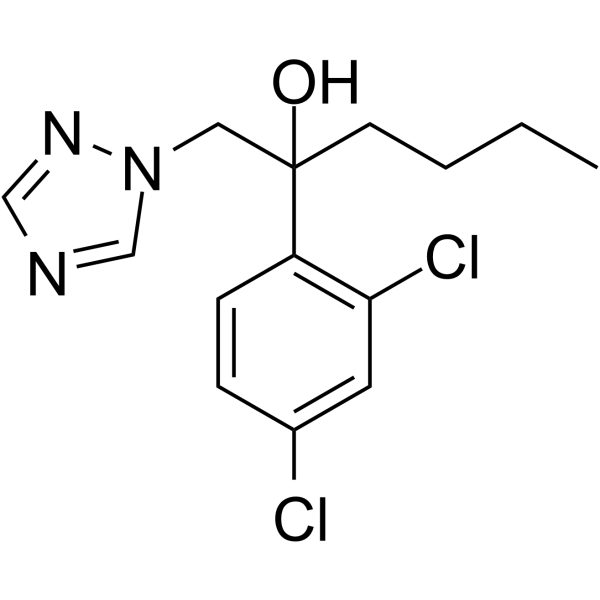
    Hexaconazole is a demethylation enzyme inhibitor and a synthetic fungicide that targets many fungi, especially ascomycetes and basidiomycetes, and it can enhance the activity of SOD and peroxidase. Hexaconazole causes endocrine disorders in zebrafish larvae .
    Hexaconazole
  • HY-B2011

    Environmental Pollutants Succinate Dehydrogenase Fungal Mitochondrial Metabolism Infection
    Flutolanil is a succinate dehydrogenase complex inhibitor and fungicide. Flutolanil blocks electron transfer between the redox center of succinate dehydrogenase and coenzyme Q, inhibits mycelial oxygen consumption, and suppresses mycelial growth. Flutolanil induces acute and sublethal toxicity in zebrafish at different life stages. Flutolanil can be used in studies on plant disease control .
    Flutolanil
  • HY-N14548

    Antibiotic Bacterial Infection
    Cryptosporiopsin can be isolated from the strain of Cryptosporiopsis sp. and Sporormia affinis. Cryptosporiopsin has antibacterial activity to many kinds of basidiomycetes, algal fungi, ascomycetes and hemiplegia fungi that cause wood rot, and can inhibit spore germination of Phytophthora potatoes. Cryptosporiopsin also has certain activity against gram-positive bacteria and negative bacteria .
    Cryptosporiopsin
  • HY-124408

    Fungal Infection
    Mepronil, a compound belonging to the carboxyamine group of fungicides, has a particularly strong bactericidal effect on basidiomycete fungi. Mepronil acts as a single point inhibitor of the succinate ubiquinone reductase or succinate dehydrogenase complex. Mepronil can be used in the study of cross resistance and biological infection .
    Mepronil
  • HY-124408R

    Reference Standards Fungal Infection
    Mepronil (Standard) is the analytical standard of Mepronil. This product is intended for research and analytical applications. Mepronil, a compound belonging to the carboxyamine group of fungicides, has a particularly strong bactericidal effect on basidiomycete fungi. Mepronil acts as a single point inhibitor of the succinate ubiquinone reductase or succinate dehydrogenase complex. Mepronil can be used in the study of cross resistance and biological infection .
    Mepronil (Standard)
  • HY-W043791

    Fungal Infection
    4-Dodecyl-2,6-dimethylmorpholine is a morpholine fungicide and plant-growth regulator. 4-Dodecyl-2,6-dimethylmorpholine targets phytopathogenic fungi including Oomycetes, Ascomycetes and Basidiomycetes. 4-Dodecyl-2,6-dimethylmorpholine acts synergistically with acylalanine fungicides to enhance antifungal efficacy and regulate plant growth. 4-Dodecyl-2,6-dimethylmorpholine can be applied to the study of plant fungal diseases and phytopathogenic fungal infections .
    4-Dodecyl-2,6-dimethylmorpholine
  • HY-182477

    Antibiotic Bacterial Fungal Infection
    Siccayne, found in the marine basidiomycete Halocyphina villosa and deuteromycete Helminthosporium siccans, is an antibiotic. Siccayne interferes with nucleotide incorporation into DNA and RNA, precursor transport enzymatic reactions, and essential macromolecule synthesis. Siccayne inhibits Gram-positive bacteria and some fungi. Siccayne can be used for research on infections caused by bacteria and fungi .
    Siccayne
  • HY-149151

    Endogenous Metabolite PKC Glycosidase TNF Receptor Reactive Oxygen Species (ROS) Infection Inflammation/Immunology
    Variegatic acid is a secondary metabolite derived from basidiomycete fungi. Variegatic acid is a PKCβ1 inhibitor with an IC₅₀ of 36.2 μM. Variegatic acid inhibits antigen- or calcium ionophore-induced β-hexosaminidase release (IC₅₀ values of 10.4 μM and 22.2 μM, respectively) and TNF-α secretion (IC₅₀ values of 16.8 μM and 20.1 μM, respectively). Variegatic acid suppresses the enzymatic activity of calcium-activated PKCβ1 and reduces Fe(III) to Fe(II) in a pH-dependent manner, enabling the generation of hydroxyl radicals (·OH) through reaction with H₂O₂, which facilitates the degradation of lignocellulose. Variegatic acid is useful for studying biological degradation and allergic responses.
    Variegatic acid
  • HY-165191

    Fungal Infection
    LY214352 is an antifungal agent that targets dihydroorotate dehydrogenase (DHO-DH). LY214352 exhibits antifungal activity against Aspergillus nidulans and agriculturally important ascomycete fungi. LY214352 can be used in studies related to grape gray mold, apple scab, and fungal infections caused by ascomycetes .
    LY214352

Inquiry Online

Your information is safe with us. * Required Fields.

Salutation


Country or Region *

Applicant Name *


Organization Name *

Department *


Email Address *


Product Name *

Cat. No.


Requested quantity *

Phone Number *


Remarks

Inquiry Online

Inquiry Information

Product Name:
Cat. No.:
Quantity:
MCE Japan Authorized Agent:

