1. Search Result
Search Result
Results for "

Ferlin Family

" in MedChemExpress (MCE) Product Catalog:

1221

Inhibitors & Agonists

16

Screening Libraries

13

Fluorescent Dyes

29

Biochemical Assay Reagents

104

Peptides

1

MCE Kits

21

Inhibitory Antibodies

167

Natural
Products

392

Recombinant Proteins

38

Isotope-Labeled Compounds

317

Antibodies

5

Click Chemistry

147

Oligonucleotides

1

GMP Molecules

Cat. No. Product Name Target Research Area
  • HY-P1410
    GsMTx4
    Maximum Cited Publications
    112 Publications Verification

    TRP Channel Piezo Channel Cardiovascular Disease Neurological Disease Inflammation/Immunology
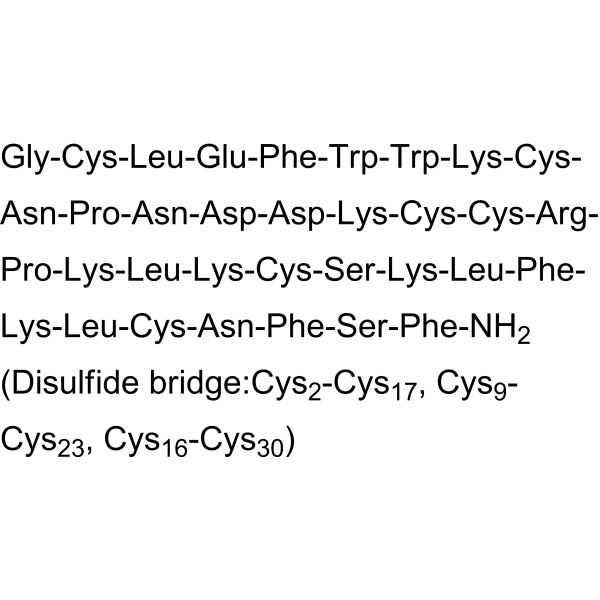
    GsMTx4 is a spider venom peptide that selectively inhibits cationic-permeable mechanosensitive channels (MSCs) belonging to the Piezo and TRP channel families. GsMTx4 also blocks cation-selective stretch-activated channels (SACs) , attenuates lysophosphatidylcholine (LPC)-induced astrocyte toxicity and microglial reactivity. GsMTx4 is an important pharmacological tool for identifying the role of these excitatory MSCs in normal physiology and pathology .
  • HY-P1410A
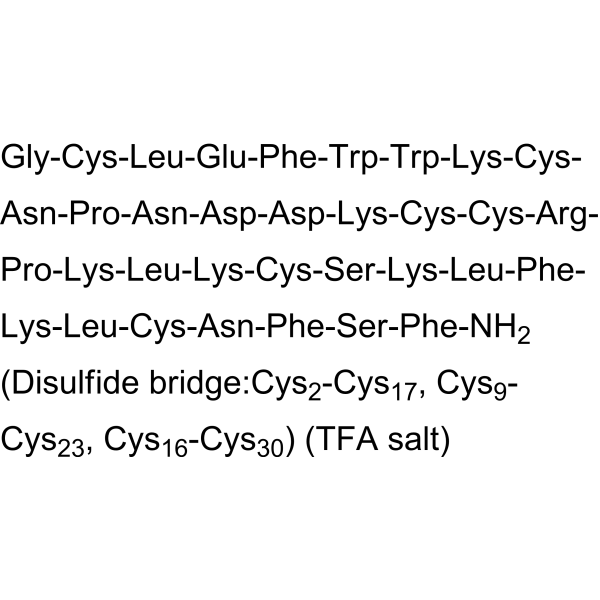
    GsMTx4 TFA
    Maximum Cited Publications
    112 Publications Verification

    TRP Channel Piezo Channel Cardiovascular Disease Neurological Disease Inflammation/Immunology
    GsMTx4 TFA is a spider venom peptide that selectively inhibits cationic-permeable mechanosensitive channels (MSCs) belonging to the Piezo and TRP channel families. GsMTx4 TFA also blocks cation-selective stretch-activated channels (SACs) , attenuates lysophosphatidylcholine (LPC)-induced astrocyte toxicity and microglial reactivity. GsMTx4 TFA is an important pharmacological tool for identifying the role of these excitatory MSCs in normal physiology and pathology .
  • HY-P0197
    Neurokinin A
    3 Publications Verification

    Substance K; Neurokinin α; Neuromedin L; NKA

    Neurokinin Receptor Neurological Disease Endocrinology
    Neurokinin A (Substance K), a peptide neurotransmitter of the tachykinin family, acts via the NK-2 receptor. Neurokinin A acts as a major mediator in human airway and gastrointestinal tissues .
  • HY-P0238

    Bombesin Receptor Cancer
    Gastrin-Releasing Peptide, human (GRP) belongs to the bombesin-like peptide family, and is not a classical hypothalamic-hypophyseal regulatory hormone since it plays only a perfunctory role in the mediation of pituitary hormone release.
  • HY-P1416
    Foxy-5
    5+ Cited Publications

    Wnt Cancer
    Foxy-5, a WNT5A agonist, is a mimicking peptide of WNT5A which is a non-canonical member of the Wnt family. Foxy-5 triggers cytosolic free calcium signaling without affecting β-catenin activation and it impairs the migration and invasion of epithelial cancer cells. Foxy-5 effectively reduces the metastatic spread of WNT5A-low prostate cancer cells in an orthotopic mouse model .
  • HY-P0241
    Neuromedin B
    1 Publications Verification

    Endogenous Metabolite Neurological Disease
    Neuromedin B (NMB) is a member of Bombesin (BN)-like peptide family in mammals.
  • HY-P0242

    Neurokinin Receptor Neurological Disease Endocrinology
    Neurokinin B belongs to the tachykinin family of peptides. Neurokinin B binds a family of GPCRs-including neurokinin receptor 1 (NK1R), NK2R, and NK3R-to mediate their biological effect .
  • HY-P0242A

    Neurokinin Receptor Neurological Disease Endocrinology
    Neurokinin B TFA belongs to the tachykinin family of peptides. Neurokinin B binds a family of GPCRs-including neurokinin receptor 1 (NK1R), NK2R, and NK3R-to mediate their biological effect .
  • HY-P0307

    Penetratin peptide

    Peptides Cancer
    Antennapedia Peptide (Penetratin peptide) is a 16 amino acid peptide, originally derived from the 60 amino acid long homeodomain of the Drosophila transcription factor Antennapedia and is a member of the family of cell-penetrating peptides.
  • HY-W250166

    Environmental Pollutants Biochemical Assay Reagents Others
    Poly(ethylene glycol) (12) tridecyl ether is a nonionic surfactant belonging to the family of ethoxylated fatty alcohols. It is commonly used as an emulsifier, solubilizer, and wetting agent in a variety of industrial and personal care products. Poly(ethylene glycol)(12) tridecyl ether has various properties that make it suitable for these applications, including its low toxicity, high solubility in water and organic solvents, and ability to stabilize emulsions. In addition, it can be used as a raw material for the production of other surfactants and specialty chemicals.
  • HY-P1527
    Bim BH3
    1 Publications Verification

    Bcl-2 Family Others
    Bim BH3 is a biological active peptide. (This Bim peptide belongs to the pro-apoptotic Bcl-2 family of proteins.)
  • HY-P3279
    EPQpYEEIPIYL
    1 Publications Verification

    Src Cancer
    EPQpYEEIPIYL, a phosphopeptide, is a Src homology 2 (SH2) domain ligand. EPQpYEEIPIYL activates Src family members (e.g. Lck, Hck, Fyn) by binding to SH2 domains .
  • HY-P1889

    Bcl-2 Family Inflammation/Immunology
    Bim BH3, Peptide IV is a 26-residue peptide from BH3-only protein Bim, which belongs to the pro-apoptotic group of the Bcl-2 family of proteins .
  • HY-P1189

    Integrin Metabolic Disease Inflammation/Immunology
    Echistatin, the smallest active RGD protein belonging to the family of disintegrins that are derived from snake venoms, is a potent inhibitor of platelet aggregation. Echistatin is a potent inhibitor of bone resorption in culture. Echistatin is a potent antagonist of αIIbβ3, αvβ3 and α5β1 .
  • HY-P11460

    Drug Derivative Infection
    Vectofusin-1 is a histidine-rich cationic amphipathic peptide derived from the LAH4 (HY-P0311) peptide family, and also acts as a Viral entry enhancer. Vectofusin-1 promotes the adhesion and fusion of retroviral/lentiviral vectors with cell membranes during viral entry, thereby improving transduction efficiency. Vectofusin-1 potently enhances lentiviral transduction of cells .
  • HY-P1985

    Notch Cardiovascular Disease Cancer
    Notch 1 (Notch homolog 1, translocation-associated) can encode a member of the NOTCH family of proteins. Members of this Type I transmembrane protein family share structural characteristics including an extracellular domain consisting of multiple epidermal growth factor-like (EGF) repeats, and an intracellular domain consisting of multiple different domain types .
  • HY-P0235

    Peptides Cancer
    CDK2 is a member of the eukaryotic S/T protein kinase family and its function is to catalyze the phosphoryl transfer of ATP γ-phosphate to serine or threonine hydroxyl (denoted as S0/T0) in a protein substrate.
  • HY-P1423A

    Bombesin Receptor Metabolic Disease Cancer
    BA 1 TFA is a potent agonist for the bombesin (BB) family of receptors. BA1 binds with high affinity to Bombesin receptor subtype-3 (BRS3), gastrin releasing peptide receptor (GRPR), neuromedin B receptor (NMBR) with IC50s of 6, 0.4, 2.5 nM .
  • HY-105343
    BW-180C
    1 Publications Verification

    [D-Ala2, D-Leu5]-Enkephalin; DADLE

    Opioid Receptor Neurological Disease
    BW-180C ([D-Ala2, D-Leu5]-Enkephalin; DADLE) is an δ opioid receptor (DOR) agonist, which belongs to the enkephalin family. Neuroprotective agent. BW-180C reversibly inhibits cellular transcription in neurons without causing cell injury .
  • HY-P1189A

    Integrin Metabolic Disease Inflammation/Immunology
    Echistatin TFA, the smallest active RGD protein belonging to the family of disintegrins that are derived from snake venoms, is a potent inhibitor of platelet aggregation. Echistatin is a potent inhibitor of bone resorption in culture. Echistatin is a potent antagonist of αIIbβ3, αvβ3 and α5β1 .
  • HY-P1416A
    Foxy-5 TFA
    5+ Cited Publications

    Wnt Cancer
    Foxy-5 TFA, a WNT5A agonist, is a mimicking peptide of WNT5A which is a non-canonical member of the Wnt family. Foxy-5 TFA triggers cytosolic free calcium signaling without affecting β-catenin activation and it impairs the migration and invasion of epithelial cancer cells. Foxy-5 TFA effectively reduces the metastatic spread of WNT5A-low prostate cancer cells in an orthotopic mouse model .
  • HY-P5481

    Peptides Others
    DABCYL-LPETG-EDANS is a biological active peptide. (This 5-amino acid peptide is a sortase substrate, C-terminal sorting signal. Sortase cleaves surface proteins at the LPXTG motif and catalyzes the formation of an amide bond between the carboxyl group of threonine and the amino group of cell-wall crossbridges. Sortases are a family of Gram-positive transpeptidases responsible for anchoring surface protein virulence factors to the peptidoglycan cell wall layer. Cleavage of this FRET substrate by sortase reveals the fluorescent signal, Abs/Em = 340/490 nm.)
  • HY-P1105

    Chloride Channel Neurological Disease
    GaTx2 is a seletive and a high affinity inhibitor of ClC-2 channels with a voltage-dependent apparent KD of ∼20 pM. GaTx2 is a peptide toxin inhibitor from Leiurus quinquestriatus hebraeus venom. GaTx2 is useful in determining the role and the membrane localization of ClC-2 in specific cell types .
  • HY-P0197A
    Neurokinin A TFA
    3 Publications Verification

    Substance K TFA; Neurokinin α TFA; Neuromedin L TFA; NKA TFA

    Neurokinin Receptor Neurological Disease Endocrinology
    Neurokinin A TFA (Substance K TFA), a peptide neurotransmitter of the tachykinin family, acts via the NK-2 receptor. Neurokinin A acts as a major mediator in human airway and gastrointestinal tissues .
  • HY-P1815

    Angiotensin Receptor Cardiovascular Disease Endocrinology
    C-Type Natriuretic Peptide (1-53), human is the 1-53 fragment of C-Type Natriuretic Peptide. C-Type Natriuretic Peptide is natriuretic peptide family peptide that is involved in the maintenance of electrolyte-fluid balance and vascular tone .
  • HY-P1815A

    Angiotensin Receptor Cardiovascular Disease Endocrinology
    C-Type Natriuretic Peptide (1-53), human TFA is the 1-53 fragment of C-Type Natriuretic Peptide. C-Type Natriuretic Peptide TFA is natriuretic peptide family peptide that is involved in the maintenance of electrolyte-fluid balance and vascular tone .
  • HY-P5390A

    Peptides Others
    GIP, rat TFA is a bioactive peptide of rat origin. (GIP (glucose-dependent insulinotropic polypeptide or also known as gastric inhibitory polypeptide) is a 42-amino acid peptide released by K cells in the duodenum and jejunum in response to food intake. GIP and GLP (gastric-like peptide) are both intestinal A member of the insulinotropic hormone peptide family that stimulates insulin secretion from pancreatic beta cells and appears to also promote beta cell proliferation and beta cell survival. Recent studies suggest that GIP plays a role in lipid homeostasis and may play a role in the pathogenesis of obesity function in the mechanism.
  • HY-P0274

    Bacterial Antibiotic Infection
    PGLa, a 21-residue peptide, is an antimicrobial peptide. PGLa is a member of the magainin family of antibiotic peptides found in frog skin and its secretions .
  • HY-P0004A
    Lysipressin acetate
    2 Publications Verification

    Lysine vasopressin acetate; [Lys8]-Vasopressin acetate

    Adenylate Cyclase Others
    Lysipressin (Lysine vasopressin) acetate is antidiuretic hormone that have been found in pigs and some marsupial families. Lysipressin acetate induces contraction of the rabbit urinary bladder smooth muscle, activate adenylate-cyclase .
  • HY-P5062A

    Decanoyl-Arg-Val-Arg-Lys-chloromethylketone TFA

    Furin Infection
    DEC-RVRK-CMK (Decanoyl-Arg-Val-Arg-Lys-chloromethylketone) TFA is a peptide-based CMK (chloromethylketone) inhibitor that targets and inactivates the secreted soluble kexin (Kex2) (Ki=8.45 μM). The yeast enzyme Kex2 (kexin, EC 3.4.21.61) is a calcium-dependent transmembrane protease and belongs to the mammalian protease family of the serine protease subtilisin family. The binding mechanism of Kex2 with different CMK inhibitors depends on substrate selectivity, particularly the selective differences between lysine and arginine at the P1 position .
  • HY-P5394

    Peptides Others
    Dby HY Peptide (608-622), mouse is a biological active peptide. (Dby HY Peptide, NAGFNSNRANSSRSS, is a HYAb epitope belonging to a well-conserved family of genes coding for known or putative RNA helicases and containing a core sequence with a DEAD (Asp-Glu-Ala-Asp) box peptide motif, hence the name Dby (Dead box RNA helicase Y). The single Phenylalanine in the sequence serves as the anchor point while FNSNRANSS most likely is the “core” sequence of this HYAb epitope.)
  • HY-P5419A

    Biochemical Assay Reagents Others
    WAAG-3R TFA is a biological active peptide. (Aggrecanases belong to the ADAMTS (A disintegrin and metalloprotease with thrombospondin motif) family of proteases. Aggrecanases cleave aggrecan, the major structural component of cartilage. Aggrecanase-1 (ADAMTS-4) is a major aggrecanase in human osteoarthritic cartilage. This FRET peptide was used in an ADAMTS-4 (Aggrecanase-1) and ADAMTS-5 (Aggrecanase-2) assay . (Ex/Em = 340/420 nm)
  • HY-P10365

    Adhesion G Protein-coupled Receptors (AGPCRs) Others
    Vmm-p15 is a peptide agonist optimized for the adhesion G protein-coupled receptor GPR64 (also known as ADGRG2 or HE6). The affinity of VPM-p15 with GPR64 is significantly higher than that of the original p15 peptide. The cAMP level induced by VMM-P15 increased significantly, activated GPR64, and triggered downstream Gs, Gq, and G12/13 signaling. VPM-p15 can be used to study the activation mechanism of adherent GPCR family members .
  • HY-P3636

    Pea-CAH-I

    Peptides Neurological Disease
    Cockroach Myoactive Peptide I (Pea-CAH-I) is a cockroach neuropeptide, a member of the adipokinetic hormone/red pigment-concentrating hormone family (AKH/RPCH family) .
  • HY-P3635

    Pea-CAH-II

    Peptides Neurological Disease Metabolic Disease
    Cockroach Myoactive Peptide II (Pea-CAH-II) is a cockroach neuropeptide. Cockroach Myoactive Peptide II is a member of the adipokinetic hormone/red pigment concentrating hormone (AKH/RPCH) family. Cockroach Myoactive Peptide II can be used for the research of metabolic functions of insect body .
  • HY-P1985A

    Notch Cardiovascular Disease Cancer
    Notch 1 TFA (Notch homolog 1, translocation-associated) can encode a member of the NOTCH family of proteins. Members of this Type I transmembrane protein family share structural characteristics including an extracellular domain consisting of multiple epidermal growth factor-like (EGF) repeats, and an intracellular domain consisting of multiple different domain types .
  • HY-P1797A

    Peptides Others
    Sakamototide substrate peptide TFA is a peptide substrate for members of the AMPK family of kinases, used in kinase activity assays .
  • HY-P0307A

    Penetratin peptide TFA

    Peptides Inflammation/Immunology Cancer
    Antennapedia Peptide (Penetratin peptide) TFA is a 16 amino acid peptide, originally derived from the 60 amino acid long homeodomain of the Drosophila transcription factor Antennapedia and is a member of the family of cell-penetrating peptides.
  • HY-P5062

    Decanoyl-Arg-Val-Arg-Lys-chloromethylketone

    Furin Infection
    DEC-RVRK-CMK (Decanoyl-Arg-Val-Arg-Lys-chloromethylketone) is a peptide-based CMK (chloromethylketone) inhibitor that targets and inactivates the secreted soluble kexin (Kex2) (Ki=8.45 μM). The yeast enzyme Kex2 (kexin, EC 3.4.21.61) is a calcium-dependent transmembrane protease and belongs to the mammalian protease family of the serine protease subtilisin family. The binding mechanism of Kex2 with different CMK inhibitors depends on substrate selectivity, particularly the selective differences between lysine and arginine at the P1 position .
  • HY-P3831

    Interleukin Related Inflammation/Immunology
    β-Interleukin II (44-56) is a 44-56 fragment of beta-interleukin II polypeptide. Interleukin family are a group of cytokines associated with immune system, mainly expressed by leukocytes .
  • HY-P1441

    Sodium Channel Others
    Mambalgin-1 is a toxin isolated from black mamba venom. Mambalgin-1 is a disulfide-rich polypeptide consisting of 57 amino acids and belongs to the family of three-finger toxins. Mambalgin-1 can bind to and stabilize ASICs (acid-sensing ion channels) in a physiologically relevant closed-channel conformation .
  • HY-124237

    Bacterial Others
    N-Octanoyl-DL-homoserine lactone is a member of N-acyl homoserine lactones (AHLs) family, also one of the signal molecule of quorum-sensing (QS) signals. N-Octanoyl-DL-homoserine lactone can regulate the production of siderophores and present positive correlation in Aeromonas sobria strain AS7. N-Octanoyl-DL-homoserine lactone can also regulate the secretion of proteases and stimulate the production of total volatile basic nitrogen (TVB-N) .
  • HY-P5925A

    SsTx Toxin TFA

    Potassium Channel Neurological Disease Inflammation/Immunology
    Ssm Spooky Toxin TFA is found in Scolopendra mutilans that potently inhibits KCNQ (voltage-gated potassium channel family 7) channels, with IC50s of 2.8 μM, 5.26 μM and 0.1-0.3 M for Kv7.4, Kv1.3, and Shal channel, respectivily. Ssm Spooky Toxin TFA inhibits cytokine generation by specifically acting on the KV1.3 channel in T cells. Ssm Spooky Toxin TFA plays an essential role in the centipede’s circulatory system .
  • HY-P3633

    Lom-TK II

    Peptides Neurological Disease
    Locustatachykinin II (Lom-TK II) is an insect neuropeptide with homology to peptides of the vertebrate tachykinin family. Locustatachykinin II can be used for the research of insect endocrine .
  • HY-P1574A

    Vasotocin TFA; Argiprestocin TFA; Arginine vasotocin TFA

    Vasopressin Receptor Oxytocin Receptor Neurological Disease
    [Arg8]-Vasotocin (TFA) is a vertebrate neurohypophyseal peptide of the vasopressin/oxytocin hormone family .
  • HY-P3812

    DYRK Neurological Disease
    Woodtide is a substrate for the DYRK (DYRK) family of kinases whose sequence is based on that around the DYRK phosphorylation site in FKHR .
  • HY-P10614

    Apoptosis Bcl-2 Family Others
    Bid BH3 peptide is a small peptide derived from Bid protein that can bind and activate the pro-apoptotic proteins Bax and Bak, leading to mitochondrial outer membrane permeabilization (MOMP) and apoptosis. Bid BH3 peptide can be used to study mitochondrial bioenergetics .
  • HY-P11289

    Apoptosis Cardiovascular Disease
    Intermedin1-53 (Human) is a 53-aa human calcitonin family peptide that reduces the vulnerability of atherosclerotic plaques by inhibiting CHOP-mediated macrophage apoptosis and inflammasome .
  • HY-P4807

    Hez-PBAN

    Peptides Neurological Disease
    Pheromone Biosynthesis Activating Neuropeptide (Helicoverpa assulta, Heliothis zea) (PBAN), a member of the PBAN/Pyrokinin neuropeptide family, characterized by a common amino acid sequence FXPRLamide motif in the C-terminus .
  • HY-P3050

    GCGR Cardiovascular Disease
    Helospectin II is a neuropeptide of the vasoactive intestinal peptide (VIP) family. Helospectin II has vasodilatory and antihypertensive activities, and decreases blood pressure. Helospectin II is originally isolated from the salivary gland venom of the lizard Heloderma suspectum .

Inquiry Online

Your information is safe with us. * Required Fields.

Salutation


Country or Region *

Applicant Name *


Organization Name *

Department *


Email Address *


Product Name *

Cat. No.


Requested quantity *

Phone Number *


Remarks

Inquiry Online

Inquiry Information

Product Name:
Cat. No.:
Quantity:
MCE Japan Authorized Agent:

