15 Results for "

G2/M phase mitotic arrest

" in MedChemExpress (MCE) Product Catalog:
Products (15)

15 Results for "G2/M phase mitotic arrest" in MCE Product Catalog:

Cat. No.: HY-112607
CAS No.: 2237054-53-2
Purity:  99.81%
Research Areas:  

Cancer

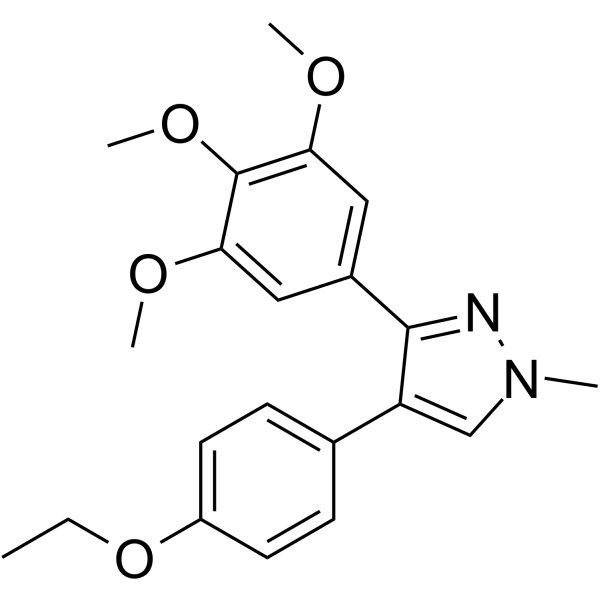
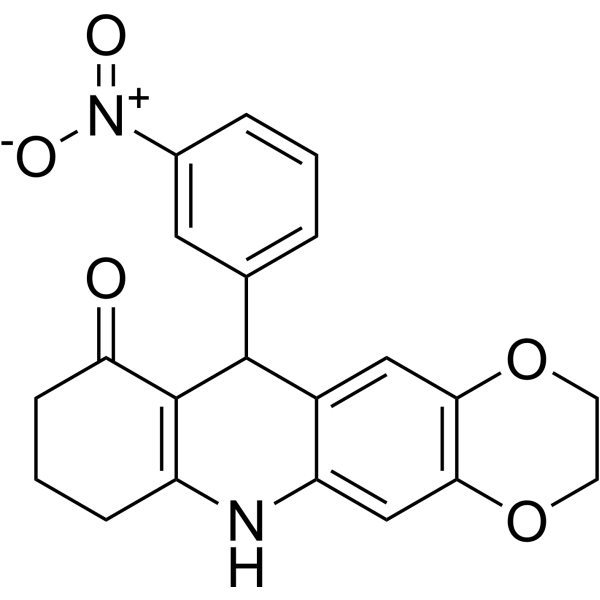
Tubulin inhibitor 1 is a tubulin inhibitor, inhibits tubulin polymerization. Tubulin inhibitor 1 shows potent anti-tumor activity, casues cellular mitotic arrest in the G2/M phase, and induces cellular apoptosis .
loading...
    loading...
Cat. No.: HY-146792
CAS No.: 2622273-55-4
Research Areas:  

Cancer

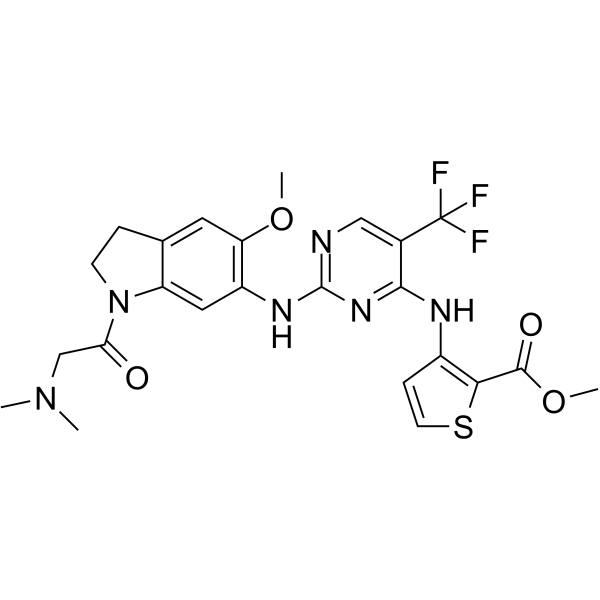
PLK1-IN-4 is a potent and selective PLK1 inhibitor with IC50 < 0.508 nM. PLK1-IN-4 has broad antiproliferative activity against a variety of cancer cell lines. PLK1-IN-4 induces mitotic arrest at the G2/M phase checkpoint, leading to cancer cell apoptosis. PLK1-IN-4 can be used for researching hepatocellular carcinoma .
loading...
    loading...
Cat. No.: HY-173274
CAS No.: 3056259-55-0
Target:  

Molecular Glues

Research Areas:  

Cancer

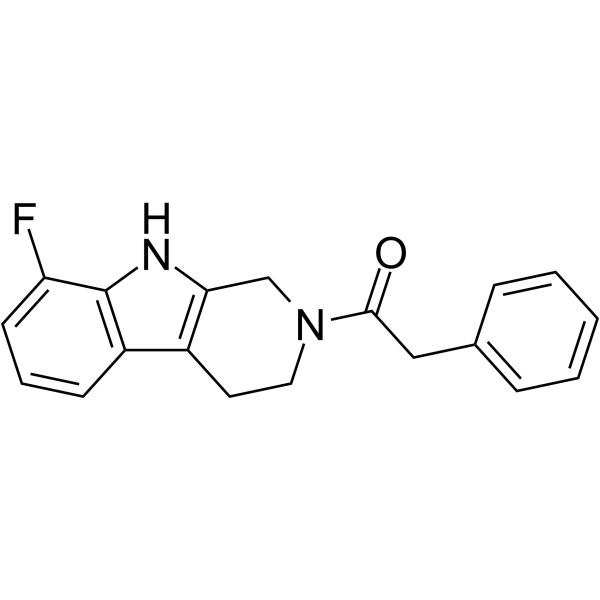
CB039 is a RBM39 molecular glue degrader with an IC50 of 36.7 nM against HCT-116 cells. CB039 induces RBM39 degradation in a dose- and time-dependent manner. This process depends on the Cullin-RING E3 ubiquitin ligase complex (CRL) and proteasome, and promotes the recruitment of RBM39 to the DCAF15-DDB1 complex with an IC50 of 594 nM. CB039 causes abnormal RNA splicing, reduces CEP192 protein levels, induces G2/M phase cell cycle arrest and mitotic spindle disorder. CB039 can be used in studies on RBM39-targeted protein degradation and colorectal cancer-related mechanisms .
loading...
    loading...
Cat. No.: HY-120339
CAS No.: 1578247-29-6
STK899704 is a tubulin polymerization inhibitor. STK899704 exhibits broad-spectrum inhibitory activity against various cancer cell lines with IC50 values ​​ranging from 0.2 to 1.0 μM. STK899704 disrupts the mitotic spindle structure, inducing G2/M phase cell cycle arrest. STK899704 inhibits the migration ability of HT29 cells by downregulating the FAK-MEK-ERK signaling pathway, thereby suppressing the expression and activity of MMP-2 and MMP-9. STK899704 activates caspase-3/7/8/9, leading to PARP cleavage and inducing apoptosis. STK899704 induces cellular senescence through the p53 pathway. STK899704 can be used in research on skin cancer, lung cancer, colon cancer, and other cancers .
loading...
    loading...
Cat. No.: HY-122249
CAS No.: 946507-08-0
Target:  

Microtubule/Tubulin

Research Areas:  

Cancer

MT-7 is a potent mitotic inhibitor. MT-7 shows antiproliferative activity. MT-7 induces cell cycle arrest at G2/M phase. MT-7 induces specific, reversible mitotic arrest and inhibits the polymerization of cellular microtubules .
loading...
    loading...
Cat. No.: HY-143660
CAS No.: 1428341-65-4
Research Areas:  

Cancer

LG308 is a novel synthetic compound with antimicrotubule activity. LG308 induces mitotic phase arrest and inhibits G2/M progression significantly which is associated with the upregulation of cyclin B1 and mitotic marker MPM-2 and the dephosphorylation of cdc2. LG308 also induces apoptosis and cell death. LG308 significantly suppresses tumor growth. LG308 with antimitotic activity has the potential for the research of prostate cancer .
loading...
    loading...
Cat. No.: HY-149376
Target:  

Microtubule/Tubulin

Research Areas:  

Cancer

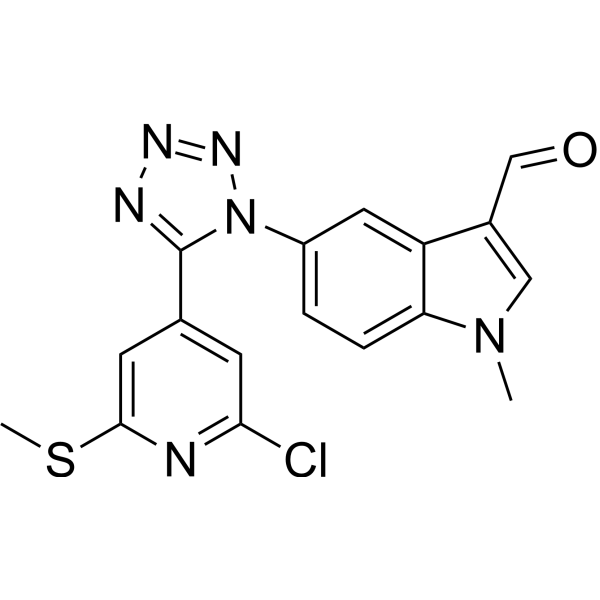
Tubulin inhibitor 38 (compound 14) is a tetrazole-based Tubulin inhibitor with antiproliferative potencies. Tubulin inhibitor 38 (100 nM,24 h) mediates mitotic arrest,blocks cell cycle at G2/M phase and induces apoptosis. Tubulin inhibitor 38 exhibits high cytotoxicity with high selectivity index among HeLa,MCF7,and U87 MG cells .
loading...
    loading...
Cat. No.: HY-156088
CAS No.: 3053861-26-7
Research Areas:  

Cancer

SSE1806 is a derivative of podophyllotoxin (a natural antimitotic agent) and a microtubule/tubulin inhibitor with significant anticancer and antiproliferative activities. The GI50 of SSE1806 on cancer cell growth ranges from 1.29-21.15 μM. SSE1806 causes mitotic abnormalities and G2/M phase arrest, increases p53 expression, and inhibits colon cancer organoid growth. SSE1806 is able to overcome multidrug resistance in cell lines overexpressing MDR-1 .
loading...
    loading...
Cat. No.: HY-400684
Target:  

Bacterial

Research Areas:  

Cancer

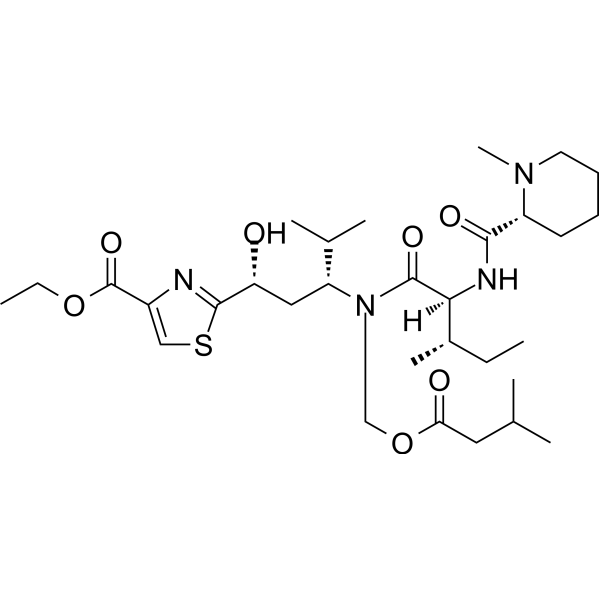
Tubulysin A intermediate-1 is an intermediate in the synthesis of the cytotoxic peptide Tubulysin A (HY-15995). Tubulysin A (TubA) is an antibiotic, anti-microtubule toxins, and apoptosis inducer isolated from myxobacteria. Tubulysin A has anti-angiogenic, anti-microtubule, anti-mitotic, and anti-proliferative activities. Tubulysin A arrests cells in the G2/M phase, effectively inhibits tubulin polymerization, and induces depolymerization of detached microtubules. Tubulysin A acts as an ADC cytotoxin (ADC Cytotoxin) to synthesize ADC .
loading...
    loading...
Cat. No.: HY-179696
CAS No.: 2734582-91-1
Research Areas:  

Cancer

destabilizing agent-3 (HY-179695). Microtubule destabilizing agent-3 is a microtubule destabilizing agent. Microtubule destabilizing agent-3 exerts its antimyeloma phenotypes by destabilizing microtubules and promoting mitotic arrest, leading to cell death. Microtubule destabilizing agent-3 induces G2/M phase arrest and caspase-dependent apoptosis .
loading...
    loading...
Cat. No.: HY-179695
Research Areas:  

Cancer

Microtubule destabilizing agent-3, a B32B3 (HY-12240) analog, is a microtubule destabilizing agent. Microtubule destabilizing agent-3 exerts its antimyeloma phenotypes by destabilizing microtubules and promoting mitotic arrest, leading to cell death. Microtubule destabilizing agent-3 induces G2/M phase arrest and caspase-dependent apoptosis. Microtubule destabilizing agent-3 can be used for the research of multiple myeloma .
loading...
    loading...
Cat. No.: HY-118447
CAS No.: 443913-79-9
Target:  

CDK Survivin

Research Areas:  

Cancer

RO0505124 is a selective CDK4 inhibitor with an IC50 of 20 nM. RO0505124 reversibly binds the ATP pocket of the kinase. RO0505124 induces G1 phase arrest in cancer cells via reduced retinoblastoma protein (Rb) phosphorylation, blocking S phase progression. RO0505124 exhibits anti-proliferative activity against various cancer cells. RO0505124 delays mitosis, induces aberrant mitosis with lagging chromosomes, driving mitotic slippage and formation of multinucleated or micronucleated cells. RO0505124 inhibits G2/M phase accumulation of survivin and borealin. RO0505124 can be used for the research of cancer .
loading...
    loading...
Cat. No.: HY-183427
CAS No.: 2660138-04-3
Research Areas:  

Cancer

KBJK557 is a Plk1 PBD inhibitor with a human-derived IC50 value of 3.05 μM. KBJK577 binds to Plk1 PBD through electrostatic interactions, π-π stacking, hydrogen bonds, salt bridges and hydrophobic interactions, thereby disrupting the subcellular localization and function of Plk1. KBJK557 induces mitotic arrest, S-phase delay, G2/M-phase arrest and apoptosis, and inhibits cancer cell proliferation. KBJK557 can be used in research related to cancer and non-small cell lung cancer .
loading...
    loading...
Cat. No.: HY-13614
CAS No.: 610787-07-0
E7974 is a selective inhibitor of α-tubulin (α-tubulin) with an IC50 of 3.9 μM. E7974 disrupts mitotic spindle formation, induces G2-M phase cell cycle arrest, initiates apoptosis, activates caspase-3, and induces poly (ADP-ribose) polymerase cleavage. E7974 reduces the area of choroidal neovascularization in mouse models, and exerts anti-angiogenic effects when loaded in modified micelles. E7974 can be used in research related to cancer and choroidal neovascularization .
loading...
    loading...
Cat. No.: HY-181074
Tubulin polymerization-IN-88 is a tubulin inhibitor that blocks tubulin polymerization, leading to microtubule destabilization and disruption of the mitotic spindle. Tubulin polymerization-IN-88 induces G2/M phase arrest and apoptosis in cancer cells, and inhibits cancer cell migration and self-renewal of cancer stem cells. It exhibits in vitro anti-proliferative activity against cancer cells with selectivity over normal cells. Tubulin polymerization-IN-88 also demonstrates in vivo anti-cancer activity without significant toxicity. Tubulin polymerization-IN-88 is applicable for research on glioblastoma, lung cancer, endometrial cancer, ovarian cancer, and leukemia .
loading...
    loading...
  • 1

