1. Search Result
Search Result
Results for "

HR repair

" in MedChemExpress (MCE) Product Catalog:

12

Inhibitors & Agonists

6

Antibodies

Cat. No. Product Name Target Research Areas Chemical Structure
  • HY-114778
    Fluzoparib
    4 Publications Verification

    SHR3162; Fuzuloparib

    PARP Cancer
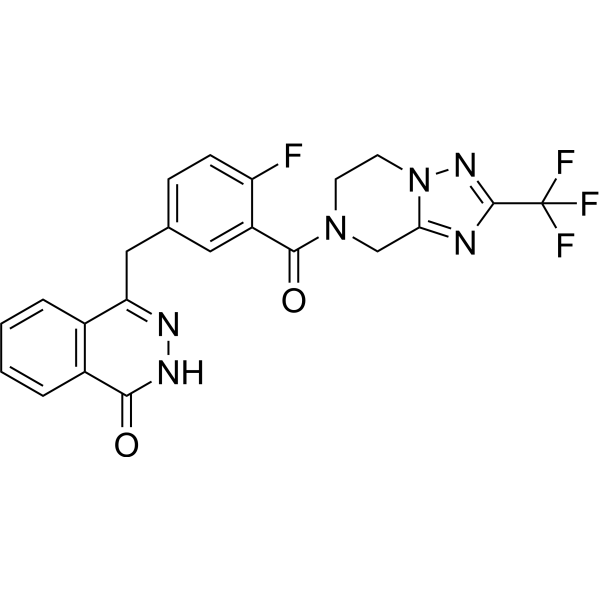
    Fluzoparib (SHR3162) is a potent and orally active PARP1 inhibitor (IC50=1.46±0.72 nM, a cell-free enzymatic assay) with superior antitumor activity. Fluzoparib selectively inhibits the proliferation of homologous recombination repair (HR)-deficient cells, and sensitizes both HR-deficient and HR-proficient cells to cytotoxic agents. Fluzoparib exhibits good pharmacokinetic properties in vivo and can be used for BRCA1/2-mutant relapsed ovarian cancer research .
    Fluzoparib
  • HY-116770
    PFM01
    5 Publications Verification

    Endonuclease Cancer
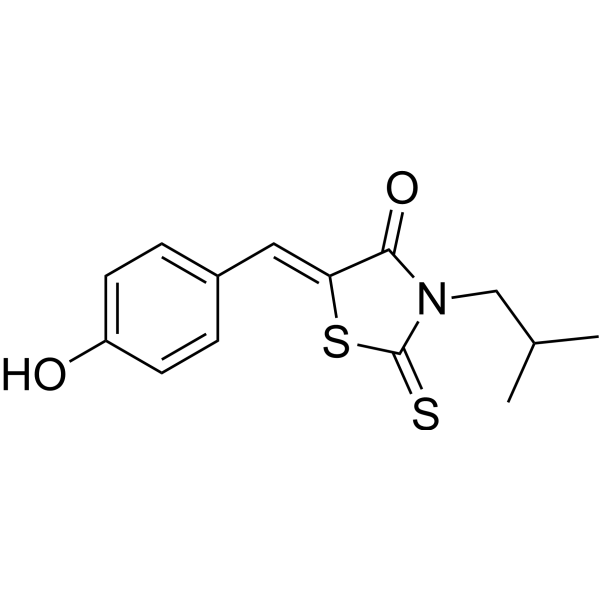
    PFM01, N-alkylated Mirin derivative, is a MRE11 endonuclease inhibitor. PFM01 can regulate double-strand break repair (DSBR) by nonhomologous end-joining (NHEJ) versus homologous recombination (HR) .
    PFM01
  • HY-115552

    PARP Cancer
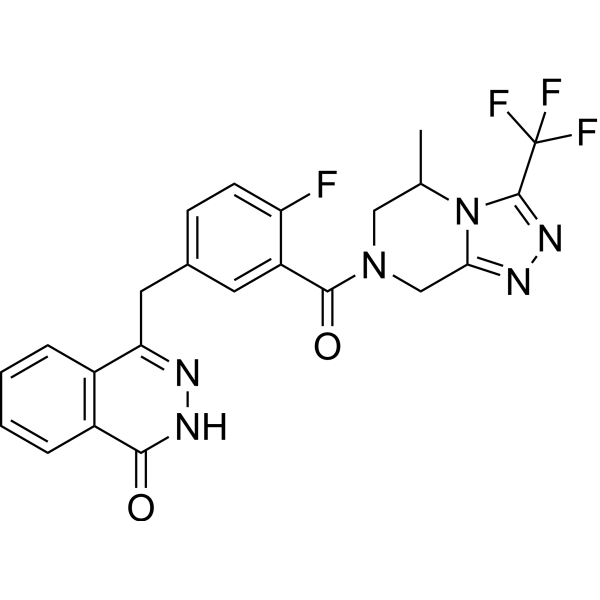
    Simmiparib is a highly potent and orally active PARP1 and PARP2 inhibitor with IC50 values of 1.75 nM and 0.22 nM, respectively. Simmiparib has more potent PARP1/2 inhibition than its parent Olaparib (HY-10162). Simmiparib induces DNA double-strand breaks (DSB) accumulation and G2/M arrest in homologous recombination repair (HR)-deficient cells, thereby inducing apoptosis. Simmiparib exhibits remarkable anticancer activities in cells and nude mice bearing xenografts .
    Simmiparib
  • HY-162384

    Histone Methyltransferase Cancer
    EPIC-0628 is an inhibitor of the HOTAIR-EZH2 interaction and promotes ATF3 expression. The long noncoding RNA HOTAIR has been found to regulate glioblastoma (GBM) progression and mediate DNA damage repair (DDR) by interacting with the catalytic subunit EZH2 of PRC2. EPIC-0628 also inhibits the ATF3-p38-E2F1 DDR pathway to inhibit the HR pathway and upregulates CDKN1A (p21) expression, causing cell cycle arrest. EPIC-0628 also synergizes with Temozolomide (TMZ) (HY-17364) to enhance its in vivo potency .
    EPIC-0628
  • HY-175812

    Endonuclease Cancer
    MU876 (Compound 32) is a MUS81 inhibitor with an IC50 of 0.5  μM. MU876 effectively inhibits MUS81-dependent homologous recombination (HR) and break-induced replication (BIR) pathways. MU876 sensitizes cancer cells to DNA-damaging agents, such as Cisplatin (HY-17394), through impairing their ability to repair DNA lesions. MU876 can be used for cancers chemotherapy research .
    MU876
  • HY-144338

    Epigenetic Reader Domain PARP Apoptosis DNA/RNA Synthesis Cancer
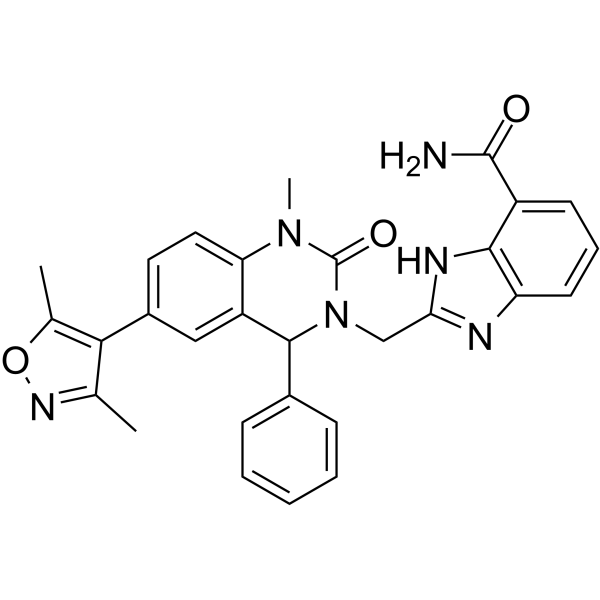
    PARP1/BRD4-IN-1 is a potent and high selective PARP1/BRD4 inhibitor (IC50s of 49 and 202 nM in PARP1 and BRD4, respectively). PARP1/BRD4-IN-1 represses the expression and activity of PARP1 and BRD4 to synergistically inhibit the malignant growth of pancreatic cancer cells .
    PARP1/BRD4-IN-1
  • HY-175466

    PARP DNA/RNA Synthesis Apoptosis Cancer
    BER-IN-1 is a base excision repair (BER) inhibtor, targeting DNA abasic sites. BER-IN-1 cleaves abasic sites via β- and β,δ-elimination mechanisms, disrupts the base excision repair (BER) pathway and leads to DNA double-strand breaks (DSBs). BER-IN-1 can enhance the effectiveness of the PARP inhibitor Olaparib (HY-10162) in homologous recombination (HR)-proficient cancer cells (MDA-MB-231, HeLa, and SKOV3). BER-IN-1 induces an S-phase arrest and apoptosis companied with Olaparib (HY-10162). BER-IN-1 can be used for the research of cancer, such as breast, cervical and ovarian cancer .
    BER-IN-1
  • HY-126972

    RAD51 Cancer
    RI(dl)-2 blocks RAD51’s D-loop activity in biochemical systems with an IC50 value of 11.1 µM and inhibits homologous recombination (HR) activity with an IC50 value of 3.0 µM. RI(dl)-2 inhibits HR-mediated repair of DNA double strand breaks and sensitizes different cancer cell lines .
    RI(dl)-2
  • HY-146194

    Reactive Oxygen Species (ROS) Cancer
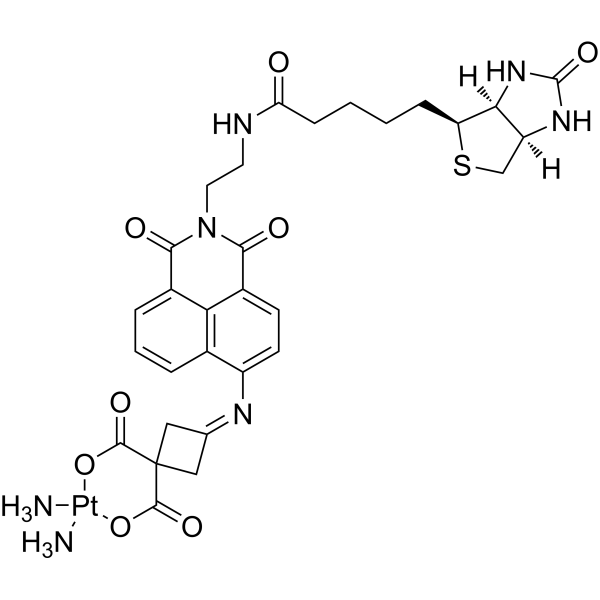
    NHEJ inhibitor-1 (Compound C2) is a trifunctional Pt(II) complex, alleviates the non-homologous end connection (NHEJ)/homologous recombination (HR)-related double strand breaks (DSBs) repairs to evade Cisplatin-resistance in non-small cell lung cancer (NSCLC). NHEJ inhibitor-1 inhibits the damage repair proteins Ku70 and Rad51 to make tumors re-sensitive to Cisplatin. NHEJ inhibitor-1 also induces ROS generation and MMP deduction .
    NHEJ inhibitor-1
  • HY-181611

    DNA/RNA Synthesis Apoptosis Cytochrome P450 Cancer
    Polθ-IN-10 is an orally active Polθ-pol inhibitor (with a human IC50 of 1.3 nM) that exhibits oral bioavailability in mice and rats. Polθ-IN-10 binds to the allosteric site of Polθ-pol, disrupts the microhomology-mediated end-joining DNA repair pathway, and inhibits CYP2C9 (IC50=1.63 μM). Polθ-IN-10 selectively inhibits the proliferation of HR-deficient cancer cells and induces apoptosis. Polθ-IN-10 is applicable to the research of HR-deficient cancers .
    Polθ-IN-10
  • HY-181840

    Endonuclease Cancer
    MU262 is a MUS81 inhibitor with an IC50 value of 0.87 μM. MU262 directly inhibits the catalytic activity of MUS81 without interfering with DNA binding, induces genomic instability in tumor cells, and specifically inhibits the HR/BIR repair pathway. The combination of MU262 with Cisplatin (HY-17394) significantly enhances the chemotherapeutic killing effect. MU262 serves as a chemical biology tool for studying MUS81 function, and also acts as a lead compound for the development of anticancer therapies that exploit DNA repair defects in cancer cells .
    MU262
  • HY-181557

    DNA Alkylator/Crosslinker DNA/RNA Synthesis Apoptosis Cancer
    SY-589 is an orally active DNA polymerase Polθ helicase domain inhibitor (IC50=2.29 nM) and DNA damage inducer. SY-589 inhibits the ATPase activity of the Polθ helicase domain and blocks the Polθ-mediated microhomology-mediated end joining (MMEJ) DNA repair pathway (IC50=0.85 nM). SY-589 also induces the accumulation of DNA double-strand breaks by increasing γ-H2AX levels. SY-589 exerts antiproliferative effects on BRCA2-deficient cells and is used in the research of HR-deficient tumors .
    SY-589

Inquiry Online

Your information is safe with us. * Required Fields.

Salutation


Country or Region *

Applicant Name *


Organization Name *

Department *


Email Address *


Product Name *

Cat. No.


Requested quantity *

Phone Number *


Remarks

Inquiry Online

Inquiry Information

Product Name:
Cat. No.:
Quantity:
MCE Japan Authorized Agent:

