
27 Results for "

NS-1 cells

" in MedChemExpress (MCE) Product Catalog:
Products (27)

27 Results for "NS-1 cells" in MCE Product Catalog:

Cat. No.: HY-P0221C
CAS No.: 129405-61-4
Target:  

PACAP Receptor

Research Areas:  

Metabolic Disease

PACAP (1-38) free acid is a desamido-PACAP (1-38), human, ovine, rat (HY-P0221). PACAP (1-38) free acid can activate the human PAC1 receptor. PACAP (1-38) free acid induces cyclic AMP (cAMP) generation in both NS-1 neuroendocrine cells and non-neuroendocrine HEK293 cells .
loading...
    loading...
Cat. No.: HY-P10927A
Synonyms: BRINP2-related peptide TFA
Target:  

PKA AP-1

Research Areas:  

Metabolic Disease

BRP (BRINP2-related peptide) TFA is a 12-peptide derived from BRINP2 that can cross the blood-brain barrier. BRP TFA induces the central activation of FOS in neuronal cells via the cAMP-PKA-CREB signaling pathway. BRP TFA exerts anorectic and anti-obesity effects without triggering nausea or aversive responses. The action of BRP TFA is independent of the leptin, GLP-1 receptor and melanocortin 4 receptor pathways. BRP TFA is applicable to obesity-related research .
loading...
    loading...
Cat. No.: HY-P10927
Synonyms: BRINP2-related peptide
Target:  

AP-1 PKA

Research Areas:  

Metabolic Disease

BRP is a 12-peptide derived from BRINP2 that can cross the blood-brain barrier. BRP induces the central activation of FOS in neuronal cells via the cAMP-PKA-CREB signaling pathway. BRP exerts anorectic and anti-obesity effects without triggering nausea or aversive responses. The action of BRP is independent of the leptin, GLP-1 receptor and melanocortin 4 receptor pathways. BRP is applicable to obesity-related research .
loading...
    loading...
Cat. No.: HY-N16392
CAS No.: 3085255-21-3
14-epi-Berkeleylactone F (Compound 8) is a C-14 epimer of Berkeleylactone F (HY-N8386). 14-epi-Berkeleylactone F can be isolated from Penicillium turbatum NRRL 5630. 14-epi-Berkeleylactone F has no significant biological activity against bacterium (Staphylococcus aureus, Bacillus subtilis and E. coli), fungi Candida albicans, the parasite Giardia duodenalis and NS-1 murine myeloma cells .
loading...
    loading...
Cat. No.: HY-118565
CAS No.: 18463-11-1
Rhizocarpic acid (Compound 2) is a secondary metabolite of lichen. Rhizocarpic acid effectively inhibits the growth of bacteria, such as Bacillus subtilis and Staphylococcus aureus, as well as murine myeloma NS-1 cells. Rhizocarpic acid is an antioxidant and an insect antifeedant with an ED50 of 71 μmol/g dry weight against neonate larvae of the Egyptian cotton leaf worm Spodoptera littoralis .
loading...
    loading...
Cat. No.: HY-N15480
Nanangenine C is a drimane sesquiterpene that has been found in Aspergillus. It is active against B. subtilis (IC50 = 5.7 μg/ml) and cytotoxic to NS-1 mouse myeloma cells (IC50 = 4.1 μg/ml).
loading...
    loading...
Cat. No.: HY-118427
CAS No.: 287117-66-2
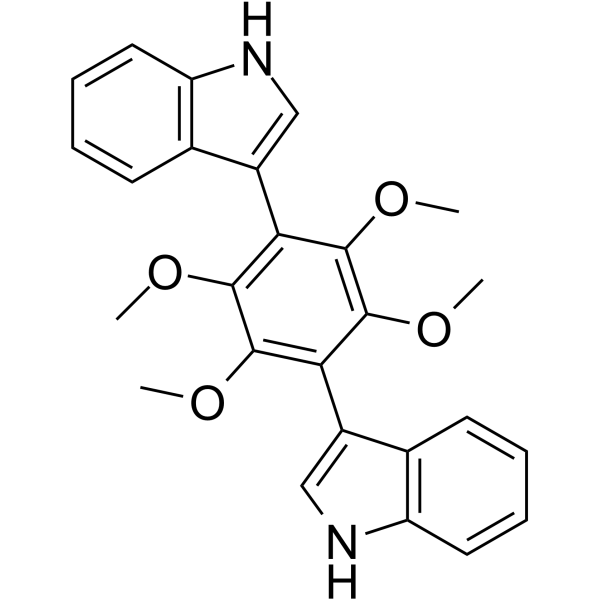
Asterriquinol D dimethyl ether is a fungal metabolite, which can inhibit mouse myeloma NS-1 cell lines with an IC50 of 28 μg/mL. Asterriquinol D dimethyl ether also inhibits Tritrichomonas foetus .
loading...
    loading...
Cat. No.: HY-177540
CAS No.: 3061155-24-3
Research Areas:  

Infection Cancer

ent-Rhizocarpic acid is an enantiomer of Rhizocarpic acid. ent-Rhizocarpic acid has more potent antibacterial and antiparasitic activity against Staphylococcus aureus (ATCC 25923) and Giardiaduodenalis 713 compared to Rhizocarpic acid. ent-Rhizocarpic acid also has a weak but selective antitumor activity against NS-1 cells .
loading...
    loading...
Cat. No.: HY-N11989
CAS No.: 1609469-72-8
Target:  

Others

Nanangenine B is a sesquiterpenoid, which can be isolated from Aspergillus nanangensis. Nanangenine B exhibits cytotixicity in cancer cell NS-1 with an IC50 of 38 μg/mL .
loading...
    loading...
Cat. No.: HY-125092
CAS No.: 204398-92-5
Target:  

Antibiotic

Research Areas:  

Infection

Drimentine C is a terpenylated diketopiperazine antibiotic originally isolated from Actinomycete bacteria. It inhibits proliferation of NS-1 murine β lymphocyte myeloma cells by 63 and 98% in vitro when used at concentrations of 12.5 and 100 μg/mL, respectively.
loading...
    loading...
Cat. No.: HY-118079
CAS No.: 204398-91-4
Target:  

Endogenous Metabolite

Research Areas:  

Infection

Drimentine B is a terpenylated diketopiperazine originally isolated from Actinomycete bacteria that has anticancer activity. It inhibits the proliferation of NS-1 murine β lymphocyte myeloma cells by 41 and 59% in vitro when used at concentrations of 50 and 100 μg/mL, respectively.
loading...
    loading...
Cat. No.: HY-N10259
CAS No.: 581786-63-2
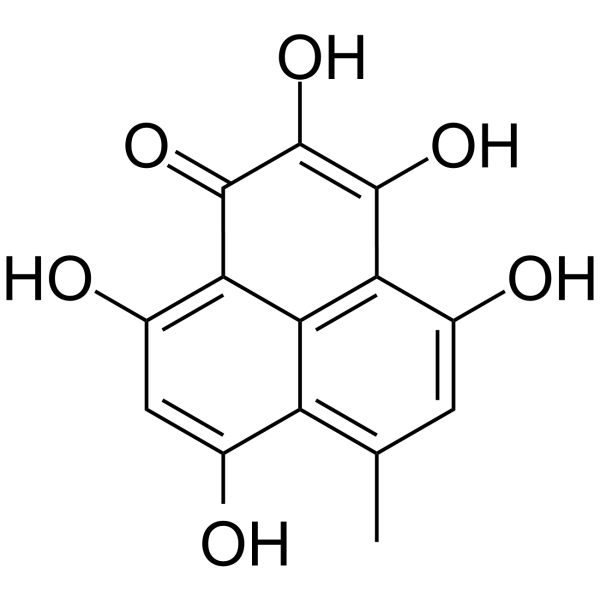
Norfunalenone exhibits weak cytotoxic activity in mouse myeloma NS-1 cell line (ATCC TIB-18) with an IC50 of 70 μM. Norfunalenone also exhibits weak antibacterial activity against B. subtilis (MIC=100 μg/mL; IC50=265 μM) .
loading...
    loading...
Cat. No.: HY-N12264
CAS No.: 2334483-46-2
Burnettramic acid A is an antibiotic, which can be isolated from Aspergillus burnettii. Burnettramic acid A exhibits antibacterial and antifungal activities, with IC50 of 0.2, 0.5, 2.3 and 5.9 μg/mL, for Saccharomyces cerevisiae, Candida albicans, Bacillus subtilis and Staphylococcus aureus, respectively. Burnettramic acid A exhibits cytotoxicity in cancer cell NS-1 with IC50 of 13.8 μg/mL .
loading...
    loading...
Cat. No.: HY-172745
CAS No.: 3053775-15-5
Target:  

Others

Conglobatin B1 is a compound that can be isolated from Australian Streptomyces MST-91080. Conglobatin B1 is cytotoxic to the NS-1 myeloma cell line with an IC50 of 0.084 μg/mL, but has low toxicity to NFF human fibroblasts. Conglobatin B1 can be used in the study of cancer .
loading...
    loading...
Cat. No.: HY-N15478
Target:  

Others

Nanangenine G is a drimane sesquiterpene that has been found in Aspergillus. It is cytotoxic to NS-1 mouse myeloma cells (IC50 = 47 μg/ml).
loading...
    loading...
Cat. No.: HY-158925
CAS No.: 2673270-37-4
Conglobatin C1 is a bacterial metabolite and has anticancer activity. Conglobatin C1 is cytotoxic to NS-1 mouse myeloma cells (IC50 = 1.05 μg/mL) .
loading...
    loading...
Cat. No.: HY-N15479
Nanangenine F is a drimane sesquiterpenoid with weak antibacterial and anticancer activities. Nanangenine F inhibits Bacillus subtilis (ATCC 6633) with an IC50 of 78 µg/mL. Nanangenine F inhibits NS-1, DU-145, MCF-7 and human fibroblast NFF cells with IC50s of 49 µg/mL, 95 µg/mL, 49 µg/mL, and 84 µg/mL, respectively .
loading...
    loading...
Cat. No.: HY-N19294
CAS No.: 2758265-34-6
Target:  

Others

Hancockiamide A is a compound found in the Australian soil fungus Aspergillus hancockii. Hancockiamide A inhibits tumor cell viability and inactivity against fibroblasts. Hancockiamide A can be used for the research of myeloma .
loading...
    loading...
Cat. No.: HY-N19219
CAS No.: 426816-67-3
Wailupemycin F is an Antibiotic and anticancer agent. Wailupemycin F is isolated from the marine-derived Streptomyces maritimus. Wailupemycin F exhibits antibacterial activity against Micrococcus luteus with a MIC of 1.1 μM. Wailupemycin F shows anticancer activity against myeloma. When used in combination with enterocin, Wailupemycin F exerts synergistic antibacterial activity against Micrococcus luteus, doubling its potency. Wailupemycin F can be used in studies related to Micrococcus luteus infection .
loading...
    loading...
Cat. No.: HY-N20676
CAS No.: 3131756-58-3
Geministatin D is a derivative of Geministatin A that retains the C17 (Z,Z)-diene alkyl side chain but lacks the complete diester backbone. As a chemical degradation fragment of the parent compound, Geministatin D shows weak antibacterial activity against Gram-positive bacteria but exerts mild inhibitory effects on Saccharomyces cerevisiae. Geministatin D can be used in studies on fungal infections caused by Saccharomyces cerevisiae .
loading...
    loading...

