8 Results for "

Pd nanoparticle

" in MedChemExpress (MCE) Product Catalog:
Products (8)

8 Results for "Pd nanoparticle" in MCE Product Catalog:

Cat. No.: HY-I0201
CAS No.: 1765-93-1
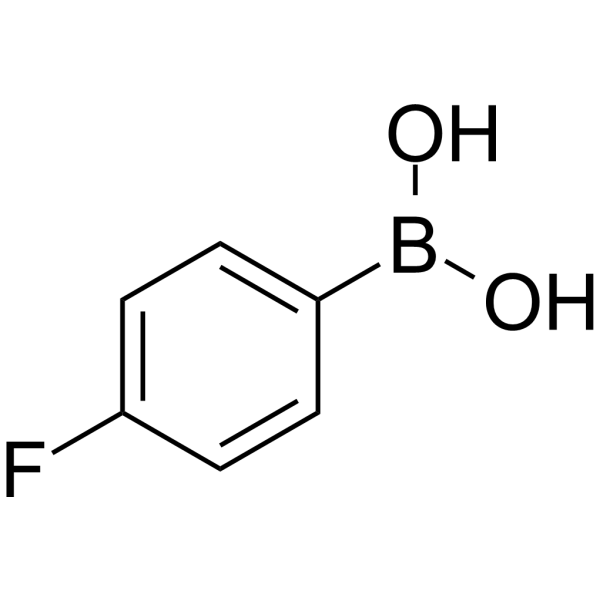
Synonyms: P-Fluorophenylboronic acid
Research Areas:  

Others

4-Fluorobenzeneboronic acid (P-Fluorophenylboronic acid) is a fluorinated arylboronic acid coupling ligand and precursor. Under the catalysis of heterogeneous palladium nanoparticles, 4-Fluorobenzeneboronic acid participates in the Suzuki-Miyaura C-C coupling reaction to generate fluorinated biphenyl derivatives. 4-Fluorobenzeneboronic acid also participates in the copper-catalyzed three-component reaction with nitrobenzene and potassium metabisulfite as substrates, and finally produces sulfonamides through the formation of arylsulfinate intermediates, copper-assisted S-N bond construction and reduction steps .
loading...
    loading...
Cat. No.: HY-174485
Target:  

mRNA

Research Areas:  

Inflammation/Immunology

OVA mRNA (N1-Me-Pseudo UTP) is an mRNA encoding chicken ovalbumin. The substitution with N1-Me-Pseudo UTP (m1Ψ) improves protein expression and reduces innate immune response. OVA mRNA binds to the STING-activating polymer PD18 and is encapsulated in optimized lipid nanoparticles to construct an mRNA vaccine platform (PD18 LNP). This platform not only enhances the lymphatic delivery efficiency and protein expression of mRNA, but also potently adjuvates immune responses via activating the STING pathway .
loading...
    loading...
Cat. No.: HY-169480
CAS No.: 3003022-09-8
Target:  

Liposome

Research Areas:  

Infection Cancer

Lipid C2 is an ionizable cationic lipid that has been used in the formation of lipid nanoparticles (LNP) for mRNA delivery in vivo. LNPs containing Lipid C2 and encapsulating an mRNA reporter selectively accumulate in the liver and spleen but not the heart, lungs, or kidneys in mice. LNP containing Lipid C2 and encapsulating mRNA encoding the Epstein-Barr virus (EBV) protein latent membrane protein 2 (LMP-2), in combination with an anti-programmed cell death protein 1 (PD-1) antibody, decrease tumor volume and reverse T cell exhaustion, as well as increase the percentage of CD3 +CD8 + central and CD3 +CD8 + effector memory T cells and decrease the percentage of CD3 + T cells expressing Pd-1, in the spleen in a CT26 murine EBV-infected colon cancer model .
loading...
    loading...
Cat. No.: HY-116604
CAS No.: 4425-23-4
Synonyms: Pd 139530
Target:  

PI3K Akt

Research Areas:  

Cancer

RLX (PD 139530) is a PI3K/Akt/FoxO3a signaling inhibitor, possessing significant therapeutic potential in experimental colon cancer. RLX can effectively modulate the tumor microenvironment, enhancing the efficacy of cancer immunotherapy. RLX demonstrates the ability to improve the retention time of therapeutic agents within the tumor microenvironment by utilizing advanced nanoparticle delivery systems. RLX can be integrated with various treatment modalities, such as chemotherapy and radiotherapy, to enhance overall tumor therapy effectiveness .
loading...
    loading...
Cat. No.: HY-116604A
CAS No.: 21314-60-3
Synonyms: Pd 139530 hydrochloride
Target:  

PI3K Akt

Research Areas:  

Cancer

RLX (PD 139530) hydrochloride is the hydrochloride of RLX (HY-116604). RLX is a PI3K/Akt/FoxO3a signaling inhibitor, possessing significant therapeutic potential in experimental colon cancer. RLX can effectively modulate the tumor microenvironment, enhancing the efficacy of cancer immunotherapy. RLX demonstrates the ability to improve the retention time of therapeutic agents within the tumor microenvironment by utilizing advanced nanoparticle delivery systems. RLX can be integrated with various treatment modalities, such as chemotherapy and radiotherapy, to enhance overall tumor therapy effectiveness .
loading...
    loading...
Cat. No.: HY-184616
Nanomaterials with sizes ranging from 1 to 100 nm are generally referred to as nanocrystals. The preparation of platinum nanocrystals with controllable morphology was first reported in 1996. Pt, Ag, Au, Rh, and other nanocrystals have been synthesized using various methods. Platinum has a face-centered cubic (fcc) structure, but unlike Ag, Au, and Pd, it rarely forms twins; most platinum nanocrystals are single-crystal structures. XFJ116 platinum nanoparticles were prepared via a chemical reduction method, exhibiting uniform size and good dispersibility, and can also provide platinum nanoparticles with amino and carboxyl terminator modifications.
loading...
    loading...
Cat. No.: HY-181967
Research Areas:  

Cancer

PROTAC PARP1 degrader-5 is a PARP1 PROTAC degrader with a DC50 of 0.12 μM. PROTAC PARP1 degrader-5 hijacks the ubiquitin-proteasome system via catalytic ternary complex formation to drive sustained PARP1 degradation. PROTAC PARP1 degrader-5 induces DNA damage, drives marginal cytosolic double-stranded DNA accumulation in tumor cells, and up-regulates PD-L1 surface expression in tumor cells. PROTAC PARP1 degrader-5 shows tumor growth inhibition activity in murine melanoma models when encapsulated in lipid nanoparticles. PROTAC PARP1 degrader-5 can be used for the research of cancer, such as melanoma .
loading...
    loading...
Cat. No.: HY-P11490
Target:  

MDM-2/p53

Research Areas:  

Inflammation/Immunology Cancer

DPMI-ω is a dual-specificity d-peptide antagonist of oncogenic proteins MDM2 and MDMX. DPMI-ω, upon fabrication on gold nanoparticles, efficiently traverses tumor cells and kills them by reactivating the p53 signaling pathway. DPMI-ω can disrupte the p53-MDM2/MDMX complex. DPMI-ω can inhibit B16 melanoma growth and induce cells G0/G1 phase arrest. DPMI-ω can augment the efficacy of immunotherapy by expanding CD3 +/CD8 + cytotoxic T cells and suppressing CD4 +/CD25 + regulatory T cells companied with anti-PD1 antibody. DPMI-ω can be used for research of melanoma .
loading...
    loading...

