19 Results for "

Picolyl chloride

" in MedChemExpress (MCE) Product Catalog:
Products (19)

19 Results for "Picolyl chloride" in MCE Product Catalog:

Cat. No.: HY-140915
CAS No.: 2222687-71-8
Purity:  95.41%
Target:  

PROTAC Linkers

Research Areas:  

Cancer

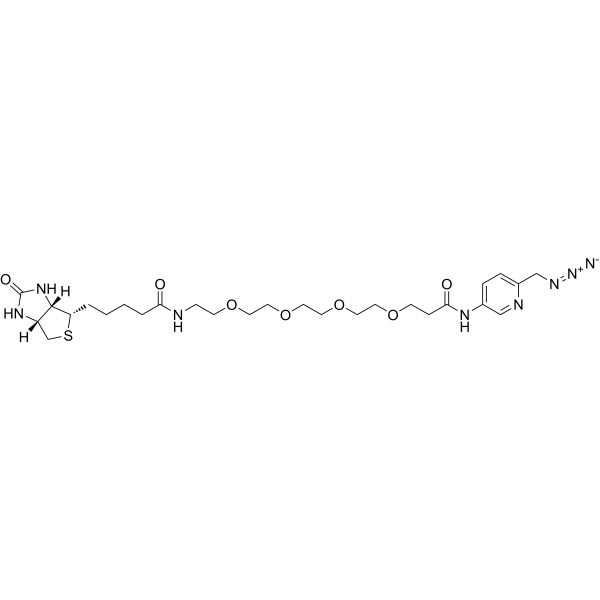
Biotin-PEG4-Picolyl azide is a PEG-based PROTAC linker that can be used in the synthesis of PROTACs . Biotin-PEG4-Picolyl azide is a click chemistry reagent, it contains an Azide group and can undergo copper-catalyzed azide-alkyne cycloaddition reaction (CuAAc) with molecules containing Alkyne groups. It can also undergo strain-promoted alkyne-azide cycloaddition (SPAAC) reactions with molecules containing DBCO or BCN groups.
loading...
    loading...
Cat. No.: HY-145383
CAS No.: 2599839-59-3
Purity:  ≥95.0%
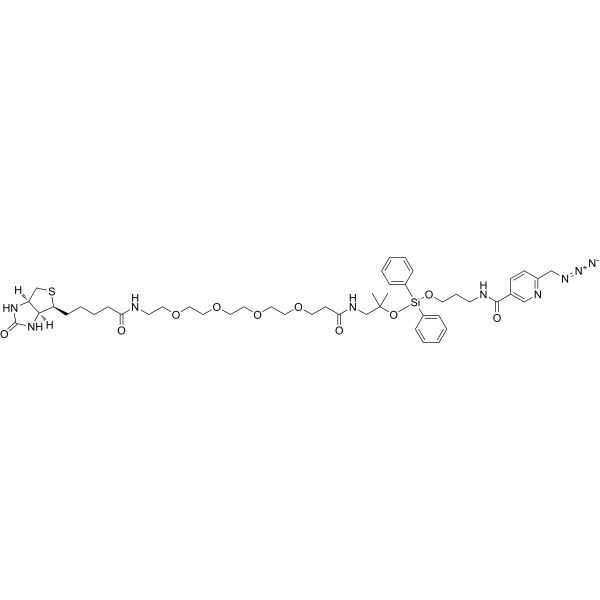
Biotin-PEG4-dialkoxydiphenylsilane-picolyl azide is a clickable, acid-cleavable biotin-picolyl azide. Biotin-PEG4-dialkoxydiphenylsilane-picolyl azide is an enrichment handle of cell surface glycoproteins for protein labeling . It contains an azide group and can undergo copper-catalyzed azide-alkyne cycloaddition (CuAAc) with molecules containing alkyne groups. It can also undergo ring strain-promoted alkyne-azide cycloaddition (SPAAC) with molecules containing DBCO or BCN groups.
loading...
    loading...
Cat. No.: HY-D2750
CAS No.: 2669097-38-3
Sulfo-Cy5 Picolyl Azide is a fluorophore featuring a sulfonate group and an azide. Azide groups are click chemistry handles which are reactive towards terminal alkynes and strained cyclooctynes such as BCN or DBCO. Cy5 is a cyanine dye with excitation and emission maxima at 651 nm and 670 nm respectively. The sulfonate group on the Cy5 dye increases this compound’s water solubility.
loading...
    loading...
Cat. No.: HY-W007502
CAS No.: 6959-47-3
Synonyms: Picolyl chloride hydrochloride
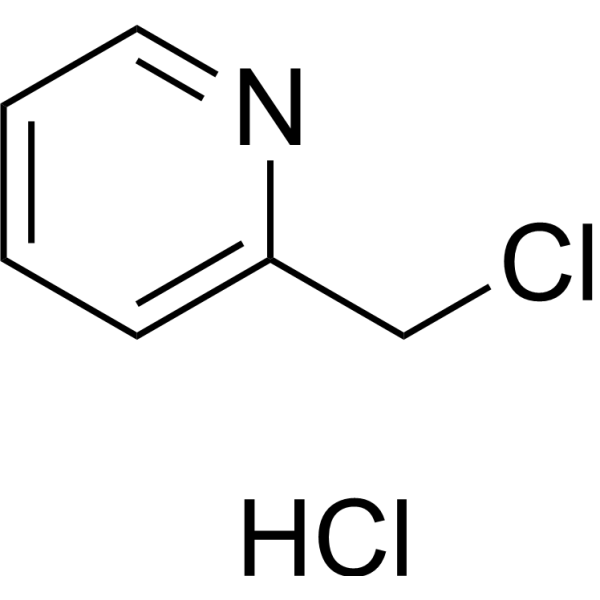
2-(Chloromethyl)pyridine (Picolyl chloride) hydrochloride is an alkylating agent that can be used in organic synthesis reactions .
loading...
    loading...
Cat. No.: HY-140917
CAS No.: 2055048-42-3
Target:  

PROTAC Linkers

Research Areas:  

Cancer

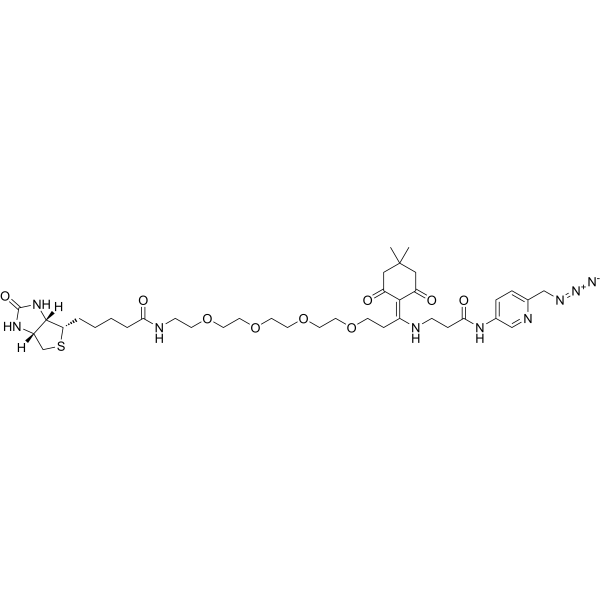
Dde Biotin-PEG4-Picolyl azide is a PEG-based PROTAC linker that can be used in the synthesis of PROTACs . Dde Biotin-PEG4-Picolyl azide is a click chemistry reagent, it contains an Azide group and can undergo copper-catalyzed azide-alkyne cycloaddition reaction (CuAAc) with molecules containing Alkyne groups. It can also undergo strain-promoted alkyne-azide cycloaddition (SPAAC) reactions with molecules containing DBCO or BCN groups.
loading...
    loading...
Cat. No.: HY-W800697
CAS No.: 2644752-87-2
BP Fluor 430 Picolyl Azide is an advanced fluorescent probe that incorporatess a copper-chelating motif to raise the effective concentration of Cu(I) at the reaction site. The rate of the CuAAC reaction depends on the concentrations of all reagents, including copper, therefore raising the effective copper concentration at the reaction site will dramatically increase the rate of CuAAC reaction without the need to increase concentration of azide reagent or copper. In addition, the use of BP Fluor 430 Picolyl Azide instead of conventional BP Fluor 430 Azide allows for at least a tenfold reduction in the concentration of the copper catalyst without sacrificing the efficiency of labeling. In summary, the introduction of a picolyl moiety into an azide probe leads to a substantial increase in the sensitivity of alkyne detection. This is of special value for the detection of low abundance targets or where significant increase in signal intensity is desired.
loading...
    loading...
Cat. No.: HY-D3348
Target:  

Fluorescent Dye

Research Areas:  

Others

Rhodamine picolyl azide is a fluorescent dye that enables visualization of protein labeling via click chemistry. The detection mechanism of Rhodamine picolyl azide is based on bioorthogonal click chemistry: Rhodamine picolyl azide reacts with the alkyne group on affinity-based protein profiling probes (ABPs) attached to labeled target proteins; this conjugation allows subsequent fluorescence imaging of proteins separated by SDS-PAGE .
loading...
    loading...
Cat. No.: HY-W800696
CAS No.: 2644752-86-1
BP Fluor 430 Azide is a water-soluble, green-fluorescent, azide-activated probe that reacts with terminal alkynes via a copper-catalyzed click reaction (CuAAC). It also reacts with strained cyclooctyne via a copper-free click chemistry reaction to form a stable triazole and does not require a Cu-catalyst or elevated temperatures. BP Fluor 430 is a bright, photostable, green-fluorescent probe with excitation near its absorption maximum at 432 nm and emission maximum at 539 nm. This probe is water soluble and pH-insensitive from pH 4 to pH 10. A next generation probe, BP Fluor 430 Picolyl Azide, is also available for detection of low abundance alkyne-tagged biomolecules.
loading...
    loading...
Cat. No.: HY-D3254
IR 650 picolyl azide is a near-infrared fluorescent probe. The click chemistry reaction handle of IR 650 picolyl azide is a terminal picolyl azide, which can undergo a 'copper-catalyzed alkyne-azide cycloaddition' reaction. (Ex = 650nm, Em = 670nm)
loading...
    loading...
Cat. No.: HY-D3581
Target:  

Fluorescent Dye

Research Areas:  

Others

AF594 Picolyl Azide is a composite fluorescent probe formed by covalent linkage of the Alexa Fluor 594 fluorophore and the Picolyl Azide functional group via chemical bonds. AF594 Picolyl Azide contains a copper chelation domain, and through the copper-catalyzed azide-alkyne cycloaddition click chemistry reaction, it can covalently label alkyne-bearing target molecules and generate fluorescent detection signals. AF594 Picolyl Azide can be used for the detection of alkyne-modified sialylated glycoconjugates, and can also label nascent bacterial polypeptides to determine bacterial protein synthesis rates .
loading...
    loading...
Cat. No.: HY-D3574
Target:  

Fluorescent Dye

Research Areas:  

Others

AF488 Picolyl Azide is a Fluorescent dye designed for bioorthogonal visualization applications. AF488 Picolyl Azide functions via copper (I)-catalyzed azide-alkyne cycloaddition click chemistry, where its azide group undergoes covalent reaction with alkyne-functionalized molecules to form fluorescent triazole conjugates. AF488 Picolyl Azide enables the visualization of metabolically labeled isoprenoids in bacteria, which localize to the cell membrane and division septum .
loading...
    loading...
Cat. No.: HY-W756144
Target:  

Fluorescent Dye

Research Areas:  

Others

Sulfo-cy3 picolyl azide is a fluorescent dye used for detecting interactions between labeled molecules and proteins based on click chemistry. Sulfo-cy3 picolyl azide undergoes copper (I)-catalyzed azide-alkyne cycloaddition (CuAAC) to covalently bind to alkyne-labeled targets, enabling fluorescent detection via scanning. The excitation/emission wavelengths of Sulfo-cy3 picolyl azide are Ex/Em = 550/560 nm. Sulfo-cy3 picolyl azide can be used for in-gel detection of protein-small molecule interactions, as well as labeling ribosome-associated cellular protein targets .
loading...
    loading...
Cat. No.: HY-D3337
Cy7 picolyl azide is a derivative of Cyanine7 (Cy7) , a near-infrared fluorescent dye. It features picolyl azide group for enhanced CuAAC click chemistry. Main applications: fluorescence labeling and detection. Commonly used in fluorescence microscopy, flow cytometry, immunoassays, and nucleic acid detection. (Ex/Em = 750/776 nm)
loading...
    loading...
Cat. No.: HY-D3577
Target:  

Fluorescent Dye

Research Areas:  

Others

AF555 Picolyl Azide is a Fluorescent dye that enables site-specific fluorescent labeling via click chemistry. AF555 Picolyl Azide conjugates with the non-canonical amino acid N-propargyl-L-lysine introduced through ochre stop codon suppression via the copper (I)-catalyzed azide-alkyne cycloaddition (CuAAC) reaction, achieving labeling of hyperpolarization-activated cyclic nucleotide-gated HCN channels; its picolyl group accelerates the CuAAC reaction rate, thus completing labeling rapidly at room temperature and minimizing copper-induced cytotoxicity. AF555 Picolyl Azide forms covalent bonds with the alkynyl groups of nucleotide analogs through its azide moiety, labeling viral genomes containing 5-ethynyl-2'-deoxyuridine for visualization via fluorescence microscopy .
loading...
    loading...
Cat. No.: HY-W998839
CAS No.: 2765331-46-0
Target:  

MOFs

Research Areas:  

Others

tris(N-(3-picolyl))phosphoramide is a metal-organic framework (MOF).
loading...
    loading...
Cat. No.: HY-D3584
Target:  

Fluorescent Dye

Research Areas:  

Others

AF647 Picolyl Azide is a far-red fluorescent probe used in bioorthogonal click chemistry. It reacts with terminal alkynes via copper-catalyzed azide-alkyne cycloaddition (CuAAC). The integrated picolyl group chelates copper, which speeds up the reaction and allows for lower copper concentrations to protect sensitive proteins (Ex/Em = 650/665 nm)[1].
loading...
    loading...
Cat. No.: HY-D3349
Target:  

Fluorescent Dye

Research Areas:  

Others

Fluorne rhodamine picolyl azide is a fluorescent dye used for optical microscopy and nanoscopy, which can be applied in fluorescence correlation spectroscopy (FCS), stimulated emission depletion (STED) nanoscopy, biomolecule labeling, and live-cell imaging .
loading...
    loading...
Cat. No.: HY-W800693
CAS No.: 2841143-99-3
BP Fluor 405 Picolyl Azide is an advanced fluorescent probe that incorporatess a copper-chelating motif to raise the effective concentration of Cu(I) at the reaction site. The rate of the CuAAC reaction depends on the concentrations of all reagents, including copper, therefore raising the effective copper concentration at the reaction site dramatically increases the rate of CuAAC reaction without increasing the concentrations of azide reagent or copper. In addition, the use of picolyl azide instead of conventional azides allows for at least a tenfold reduction in the concentration of the copper catalyst without sacrificing the efficiency of labeling. In summary, the introduction of a picolyl moiety into an azide probe leads to a substantial increase in the sensitivity of alkyne detection. This is of special value for the detection of low abundance targets or where significant increase in signal intensity is desired.
loading...
    loading...
Cat. No.: HY-W800691
CAS No.: 2644752-83-8
Target:  

Fluorescent Dye

Research Areas:  

Others

BP Fluor 350 Picolyl Azide is a blue-fluorescent azide-activated probe that reacts with terminal alkynes via a copper-catalyzed click reaction (CuAAC). It also reacts with strained cyclooctyne via a copper-free click chemistry reaction to form a stable triazole and does not require Cu-catalyst or elevated temperatures.
loading...
    loading...
  • 1

