1. Search Result
Search Result
Results for "

Proteus mirabilis

" in MedChemExpress (MCE) Product Catalog:

13

Inhibitors & Agonists

2

Biochemical Assay Reagents

6

Natural
Products

Cat. No. Product Name Target Research Areas Chemical Structure
  • HY-108964

    Bacterial Infection Neurological Disease Inflammation/Immunology Cancer
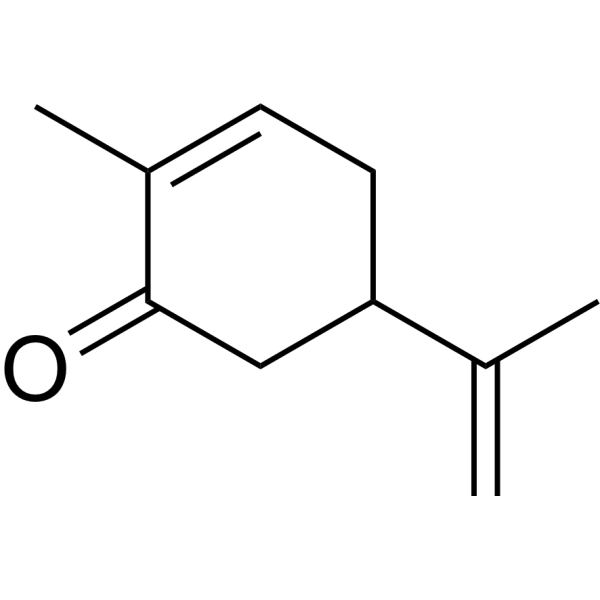
    Carvone is a ketone monoterpene found in the essential oils from plants of the genus Mentha. Carvone has such effects as anticancer, antimicrobial, antioxidant, anti-inflammatory, antispasmodic, antinociceptive, anticonvulsant .
    Carvone
  • HY-D1056B2

    LPS, from bacterial (Proteus mirabilis)

    Toll-like Receptor (TLR) Inflammation/Immunology
    Lipopolysaccharides, from Proteus mirabilis are lipopolysaccharide endotoxins and TLR-4 activators derived from Proteus mirabilis, classified as S-type LPS, which can activate pathogen-associated molecular patterns (PAMP) of the immune system and induce cellular secretion of migrasomes. Lipopolysaccharides, from Proteus mirabilis exhibit a typical three-part structure: O-antigen, core oligosaccharide, and lipid A. Proteus mirabilis is a major pathogen causing urinary tract infections and may also contribute to rheumatoid arthritis. Lipopolysaccharides, from Proteus mirabilis also exhibit potential anti-tumor effects, demonstrating in vivo inhibitory activity against solid tumors such as meningosarcoma and Walker carcinosarcoma .
    It is recommended to prepare a solution with concentration ≥2 mg/mL. Vortex thoroughly for more than 10 minutes. Due to the adsorption characteristics of LPS, silanized container or low adsorption centrifuge tubes should be used for aliquoting and storage, and mix thoroughly before use.
    Lipopolysaccharides, from Proteus mirabilis
  • HY-N7097

    Antibiotic Bacterial Infection
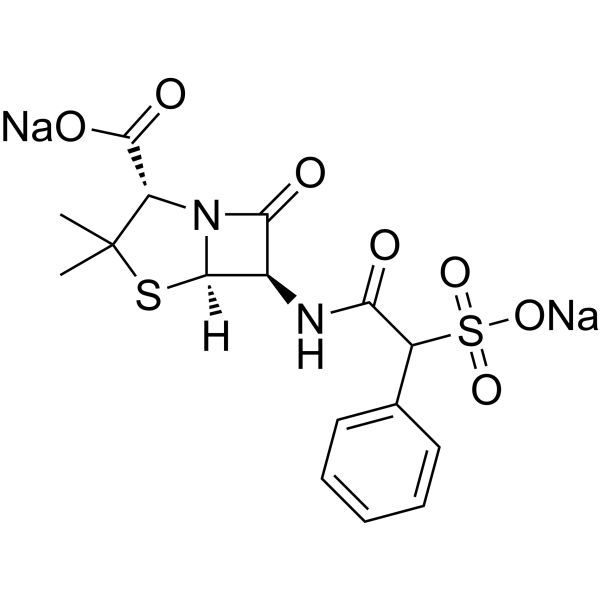
    Sulbenicillin disodium is a semisynthetic α-sulfonylbenzylpenicillin antibiotic. Sulbenicillin disodium exerts antibacterial activity against multiple gram-negative rods. Sulbenicillin disodium inhibits primary and secondary platelet aggregation, serotonin release from platelets, and platelet adherence via platelet surface coating. Sulbenicillin disodium can be used for the research of Pseudomonas aeruginosa, Pseudomonas maltophilia, and Pseudomonas cepacia infections .
    Sulbenicillin disodium
  • HY-77785
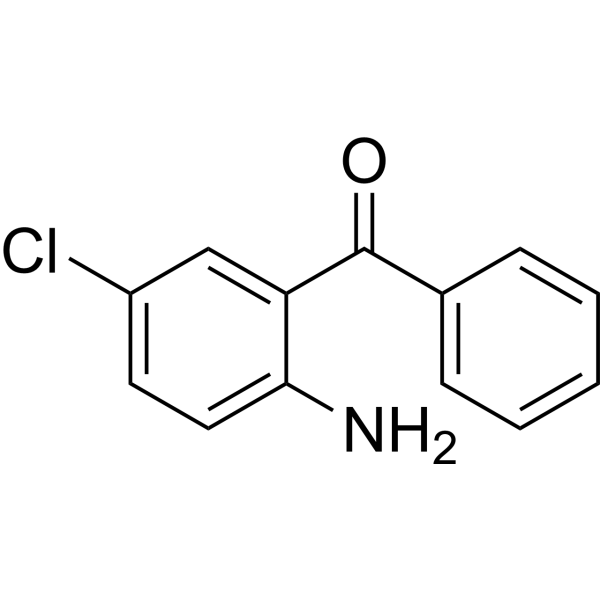
    2-Amino-5-chlorobenzophenone
    1 Publications Verification

    5-Chloro-2-aminobenzophenone

    Drug Intermediate Infection Neurological Disease
    2-Amino-5-chlorobenzophenone (5-Chloro-2-aminobenzophenone) is a chemical intermediate. Derivatives of 2-Amino-5-chlorobenzophenone serve as skeletal muscle relaxants. 2-Amino-5-chlorobenzophenone acts as a starting material for the synthesis of anti-biofilm 2-amino-5-chlorobenzophenone Schiff bases. 2-Amino-5-chlorobenzophenone is applicable to research related to bacterial infections .\n

    2-Amino-5-chlorobenzophenone
  • HY-N2754

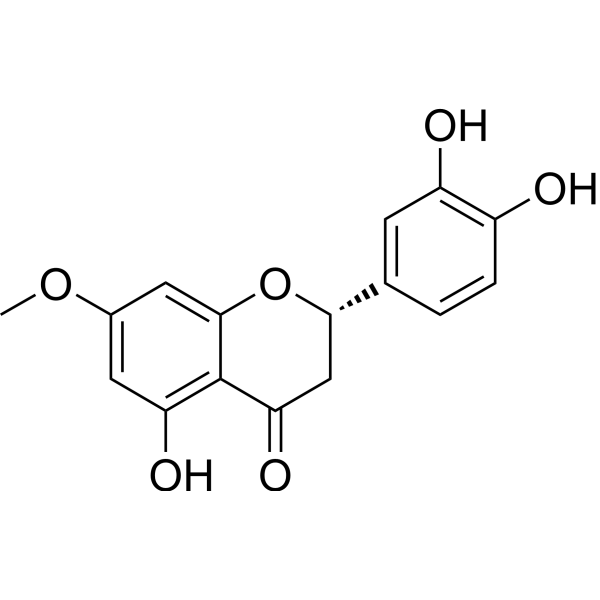
    Eriodictyol 7-methyl ether; 7-O-Methyleriodictyol

    Bacterial Infection Cardiovascular Disease
    Sternbin (Eriodictyol 7-methyl ether) is a flavanone and antibacterial agent. Sternbin can be isolated from Heliotropium sinuatum. Sternbin has antibacterial activity against a wide range of bacteria. Sternbin has antiviral activity against infectious salmon anemia virus (ISAV). Sternbin inhibits the contraction of isolated rat smooth muscle .
    Sternbin
  • HY-N11554

    Bacterial Infection
    (-)-Codonopsine is an alkaloid with antibacterial activity. (-)-Codonopsine can be used in research related to Staphylococcus aureus and Escherichia coli infections .
    (-)-Codonopsine
  • HY-W145053

    Sodium chloro(4-methylbenzenesulfonyl)azanide hydrate

    Factor Xa Bacterial Infection
    ChloraMine-T hydrate (Sodium chloro(4-methylbenzenesulfonyl)azanide (hydrate)) is a common reagent in various synthetic processes. It has been used as a reagent in aminohydroxylation and allylic amination reactions, a nitrogen source in aziridination reactions of alkenes and alkenes, and deprotection of sulfur groups in sulfur-containing compounds. It has been used as a reagent in the synthesis of factor Xa inhibitors. ChloraMine-T hydrate (Sodium chloro(4-methylbenzenesulfonyl)azanide (hydrate)) (0.2% w/v) is also an antimicrobial agent that kills Staphylococcus epidermidis, Staphylococcus aureus, Enterococcus faecalis, Escherichia coli, Proteus mirabilis, and Enterococcus cloacae.
    ChloraMine-T hydrate
  • HY-111190

    Antibiotic Bacterial Infection
    Thiotropocin is a tropothione Antibiotic with antibacterial activities against Gram-positive and Gram-negative bacteria, some phytopathogens and mycoplasma. Thiotropocin causes morphological changes of Proteus mirabilis and Escherichia coli .
    Thiotropocin
  • HY-167714

    Drug Derivative Bacterial Infection
    Cefazaflur is a novel semi-synthetic cephalosporin derivative that exhibits significant antibacterial activity, effectively inhibiting various strains of Staphylococcus aureus, Escherichia coli, Klebsiella, and Proteus mirabilis at low concentrations.
    Cefazaflur
  • HY-100568

    A-49759

    Antibiotic Bacterial Infection
    3-O-Demethylfortimicin A (A-49759) is an aminocyclitol antibiotic with antibacterial activity. 3-O-Demethylfortimicin A is particularly effective against Gram-negative pathogens and staphylococcus .
    3-O-Demethylfortimicin A
  • HY-117736

    Penicillin-binding protein (PBP) Bacterial Infection Inflammation/Immunology
    Ro 09-1428 is a broad-spectrum parenteral cephalosporin. Ro 09-1428 has potent antibacterial activities against Pseudomonas aeruginosa and Acinetobacter caloaceticus, with MIC90s of 0.39 and 6.25 μg/mL, respectively, better than Ceftazidime (HY-B0593). Additionally, Ro 09-1428 shows high activity against Escherichia coli, Kkbsielia pneumoniae, Proteus mirabilis, P. aeruginosa, staphylococci, and more. Ro 09-1428 preferentially attacks PBP 3 for target in E. coli and P. aeruginosa, which is promising for research of septicemias and serious P. aeruginosa infections .
    Ro 09-1428
  • HY-181149

    Urease Bacterial Infection Cancer
    Urease/thymidine phosphorylase-IN-1 (compound 8) is a urease and thymidine phosphorylase inhibitor with a urease IC50 of 8.20 μM, thymidine phosphorylase IC50 of 9.29 μM. Urease/thymidine phosphorylase-IN-1 can be used for the research of helicobacter pylori infection, proteus mirabilis infection, cancer .
    Urease/thymidine phosphorylase-IN-1
  • HY-182622

    Antibiotic Bacterial Infection
    Etimicin is a fourth-generation semisynthetic aminoglycoside antibiotic. Etimicin exhibits broad spectrum of activity against gram-positive, gram-negative, and aminoglycoside-resistant bacterial strains, with lower ototoxicity and nephrotoxicity. Etimicin exerts rapid, concentration-dependent bactericidal activity against bacteria. Etimicin can be used for the research of bacterial infections .
    Etimicin

Inquiry Online

Your information is safe with us. * Required Fields.

Salutation


Country or Region *

Applicant Name *


Organization Name *

Department *


Email Address *


Product Name *

Cat. No.


Requested quantity *

Phone Number *


Remarks

Inquiry Online

Inquiry Information

Product Name:
Cat. No.:
Quantity:
MCE Japan Authorized Agent:

