
1. Search Result
Search Result
Pathways Recommended: NF-κB
Results for "

TLR4/NF-κB-IN-1

" in MedChemExpress (MCE) Product Catalog:

6

Inhibitors & Agonists

1

Biochemical Assay Reagents

1

Natural
Products

Targets Recommended:
Cat. No. Product Name Target Research Areas Chemical Structure
  • HY-108910
    Chymotrypsin
    2 Publications Verification

    EC 3.4.21.1; ChymotrypsIN A

    Toll-like Receptor (TLR) NF-κB MMP Others Inflammation/Immunology
    Chymotrypsin (EC 3.4.21.1; Chymotrypsin A) is an orally effective inhibitor targeting molecules such as TLR4, NF-κB, MMP-1, TNF-α, IL-1β, and IL-6. Chymotrypsin downregulates the TLR4/NF-κB signaling pathway, inhibiting the release of inflammatory factors, reducing cell infiltration and tissue damage. It also reduces the expression of tumor cell adhesion molecules (such as CD44 and CD54) and can be specifically detected by fluorescent probes (such as NBD-3). Chymotrypsin has anti-inflammatory, hepatoprotective, joint damage-reducing, liver protection against lipotoxicity, and anti-tumor metastasis functions. It can be used in research on diseases such as rheumatoid arthritis, non-alcoholic fatty liver disease, and melanoma metastasis. Chymotrypsin can be used in studies of inflammation, edema, and expectoration .
    Chymotrypsin
  • HY-108910A
    Chymotrypsin (MS grade)
    2 Publications Verification

    EC 3.4.21.1 (MS grade); ChymotrypsIN A (MS grade)

    Toll-like Receptor (TLR) NF-κB MMP Others Inflammation/Immunology
    Chymotrypsin (EC 3.4.21.1; Chymotrypsin A) (MS grade) is an orally effective inhibitor targeting molecules such as TLR4, NF-κB, MMP-1, TNF-α, IL-1β, and IL-6. Chymotrypsin (MS grade) downregulates the TLR4/NF-κB signaling pathway, inhibits the release of inflammatory factors, reduces cell infiltration and tissue damage, and also reduces the expression of tumor cell adhesion molecules (such as CD44 and CD54). It can also be specifically detected by fluorescent probes (such as NBD-3). Chymotrypsin (MS grade) has anti-inflammatory, hepatoprotective, joint damage-reducing, liver protection against lipotoxicity, and anti-tumor metastasis functions, and can be used in the research of diseases such as rheumatoid arthritis, non-alcoholic fatty liver disease, and melanoma metastasis. Chymotrypsin (MS grade) can be used in studies of inflammation, edema, and expectoration .
    Chymotrypsin (MS grade)
  • HY-168710

    Toll-like Receptor (TLR) NF-κB IKK Inflammation/Immunology
    TLR4/NF-κB-IN-1 (Compound 7x) is an orally available inhibitor that specifically targets the TLR4/NF-κB signaling pathway, offering anti-inflammatory effects and the ability to cross the blood-brain barrier. TLR4/NF-κB-IN-1 can reduce acute neuroinflammation in mice caused by LPS (HY-D1056) and downregulate the expression of TLR4, P-NF-κB and P-IκB-α proteins .
    TLR4/NF-κB-IN-1
  • HY-101318
    β-Funaltrexamine hydrochloride
    2 Publications Verification

    β-FNA hydrochloride

    Opioid Receptor p38 MAPK STAT NF-κB NO Synthase Toll-like Receptor (TLR) Cardiovascular Disease Neurological Disease
    β-Funaltrexamine (β-FNA) hydrochloride is a blood-brain barrier-permeable, selective and irreversible μ-opioid receptor antagonist with immunomodulatory, anti-inflammatory and neuroprotective activities. β-Funaltrexamine hydrochloride inhibits p38 MAPK and TLR4 signaling by blocking μ-opioid receptors, and reduces the transcriptional activities of NF-κB, AP-1, CREB and Stat. Furthermore, β-Funaltrexamine hydrochloride inhibits iNOS activation and pro-inflammatory microglial polarization, converting microglia to an anti-inflammatory phenotype, thereby downregulating neuroinflammation and ameliorating neuronal degeneration. β-Funaltrexamine hydrochloride is widely applicable to research related to stroke, cerebral ischemia/reperfusion injury and neurodegenerative diseases .
    β-Funaltrexamine hydrochloride
  • HY-N12527

    NF-κB Others
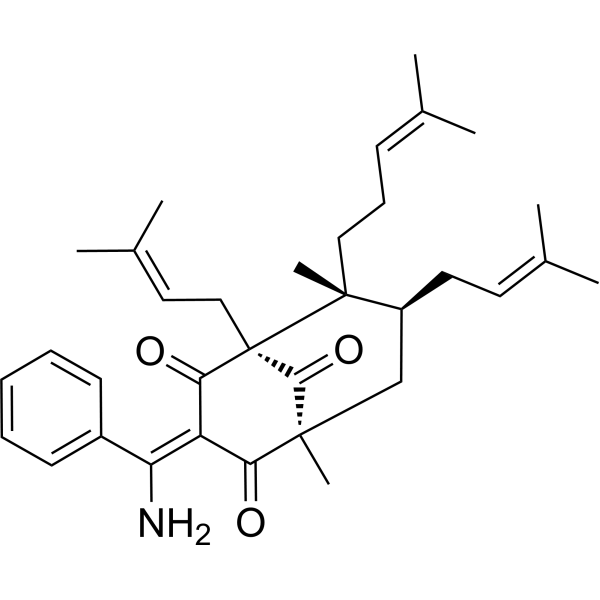
    Hyperelamine A (compound 5) is a polycyclic polyprenylated acylphloroglucinols (PPAPs). Hyperelamine A exhibits inhibitory activity against LPS-activated NO production in BV-2 cells via TLR-4/NF κB signaling .
    Hyperelamine A
  • HY-160938

    β-FNA

    Opioid Receptor STAT NF-κB Toll-like Receptor (TLR) NO Synthase p38 MAPK Cardiovascular Disease Neurological Disease
    β-Funaltrexamine (β-FNA) is a blood-brain barrier-permeable, selective and irreversible μ-opioid receptor antagonist with immunomodulatory, anti-inflammatory and neuroprotective activities. β-Funaltrexamine inhibits p38 MAPK and TLR4 signaling by blocking μ-opioid receptors, and reduces the transcriptional activities of NF-κB, AP-1, CREB and Stat. Furthermore, β-Funaltrexamine inhibits iNOS activation and pro-inflammatory microglial polarization, converting microglia to an anti-inflammatory phenotype, thereby downregulating neuroinflammation and ameliorating neuronal degeneration. β-Funaltrexamine is widely applicable to research related to stroke, cerebral ischemia/reperfusion injury and neurodegenerative diseases .
    β-Funaltrexamine

Inquiry Online

Your information is safe with us. * Required Fields.

Salutation


Country or Region *

Applicant Name *


Organization Name *

Department *


Email Address *


Product Name *

Cat. No.


Requested quantity *

Phone Number *


Remarks

Inquiry Online

Inquiry Information

Product Name:
Cat. No.:
Quantity:
MCE Japan Authorized Agent:

