8 Results for "

TRP family

" in MedChemExpress (MCE) Product Catalog:
Products (8)

8 Results for "TRP family" in MCE Product Catalog:

135
135 Cited Publications
Cat. No.: HY-P1410
CAS No.: 1209500-46-8
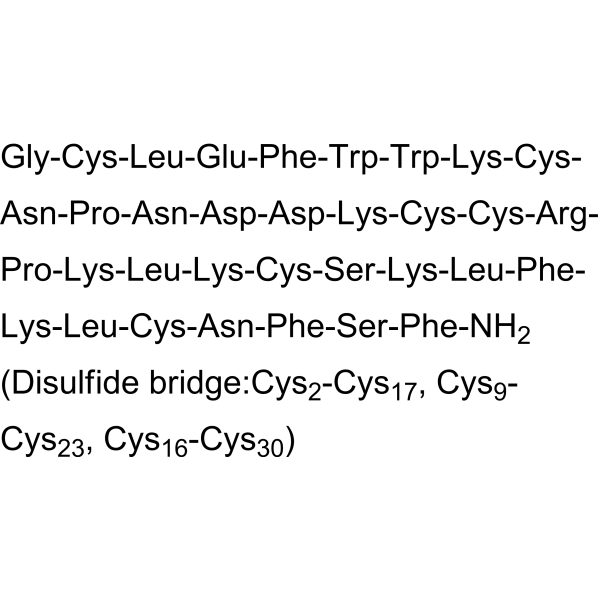
GsMTx4 is a spider venom peptide that selectively inhibits cationic-permeable mechanosensitive channels (MSCs) belonging to the Piezo and TRP channel families. GsMTx4 also blocks cation-selective stretch-activated channels (SACs) , attenuates lysophosphatidylcholine (LPC)-induced astrocyte toxicity and microglial reactivity. GsMTx4 is an important pharmacological tool for identifying the role of these excitatory MSCs in normal physiology and pathology .
loading...
    loading...
135
135 Cited Publications
Cat. No.: HY-P1410A
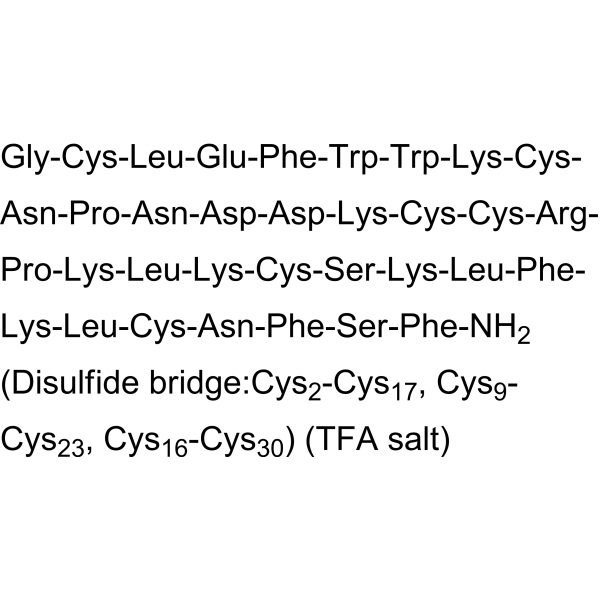
GsMTx4 TFA is a spider venom peptide that selectively inhibits cationic-permeable mechanosensitive channels (MSCs) belonging to the Piezo and TRP channel families. GsMTx4 TFA also blocks cation-selective stretch-activated channels (SACs) , attenuates lysophosphatidylcholine (LPC)-induced astrocyte toxicity and microglial reactivity. GsMTx4 TFA is an important pharmacological tool for identifying the role of these excitatory MSCs in normal physiology and pathology .
loading...
    loading...
Cat. No.: HY-165559
CAS No.: 2019994-90-0
Target:  

TRP Channel

Research Areas:  

Inflammation/Immunology

Trpvicin is a potent and subtype-selective TRPV3 inhibitor with IC50s of 0.41 and 0.22 μM for hTRPV3-WT and hTRPV3-G573S mutant, respectively. Trpvicin exhibits minimal effects on other TRP family members (such as TRPV1/2/4/5/6, TRPA1 and TRPM8). Trpvicin inhibits the TRPV3 channel by stabilizing it in a closed state via VSLD-PD binding. Trpvicin accesses additional binding sites inside the central cavity of the G573S mutant to remodel symmetry and block the channel. Trpvicin inhibits itch and hair loss in mouse models. Trpvicin can be used for study of inflammation and immunology .
loading...
    loading...
Cat. No.: HY-N15721
CAS No.: 1630745-39-9
Synonyms: TRP-CA
Tryptophan-cholic acid (Trp-CA) is a microbial amino acid-conjugated bile acid that acts as an endogenous ligand and agonist (EC50=9.6 μM) for the orphan G protein-coupled receptor (GPCR) MRGPRE (Mas-related G protein-coupled receptor family member E). Tryptophan-cholic acid is orally effective but has poor oral absorption and does not cross the blood-brain barrier. Tryptophan-cholic acid promotes the secretion of glucagon-like peptide GLP-1, thereby improving glucose tolerance in diabetic mice. Tryptophan-cholic acid improves glucose tolerance, promotes insulin secretion, and alleviates high-fat diet-induced hepatic steatosis without causing pruritus side effects. Tryptophan-cholic acid is primarily used in research on type 2 diabetes (T2D) .
loading...
    loading...
Cat. No.: HY-133012
CAS No.: 2304549-73-1
Purity:  99.74%
Target:  

TRP Channel

Research Areas:  

Neurological Disease

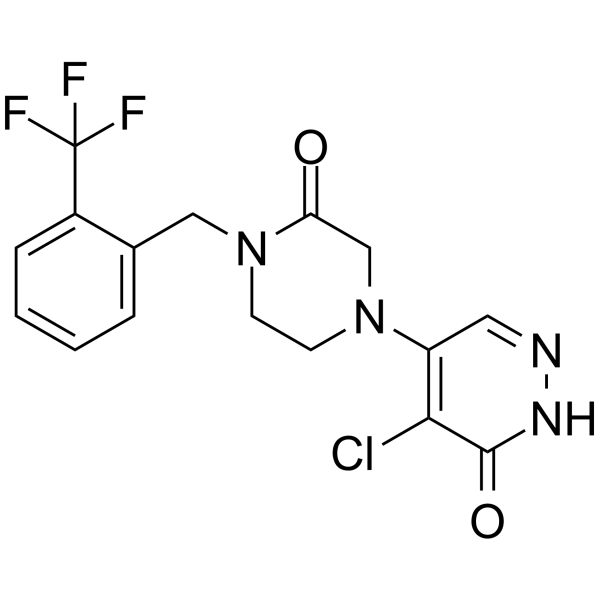
GFB-8438 is a potent and subtype selective TRPC5 inhibitor, with IC50s of 0.18 and 0.29 μM of hTRPC5 and hTRPC4, respectively. GFB-8438 shows excellent selectivity against TRPC6, other TRP family members, NaV 1.5, as well as limited activity against the hERG channel. GFB-8438 protects mouse podocytes from injury induced by protamine sulfate model .
loading...
    loading...
Cat. No.: HY-120963
CAS No.: 52514-04-2
Purity:  98%
Target:  

Endogenous Metabolite

Research Areas:  

Metabolic Disease

Several different arachidonoyl amino acids, including N-arachidonoyl dopamine and N-arachidonoyl serine, have been isolated and characterized from bovine brain.1 During mass spectral lipidomics analysis of rat brain, a series of fatty acyl amides of a third amino acid, taurine, were discovered.2 This novel class of compounds is present in kidney and activates members of the transient receptor potential (TRP) family of calcium channels.3 N-Oleoyl taurine is an amino-acyl endocannabinoid isolated from rat brain that may activate TRPV1 and TRPV4.
loading...
    loading...
Cat. No.: HY-120964
CAS No.: 63155-80-6
Purity:  99.00%
Target:  

Endogenous Metabolite

Research Areas:  

Metabolic Disease

Several different arachidonoyl amino acids, including N-arachidonoyl dopamine (NADA) and N-arachidonoyl serine (ARA-S), have been isolated and characterized from bovine brain.1 During mass spectral lipidomic analysis of rat brain, a series of fatty acyl amides of a third amino acid, taurine, is discovered.2 This novel class of compounds is present in kidney and activates members of the transient receptor potential (TRP) family of calcium channels.3 N-Stearoyl taurine is a prominent amino-acyl endocannabinoid isolated from rat brain during lipidomics profiling.
loading...
    loading...
Cat. No.: HY-126720
CAS No.: 807370-75-8
Purity:  ≥99.0%
Target:  

Endogenous Metabolite

Research Areas:  

Metabolic Disease

N-Lignoceroyl Taurine is an arachidonoyl amino acid and taurine conjugate with a fatty acid that can be isolated from bovine brain. N-Lignoceroyl Taurine is one of several novel taurine-conjugated fatty acids discovered during mass spectrometry lipidomic analysis of the brain and spinal cord of wild-type and fatty acid amide hydrolase (FAAH) knockout mice. N-Lignoceroyl Taurine levels were 23-26-fold higher in FAAH -/- mice compared to wild-type mice, suggesting that FAAH utilizes N-Lignoceroyl Taurine as a substrate. However, in vitro experiments with purified FAAH showed that N-Lignoceroyl Taurine was hydrolyzed 2,000-fold slower in FAAH compared to oleoylethanolamide. N-Acyl Taurines with polyunsaturated acyl chains can activate members of the transient receptor potential (TRP) calcium channel family, including TRPV1 and TRPV4.
loading...
    loading...

