7 Results for "

allelochemical

" in MedChemExpress (MCE) Product Catalog:
Products (7)

7 Results for "allelochemical" in MCE Product Catalog:

Cat. No.: HY-N7100
CAS No.: 97-41-6
Target:  

Insecticide

Research Areas:  

Others

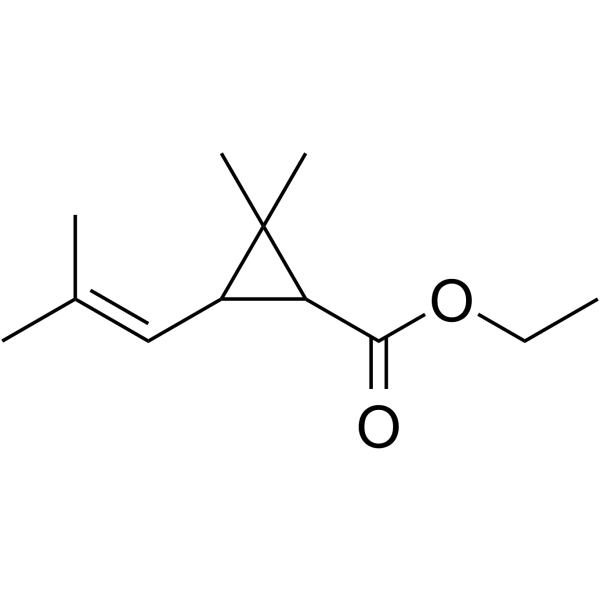
Ethyl chrysanthemate is an allelochemical compound used as an attractant .
loading...
    loading...
Cat. No.: HY-W753976
Ethyl chrysanthemate-d6 is the deuterium labeled Ethyl chrysanthemate (HY-N7100). Ethyl chrysanthemate is an allelochemical compound used as an attractant .
loading...
    loading...
Cat. No.: HY-W720629
CAS No.: 21420-37-1
Cyanamide- 15N2 is the 15N-labeled Cyanamide (HY-Y0070). Cyanamide is a cell division and plant growth inhibitor, as well as an allelochemical derived from Vicia villosa. Cyanamide inhibits root growth and biomass accumulation in a dose-dependent manner by disrupting the formation of mitotic spindles and phragmoplast complexes, reducing the number of mitotic cells and blocking the cell cycle. The effects of Cyanamide are partially reversible after removal from low-concentration environments. Cyanamide is also a specific inhibitor of aldehyde dehydrogenase (ALDH). Although Cyanamide has no direct effect on tumor growth, it can significantly enhance the anti-tumor efficacy of Cyclophosphamide (HY-17420) at non-toxic doses by inhibiting the inactivation of Cyclophosphamide. Cyanamide enables Cyclophosphamide to exert equivalent therapeutic effects at lower doses, effectively inhibiting the growth of primary and metastatic tumors and prolonging the lifespan of tumor-bearing mice. Cyanamide is commonly used in studies related to ha-1 hepatoma and rls lymphosarcoma .
loading...
    loading...
Cat. No.: HY-N17535
CAS No.: 2125954-15-4
Caffeoyltartaric acid is an allelochemical. Caffeoyltartaric acid can be isolated from the residues of Agave lechuguilla. Caffeoyltartaric acid exhibits allelopathic activity .
loading...
    loading...
Cat. No.: HY-N11293
CAS No.: 51415-07-7
Momilactone A is a naturally derived diterpene lactone with multiple biological activities including anticancer, antibacterial and antioxidant properties. Momilactone A inhibits inflammatory responses by reducing NO production and iNOS expression. Momilactone A acts as a corrosion inhibitor for mild steel; it forms an isolating film on the metal surface via adsorption between oxygen atoms of the molecule and iron ions, thereby blocking corrosive media. Momilactone A inhibits the growth of fungal and bacterial organisms, and also functions as an allelochemical to inhibit the growth of adjacent competing plants. Momilactone A can be used in studies related to leukemia, fungal infections and bacterial infections .
loading...
    loading...
Cat. No.: HY-Y0070
CAS No.: 420-04-2
Cyanamide is a cell division and plant growth inhibitor, as well as an allelochemical derived from Vicia villosa. Cyanamide inhibits root growth and biomass accumulation in a dose-dependent manner by disrupting the formation of mitotic spindles and phragmoplast complexes, reducing the number of mitotic cells and blocking the cell cycle. The effects of Cyanamide are partially reversible after removal from low-concentration environments. Cyanamide is also a specific inhibitor of aldehyde dehydrogenase (ALDH). Although Cyanamide has no direct effect on tumor growth, it can significantly enhance the anti-tumor efficacy of Cyclophosphamide (HY-17420) at non-toxic doses by inhibiting the inactivation of Cyclophosphamide. Cyanamide enables Cyclophosphamide to exert equivalent therapeutic effects at lower doses, effectively inhibiting the growth of primary and metastatic tumors and prolonging the lifespan of tumor-bearing mice. Cyanamide is commonly used in studies related to ha-1 hepatoma and rls lymphosarcoma .
loading...
    loading...
Cat. No.: HY-W750858
CAS No.: 155835-54-4
DIBOA-Glucoside is a glycoside derivative that can be found in cereal crops like rye, wheat, and maize. DIBOA-Glucoside is a stable, less toxic glucoside form of DIBOA. DIBOA-Glucoside, upon pest or pathogen attack, is hydrolyzed by an enzyme, releasing the toxic aglycone DIBOA and glucose, thereby deterring insects and suppressing weeds through an allelopathic effect .
loading...
    loading...

