9 Results for "

aspartate residues

" in MedChemExpress (MCE) Product Catalog:
Products (9)

9 Results for "aspartate residues" in MCE Product Catalog:

Cat. No.: HY-W014316
CAS No.: 30007-47-7
Target:  

Bacterial Fungal

Research Areas:  

Infection

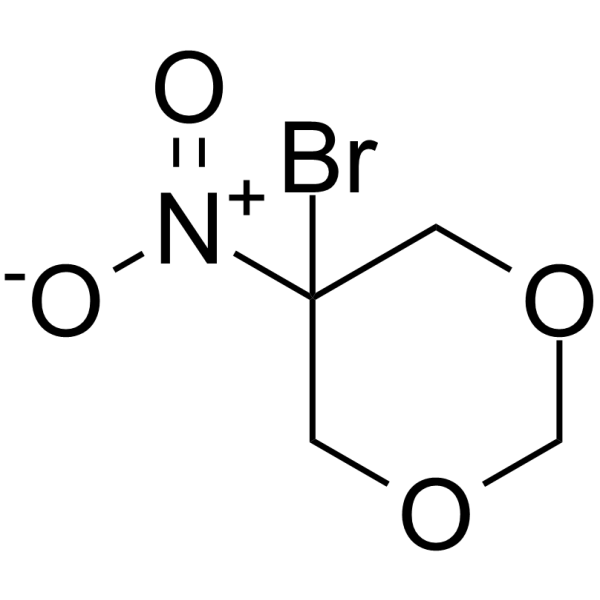
5-Bromo-5-nitro-1,3-dioxane is a broad-spectrum antimicrobial agent active against Gram-positive bacteria, Gram-negative bacteria and fungi. 5-Bromo-5-nitro-1,3-dioxane oxidizes free thiol groups to their corresponding disulfides. 5-Bromo-5-nitro-1,3-dioxane induces intracellular substance leakage in Escherichia coli and Staphylococcus aureus. 5-Bromo-5-nitro-1,3-dioxane modulates the oxygen consumption of Escherichia coli and Staphylococcus aureus .
loading...
    loading...
Cat. No.: HY-P1887
CAS No.: 209518-24-1
Target:  

HSP

Research Areas:  

Infection

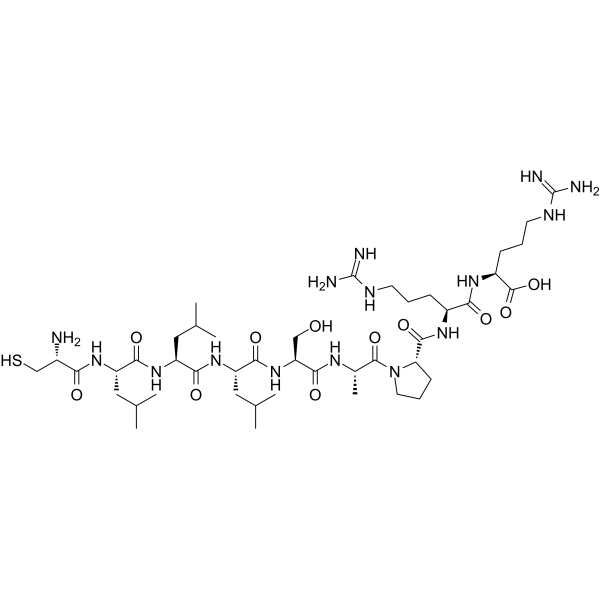
p5 Ligand for Dnak and DnaJ is a nonapeptide, which corresponds to the main binding site for the 23-residue part of the presequence of mitochondrial aspartate aminotransferase. p5 Ligand for Dnak and DnaJ is a high-affinity ligand for DnaK and DnaJ .
loading...
    loading...
Cat. No.: HY-E70933
Target:  

Endogenous Metabolite

Research Areas:  

Metabolic Disease

Protease, Streptomyces griseus, exhibits broad substrate specificity. Its active site consists of one aspartic acid residue, one histidine residue, and one serine residue. Protease tends to hydrolyze the peptide bond on the carboxyl side of glutamate or aspartate.
loading...
    loading...
Cat. No.: HY-P2820D
Research Areas:  

Others

β-Phosphoglucomutase (EC 5.4.2.6) requires Mg2+ and phosphorylation of an aspartate residue at the active site. The enzyme is able to autophosphorylate itself with its substrate β-D-glucose 1-phosphate.
loading...
    loading...
Cat. No.: HY-E70997
Research Areas:  

Metabolic Disease

Glycopeptidase A, Almonds (EC 3.5.1.52) is an enzyme that catalyzes a chemical reaction that cleaves a N4-(acetyl-beta-D-glucosaminyl)asparagine residue in which the glucosamine residue may be further glycosylated, to yield a (substituted) N-acetyl-beta-D-glucosaminylamine and a peptide containing an aspartate residue. Glycopeptidase A, Almonds (EC 3.5.1.52) belongs to the family of hydrolases, specifically those acting on carbon-nitrogen bonds other than peptide bonds in linear amides.
loading...
    loading...
Cat. No.: HY-E71085
Research Areas:  

Others

(R)-2-Hydroxy-4-methylpentanoate CoA-transferase (EC 2.8.3.24) , characterized from the bacterium Peptoclostridium difficile, participates in an L-leucine fermentation pathway. The reaction proceeds via formation of a covalent anhydride intermediate between a conserved aspartate residue and the acyl group of the CoA thioester substrate.
loading...
    loading...
Cat. No.: HY-187623
CAS No.: 149607-21-6
Target:  

HIV Protease

Research Areas:  

Inflammation/Immunology

U 92163 is an HIV-2 protease inhibitor. It is a synthetic peptidomimetic transition-state analog. U 92163 binds in an extended conformation along the length of the enzyme's binding cleft, and forms hydrogen bonds with the catalytic aspartate pair and other protease residues to block enzyme activity. U 92163 can be used in research on acquired immunodeficiency syndrome (AIDS) .
loading...
    loading...
Cat. No.: HY-117641
CAS No.: 121584-61-0
Target:  

Ser/Thr Protease

Research Areas:  

Cardiovascular Disease

CP 81282 is a tripeptide aspartic protease inhibitor, with an IC50 of 1 nM against human renin and an IC50 of 11 nM against endopeptidase. CP 81282 is applicable to the research of hypertension .
loading...
    loading...
Cat. No.: HY-114003
CAS No.: 25881-35-0
Target:  

Phosphatase

Research Areas:  

Cancer

(R,S)-Phosphonsaeure (Compound 2A) is an inhibitor of prostatic acid phosphatase with an IC50 value of 4 nM. (R,S)-Phosphonsaeure can be used in the research of prostate cancer .
loading...
    loading...

