13 Results for "

depressive symptoms

" in MedChemExpress (MCE) Product Catalog:
Products (13)

13 Results for "depressive symptoms" in MCE Product Catalog:

1
1 Cited Publications
Cat. No.: HY-N1916
CAS No.: 63644-62-2
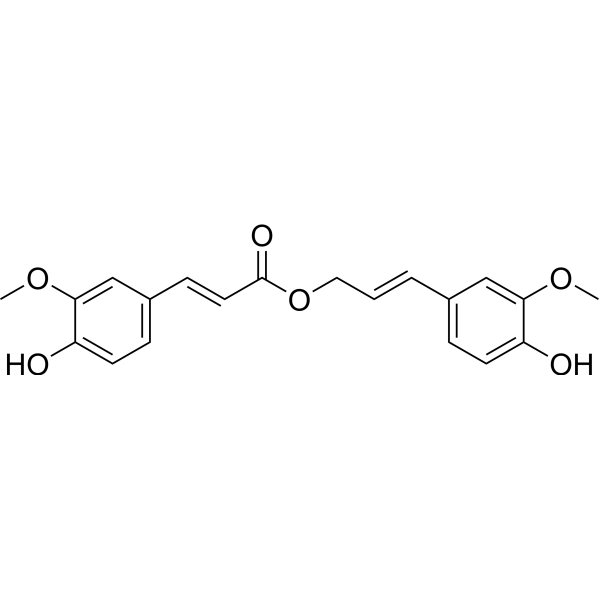
Coniferyl ferulate is an orally active phenolic acid compound. Coniferyl ferulate is a potent inhibitor of glutathione S-transferase (GST) (IC50 = 0.3 μM), which downregulates P-gp expression, induces apoptosis in B-MD-C1 (ADR+/+) cells, and reverses multidrug resistance. Coniferyl ferulate blocks the NMDAR/NR2B-CaMKII-MAPKs signaling pathway, inhibits ROS production and mitochondrial apoptosis, while reshapes the intestinal microbiota and microbial metabolism, ameliorates colonic inflammation and alleviates depressive symptoms in mice. Coniferyl ferulate can alleviate the toxicity of xylene to hematopoietic stem and progenitor cells by targeting Mgst2. Coniferyl ferulate exhibits antibacterial activity against the Gram-positive Bacillus subtilis and Staphylococcus aureus .
loading...
    loading...
Cat. No.: HY-156836
CAS No.: 30223-92-8
Synonyms: Tyramine sulfate
Target:  

Drug Metabolite

Research Areas:  

Neurological Disease

Tyramine O-sulfate (Tyramine sulfate) is a metabolite of Tyramine (HY-W007606) formed via sulfation, which serves as a biomarker for depression. Tyramine O-sulfate can be used in the research of depression .
loading...
    loading...
Cat. No.: HY-114682
CAS No.: 24678-13-5
Purity:  98.11%
Synonyms: AHR 2277 free base
Target:  

Dopamine Receptor

Research Areas:  

Neurological Disease

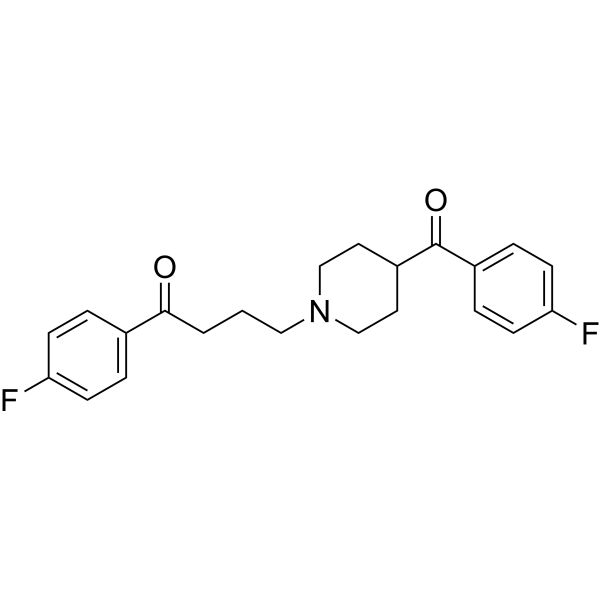
Lenperone (AHR 2277 free base) has antipsychotic effect. Lenperone improves depressive symptoms .
loading...
    loading...
Cat. No.: HY-B0158R
CAS No.: 65-46-3
Synonyms: Cytosine β-D-riboside (Standard); Cytosine-1-β-D-ribofuranoside (Standard)
Cytidine (Standard) is the analytical standard of Cytidine. This product is intended for research and analytical applications. Cytidine is a pyrimidine nucleoside and acts as a component of RNA. Cytidine is a precursor of uridine. Cytidine controls neuronal-glial glutamate cycling, affecting cerebral phospholipid metabolism, catecholamine synthesis, and mitochondrial function . In Vivo:Cytidine decreases glutamate/glutamine levels and induces earlier improvement of depressive symptoms .
loading...
    loading...
Cat. No.: HY-130307
CAS No.: 3567-00-8
Purity:  98.19%
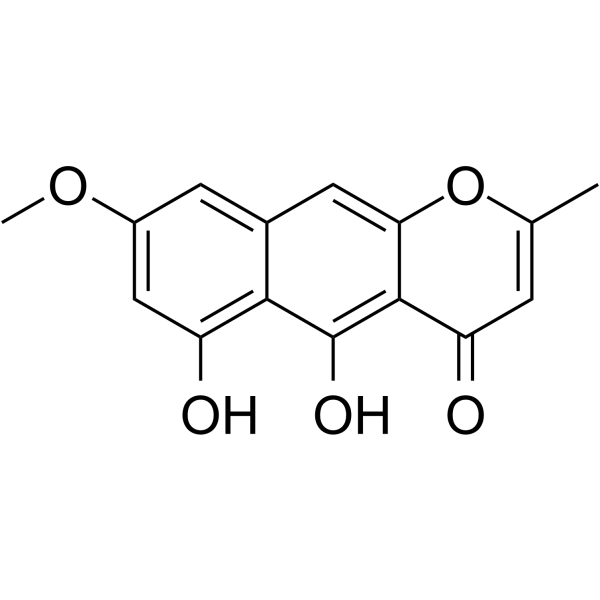
Rubrofusarin is an orange polyketide pigment from Fusarium graminearum . Rubrofusarin is also an active ingredient of the Cassia species and ameliorates chronic restraint stress (CRS) -induced depressive symptoms through PI3K/Akt signaling. Rubrofusarin has anticancer, antibacterial, and antioxidant effects .
loading...
    loading...
Cat. No.: HY-108920
CAS No.: 153152-32-0
Purity:  99.94%
Synonyms: 4-Cl-KYN; AV-101
Target:  

iGluR

Research Areas:  

Neurological Disease

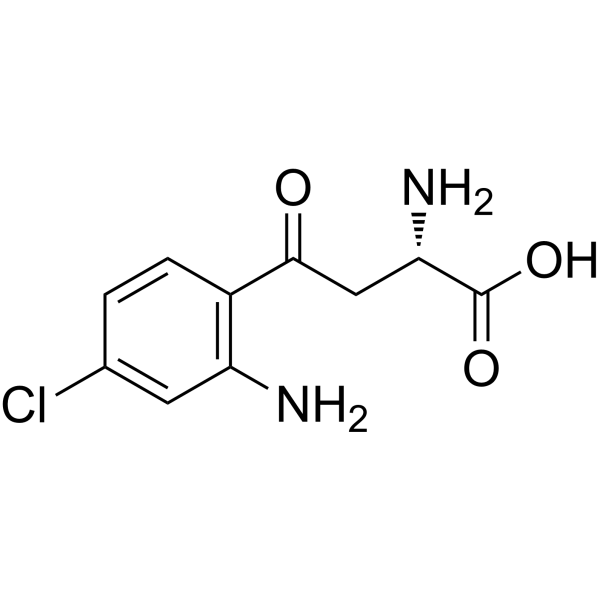
4-Chlorokynurenine (4-Cl-KYN) is a prodrug of 7-Chlorokynurenic acid (NMDA receptor antagonist) (HY-100811). 4-Chlorokynurenine has orally activity and blood-brain permeability. 4-Chlorokynurenine can reduce depressive symptoms and neurotoxicity. 4-Chlorokynurenine can be used for the research of neurological disease, such as depression and seizure .
loading...
    loading...
Cat. No.: HY-121850
CAS No.: 2829-19-8
Synonyms: EX-4883
Target:  

HBV

Research Areas:  

Neurological Disease

Rolicyprine (EX-4883) is an antidepressant with neuroprotective activity. Rolicyprine can improve depressive symptoms and promote neuroregeneration. Rolicyprine also shows potential effectiveness for anxiety suppression .
loading...
    loading...
Cat. No.: HY-125047
CAS No.: 23226-37-1
Synonyms: UK 3557 tosylate
Daledalin tosylate is an orally active indoline antidepressant targeting noradrenaline and serotonin transporters in the brain. Daledalin tosylate enhances central monoaminergic neurotransmission to alleviate depressive symptoms. Daledalin tosylate is proming for rasearch of depression, including endogenous and neurotic depression .
loading...
    loading...
Cat. No.: HY-125047A
CAS No.: 22136-27-2
Synonyms: UK 3557
Daledalin (UK 3557) is an orally active indoline antidepressant targeting noradrenaline and serotonin transporters in the brain. Daledalin enhances central monoaminergic neurotransmission to alleviate depressive symptoms. Daledalin is proming for rasearch of depression, including endogenous and neurotic depression .
loading...
    loading...
Cat. No.: HY-P10545
Research Areas:  

Neurological Disease

[D-His26]-Neuropeptide Y, human, rat is a synthetic variant of neuropeptide Y (NPY). [D-His26]-Neuropeptide Y, human, rat acts as a Y1R agonist that can prevent the development of anxiety, social impairment, and depressive symptoms, and has the potential to be used as an early intervention treatment for post-traumatic stress reactions .
loading...
    loading...
Cat. No.: HY-W740116
CAS No.: 10488-36-5
Synonyms: TOF hydrochloride
Target:  

Drug Intermediate

Research Areas:  

Neurological Disease

Tofenacin hydrochloride (TOF hydrochloride) is an orally active weak anticholinergic compound. Tofenacin hydrochloride can be used to study extrapyramidal symptoms and depressive side effects associated with the use of Fluphenazine decanoate (HY-B1904) .
loading...
    loading...
Cat. No.: HY-W740116A
CAS No.: 15301-93-6
Synonyms: TOF
Target:  

Drug Intermediate

Research Areas:  

Neurological Disease

Tofenacin (TOF) is an orally active weak anticholinergic compound. Tofenacin can be used to study extrapyramidal symptoms and depressive side effects associated with the use of Fluphenazine decanoate (HY-B1904) .
loading...
    loading...
Cat. No.: HY-105628
CAS No.: 3734-17-6
Synonyms: CI-427
Target:  

Others

Prodilidine (CI-427) is an orally active, pyrrolidine-derived non-narcotic pain inhibitor. Prodilidine exerts analgesic activity against various nociceptive stimuli, and shows no antipyretic, anti-inflammatory or respiratory depressive effects. Prodilidine fails to inhibit withdrawal symptoms of addictive agents in monkeys, but exhibits excitatory effects and enhances the crossed extensor reflex at toxic doses. Prodilidine is well absorbed from the gastrointestinal tract and metabolized via hepatic microsomal N-demethylation, displaying isomer-specific activity, toxicity and metabolic characteristics. Prodilidine can be used in research related to chronic pain (e.g., cancer-, musculoskeletal/arthritis-derived), traumatic pain and arthritic pain .
loading...
    loading...
  • 1

