7 Results for "

energy transfer receptor

" in MedChemExpress (MCE) Product Catalog:
Products (7)

7 Results for "energy transfer receptor" in MCE Product Catalog:

Cat. No.: HY-137115
CAS No.: 334658-24-1
Target:  

Smo

Research Areas:  

Cancer

BODIPY-Cyclopamine is a fluorescently labeled ligand for the Smoothened (SMO) receptor. The activation of SMO is regulated by Patch protein, and over-activated SMO signaling pathways are associated with tumorigenesis. The NanoBRET (Nanofluorescein bioluminescence resonance energy transfer) technique used in the study can sensitively detect the resonance energy transfer between SMO and BODIPY-Cyclopamine, which can be used for high-throughput screening and kinetic analysis. Studying the binding site of BODIPY-Cyclopamine on SMO can also further explore SMO-targeted drugs .
loading...
    loading...
Cat. No.: HY-D1671
Target:  

Fluorescent Dye

Research Areas:  

Others

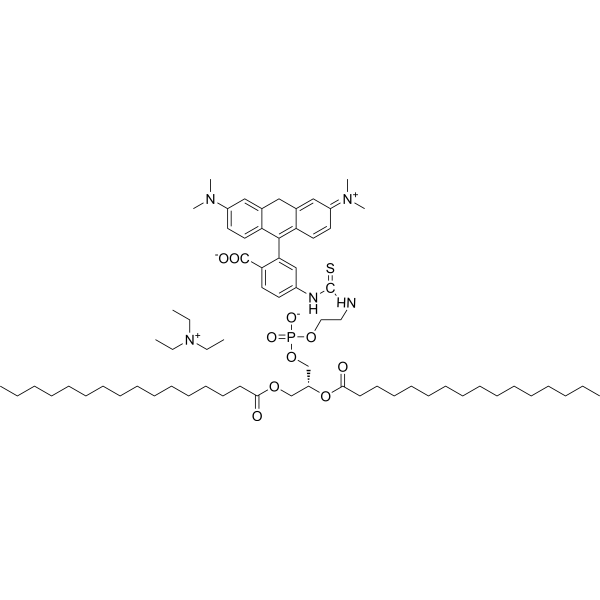
TRITC-DHPE is a rhodamine-labeled glycerophosphate ethanolamine lipid, with head groups marked with bright red fluorescent TRITC dye (λEx/λEm=514/580 nm). TRITC-DHPE can be used for membrane fusion assay to trace lipid processing in intracellular phagocytosis. TRITC-DHPE can serves as an energy transfer receptor for NBD, BODIPY and fluorescein lipid probes .
loading...
    loading...
Cat. No.: HY-153114
CAS No.: 2181834-03-5
Purity:  98.01%
Target:  

FXR

Research Areas:  

Inflammation/Immunology

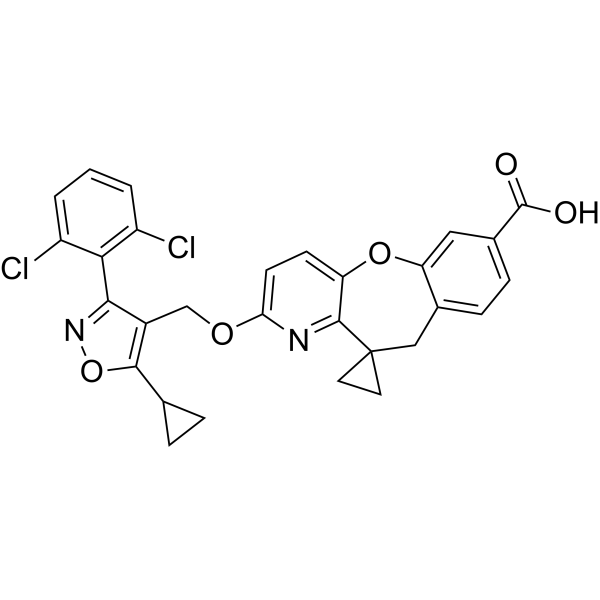
HEC96719 is a selective and orally active tricyclic farnesoid X receptor (FXR) agonist with EC50 values of 1.37 and 1.55 nM by time-resolved fluorescence energy transfer (TR-FRET) and luciferase reporter assays, respectively. HEC96719 significantly improves non-alcoholic steatohepatitis (NASH) and liver fibrosis with favorable tissue distribution in liver and intestine. HEC96719 can be used for the research of non-alcoholic steatohepatitis .
loading...
    loading...
Cat. No.: HY-D3277
PE-VF594 is a high-brightness fluorescent dye used in flow cytometry, primarily for labeling antibodies or streptavidin to help identify specific cell subpopulations. PE-VF594 is a tandem dye composed of two covalently linked fluorescent groups: one is phycoerythrin (PE), responsible for absorbing laser energy; the other is the receptor molecule VF594. Energy is transferred from PE to VF594 via fluorescence resonance energy transfer (FRET) mechanism (Ex/Em = 450-500 nm/614 nm) .
loading...
    loading...
Cat. No.: HY-182041
Research Areas:  

Infection

Insecticidal agent 31 is an insecticide targeting the γ-aminobutyric acid receptor (GABAR). Insecticidal agent 31 exhibits insecticidal activity against Plutella xylostella, Spodoptera frugiperda and Spodoptera exigua. Insecticidal agent 31 can serve as a lead compound for the design and synthesis of novel isoxazole-based insecticides .
loading...
    loading...
Cat. No.: HY-D3579
Target:  

Fluorescent Dye

Research Areas:  

Others

AF568 C5 Maleimide is a bright orange-red thiol-reactive fluorescent dye. AF568 C5 Maleimide selectively labels the thiol groups on cysteine residues in proteins, peptides and antibodies via stable thioether bonds (Ex/Em = 575/600 nm) .
loading...
    loading...
Cat. No.: HY-L164
2,276 compounds

Protein serine/threonine kinases (PSKs) are protein kinases that use ATP as a high-energy donor molecule to transfer phosphate groups to serine/threonine residues of target protein. As an important signal transduction regulator, serine/threonine kinases can affect the function of target proteins by disrupting enzyme activity or binding of target proteins to other proteins. Serine/threonine kinases are involved in the regulation of immune response, cell proliferation, differentiation, apoptosis and other physiological processes. Serine/threonine kinase inhibitors are an important class of compounds that have been widely studied in cancer, chronic inflammation, autoimmune diseases, aging and other diseases.

MCE designs a unique collection of 2,276 serine/threonine kinase inhibitors, mainly targeting the receptor PKA, Akt, PKC, MAPK/ERK, etc, which is an effective tool for development and research of anti-cancer, anti-chronic inflammatory diseases, anti-autoimmune diseases and anti-aging compounds.

