

9 Results for "

heat inactivation

" in MedChemExpress (MCE) Product Catalog:
Products (9)

9 Results for "heat inactivation" in MCE Product Catalog:

  • Targets Recommended:
28
28 Publications Verification
Cat. No.: HY-108717
CAS No.: 39450-01-6
Synonyms: Protease K
Target:  

Ser/Thr Protease

Research Areas:  

Others

Proteinase K (Protease K) is a nonspecific serine protease that is useful for general digestion of proteins. Proteinase K is active in the presence of SDS or urea and over a wide range of pH (4-12), salt concentrations, and temperatures. Proteinase K can be use for promoting methods of viral nucleic acid extraction, and detection .
loading...
    loading...
25
25 Cited Publications
Cat. No.: HY-153808
CAS No.: 9007-81-2
Research Areas:  

Inflammation/Immunology

Complete Freund's adjuvant (CFA) is an immunoadjuvant emulsified with antigen by its discoverer Jules T. Freund to enhance an animal's immune response to an antigen. Complete Freund's adjuvant (CFA) is also an inducer of the Th1 immune response and a ligand of TLRs. Complete Freund's adjuvant (CFA) contains heat-killed inactive tuberculosis bacilli and consists of a paraffin oil-in-water emulsion. Complete Freund's adjuvant (CFA) stimulates a strong and durable immune response and can be used to induce persistent inflammatory pain models in mice, experimental autoimmune myocarditis (EAM) models, and more. Incomplete Freund's adjuvant (IFA) (HY-153808A) is another type of Freund's Adjuvant that stimulates a weaker immune response .
loading...
    loading...
7
7 Cited Publications
Cat. No.: HY-B0710
CAS No.: 107-43-7
Synonyms: Trimethylglycine; carboxy-N,N,N-trimethylmethanaminium
Betaine (Trimethylglycine) is a natural compound found in many foods and also an active methyl-donor which can maintain normal DNA methylation patterns [1,2]. Betaine is found ubiquitously in plants, animals, microorganisms, and rich dietary sources including seafood, spinach, and wheat bran. Betaine also acts as an osmolyte, to maintain the avian’s cellular water and ion balance to improve the avian’s capacity against heat stress via preventing dehydration and osmotic inactivation. It helps in maintaining the protective osmolytic activity, especially in heat-stressed birds. Betaine may promote various intestinal microbes against osmotic variations and thus improve microbial fermentation activity .
loading...
    loading...
Cat. No.: HY-153808B
CAS No.: 9007-81-2
Research Areas:  

Inflammation/Immunology

Complete Freund's adjuvant (CFA, 1 mg/ml) is an immunoadjuvant emulsified with antigen that can enhance an animal's immune response to an antigen. Complete Freund's adjuvant (CFA, 1 mg/ml) is also an inducer of the Th1 immune response and a ligand of TLRs. Complete Freund's adjuvant (CFA, 1 mg/ml) contains heat-killed inactive tuberculosis bacilli and consists of a paraffin oil-in-water emulsion. Complete Freund's adjuvant (CFA, 1 mg/ml) stimulates a strong and durable immune response and can be used to induce rheumatoid arthritis in rats, and more .
loading...
    loading...
Cat. No.: HY-B0710R
CAS No.: 107-43-7
Synonyms: Trimethylglycine (Standard); carboxy-N,N,N-trimethylmethanaminium (Standard)
Betaine (Standard) is the analytical standard of Betaine. This product is intended for research and analytical applications. Betaine (Trimethylglycine) is a natural compound found in many foods and also an active methyl-donor which can maintain normal DNA methylation patterns [1,2]. Betaine is found ubiquitously in plants, animals, microorganisms, and rich dietary sources including seafood, spinach, and wheat bran. Betaine also acts as an osmolyte, to maintain the avian’s cellular water and ion balance to improve the avian’s capacity against heat stress via preventing dehydration and osmotic inactivation. It helps in maintaining the protective osmolytic activity, especially in heat-stressed birds. Betaine may promote various intestinal microbes against osmotic variations and thus improve microbial fermentation activity .
loading...
    loading...
Cat. No.: HY-148745
CAS No.: 2241517-83-7
Target:  

Drug Derivative HSP

Research Areas:  

Cancer

JG-258 is an inactive negative control for Hsp70 inhibitors. JG-258 is an inactive structural analog of JG-98 (HY-117282), an allosteric inhibitor of heat shock protein 70 (Hsp70) with demonstrated anticancer activity. JG-258 can be used in cancer-related research .
loading...
    loading...
Cat. No.: HY-B0710S
CAS No.: 309762-22-9
Synonyms: Trimethylglycine-13C3; Carboxy-N,N,N-trimethylmethanaminium-13C3
Betaine- 13C3 (Trimethylglycine- 13C3) is the 13C labeled isotope of Betaine (HY-B0710). Betaine (Trimethylglycine) is a natural compound found in many foods and also an active methyl-donor which can maintain normal DNA methylation patterns [1,2]. Betaine is found ubiquitously in plants, animals, microorganisms, and rich dietary sources including seafood, spinach, and wheat bran. Betaine also acts as an osmolyte, to maintain the avian’s cellular water and ion balance to improve the avian’s capacity against heat stress via preventing dehydration and osmotic inactivation. It helps in maintaining the protective osmolytic activity, especially in heat-stressed birds. Betaine may promote various intestinal microbes against osmotic variations and thus improve microbial fermentation activity .
loading...
    loading...
Cat. No.: HY-12349
CAS No.: 351438-49-8
Purity:  96.40%
Target:  

Enterovirus

Research Areas:  

Infection

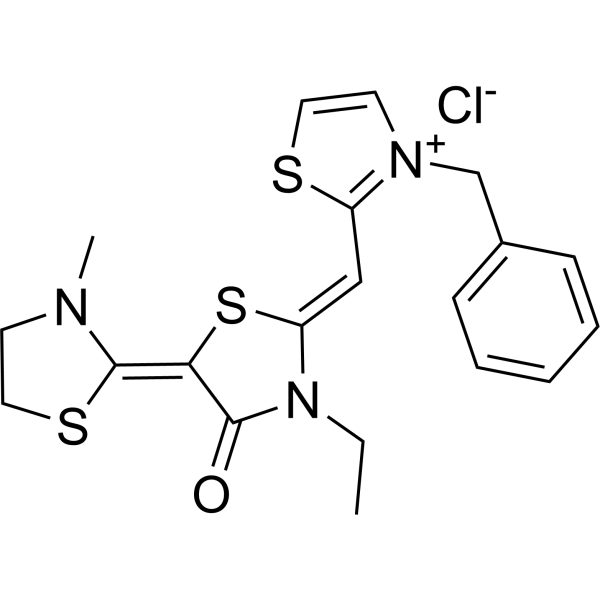
H1PVAT is a potent and selective inhibitor of poliovirus serotypes (PV-1, PV-2, PV-3), and inhibits early stage of the replication. H1PVAT interacts with viral capsid directly and protects PV against heat inactivation .
loading...
    loading...
Cat. No.: HY-117387
CAS No.: 107572-73-6
Target:  

Endogenous Metabolite

Research Areas:  

Infection

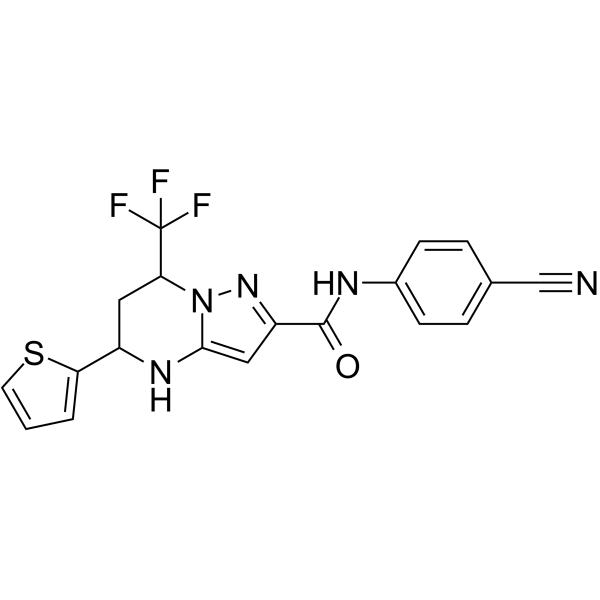
BFE-37 is a yeast introduction with heat resistance activity. The survival rate change of BFE-37 after heating at 55 °C for 5 minutes was 6.53 log CFU/mL, showing its strong heat resistance in acidic orange juice. The dynamic behavior of BFE-37 at different temperatures showed a first-order logarithmic linear inactivation characteristic, which indicates its stability in heat treatment. The study of BFE-37 helps to understand the effect of mild heat treatment on juice and provide guidance for microbial control in the food industry .
loading...
    loading...

