
8 Results for "

hepatic PCSK9

" in MedChemExpress (MCE) Product Catalog:
Products (8)

8 Results for "hepatic PCSK9" in MCE Product Catalog:

1
1 Cited Publications
Cat. No.: HY-150223
Purity:  92.48%
GalNAc unconjugated/naked Inclisiran is a double-stranded small interfering RNA molecule that targets hepatic PCSK9 production to reduce LDL-C levels. GalNAc unconjugated/naked Inclisiran can be used in the research of cardiovascular diseases and hypercholesterolemia .
loading...
    loading...
Cat. No.: HY-101354
CAS No.: 2133832-83-2
Purity:  98.76%
Synonyms: PF-00932239
Target:  

PCSK9 Ras MEK ERK NF-κB LDLR

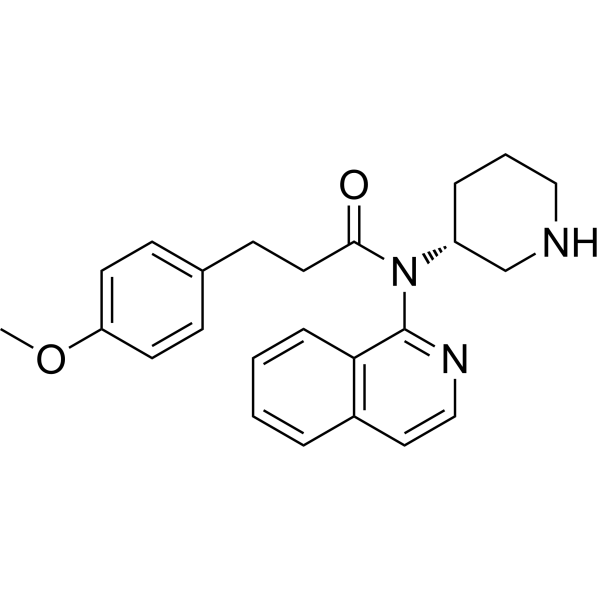
R-IMPP (PF-00932239) is a PCSK9 translation inhibitor and a selective 80S ribosome binder. R-IMPP inhibits the KRAS/MEK/ERK signaling cascade. R-IMPP reduces LPS-induced nuclear translocation of NFkB P65. R-IMPP increases LDL-R levels in cells, promotes LDL-C uptake, and does not alter the secretion of transferrin or albumin. R-IMPP inhibits the growth of colorectal cancer (CRC) cells, organoids and xenografts carrying APC/KRAS mutations, as well as the number and burden of spontaneous mouse tumors. R-IMPP can be used in research related to colorectal cancer with APC/KRAS mutations, hepatic ischemia-reperfusion injury and hypercholesterolemia .
loading...
    loading...
Cat. No.: HY-162562
CAS No.: 930017-01-9
Target:  

PCSK9

E28362 is an orally active lipid-lowering agent and a selective PCSK9 antagonist. E28362 blocks the interaction between PCSK9 and LDLR, and induces PCSK9 degradation via the ubiquitin-proteasome pathway. E28362 significantly increases the levels of cell surface and total LDLR proteins, enhances low-density lipoprotein uptake, thereby effectively reducing plasma lipids, hepatic cholesterol and triglyceride levels. E28362 shows no obvious cytotoxicity at high concentrations, and significantly attenuates atherosclerotic lesions in animal models. E28362 is an important molecule in research of hyperlipidemia and atherosclerosis .
loading...
    loading...
Cat. No.: HY-P11071
Target:  

PCSK9 LDLR

Research Areas:  

Cardiovascular Disease

PCSK9 Inhibitor, EGF-A is a PCSK9 inhibitor with LDLR degradation inhibitory activity and LDLR recycling promoting activity. PCSK9 Inhibitor, EGF-A is a synthetic peptide consisting of 42 amino acid residues, which contains the calcium-binding site of the epidermal growth factor A domain (EGF-A). PCSK9 Inhibitor, EGF-A reduces plasma LDL cholesterol levels by maintaining hepatic LDLR levels and enhancing the clearance capacity of circulating LDL. PCSK9 Inhibitor, EGF-A can be used in research related to hypercholesterolemia, premature atherosclerosis, coronary heart disease and familial hypercholesterolemia .
loading...
    loading...
Cat. No.: HY-P991574
CAS No.: 2643310-75-0
Synonyms: REG-101
MEDI-5884 (REG-101) is a humanized IgG4Pκ neutralizing monoclonal antibody targeting endothelial lipase (EL), with an IC50 of 1.3 nM and 1.7 nM against human and cynomolgus monkey EL, respectively; its Kd values for human and cynomolgus monkey EL are 4.1 nM and 1.6 nM, respectively. MEDI-5884 increases plasma levels of HDL-C, apolipoprotein A1 (ApoA1) and phospholipids, while causing a slight increase in LDL-C and apolipoprotein B (ApoB) levels. MEDI-5884 can be used in research related to cardiovascular diseases, coronary heart disease, coronary atherosclerosis and stable coronary artery disease .
loading...
    loading...
Cat. No.: HY-W1126955
CAS No.: 2861205-06-1
Synonyms: MK-0616 decanoate
Target:  

PCSK9

Enlicitide (MK-0616) decanoate is an orally active macrocyclic peptide PCSK9 inhibitor. Enlicitide decanoate binds to PCSK9, blocks its interaction with low-density lipoprotein receptor (LDLR), and enhances hepatic clearance of LDL-C. Enlicitide decanoate reduces atherogenic lipoproteins, including non-HDL cholesterol, apolipoprotein B, and lipoprotein (a). Enlicitide decanoate is applicable to research related to hypercholesterolemia, heterozygous familial hypercholesterolemia, and atherosclerotic cardiovascular disease .
loading...
    loading...
Cat. No.: HY-18778C
CAS No.: 866399-89-5
Synonyms: TA-8995 hemicalcium; DEZ-001 hemicalcium; AMG-899 hemicalcium
Target:  

CETP PCSK9 LDLR

Research Areas:  

Inflammation/Immunology

Obicetrapib hemicalcium (TA-8995 hemicalcium) is an orally active cholesteryl ester transfer protein (CETP) inhibitor. Obicetrapib hemicalcium shifts the plasma lipoprotein profile toward more HDL-C particles, reduces circulating PCSK9 levels, increases hepatic LDLR expression and LDLR mRNA levels, and promotes hepatic clearance of VLDL remnants. Obicetrapib hemicalcium increases the number of large HDL particles, reduces the number and area of atherosclerotic lesions and alleviates lesion severity, increases the proportion of unaffected arterial segments, improves lesion stability, and promotes regression of aortic root lesions. Obicetrapib hemicalcium also exerts a synergistic effect with Ezetimibe (HY-17376) to reduce non-HDL-C levels and improve atherosclerosis. Obicetrapib hemicalcium can be used in studies related to atherosclerosis and dyslipidemia .
loading...
    loading...
Cat. No.: HY-101354A
CAS No.: 2173005-10-0
Synonyms: PF-00932239 hydrochloride
R-IMPP hydrochloride (PF-00932239 hydrochloride) is a PCSK9 translation inhibitor and a selective 80S ribosome binder. R-IMPP hydrochloride inhibits the KRAS/MEK/ERK signaling cascade. R-IMPP hydrochloride reduces LPS-induced nuclear translocation of NFkB P65. R-IMPP hydrochloride increases LDL-R levels in cells, promotes LDL-C uptake, and does not alter the secretion of transferrin or albumin. R-IMPP hydrochloride inhibits the growth of colorectal cancer (CRC) cells, organoids and xenografts carrying APC/KRAS mutations, as well as the number and burden of spontaneous mouse tumors. R-IMPP hydrochloride can be used in research related to colorectal cancer with APC/KRAS mutations, hepatic ischemia-reperfusion injury and hypercholesterolemia .
loading...
    loading...

