13 Results for "

large unilamellar vesicles

" in MedChemExpress (MCE) Product Catalog:
Products (13)

13 Results for "large unilamellar vesicles" in MCE Product Catalog:

Cat. No.: HY-112768
Purity:  ≥95.0%
Research Areas:  

Others

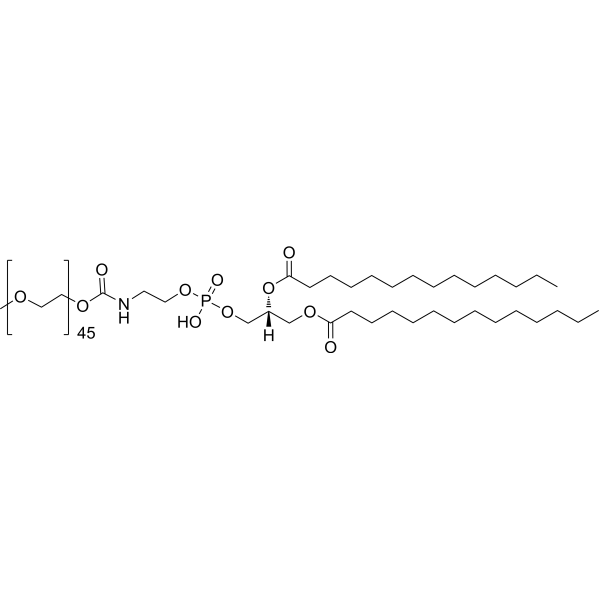
PEG2000-DMPE is a polyethylene glycol-lipid conjugate combined with phosphatidylethanolamine. PEG2000-DMPE undergoes a conformational transition from mushroom-like to brush-like at a concentration of 7 mol%, thereby exerting multiple functions such as inhibitor, stabilizer and surface defect modifier. PEG2000-DMPE can form a steric hindrance barrier on the vesicle surface to block calcium ion-induced liposome fusion, and dynamically regulate the fusion process through spontaneous transfer rate. PEG2000-DMPE can delay the thinning of foam thin liquid films and smoothly seal surface defects of solid support layers. PEG2000-DMPE can be used in the design and related research of stealth liposomes and micelles .
loading...
    loading...
Cat. No.: HY-D0074
CAS No.: 70504-01-7
Target:  

Fluorescent Dye

Research Areas:  

Others

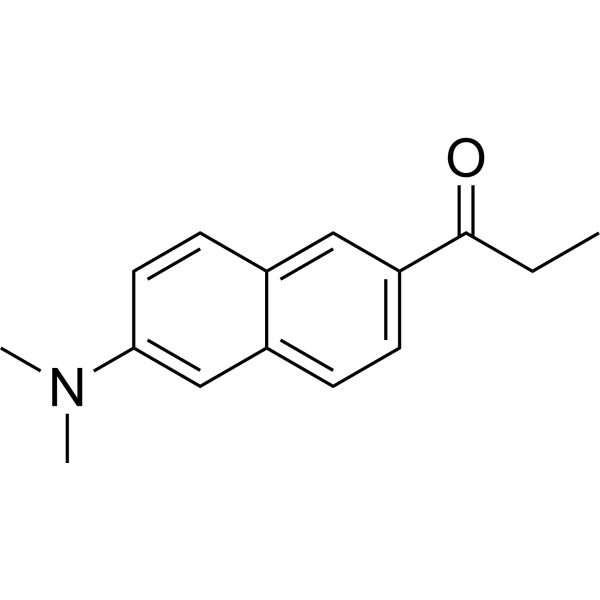
Prodan is an environment-sensitive fluorescent probe used to investigate the polarity, fluidity, and structure of lipid membranes. Prodan exhibits environment-dependent excitation/emission wavelengths, with its wavelength range covering Ex = 360-410 nm and Em = 430-530 nm when in solvents, bound to DNA, located in lipid bilayers, or associated with proteins. Prodan can interact with the major groove of DNA, regions of lipid bilayers, and hydrophobic pockets of proteins. During phase transitions, Prodan localizes to different regions of the bilayer: the emission minimum is 430-440 nm in the gel phase, while it shifts to 480-500 nm in the liquid-crystalline phase or interdigitated gel phase. When bound to rigid hydrophobic sites of proteins, the emission peak of Prodan undergoes a blue shift and its fluorescence intensity increases .
loading...
    loading...
Cat. No.: HY-N10407
CAS No.: 30311-61-6
Target:  

Drug Derivative

Research Areas:  

Others

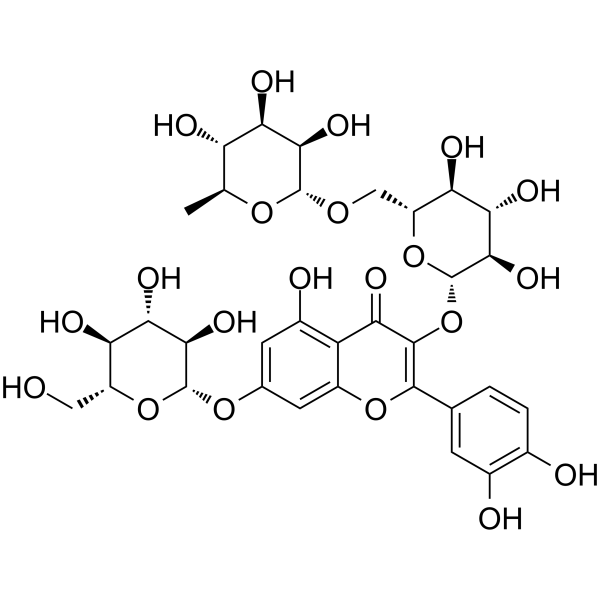
Quercetin 3-O-rutinoside-7-O-glucoside is a flavonol glycoside and a derivative of Quercetin (HY-18085). Quercetin 3-O-rutinoside-7-O-glucoside can be isolated from the leaves and fruits of Korean Morus alba L. as well as the leaves of Hemerocallis fulva. Quercetin 3-O-rutinoside-7-O-glucoside inhibits lipid peroxidation in large unilamellar vesicles in vitro. Quercetin 3-O-rutinoside-7-O-glucoside possesses antioxidant activity .
loading...
    loading...
Cat. No.: HY-D1556
CAS No.: 384832-91-1
Synonyms: 1,2-dioleoyl-sn-glycero-3-phosphoethanolamine-N-(carboxyfluorescein) ammonium
Target:  

Fluorescent Dye

Research Areas:  

Cancer

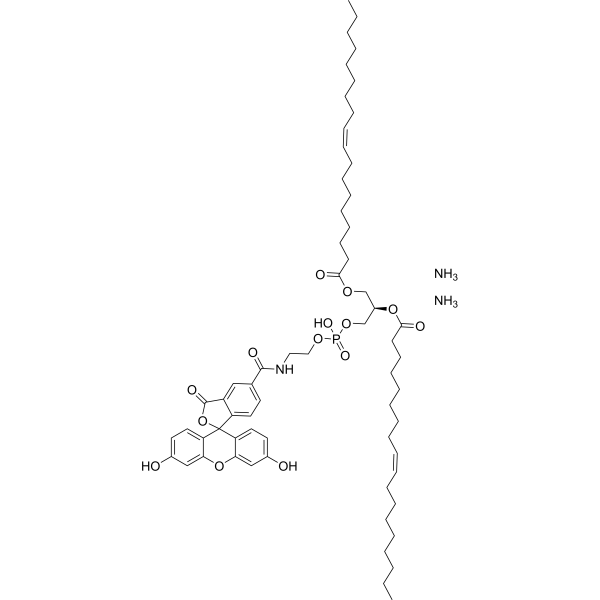
18:1 PE CF (1,2-dioleoyl-sn-glycero-3-phosphoethanolamine-N-(carboxyfluorescein) (ammonium)) is a pH-sensitive fluorescent indicator. 18:1 PE CF exhibits changes in fluorescence intensity in response to pH variations and reflects the electrostatic states of cationic liposomes and lipoplexes. 18:1 PE CF supports real-time visualization of pH distribution and membrane deformation in giant unilamellar vesicles and is suitable for steady-state fluorescence testing in large unilamellar vesicle membranes. 18:1 PE CF is capable of monitoring the surface electrical potential of cationic liposomes and lipoplexes and can effectively label lipid bilayers and nanomicelles. 18:1 PE CF can be used for the research of the investigation of lung cancer (Ex = 495 nm; Em = 520 nm) .
loading...
    loading...
Cat. No.: HY-D1305
CAS No.: 1443553-08-9
Target:  

Fluorescent Dye

Research Areas:  

Others

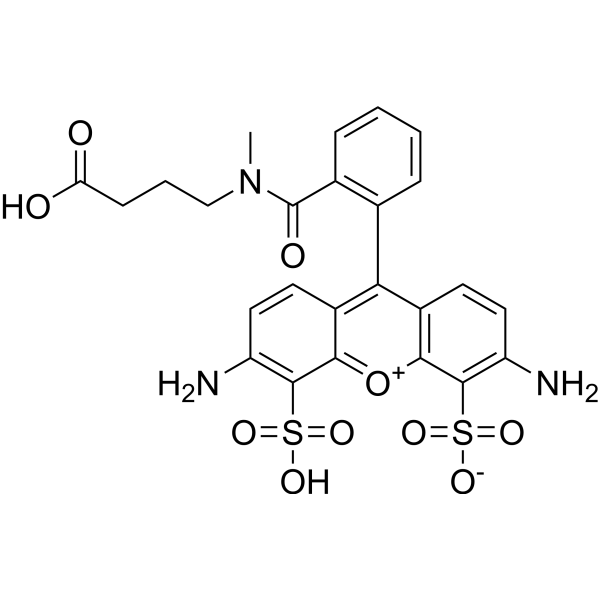
ATTO 488 carboxylic acid is a bright green fluorescent dye with high photostability, which is commonly used in protein fluorescent labeling, single-molecule fluorescence imaging and super-resolution microscopy studies. The carboxylic acid form of ATTO 488 can be covalently coupled to primary amines of proteins via activation, or prepared into a maleimide derivative for coupling with thiol groups; it emits green fluorescence after labeling. Ex/Em = 488/524 nm .
loading...
    loading...
Cat. No.: HY-D2817
Target:  

Fluorescent Dye

Research Areas:  

Others

FITC-PLL is a fluorescently labeled polycationic polypeptide probe composed of polylysine (PLL) and FITC (HY-66019), with a typical Ex/Em of 495/520 nm. The fluorescence intensity and lifetime of FITC-PLL are sensitive to pH and FITC density. FITC-PLL can be used for quantifying hapten receptor binding and endocytosis kinetics in macrophages, as a patternable substrate for neuron guidance, for negatively charged phospholipid membrane binding and transmembrane transport, and for live-cell imaging of starch nanoparticle conjugates and lysosome labeling .
loading...
    loading...
Cat. No.: HY-P11353
CAS No.: 117138-19-9
Research Areas:  

Infection Cancer

HA2 peptide is a potent pH-responsive fusion peptide derived from hemagglutinin (HA), corresponding to the N-terminal fusion peptide domain consisting of 23 amino acid residues of HIV-1 gp41 envelope glycoprotein. HA2 peptide adopts a random coil structure under physiological pH conditions; in acidic endosomes, protonation of carboxyl groups reduces negative charge, inducing a transition to an α-helical conformation that can fuse with and destabilize the endosomal membrane. After binding to membranes, the N-terminal and middle regions of HA2 peptide mainly adopt a β-strand conformation, while the C-terminal region remains unstructured. HA2 peptide induces lipid mixing and promotes aqueous content leakage from large unilamellar vesicles whose lipid composition matches that of HIV-1 viruses and target T cells. HA2 peptide is anionic and can bind to cationic peptides to achieve siRNA condensation. HA2 peptide can be used in studies related to cancer and human immunodeficiency virus (HIV) infection .
loading...
    loading...
Cat. No.: HY-167807
CAS No.: 324054-50-4
1-Palmitoyl-2-(6,7-dibromo)stearoyl-sn-glycero-3-phosphocholine is a phospholipid with good biocompatibility. 1-Palmitoyl-2-(6,7-dibromo)stearoyl-sn-glycero-3-phosphocholine can be used to prepare large unilamellar vesicles.
loading...
    loading...
Cat. No.: HY-185564
CAS No.: 118680-70-9
Research Areas:  

Others

F6OM, a nonionic fluorinated octyl maltoside derivative, is a surfactant. F6OM readily interacts with and completely solubilizes phospholipid vesicles via a heterogeneous solubilization mechanism, without compromising membrane order at subsolubilizing concentrations. F6OM promotes bilayer insertion of an integral membrane enzyme in the absence of micelles to support functional refolding of integral membrane proteins. F6OM can be used for membrane-protein applications .
loading...
    loading...
Cat. No.: HY-D3110
CAS No.: 2757682-03-2
NRGolgi is a Nile Red-based solvatochromic fluorescent probe targeted to the Golgi apparatus. NRGolgi localizes selectively to the Golgi membrane via its myristic acid group, and leverages the property of its emission wavelength undergoing blue/red shift with local polarity to quantitatively detect the lipid order of the Golgi membrane in living cells using dual-emission ratiometric imaging (550-600 nm / 600-650 nm). NRGolgi is suitable for real-time monitoring of Golgi lipid order under conditions of oxidative stress, mechanical stress, and altered cholesterol metabolism .
loading...
    loading...
Cat. No.: HY-D3073
CAS No.: 2477607-64-8
Target:  

Fluorescent Dye

Research Areas:  

Others

DXB-NIR is a push-pull dioxaboron fluorescent probe with solvatochromic properties, featuring high fluorescence brightness, photostability, and a large two-photon absorption cross-section. DXB-NIR exhibits Ex/Em of 550/620–780 nm (with two-photon excitation at 930 nm). DXB-NIR quantifies local polarity via the intensity ratio I (>640)/I (<640) between the far-red channel (<640 nm) and the near-infrared channel (>640 nm), and it can simultaneously label the plasma membrane, endoplasmic reticulum, and lipid droplets in live cells. DXB-NIR monitors the increase in local polarity of various cell compartments under conditions of cholesterol depletion, starvation, and oxidative stress. DXB-NIR can be used for polarity imaging of biological membranes and lipid droplets, as well as studies related to cellular stress .
loading...
    loading...
Cat. No.: HY-D3437
Target:  

Fluorescent Dye

Research Areas:  

Others

LRhod-PM is a photo-activated plasma membrane fluorescent probe based on a self-initiating photo-oxidation cascade mechanism. LRhod-PM, a non-fluorescent reduced rhodamine, is oxidized to the fluorescent form Rhod-PM upon visible light irradiation. LRhod-PM has maximum excitation and emission wavelengths of 560 nm and 585 nm, respectively. LRhod-PM enables wash-free labeling of the plasma membrane of living cells, including fine structures such as filopodia and tunneling nanotubes. LRhod-PM can be used in studies related to single-molecule localization super-resolution imaging of living cells .
loading...
    loading...
Cat. No.: HY-W673649
CAS No.: 108392-10-5
Research Areas:  

Others

N-Oleyl-sphingomyelin is a bilayer property lipid modulator with affinity for cholesterol bilayers. N-Oleyl-sphingomyelin reduces the amount of cholesterol required for liquid-ordered phase formation and enhances the cholesterol tolerance of membrane structures. N-Oleyl-sphingomyelin can be used in studies related to membrane lipid phase separation and lipid raft structures .
loading...
    loading...
  • 1

