5 Results for "

laser-induced choroidal neovascularization

" in MedChemExpress (MCE) Product Catalog:
Products (5)

5 Results for "laser-induced choroidal neovascularization" in MCE Product Catalog:

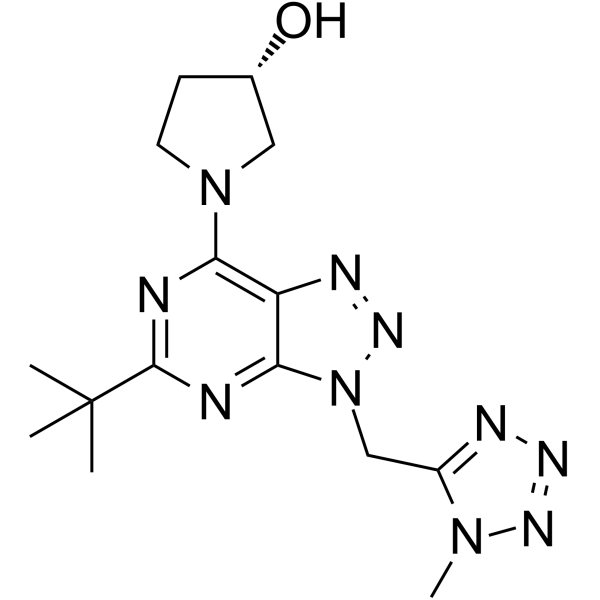
Cat. No.: HY-145604
CAS No.: 1433361-02-4
Purity:  98.37%
Synonyms: RG7774
Vicasinabin (RG7774) is an orally active, selective, and full CB2R agonist, with EC50 values of 2.81 nM and 2.60 nM for human CB2R and mouse CB2R, respectively. Vicasinabin inhibits inflammation, reduces leukocyte adhesion and decreases vascular permeability by selectively activating CB2R. Vicasinabin can be used in the researches for diabetic retinopathy, uveitis and laser-induced choroidal neovascularization .
loading...
    loading...
Cat. No.: HY-187718
CAS No.: 304911-08-8
Target:  

Potassium Channel

Research Areas:  

Cardiovascular Disease

CGC-11150 is a decamine-based polyamine analog that acts as a voltage-dependent pore blocker of Kir channels. CGC-11150 produces voltage-dependent pore block similar to that of Spermine (HY-B1777) in recombinant Kir6.2 [N160D, L164C, C166S, Δ36] + SUR1 channels, but with faster on and off rates. CGC-11150 inhibits the development of and induces regression of laser-induced choroidal neovascularization (CNV). CGC-11150 is used in studies related to choroidal neovascularization .
loading...
    loading...
Cat. No.: HY-182372
CAS No.: 1638153-78-2
Target:  

Epoxide Hydrolase

Research Areas:  

Neurological Disease

SH-11037 is a potent inhibitor of soluble epoxide hydrolase (sEH) and docks to the substrate binding cleft in the sEH hydrolase domain. SH-11037 dose-dependently suppresses angiogenesis in the choroidal sprouting assay ex vivo and inhibited ocular developmental angiogenesis in zebrafish larvae. SH-11037 reduces choroidal neovascularisation lesion volume in the laser-induced CNV mouse model. SH-11037 synergises with anti-VEGF treatments in vitro and in vivo. SH-11037 induces G2/M phase blockade and retains retinal endothelial cell viability at active concentrations without overt toxicity. SH-11037 can be used for the research of retinal neovascularization and ocular neovascularization .
loading...
    loading...
Cat. No.: HY-183377
CAS No.: 1260071-76-8
DMBT is an orally effective anti-tumor metastasis and anti-angiogenesis agent. DMBT downregulates key molecules such as EGFR/p-Akt/HIF-1α/VEGF/MMP-9, inhibits the HIF-1α/VE-cadherin (cadherin)/MMPs and Nrf2/HO-1 signaling pathways, and reduces hypoxia-induced ROS levels as well as the secretion and activity of MMP-9. DMBT inhibits hypoxia-induced vasculogenic mimicry, cancer cell migration, invasion and metastasis, and exhibits no obvious cytotoxicity to normal cells. DMBT reduces the area of laser-induced choroidal neovascularization lesions. DMBT can be used in studies related to breast cancer, melanoma and macular degeneration .
loading...
    loading...
Cat. No.: HY-113040B
Synonyms: (±)-17(S),18(R)-EETeTr
Target:  

Drug Isomer

Research Areas:  

Others

(±)-(17S,18R)-Epoxyeicosatetraenoic acid ((±)-17 (S),18 (R)-EETeTr) is one of the constituent enantiomers of (±) 17 (18)-EpETE. (±) 17 (18)-EpETE is an active metabolite of the ω-3 fatty acid eicosapentaenoic acid, and also an agonist of sphingosine-1-phosphate receptor 1 (S1P1) .
loading...
    loading...

